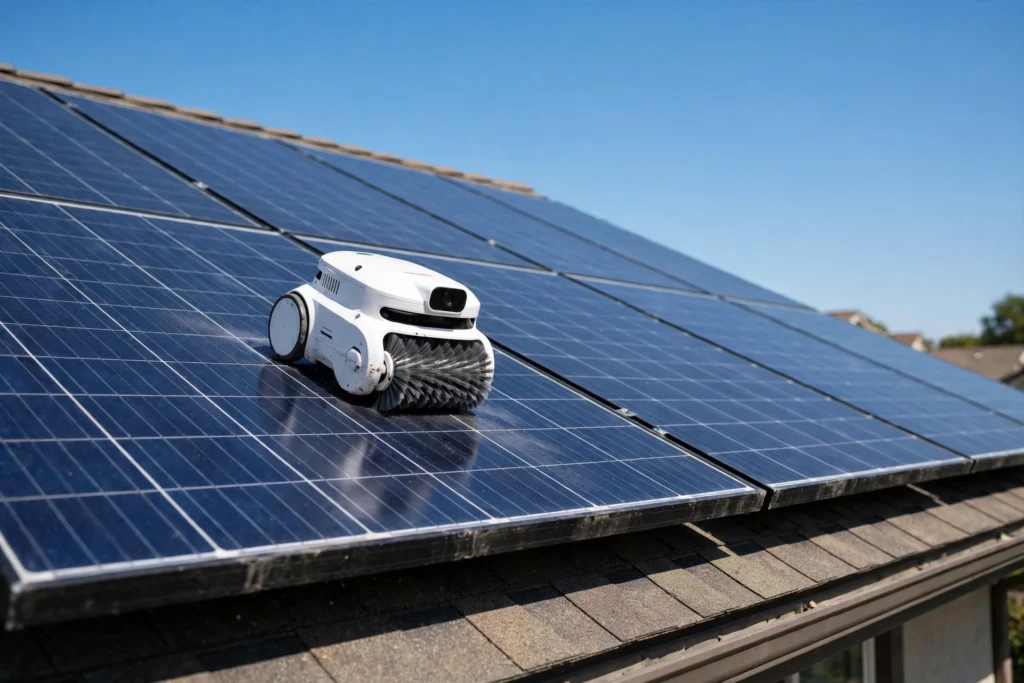
Solar panel cleaning robots are small machines that travel across solar panels, brushing away dust and rinsing off grime so the panels catch more sunlight. They work like a slow, careful window cleaner — except the “glass” is a tilted panel on a roof or in a field, where a fall or a scratch could be costly.
A dirty panel is a quiet problem. Dust, pollen, bird droppings, and dried rain spots block sunlight before it reaches the cells underneath, so the panel produces less power than it should. On one rooftop array you might never notice. Across a solar farm with thousands of panels, the loss adds up fast — which is why owners send robots instead of people with ladders and hoses.
Key Takeaways
- Solar panel cleaning robots move across panels on wheels, tracks, or rails, brushing and rinsing as they go.
- Soft rotating brushes and controlled water lift dust without scratching the glass.
- Edge and tilt sensors keep the robot on the panel and stop it before it drives off the side.
- Most models run on batteries and recharge at a dock between cleaning rounds.
- They suit large, flat arrays best; steep or oddly shaped panels may still need a human cleaner.
Why do solar panels need cleaning at all?
A solar panel turns sunlight into electricity, and anything on its surface gets in the way. A thin film of dust is easy to ignore, but over weeks in a dry area it can cut output noticeably, and one patch of bird droppings can shade a whole section of cells. Rain helps, but light rain often leaves a muddy film when it dries, and desert regions may see no useful rain for months. Manual cleaning works, yet it is slow, repetitive, and risky on rooftops. A robot can repeat the same careful pass every few days without getting tired. The same logic sits behind other cleaning robots, from robot vacuums that patrol living rooms to window cleaning robots that cling to tall glass.
How does a solar panel cleaning robot move across a panel?
Rooftop models are usually compact machines with wheels or tracks that grip the glass, creeping along in straight lines, row by row, a bit like mowing a lawn. Many use suction or a light vacuum grip, much like window cleaning robots, to stay attached on tilted panels. Larger solar farms use a different approach: some robots run on rails fixed along the edge of a row, rolling back and forth in one pass, while others are free-roaming and drive from row to row, guided by markers or a stored map. Rails are faster and more predictable; free-roaming models suit sites where rails would be impractical.
Either way, the robot must know where the panel ends. Edge sensors, usually infrared or ultrasonic, watch for the drop at the border, and the robot turns or stops before it runs out of surface. Tilt sensors add a second layer of protection: if the machine tips more than it should, it halts and waits for help.
How do the brushes and water actually clean the glass?
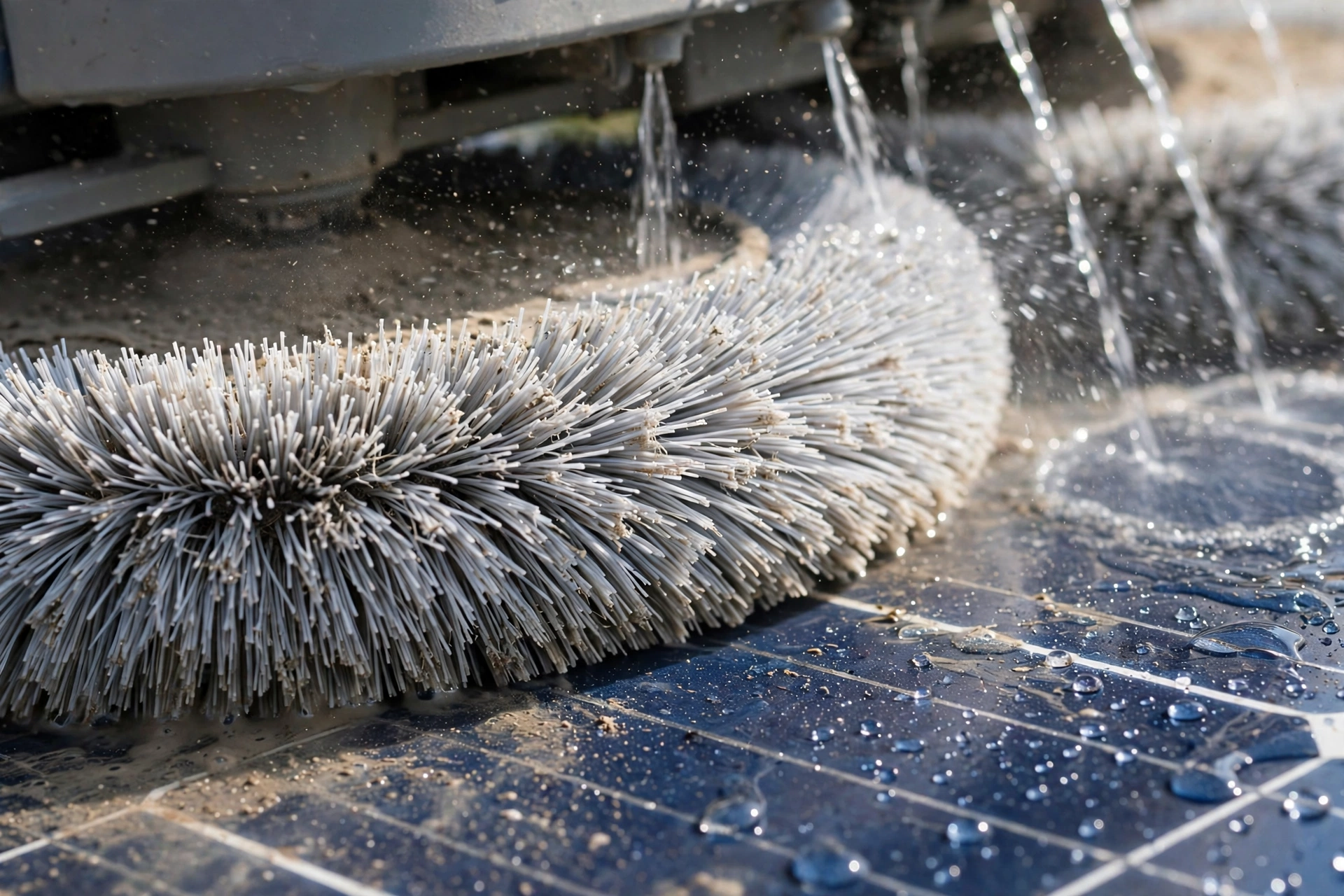
The job has two steps: loosen the dirt, then carry it away. Most robots carry one or two soft rotating brushes made from microfibre or fine nylon bristles, spinning gently across the glass to lift dust and dried spots without grinding grit into the surface. Harder brushes would clean faster but risk scratching the panel’s protective coating, so makers choose softness over speed.
Water comes next, and the amount matters. Some robots spray a fine mist ahead of the brush, just enough to soften dried dirt. Others carry a small tank and rinse as they move, with a squeegee behind the brush to clear the water. A few dry-cleaning models skip water entirely and rely on brushes plus gentle airflow, which suits desert sites where water is scarce. Pressure is kept light and steady too, since too much force on a cracked or ageing panel could make things worse — the better designs slow down or stop when they detect a raised edge or damaged section.
How does the robot know where it has already cleaned?
A robot that wandered at random would miss patches and clean the same spot twice, so most follow a planned path. Rooftop units clean in neat parallel lanes, turning at the end of each lane. Farm-scale robots often work from a map of the array, tracking their position with wheel sensors, GPS, or markers at the end of each row. Some add a camera or dirt sensor that spots heavy soiling and triggers a slower second pass. It is modest sensing — nothing like the mapping in a high-end robot vacuum — but it is enough for a job where the surface is flat and the route is predictable. Pool cleaning robots use a similar idea, following a planned pattern across a pool floor rather than wandering.
Are solar panel cleaning robots safe for the panels?
Usually yes, with the right design. The glass on a solar panel is toughened, and the soft brushes and low-pressure water these robots use are far gentler than a stiff yard brush or a pressure washer. The risk comes from the exceptions — a cracked panel, a loose frame, or a robot that gets stuck and keeps scrubbing one spot. That is why edge detection, tilt sensors, and pressure limits matter more than raw cleaning power: a good robot stops when something is wrong instead of forcing its way through. Owners should still inspect panels now and then, especially after storms, because no robot can tell a cracked cell from a dirty one with complete confidence. For a broader look at how robots sense and move safely, the Britannica robotics overview explains the shared building blocks — sensors, actuators, and control systems — behind machines like these.
Where do these robots work best?
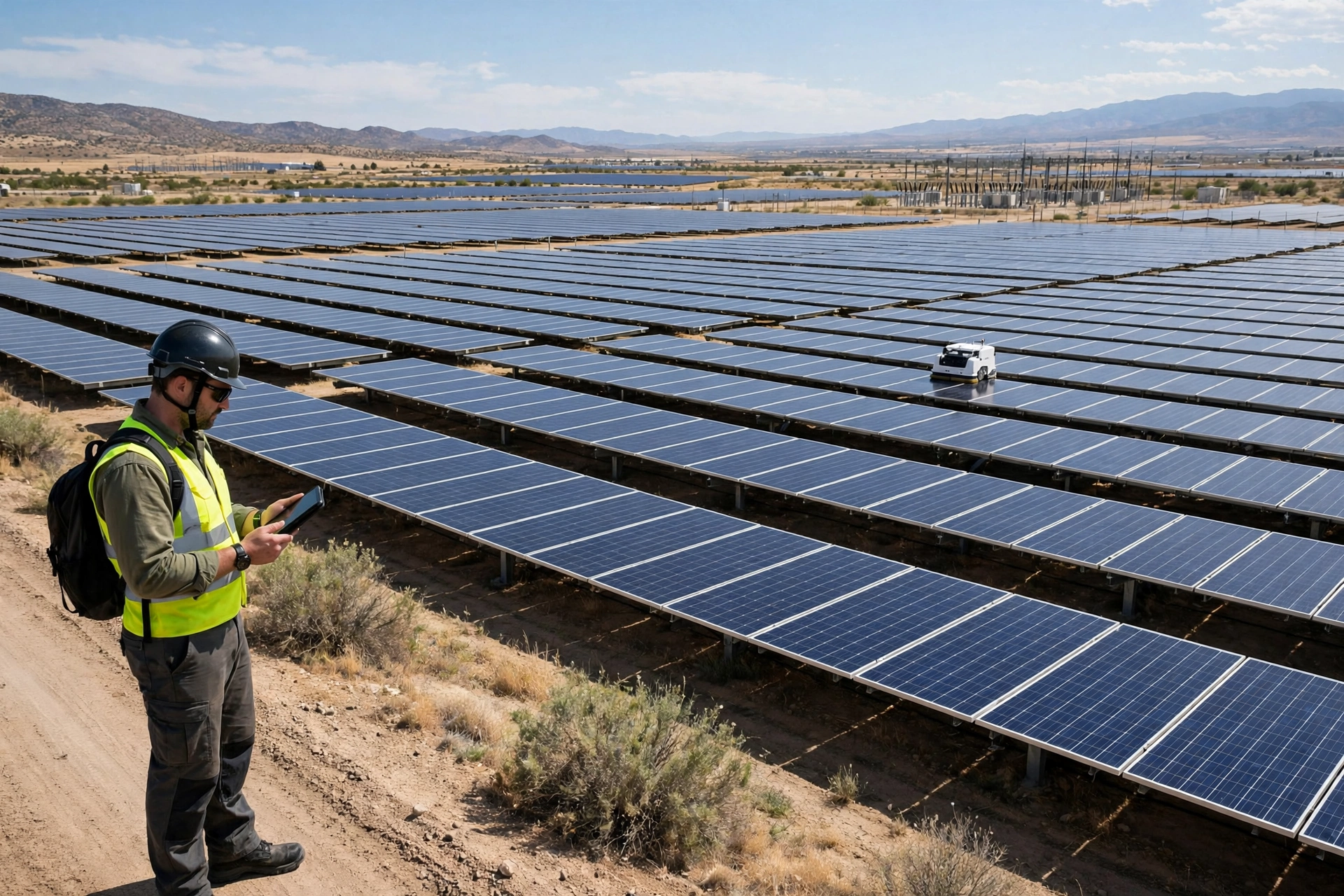
They shine on large, regular arrays: solar farms, warehouse roofs, and commercial buildings where hundreds of identical panels sit in neat rows. The bigger and more uniform the site, the more the robot’s steady, repeatable passes pay off. They struggle where the layout is awkward — steep roofs, curved panels, broken frames, and arrays mixed with skylights or vents can confuse a robot built for flat, open glass. Very small home arrays are another edge case: for a dozen panels, the cost and setup of a robot may not beat a quick manual clean. And in places with heavy snow or thick ice, a cleaning robot is the wrong tool — that is a job for a person with the right equipment and a safe way up there.
What should you check before buying one?
Start with your panels, not the robot. Note their size, tilt, frame style, and layout, then check the robot is made for that setup. A rail-guided model needs rails, which means installation work; a free-roaming model needs clear access between rows. Ask about water use and brush type, especially if your panels have an anti-reflective coating, and ask what happens if the robot loses power mid-panel — a good design parks safely instead of sliding. Check the battery life against the size of your array, and look at the running costs: replacement brushes, water, and servicing add up. If you are weighing up how panels work in the first place, the Wikipedia solar panel article is a useful refresher on how panels convert sunlight into electricity.
FAQs
Do solar panel cleaning robots use a lot of water?
No, most use far less than a person with a hose. Many spray a fine mist and wipe it away, and dry-cleaning models use no water at all — a practical choice in dry regions where water is limited.
Can a cleaning robot damage my solar panels?
It should not, if the brushes are soft and the pressure is controlled. The main risks are a pre-existing crack, a loose frame, or a robot that keeps scrubbing one stuck spot. Inspecting panels after storms helps catch damage first.
How often should panels be cleaned?
It depends on where you live. In a dusty area, a clean every few weeks may help; in a rainy climate with little dust, a few times a year can be enough. Watching your output over time is a better guide than any fixed schedule.
Do these robots work on home rooftop panels?
Some do, but they suit large, flat, regular roofs best. Small or steep home arrays may be awkward for a robot, and a manual clean may be quicker and cheaper for a dozen panels.
Can a solar panel cleaning robot work in the rain?
Most handle light rain, but heavy rain or storms are a different matter. Many owners schedule cleaning for calm, dry mornings so the robot can work steadily and the panels dry cleanly afterwards.
Conclusion
Solar panel cleaning robots do a simple job well: they cross the glass in neat lanes, loosen dust with soft brushes, rinse it away with a little water, and stay on the panel thanks to edge and tilt sensors. They are at their best on large, uniform arrays, where the same careful pass repeated often keeps output steady without anyone climbing a ladder.
If you own panels, the practical next step is a quick look at your own array — count the panels, note their tilt and layout, and check whether they sit in neat rows a robot could follow. If they do, a cleaning robot may be worth a closer look; if they don’t, a careful manual clean remains the sensible choice. Either way, clean panels catch more sun, and more sun means more power from the same roof.