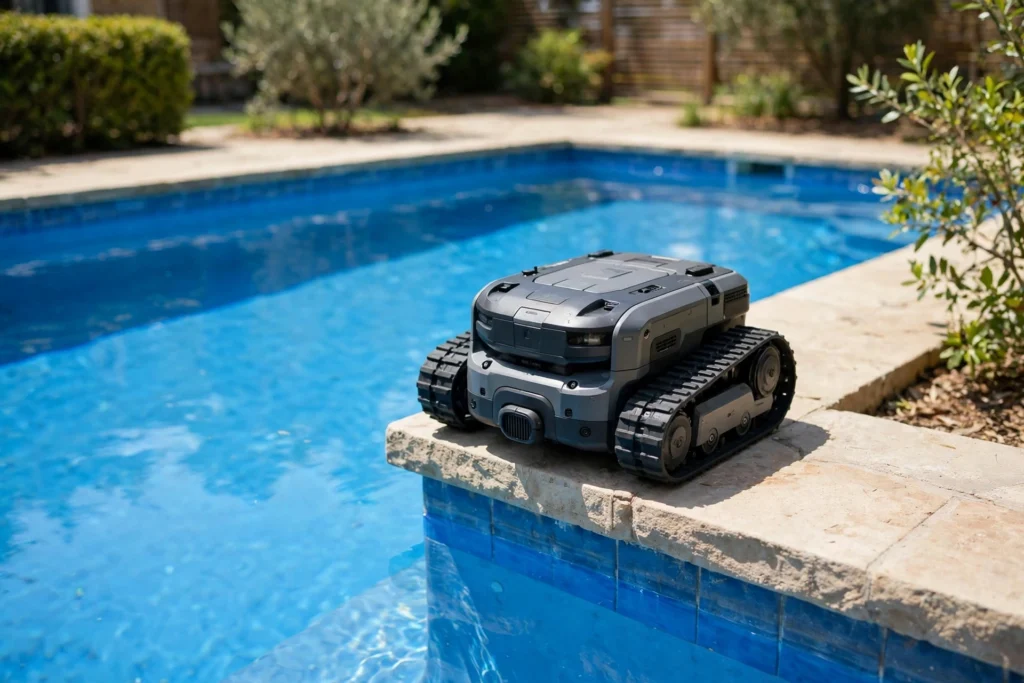
A pool cleaning robot is a small, sealed machine that drives around the inside of a swimming pool, scrubs the surfaces, and traps dirt in its own filter. It works on its own once you drop it in and start a cycle, and it does not need your pool pump to do the cleaning.
Key Takeaways
- A pool cleaning robot carries its own motor, pump, brushes, and filter, so it cleans independently of the pool’s main pump.
- Tracks or wheels move it across the floor, while water pressure and grip help many models climb walls to the waterline.
- Rotating brushes loosen algae film and dirt, and suction pulls the loosened debris into a basket or cartridge.
- Corded models use a low-voltage power supply on the deck; cordless models run on a sealed rechargeable battery.
- Rinsing the filter after each run matters more than any fancy setting, because a clogged filter quickly weakens suction.
What exactly is a pool cleaning robot?
Think of it as a compact underwater vacuum with its own brain, in the same family as the home robots in How Do Robot Vacuums Work?, but built to work underwater. Most models are roughly the size of a small suitcase, low and wide, with a handle on top so you can lift them out of the water.
Inside the sealed body there are usually two jobs happening at once. A drive motor turns the tracks or wheels, and a pump motor pulls water in through the bottom, through the filter, and out through the top. A simple controller decides how long the cycle runs, when to turn, and whether to focus on the floor, the walls, or both. It is not thinking about your pool in a clever way; it is following a pattern, reacting to obstacles, and repeating that pattern until the cycle ends.
That independence is the key difference from older pool cleaners. Suction-side and pressure-side cleaners borrow power and water flow from the pool system itself. A robotic cleaner brings its own suction, so the pool pump can stay off while it works, and the dirt it collects stays inside the robot instead of heading for the skimmer.
How does it move around the pool?
Most pool robots move on tracks or chunky wheels, much like a small tank. Tracks give good grip on a slippery tiled or vinyl surface, and they spread the weight so the robot does not slide sideways on a slope. When it reaches a wall, step, or drain cover, it usually bumps, backs up a little, turns, and tries a new direction.
Some models follow a fairly random pattern, turning at set intervals and gradually covering the pool over a long cycle. Others use a more planned route, working in lanes or a grid so they waste less time revisiting clean water. Either way, coverage improves with time: a short floor-only cycle may leave corners untouched, while a longer full cycle gives the robot more chances to reach them.
Sensors help, but they are simple. A robot may detect when it has hit an obstacle, when it is tilted, or when it has reached the waterline. It does not build a detailed map of your pool in the way a home robot maps a living room, and it can still miss a tight corner behind steps or a ladder. That is normal, not a fault, and it is why a quick manual brush in those spots still helps.
How does it scrub and filter the water?
Scrubbing comes first. Brushes at the front, rear, or both ends spin as the robot moves, loosening the thin film of algae, dust, and sunscreen residue that clings to pool surfaces. On a rough plaster finish, stiff brushes work well; on vinyl or fibreglass, softer brushes are kinder to the surface. The brushes do not need to be aggressive — steady contact and repeated passes do most of the work.
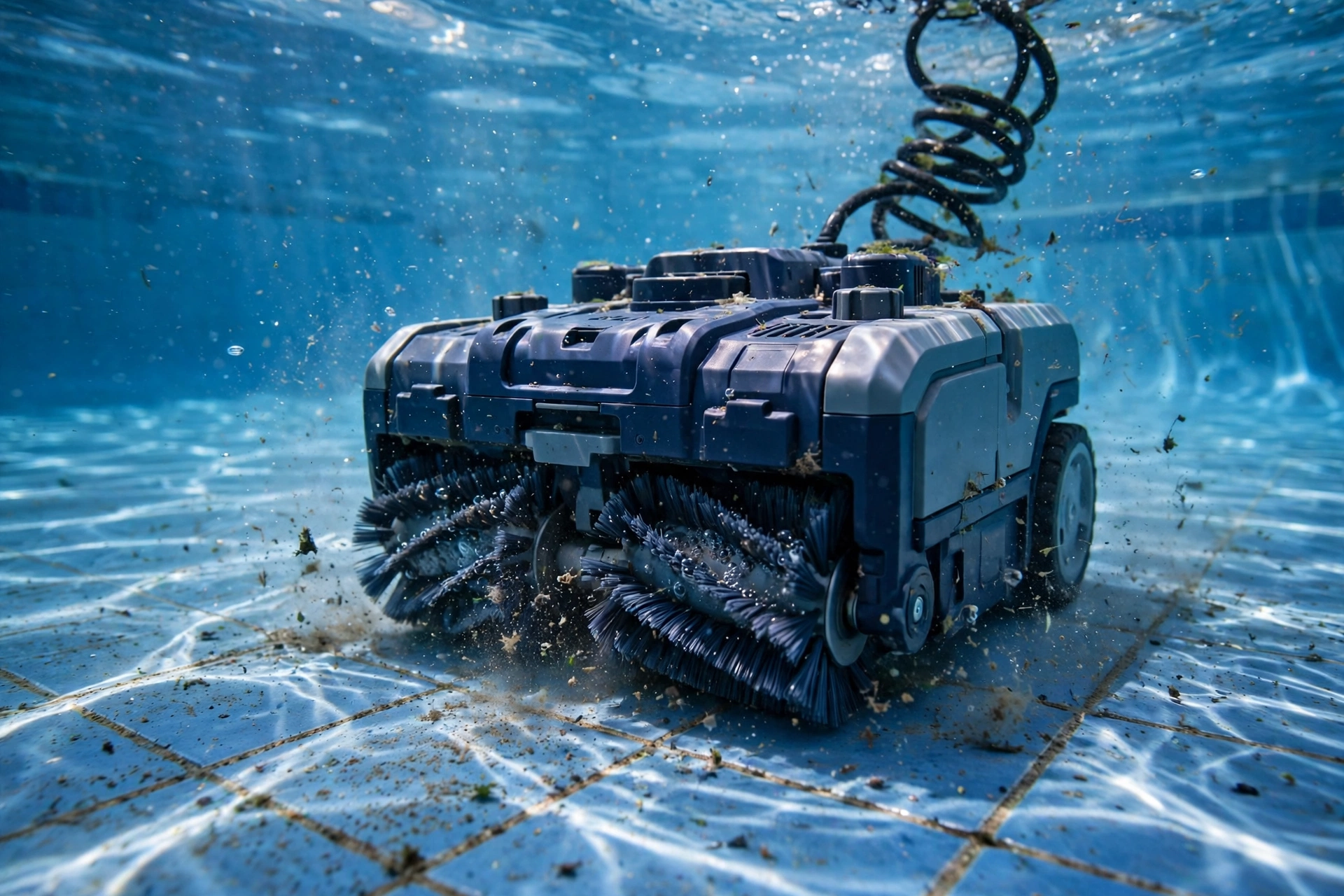
Suction comes second. As the robot moves, its pump draws water in from underneath, carrying leaves, sand, hair, and loosened dirt with it. That water passes through a filter basket or cartridge inside the robot, which traps the debris, and then flows back out into the pool. Fine filters catch smaller particles, while coarse baskets cope better with leaves and larger debris. Some owners keep both, swapping the filter to match the season: a coarse basket after a storm, a fine cartridge for everyday dust.
This is also why the robot can clean walls. As water is pumped out of the top, the reaction pushes the robot against the surface, a bit like holding a vacuum cleaner firmly against a wall. Combined with grippy tracks, that push helps it climb from the floor, up the wall, and along the waterline where oils and sunscreen tend to gather.
Corded or cordless: how is it powered?
Corded models plug into a power supply box that sits on the pool deck, well away from the water. That box steps the mains electricity down to low voltage, and a floating cable carries that low-voltage power to the robot. The cable is long enough to reach across the pool, but it can tangle, so many owners untangle it and lay it out straight before each run.
Cordless models carry a rechargeable battery sealed inside the body, so there is no cable at all. That makes them easier to drop in and lift out, especially for smaller above-ground pools, but the battery sets a hard limit on run time. When it runs low, the robot usually parks itself near the surface or stops, and you lift it out to charge. Corded models, by contrast, can run longer cycles because they are not carrying their own power supply.
Safety deserves a plain note here. Never plug the power supply into a damaged outlet, never use a corded model with a frayed cable, and keep the power box dry and away from the pool edge, following the maker’s guidance. Low voltage is safer than mains voltage in water, but it is not a reason to ignore basic electrical care.
What cleaning cycles can you choose?
Most robots offer at least two choices. A floor-only cycle is shorter and suits a quick daily tidy, especially if leaves have blown in overnight. A full cycle adds walls and the waterline, takes longer, and suits a weekly deeper clean. Some models let you pick a waterline-only pass, which is handy when the surface looks clean but a greasy line has formed at the top.
Cycle length varies with pool size and model, but a full clean often takes a couple of hours. That sounds long, yet the robot is doing the work while you are doing something else, so the time matters less than the result. If the pool is very dirty, run a floor cycle first to pick up the worst debris, rinse the filter, and then run a full cycle, rather than expecting one pass to fix everything.
You can compare this steady, repetitive approach with other outdoor robots: How Do Robot Lawn Mowers Work? follows a similar little-and-often idea on grass, while How Do Underwater Robots Work? shows how larger machines cope with deeper water and stronger currents.
What are the limits of a pool cleaning robot?
A pool robot is a maintenance tool, not a repair tool. It will not fix cloudy water caused by poor water chemistry, and it will not remove stains that have soaked into plaster. If the water is green or the chemistry is off, sort that first; otherwise the robot will just stir up algae and clog its filter.
Shape matters too. Tight corners, steps, benches, and ladders can block its path or trap it. Very large debris, such as big twigs or stones, can jam the brushes or block the intake, so skim those out by hand before a run. Fine dust can also pass through a coarse basket and settle again, which is why matching the filter to the job matters.
Finally, the robot still needs you. Filters need rinsing, brushes wear out, tracks collect grit, and the cable, if there is one, needs untangling and storing out of sunlight. A robot that is never cleaned will clean less well each time, no matter how good it was when new.
Looking after your pool robot
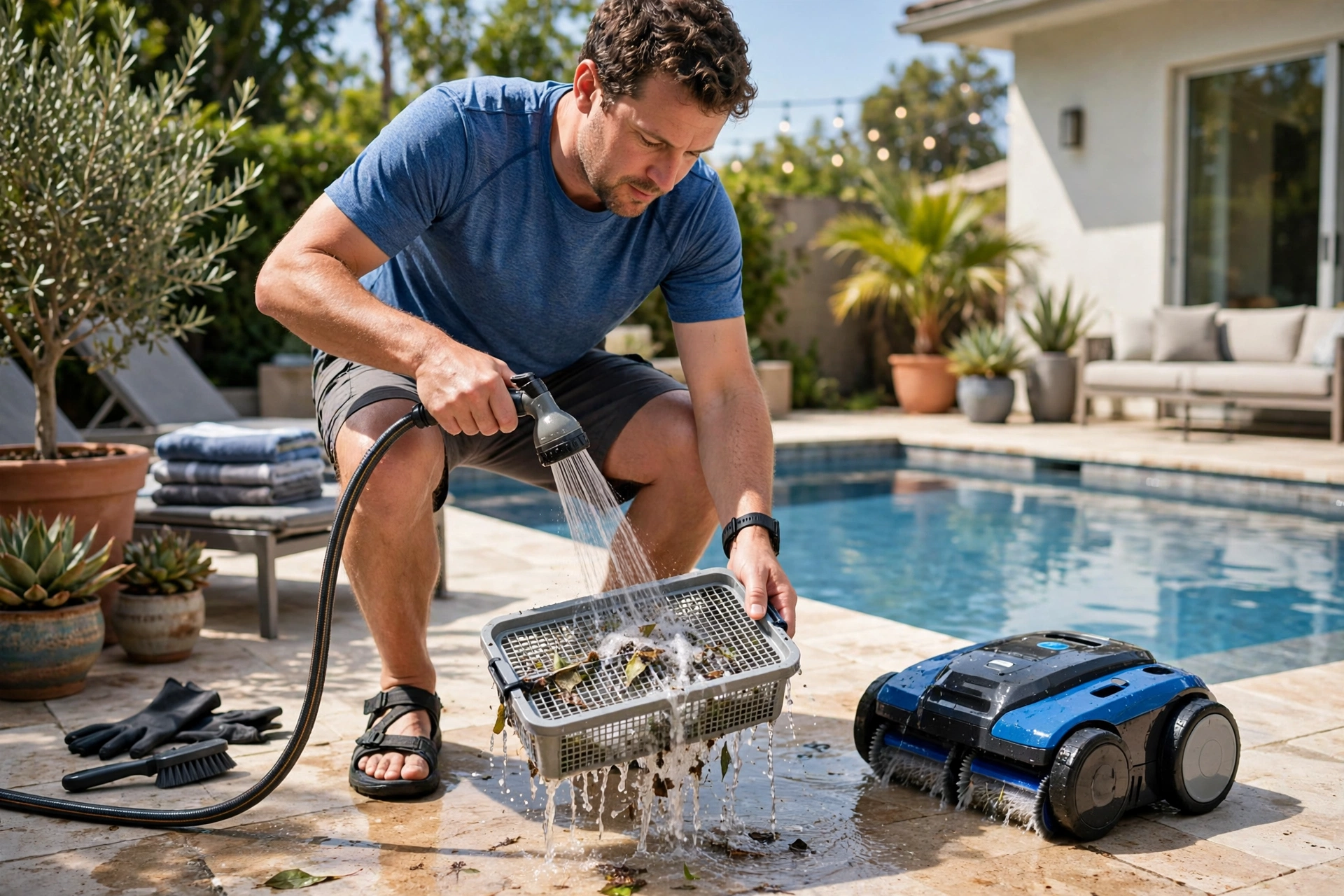
After each run, lift the robot out using its handle, let it drain for a few seconds, and open the filter. Tip out leaves and debris, rinse the basket or cartridge with a hose, and check that nothing is stuck in the brushes or tracks. That two-minute job keeps suction strong and stops smells building up inside a damp filter.
Store it in the shade when it is not in use, out of direct sun and away from pool chemicals. Check the cable for twists or nicks, and check the brushes from time to time: worn brushes scrub less well and can leave streaks. Replacing a filter or a set of brushes is usually simple, and it is far cheaper than replacing the whole robot.
For broader background on how robots sense and move, see Britannica’s robotics overview and Wikipedia’s automated pool cleaner article. For a different kind of arm-based machine, How Do Robot Arms Work? explains joints, motors, and grippers in factories.
FAQs
Can a pool cleaning robot work while people are swimming?
No, do not run it while anyone is in the pool. Lift swimmers out first, run the cycle, and only swim again after the robot is out and the water has settled.
Does it replace the pool pump and filter?
No. The robot has its own filter for debris, but the pool pump and main filter still circulate and treat the water. Think of the robot as a cleaner, not a replacement for the whole system.
Can it clean an above-ground pool?
Many models can, if the pool is large enough and the shape suits the robot, but check the maker’s guidance for your pool type, liner, and depth first. Very small or very shallow pools may not suit a full-size robot.
How often should I run it?
That depends on leaves, dust, and use. Many owners run a short cycle a few times a week in summer and a full cycle once a week, rinsing the filter after each run.
What should I do if it keeps getting stuck?
Check for a ladder, step, or drain cover trapping it, clear large debris by hand, and try a different cycle or starting position. If it still sticks in the same spot, that corner may simply need a manual brush.
Conclusion: start with a simple cycle
A pool cleaning robot works by driving on tracks or wheels, scrubbing with brushes, and pulling debris into its own filter, all without needing the pool pump. It will not fix water chemistry or remove deep stains, but for everyday leaves, dust, and waterline film, it can save a lot of manual vacuuming.
A practical next step is to walk around your pool and note its shape, steps, ladders, and any tight corners, then check whether a floor-only or full cycle, a corded or cordless model, and a fine or coarse filter best match that layout. That quick check will tell you whether a pool robot is a good fit, or whether a smaller model, a different filter, or a manual clean for the tricky spots is still the better choice.