
AI help with writing works best as a drafting partner, not a replacement writer. It can turn a rough idea into a first draft, tidy up grammar, suggest clearer phrasing, and brainstorm angles in seconds. But it still needs a human to check facts, keep the voice honest, and decide what is worth saying in the first place.
Key Takeaways
- AI writing tools are strongest at first drafts, outlines, and quick edits — not at original thinking.
- A good prompt with clear context produces far better text than a vague one-liner.
- AI can invent facts, quotes, and sources, so every claim needs a human check.
- Your voice survives when you edit AI output the way you would edit anyone else’s draft.
- Treat AI as a starting point: the final words, and the responsibility for them, stay with you.
What can AI actually do for a writer?
Most writing tools built on large language models can do a handful of jobs well. They can summarise a long document into a few paragraphs, expand a bullet list into flowing prose, rewrite a sentence in a simpler tone, and spot repeated words you have stopped noticing.
What they cannot do is know things. An AI writing assistant predicts likely words; it does not check them against the world. Used well, these tools remove the slow, mechanical parts of writing — the blank page, the typo hunt, the fifth rewrite of the same sentence — and leave you more time for the thinking only you can do. For a fuller picture of the technology behind these tools, see our guide to what artificial intelligence is and how generative AI produces text.
How does AI help with drafting?
Drafting is where AI help with writing feels most useful, because a rough draft is cheap to fix. Start with a short brief instead of a single word: the topic, the reader, the length, and the point you want to make. “Write a 300-word introduction to composting for new gardeners, in a friendly tone” will beat “write about composting” every time.
A practical way to work is to ask for an outline first, pick the structure you like, and then ask for one section at a time. That keeps you in charge of the argument while the tool handles the sentences. This is the same skill at the heart of prompt engineering, and a little practice pays off quickly. OpenAI’s guide to using ChatGPT for writing tasks shows how its assistant handles drafts, summaries, and rewrites.
How does AI help with editing?
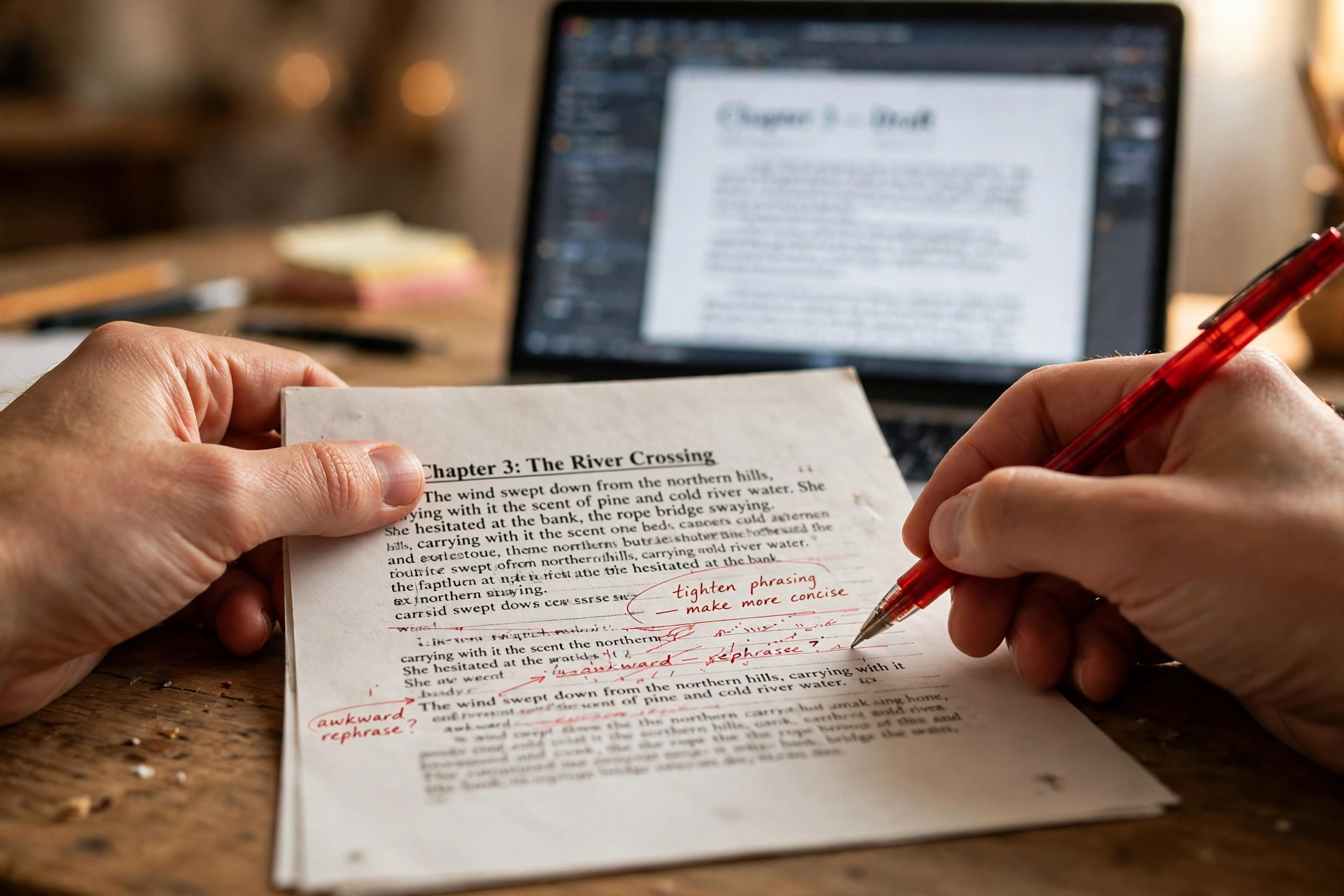
Editing is the quieter half of the job, and it is where AI tools are often most reliable. Paste in a finished draft and ask for grammar and spelling fixes, shorter sentences, or a check that the tone stays consistent. The tool will catch the “their” that should be “there” and the sentence that runs on for four lines.
It can also flag jargon a beginner would not understand. One caution: when a tool rewrites your sentences, it can smooth away the quirks that make your writing sound like you. Keep the edits that help and reject the ones that flatten your voice. Dedicated editing assistants such as Grammarly’s AI writing tools are built for exactly this kind of pass.
Where does AI fall short?
The biggest weakness is accuracy. AI tools can state wrong facts with total confidence, invent a study that does not exist, or attribute a quote to the wrong person. This habit has a name — AI hallucination — and it is the reason no AI draft should be published unchecked. If a sentence contains a number, a date, a name, or a claim about the world, verify it from a source you trust before it goes live.
There are softer limits too. AI writing tends toward the average: safe phrasing, predictable structure, the same opening moves. It rarely has a genuinely new idea, a personal story, or a strong opinion, because those come from lived experience. For anything that needs judgement — what to leave out, what to say plainly, what not to say at all — a human still has to decide.
How do you keep your own voice?
The simplest test is to read the finished piece aloud. If it sounds like you on a good day, keep it. If it sounds like a brochure, rewrite the flat parts in your own words. Write the first paragraph yourself, even roughly, so the piece starts from your thinking rather than the tool’s, and add at least one detail only you could know: an example from your work, a mistake you made, a question a reader actually asked you.
It also helps to set rules for the tool — which words to avoid, which tone to keep — and to look for the tells when you edit: sentences that start the same way, lists of three that add nothing, and phrases like “in today’s fast-paced world” that say nothing at all. Cutting those is often the fastest way to make AI-assisted writing sound human.

How should you check AI-written text before publishing?
A short checklist before anything goes live will save most embarrassment. First, read every factual claim and check the ones that matter. Second, click every link and confirm it goes where it claims to go. Third, search for any quote or statistic and make sure the source is real. Finally, read the piece once for tone: does it sound like you, and would your reader trust it? If the piece says nothing new, add the part only you can add — an example, a judgement, a next step — before you hit publish.
Frequently Asked Questions
Can AI write a whole article for me?
It can produce a full draft, but the result usually needs heavy editing. Facts must be checked, the structure often needs tightening, and the voice rarely sounds like yours. Think of it as a first draft, not a finished article.
Is it cheating to use AI for writing?
That depends on the context. For your own blog or business, using a tool to draft and edit is much like using a spellchecker. For school or professional work, follow the rules of the place you are writing for, and be honest about how the text was produced.
Will readers notice if I use AI to write?
Often, yes — especially if the text is published unedited. Repeated sentence patterns, vague claims, and a flat, generic tone are common giveaways. Editing in your own examples and opinions makes the difference.
Can AI help with writer’s block?
Yes, and this is one of its best uses. Ask for five opening lines, three different angles, or a list of questions your reader might have. You do not have to use any of them; the point is to get moving again.
Does AI writing hurt search rankings?
No tool can guarantee a ranking, and search engines judge the page on its usefulness, not on how it was written. A clear, accurate, genuinely helpful article performs better than a generic one, however it was produced.
Conclusion
AI help with writing is at its best when it handles the heavy lifting — first drafts, outlines, grammar checks — and leaves the thinking to you. The writers who get the most from these tools are the ones who stay in charge: they brief clearly, edit firmly, check every fact, and add the personal detail no model can invent.
Try it on your next piece. Write the opening yourself, ask the tool for a draft of one section, then edit the result as if a colleague wrote it — keeping what works, cutting what does not, and adding one example only you could give.