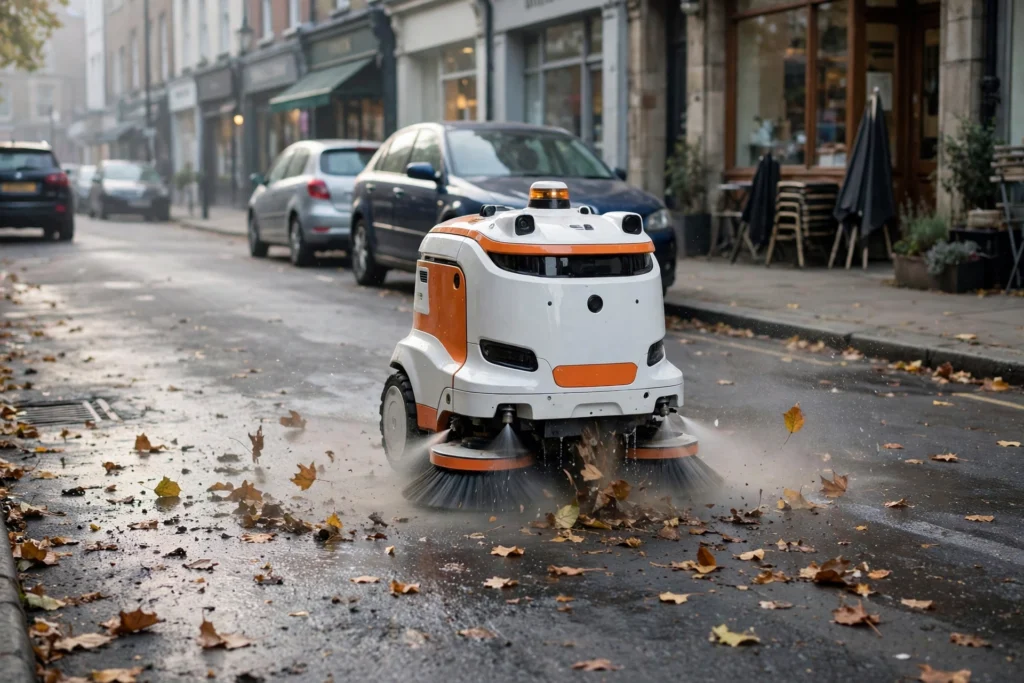
Street cleaning robots work by driving a route along kerbs and pavements while rotating brushes sweep dust, leaves and litter into a collection tray. A light water spray keeps dust down, and sensors watch for parked cars, people and obstacles. When the dustbin fills or the battery runs low, the robot returns to its depot to empty itself and recharge.
Key Takeaways
- Brushes, water jets, suction and a dustbin do the cleaning; sensors and mapping do the driving.
- Most street cleaning robots follow a planned route and work best on light litter, dust and leaves.
- They empty their dustbin at a dock or depot, and a worker checks the brushes, water and filters.
- They suit pavements, cycle lanes, car parks and quiet streets, not busy traffic or heavy rubbish.
What parts does a street cleaning robot have?
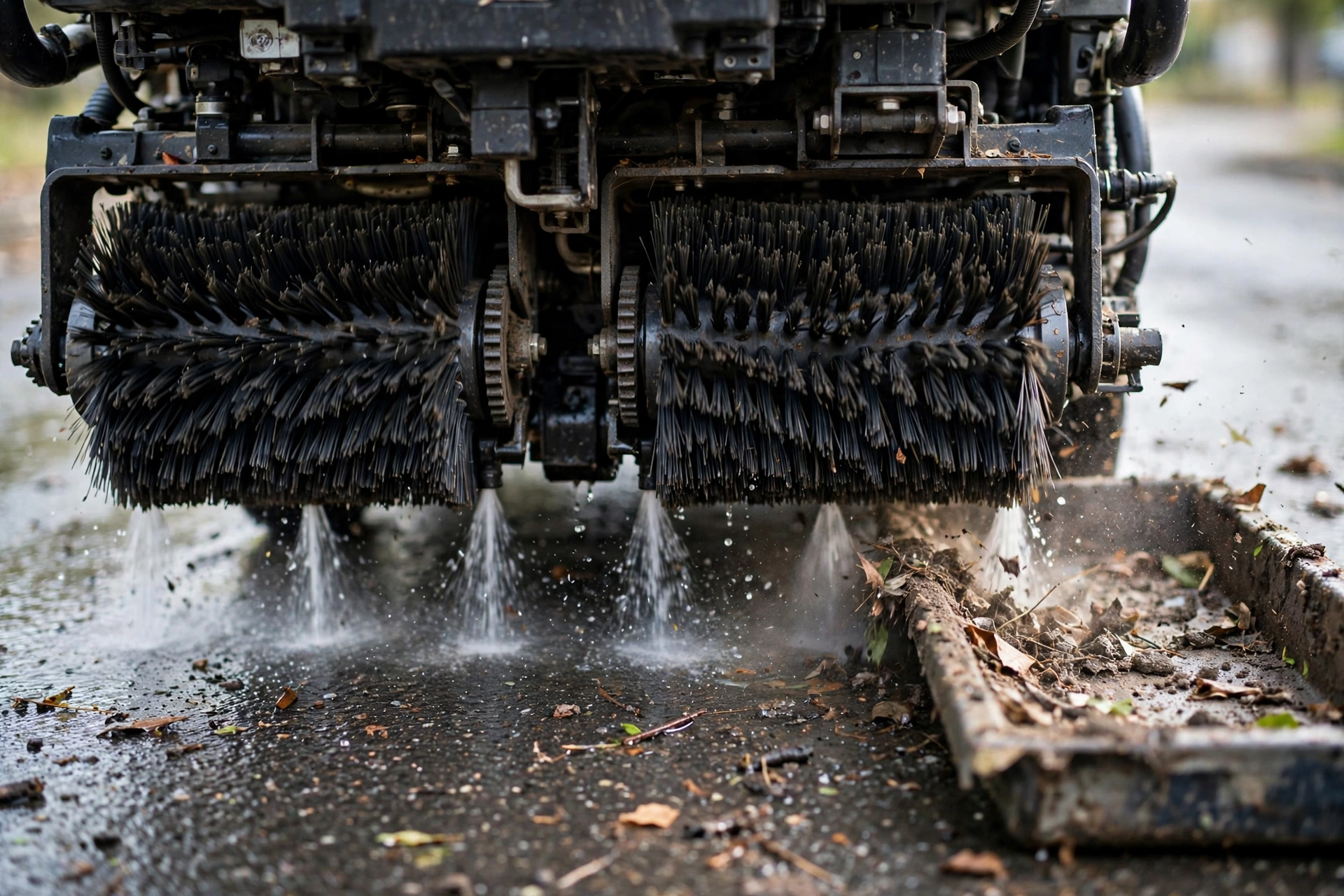
A street cleaning robot is a small sweeping machine with a robot brain. Underneath it you’ll usually find one or two round side brushes, a wide cylindrical brush, and a set of water jets. Behind the brushes sits a suction inlet and a dustbin, often with a filter that catches fine dust.
On top are the parts that let it see and think: cameras, ultrasonic sensors and sometimes a spinning lidar unit that scans the street ahead. A small computer holds the map of the route, and a battery pack powers the wheels, brushes and suction. These are the same basic parts found in any robot, as described in Britannica’s robotics overview. Unlike a robot vacuum for the home, which is designed for smooth floors, a street cleaning robot is built low and tough for rough outdoor surfaces and for running for hours at a time.
How do the brushes and water actually clean the street?
The cleaning is a simple sequence, repeated metre after metre. The side brushes spin and flick dust, leaves and small bits of litter from the kerb edge into the path of the main brush, which sweeps the debris back towards the suction inlet. A vacuum stage on some models traps the smallest grains through a filter, so these robots can pick up the gritty dust that settles along kerbs. Water helps, too: a fine spray wets the surface ahead of the brushes, keeping dust down. The idea is familiar — car washing robots use the same mix of brushes and water jets — and street sweepers have used rotating brushes since the 19th century. What the robot adds is the ability to do the job on its own, at walking pace, without a driver. Large items are left alone: a brick or a broken bottle won’t fit through the inlet.
How does the robot know where to go?
Most street cleaning robots work from a map that a human operator sets up first. The route — which streets, which kerbs, which cycle lanes — is planned on a computer and loaded onto the robot, which then follows it in order, tracking its progress with wheel sensors.
To stay on track it uses a mix of signals. Satellite positioning gives a rough location, while lidar and cameras pick out kerbs, walls and parked cars as landmarks. Wheel sensors count each rotation, so the robot can estimate distance even when the satellite signal drops between tall buildings. A few newer models build their own map on the first run. Either way, the robot isn’t wandering: it is following a plan, and if anything has changed — roadworks, a closed lane, a skip on the kerb — it will wait, edge around the obstacle, or stop and call for help.
How does it avoid people, parked cars and kerbs?
Safety gets the most attention, because these robots share space with pedestrians. Their sensors look ahead and to the sides several times a second. If a person steps in front of the robot, it slows down or stops. If a parked car blocks the kerb, it steers out around it and pulls back in once it has passed.
The robot moves slowly, usually at walking pace or below, which gives it time to react and gives people time to step aside. Its brushes stop spinning when it pauses, so nothing is thrown towards passers-by. Kerb detection is a separate job: the robot watches the height of the ground ahead, so it can tell flat tarmac from a raised kerb or a step down into the road, and it won’t drive off a drop that is too big. Like the floor scrubbing robots used indoors, they depend on their sensors to stay on safe ground.
What happens when the dustbin is full or the battery runs low?
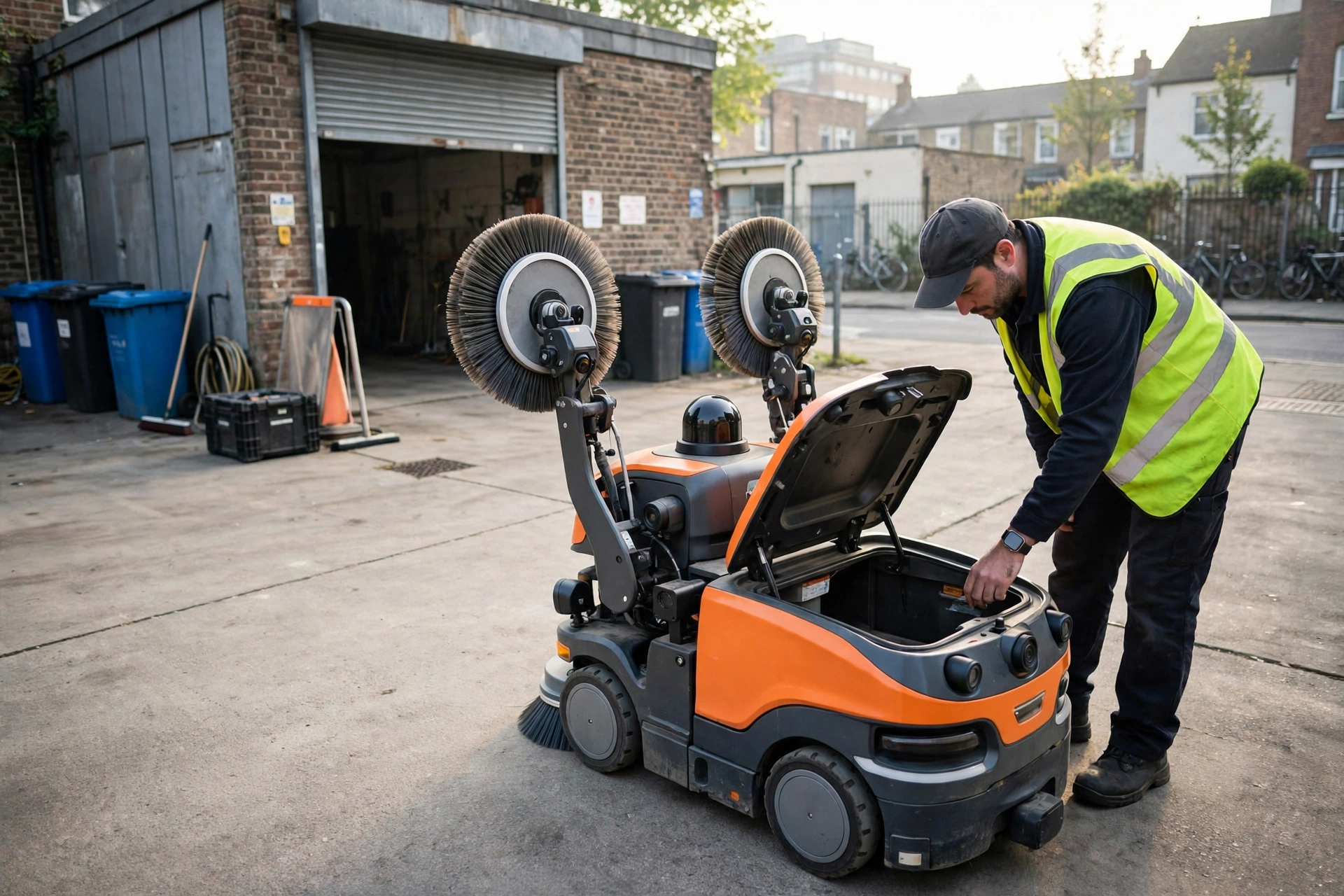
A street cleaning robot doesn’t clean until it drops. It watches its own dustbin level and battery charge, and when either one reaches a set limit it heads back to its depot or docking station on its own. On some models the robot tips its bin into a larger container by itself; on others a worker lifts the bin out. The same visit is when the water tank is topped up, the filter is checked, and worn brushes are replaced.
Charging happens at the same dock: the robot parks, connects, and tops up its battery ready for the next shift. The rhythm is always the same — clean, return, empty, recharge, and go out again — which is why cities like them for early-morning work.
Where do street cleaning robots work best?
These robots shine on predictable, flat ground. Pavements, cycle lanes, pedestrian squares, car parks and quiet residential streets are ideal: the surfaces are even, the obstacles are few, and the mess is mostly dust, leaves and light litter. A robot can cover the same streets every morning, which keeps them consistently clean. They also suit places a big sweeping truck can’t easily reach — narrow lanes, the space between parked cars, and the edges of a market square.
Weather matters, though. Light rain is fine — the robot is built to work in the wet — but heavy rain washes the dirt away faster than the robot can collect it, and deep puddles can be a hazard for its electronics. Snow and ice are a job for snow-clearing robots instead, which are built with ploughs and heated parts for winter work.
What are the limits of a street cleaning robot?
A street cleaning robot is a sweeper, not a street crew. It can’t pick up heavy rubbish, clear a blocked drain, or sweep a street that is full of parked cars and delivery vans. It follows a fixed route, so anything outside that route stays dirty, and anything it can’t identify — a spilled bag of rubbish, a fallen branch, a patch of wet cement — is either driven around or left for a person.
Battery life is another limit: brushes and suction draw a lot of power, so most robots work in shifts with charging time built in. They still need people, too: someone plans the routes, checks the machines, and deals with anything the robot can’t handle. The robot takes over the repetitive sweeping; it doesn’t remove the need for a cleaning team. Even so, for cities the trade-off often works: a small robot sweeping the same streets every morning is cheaper to run than a large truck.
Frequently Asked Questions
Do street cleaning robots work in the rain?
Yes, in light rain — they are built to work on wet roads, and the water spray is part of their normal cleaning. Heavy rain or deep standing water can flood the dustbin and hide drains and kerbs, so operators usually pause the robot until conditions improve.
How fast do street cleaning robots move?
Most travel at walking pace or slower while sweeping, often around 3 to 5 kilometres per hour. The slow speed gives the brushes time to pick up debris and the sensors time to spot people and obstacles.
Can a street cleaning robot pick up glass and sharp litter?
It can pick up small pieces of glass and grit. Larger or sharper items, such as a broken bottle, are usually left alone, because they can damage the brushes or the filter — those jobs are left for a human cleaning crew.
Do street cleaning robots replace street cleaners?
No. They take over the routine sweeping of set routes, but people are still needed to plan routes, maintain the machines, and handle anything the robot can’t — heavy rubbish, blocked drains, and unusual messes.
How do street cleaning robots charge?
They return to a docking station or depot when the battery runs low, park themselves, and connect to a charger. Charging usually happens between shifts, alongside emptying the dustbin and checking the brushes and filters.
Conclusion
Street cleaning robots combine old-fashioned sweeping — spinning brushes, a little water, and a dustbin — with modern sensors and mapping that let them follow a route and stay safe around people.
If your town or city is thinking about them, the practical next step is a small trial: pick one flat, predictable area such as a pedestrian square, run a robot there for a few weeks, and compare the result with the streets a human crew sweeps by hand.