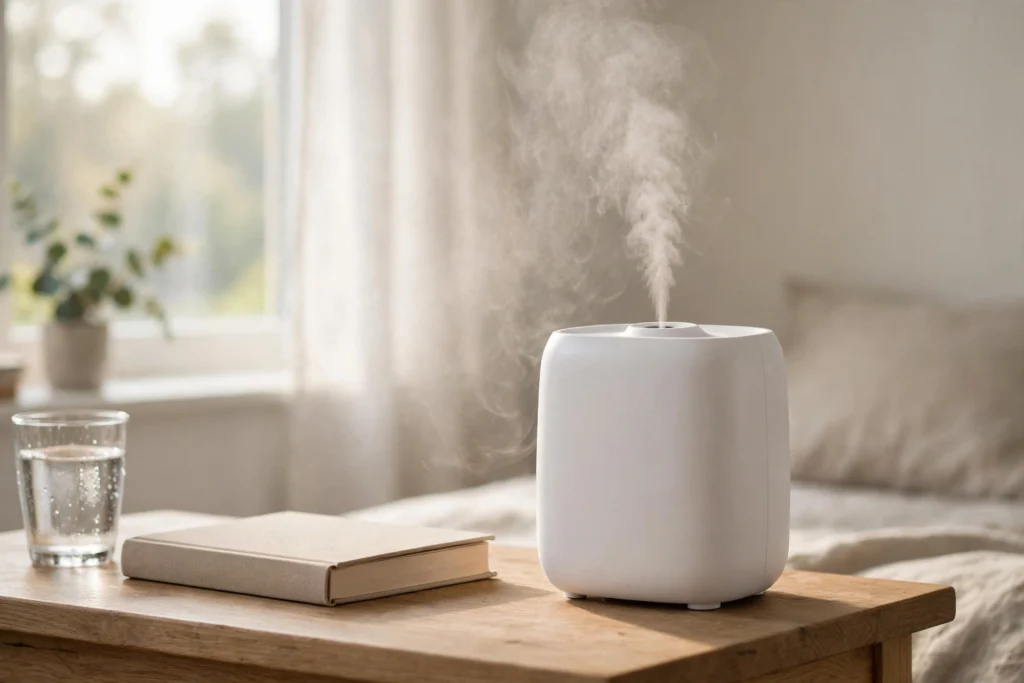
A humidifier works by adding water vapour to dry indoor air. Most models either vibrate water into a cool, fine mist, blow air through a wet wick so the water evaporates, or boil water into clean steam — then a built-in sensor switches the machine off once the room reaches the humidity you set.
Key Takeaways
- A humidifier raises indoor humidity by turning water into mist, vapour, or steam.
- Ultrasonic models use a vibrating disc; evaporative models use a fan and a wet wick.
- A humidistat measures the air and switches the machine on or off to hold your target level.
- Healthy indoor humidity usually sits between 30% and 50%.
- Daily emptying and weekly cleaning matter more than the model you buy.
What does a humidifier actually do?
Dry air is uncomfortable in ways you can feel straight away. Your throat gets scratchy, your nose feels blocked, your skin dries out, and static shocks zap you every time you touch a door handle. A humidifier fixes the cause rather than the symptoms: it puts moisture back into the air.
Heating makes it worse in winter: cold outdoor air holds little moisture, and warming it up inside drops its relative humidity sharply.
Relative humidity is the water vapour in the air compared with the maximum it could hold at that temperature. Most guides suggest 30% to 50%: below 30%, dryness causes sore throats and cracked skin; above 50%, you get condensation, musty smells, and mould. It is a different job from an air purifier, which filters particles out of the air instead of adding moisture.
How does an ultrasonic humidifier work?
Ultrasonic humidifiers are the quiet, cool-mist machines you see most often on desks and bedside tables. Inside the base sits a small metal disc called a transducer. It vibrates at ultrasonic frequency — too fast to hear — shaking the water above it into tiny droplets, which a small fan pushes out through a nozzle.
There is no heating involved, so the mist feels cool and the machine uses very little electricity. The droplets are so small they evaporate into the room air almost immediately, which is how the humidity rises without leaving puddles.
One thing to watch: ultrasonic models turn everything dissolved in the water into mist too. With hard tap water, minerals can settle on nearby furniture as a fine white dust — distilled or demineralised water avoids that.
How does an evaporative humidifier work?
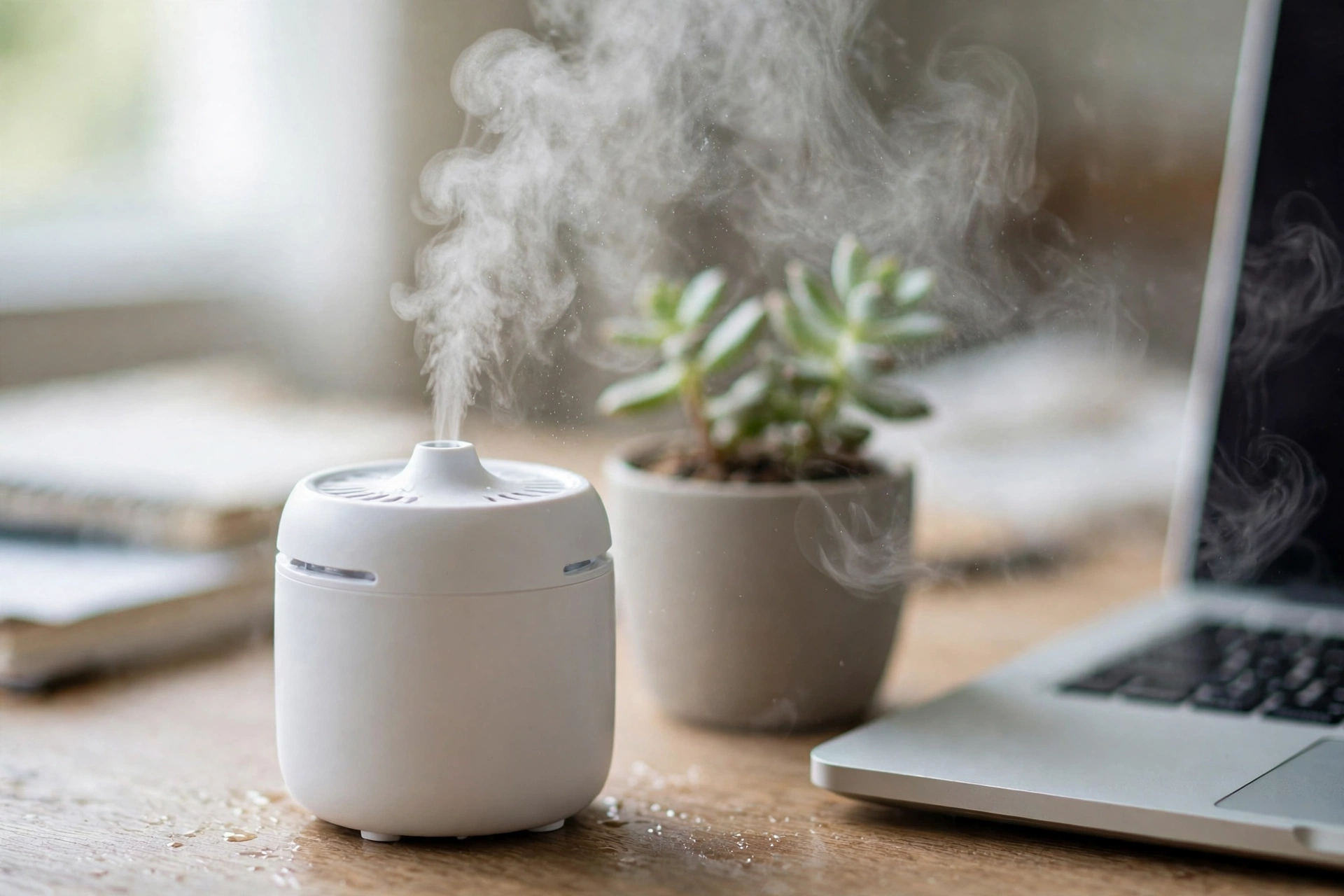
Evaporative humidifiers take a more old-fashioned route that is naturally self-regulating. A wick — a paper or fabric filter — sits partly in the water tank and soaks up moisture like a sponge, while a fan blows room air across it so water evaporates into the airstream.
The neat part is the physics. Evaporation slows down as the air gets more humid, so an evaporative humidifier finds it harder and harder to over-humidify a room. It is the closest thing to a machine that regulates itself.
The trade-off is noise and upkeep. The fan makes a gentle hum, and the wick needs replacing every month or two as minerals and microbes build up on it. A grey or slimy wick is a sign it should have been changed sooner.
What about steam vaporisers?
Steam vaporisers, sometimes called warm-mist humidifiers, work by boiling water. A heating element brings the tank water to a boil, and the steam rises out of a vent and mixes with the room air. Because the water is boiled, the steam is effectively sterile when it leaves the machine.
The downsides are clear: they use far more electricity, the steam can scald if a child tips the machine over, and they need regular descaling as boiling leaves mineral deposits on the heating element. For most homes, a cool-mist model is simpler and safer.
How do humidistats and sensors keep humidity in range?
Most modern humidifiers have a humidistat, a humidity sensor paired with a control circuit. You set a target — say 40% — and the machine compares the sensor reading with that target. If the air is drier than the target, it runs; once the reading reaches the target, it pauses.
Better models show the current humidity on a small display, and some connect to a phone app. A few can even report the reading through a smart speaker, and some smart thermostats report humidity too. Placement matters, though: beside a damp towel or a steaming kettle, the sensor will read higher than the rest of the room, so give it clear space.
How much humidity is healthy indoors?
The 30% to 50% range is the usual advice, but your ideal number depends on your home. In a well-insulated house, 40% to 45% feels comfortable; in an older home with single glazing, stay closer to 35% in winter to keep the glass dry.
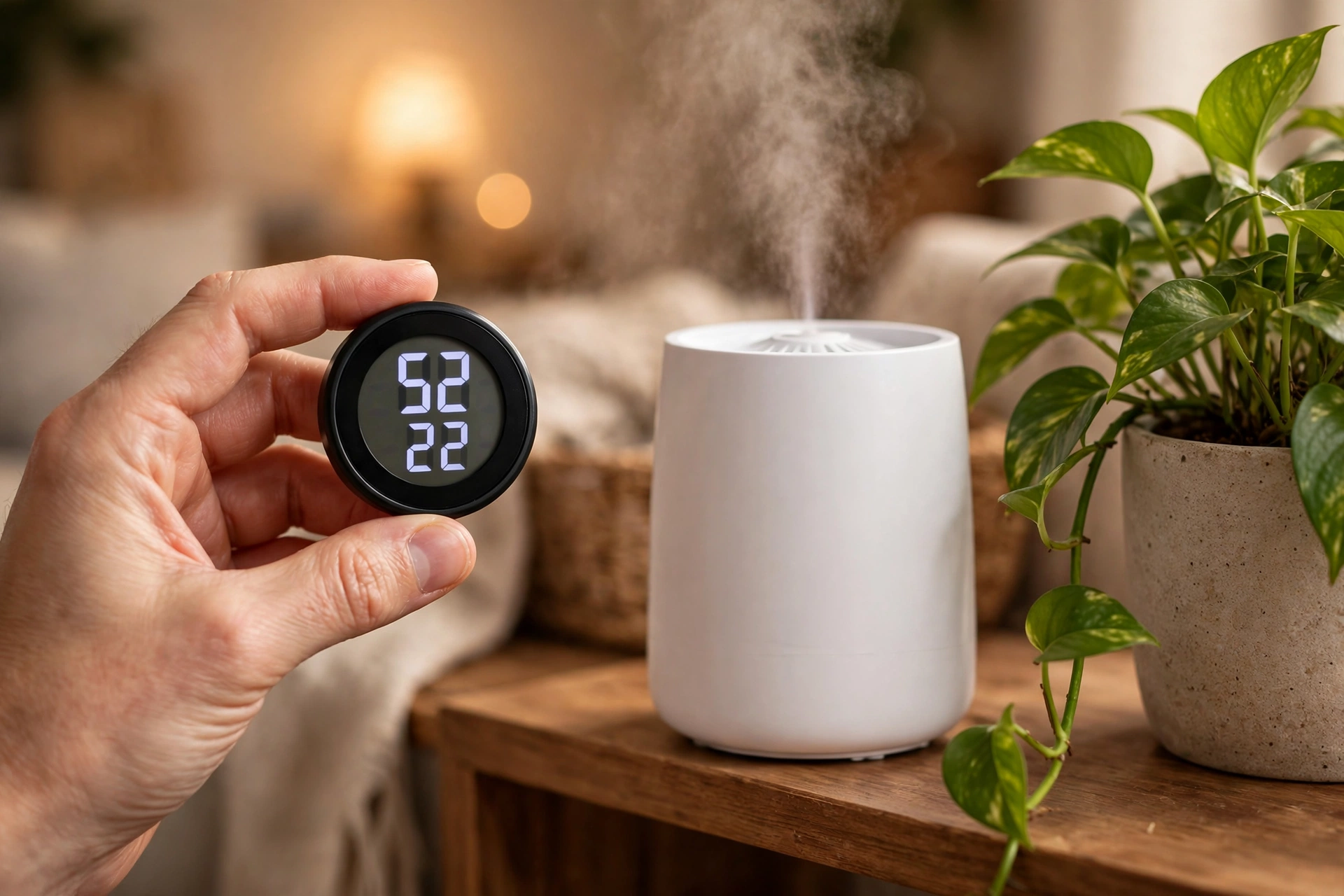
A cheap hygrometer — a small humidity meter — tells you what your rooms actually measure, rather than what the humidifier’s own sensor claims. Running a ceiling fan on low can help spread the moistened air evenly around the room. If your home already sits above 50%, a humidifier will only make things worse, and a dehumidifier is the machine you need instead.
How do you clean a humidifier safely?
This is the part most owners skip, and it is the most important. A humidifier tank is warm, dark, and wet — exactly the conditions where mould and bacteria grow. Running a dirty humidifier can spray those microbes into the air you breathe.
Empty the tank daily and refill with fresh water rather than topping it up. Once a week, wash the tank and base with mild soap and water. Every week or two, descale with weak white-vinegar solution, rinse until the smell is gone, and let the parts dry fully before reassembling.
Which type should you choose?
For a bedroom or nursery, an ultrasonic cool-mist model is usually the best pick: quiet, cheap to run, and safe around children. Look for a built-in humidistat and a tank you can lift off and wash easily, because you will do that weekly.
For a large living room, an evaporative model handles the bigger space well and is harder to overdo. For someone who wants the cleanest possible output and does not mind the running cost, a steam vaporiser is the third option.
Whichever type you buy, check two things before you pay: that the tank is easy to clean, and that replacement wicks or filters are actually available for that model. A humidifier you cannot clean is a humidifier you will stop using.
Frequently Asked Questions
Can a humidifier make a cold worse?
It can help or hurt. Moist air can soothe a dry, irritated throat and loosen congestion. But a dirty tank can spread germs, and over-humidified air encourages mould. Keep humidity between 30% and 50% and clean the machine weekly.
Should you run a humidifier all night?
Yes, if the room is dry and the machine has a humidistat. The sensor switches it off once the target humidity is reached, so it will not run flat out all night. Fill the tank with fresh water before bed.
Why is white dust appearing on furniture near my humidifier?
That is mineral residue from hard tap water, carried out in the ultrasonic mist and left behind when the droplets evaporate. Switching to distilled or demineralised water stops it completely.
Is tap water safe to use in a humidifier?
For evaporative and steam models, tap water is generally fine. For ultrasonic models, distilled water is better: it avoids white dust and slows mineral build-up on the transducer. Always follow your model’s manual.
Can a humidifier help with dry skin and nosebleeds?
Moist air can ease dry skin and reduce nosebleeds caused by dry nasal passages, especially in winter. It is a comfort measure, not a medical treatment — if nosebleeds keep happening, speak to a clinician.
Conclusion
A humidifier is a simple machine doing a simple job: it turns water into mist or vapour and lets a sensor hold your room at a comfortable humidity. The technology matters less than the habits around it — fresh water daily, a proper clean weekly, and a humidity level kept between 30% and 50%.
Your practical next step is a cheap one: put a small hygrometer in the room and check the reading for a few days. If it regularly sits below 30%, a humidifier will make a real difference — and now you know which type to pick and how to keep it clean.