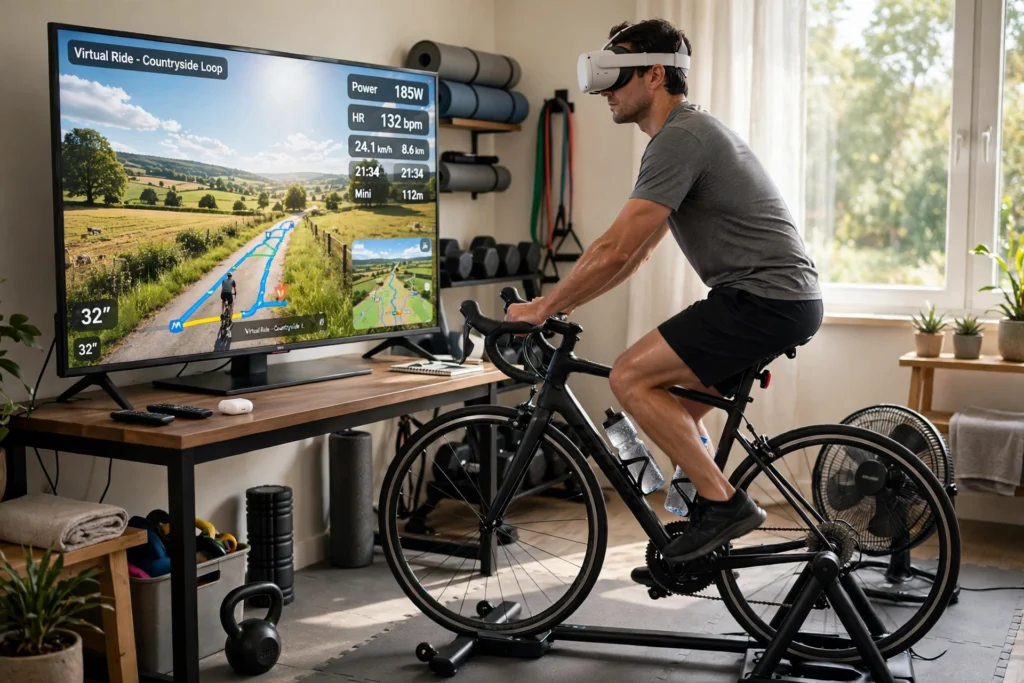
VR cycling turns your real bike into the controller for a virtual ride. You mount the bike on a smart trainer, put on a VR headset, and pedal through computer-made roads: the trainer changes resistance to match hills, sensors send your speed and power to the app, and the headset shows the route around you.
Key Takeaways
- A smart trainer holds your bike still and changes resistance to match the virtual road.
- Speed, cadence and power sensors feed your effort into the cycling app in real time.
- A VR headset replaces the screen, so hills, corners and other riders feel close.
- Start with short, flat rides before chasing steep climbs.
What do you need for VR cycling?
You need four things, and you may already own two of them. First, a bike you are happy to ride indoors — most road bikes work, and it does not need to be new. Second, a smart trainer, a stand that grips the rear of the bike and stops it moving while you pedal. Third, a VR headset, though many riders start with a phone, tablet or TV and add the headset later. Fourth, a cycling app that builds the virtual world and talks to the trainer.
The bike clamps into the trainer, the trainer plugs in or runs on a battery, and the app pairs with it over Bluetooth, much like pairing wireless headphones. Before your first ride, run the trainer’s calibration and put a fan in front of you, since you overheat far faster indoors than outside. Our guide to how VR headsets work explains the basics.
How does the smart trainer change resistance?
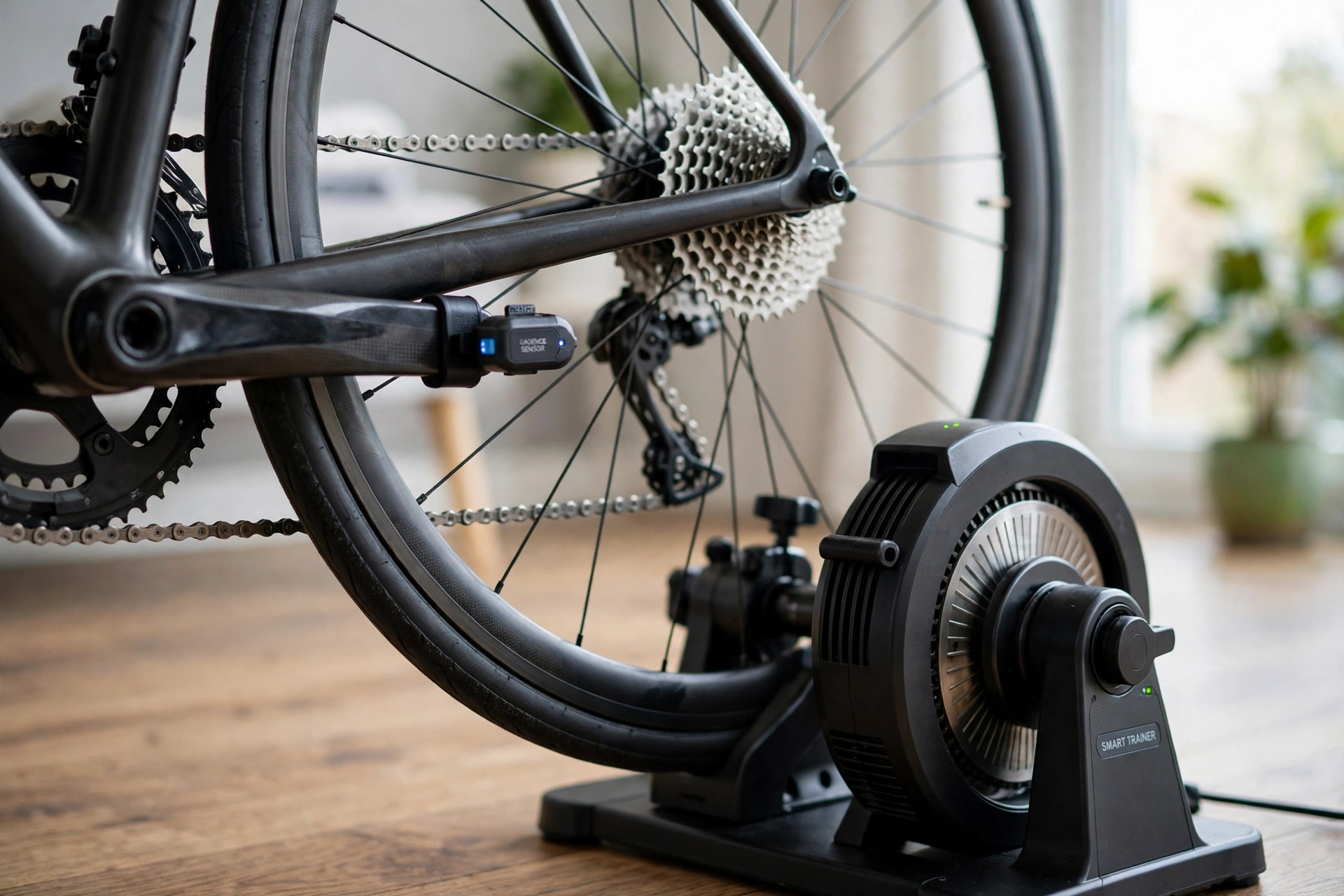
A smart trainer is not just a stand: it has a brake inside that can make pedalling harder or easier on command. When the virtual road climbs, the app sends the gradient and the brake pushes back so your legs feel the hill; on a flat it eases off, and on a descent the wheel spins freely.
Some trainers clamp onto the rear wheel, while “direct drive” models replace the wheel and connect straight to the chain. Direct drive feels smoother and measures power better, but wheel-on trainers cost less and set up faster. Either way, the trainer measures your power in watts and sends it to the app constantly. That power figure is the heart of the system: it sets your speed and how hard the climbs feel.
What do you actually see inside the headset?
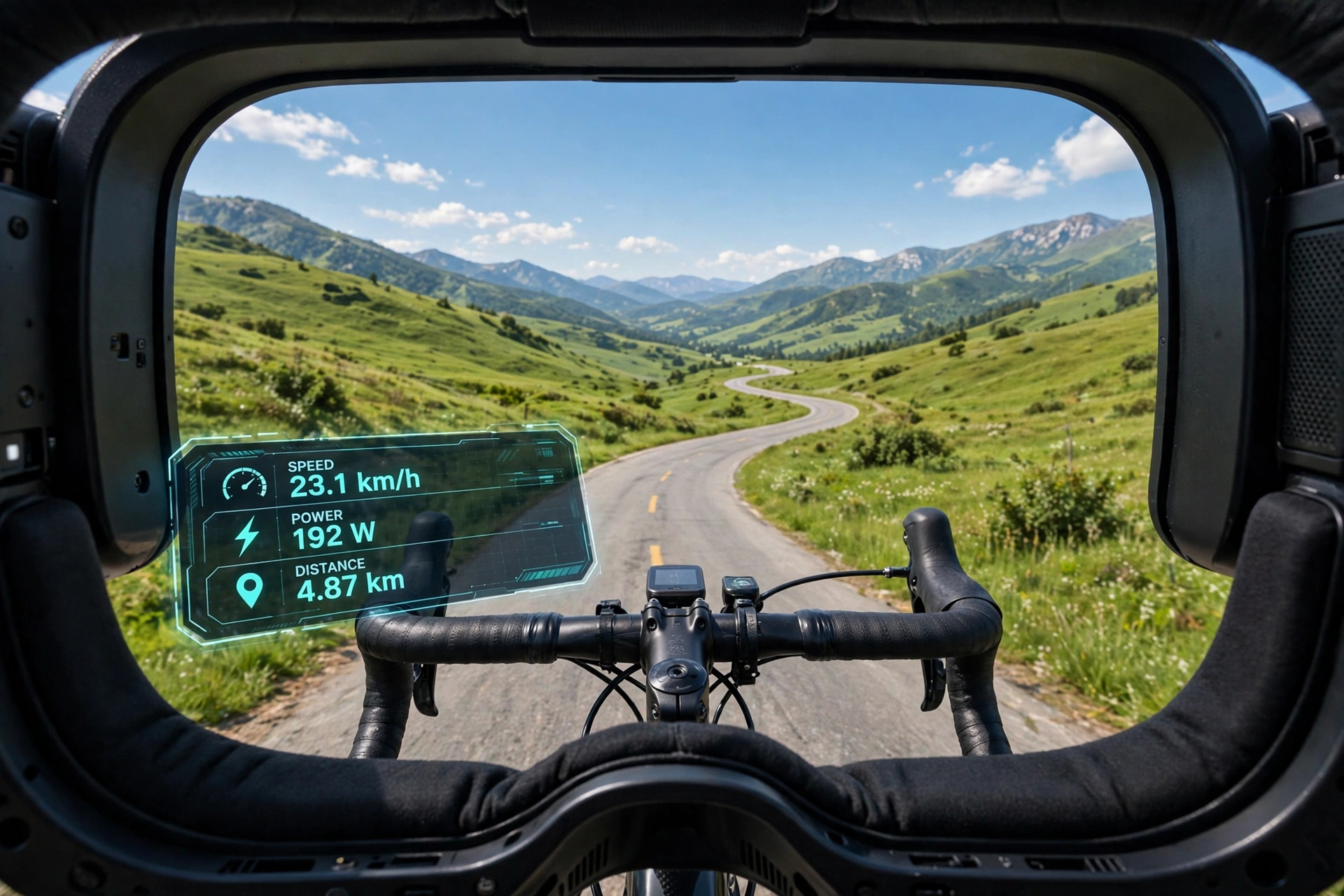
Put the headset on and the room disappears, replaced by a three-dimensional road: countryside lanes, city streets, mountain passes or fantasy worlds, depending on the app. You see your rider from behind, the road ahead, and a small display showing speed, power and distance.
Other riders appear as avatars around you, and you can ride alongside or overtake them, just as outdoors. Because you cannot see your room, clear the floor around the bike and keep a fan, towel and water bottle within reach. Most headsets also offer a quick passthrough view of your surroundings.
How do sensors turn pedalling into speed on screen?
The app never sees your real speed, so it works out a virtual speed from your effort. Speed and cadence sensors count how fast the wheel and cranks turn, while a power meter measures the force of each pedal stroke. Those numbers travel to the app over Bluetooth, where a simple piece of physics turns them into speed: your power, the road gradient, your weight and a bit of drag decide how fast your avatar moves.
That is why two riders pedalling at the same cadence can travel at very different speeds, and why a hill slows you down even as your legs work harder. If your numbers look wrong, check the sensor batteries and re-pair the trainer.
Can you ride with other people in VR?
Yes, and for many riders this is the main reason to bother with VR at all. Most cycling apps run group rides, races and training sessions where hundreds of riders share the same virtual road. You can draft behind another rider to save energy, just as in a real peloton, and the app works out the benefit for you. Leaderboards, sprint points and climb competitions make a lonely indoor session feel like a club ride.
Zwift is the best-known platform for this, with virtual worlds, structured workouts and regular events. If group training appeals to you more broadly, our guide to how VR works for sports training covers how other sports use the same idea.
Is VR cycling a good workout?
It can be, because the headset makes a hard session easier to stick with. Structured workouts guide you through intervals — short bursts of hard pedalling followed by recovery — and the trainer adjusts the resistance for each block, so you only have to keep pedalling. Many riders find a 45-minute virtual ride passes far quicker than staring at a garage wall.
That said, build up gradually: start with flat routes of 20 to 30 minutes, drink water, and stop if you feel dizzy or unwell. Treat it as general fitness, not a training plan, and check with a doctor first if you have a health condition or are returning to exercise after a long break. Our guides to VR fitness and VR treadmills cover the wider picture.
FAQs
Do I need a special bike for VR cycling?
No. Most road bikes fit a standard smart trainer, and many riders keep an older bike indoors. Check the trainer’s compatibility list for your axle type and gear count before buying.
Can I use a VR headset I already own?
Usually, yes, as long as the cycling app supports it. Some apps run directly on the headset; others run on a phone or computer and mirror the view into it. Check the app’s supported devices first.
Does VR cycling work without the internet?
Most apps need a connection for group rides, leaderboards and new routes, though some let you ride saved routes offline. Your trainer and sensors still work; you just lose the live features.
Will VR cycling make me feel sick?
It can, especially at first: pedalling hard while sitting still confuses some people’s balance. Short rides, a fan on your face and eyes on the road ahead usually help, and most riders adjust within a few sessions.
How much space do I need?
About the footprint of the bike plus room to step off safely — roughly two metres by one metre — with space in front for a fan and headroom to sit upright.
Conclusion
VR cycling joins three simple ideas: a smart trainer that changes resistance, sensors that measure your effort, and a headset that turns that effort into a ride through a virtual world. If you already own a bike, the next step is practical: check which trainers fit it, try a free trial of a cycling app, and take one short, flat ride to see whether the virtual road keeps you pedalling. For background on the sport itself, Britannica’s cycling overview is a solid starting point.