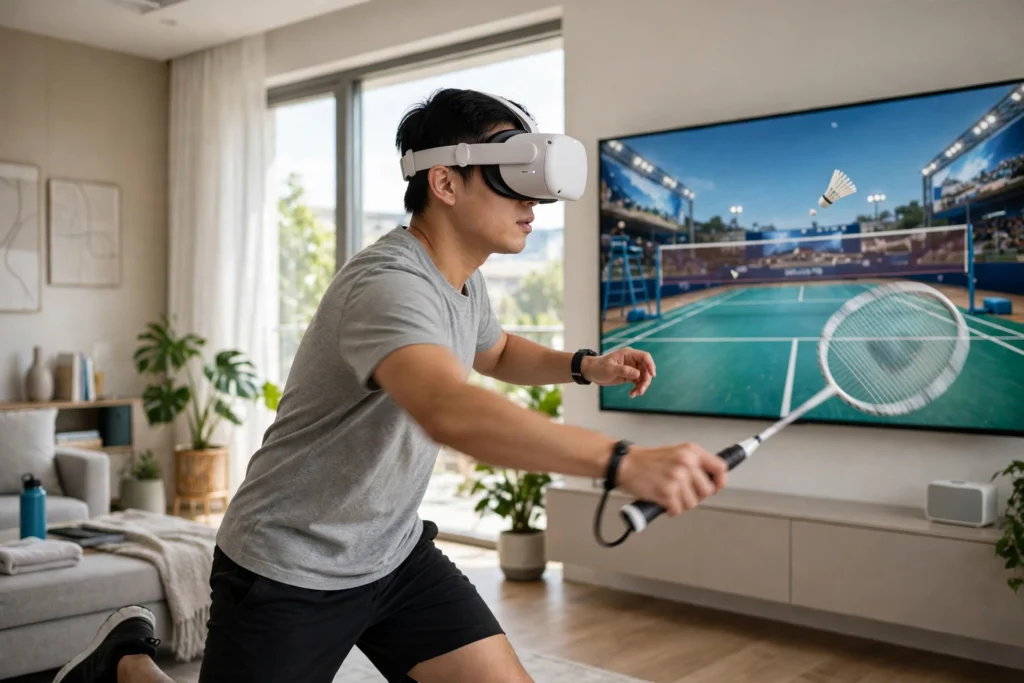
VR badminton drops you onto a virtual court, racket in hand, shuttlecock flying at you — no hall booking, no partner needed. Your headset tracks your swings, the game simulates the shuttle’s flight, and a small buzz tells you when you’ve caught it cleanly. It won’t replace a real court, but for practice and fun, it’s surprisingly close.
Key Takeaways
- Your headset and controllers track swings, serves, and footwork on a virtual court.
- Shuttle flight is simulated with drag and gravity, so timing matters more than power.
- Games range from arcade fun (Badminton Time!) to training tools (BadmintonXR, Badminton Training Simulator).
- Footwork is the weak spot: most games limit how far you can move, so real-court movement still needs real practice.
- Short sessions, a clear play space, and a wrist strap are the basics of playing safely.
A Rally, From Serve to Smash
Picture the first rally. You stand in the middle of your living room, headset on, and a virtual court stretches out in front of you. Your opponent serves, the white shuttle arcs over the net, you step in and swing, and a small vibration tells you the virtual racket connected. Ten seconds later you’re breathing harder than you expected.
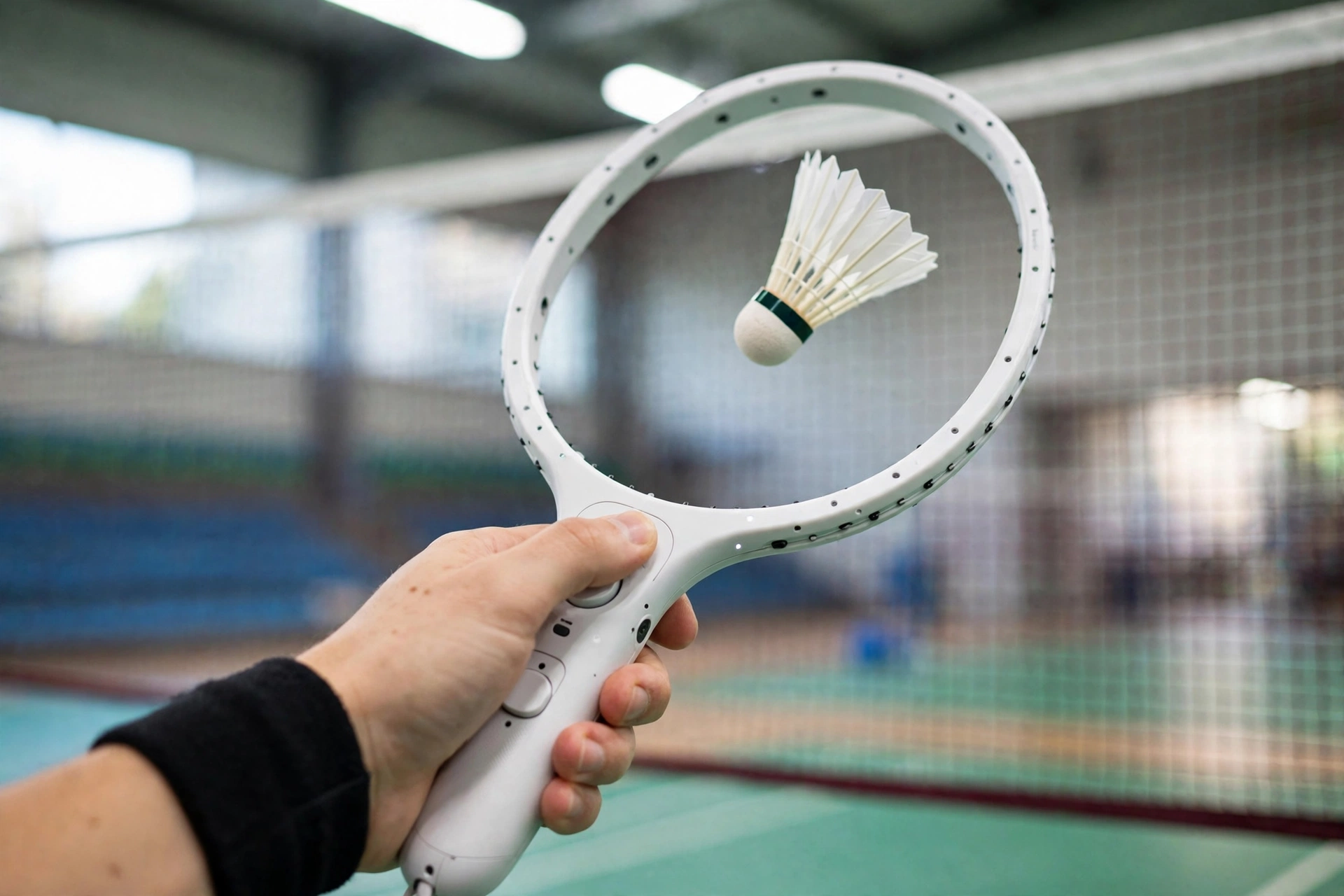
That loop — watch, move, swing, recover — is what makes VR badminton work as a game. The headset’s cameras track your controllers several times a second, so the game knows where your racket is and how fast it’s moving. When racket meets shuttle, the game works out the result from angle, speed, and contact point. Because a shuttlecock is light and feathery, it slows down fast in the air, and good VR badminton games model that drag — a hard smash still drops quickly, while a gentle clear floats high and deep.
What the Headset Actually Tracks
The magic is mostly in the tracking. Standalone headsets like the Meta Quest 3 use cameras on the headset itself to watch your controllers, a setup called inside-out tracking. It handles the big, sweeping swings badminton needs well, though it can struggle when your hand moves behind your back or too close to your face — the cameras simply can’t see the controller there.
Your feet are a different story. Most VR badminton games don’t track your legs at all. They watch your head position and guess your movement from that, or they keep you mostly in one spot and let you strafe sideways with a thumbstick. So the footwork — the split step, the lunge, the recovery to base — is only partly real. Some training apps add footwork drills that ask you to step to marked spots on the floor, which helps, but a real court still teaches movement better than any headset can.
The Games Worth Trying First
The field is small but growing, and the games split into two camps. On the fun side, Badminton Time! is the crowd-pleaser: bright courts, arcade mini-games, online tournaments, and a style closer to a party game than a simulation. Home Sports, a mixed-reality collection for Quest 3, includes badminton alongside pickleball and bowling, and drops the court into your actual living room.
On the serious side, BadmintonXR is a training-first app built by a former junior national-level player, with drills for smashes, drops, and receives, an AI opponent with adjustable difficulty, and a wall-practice mode for grooving your swing. Badminton Training Simulator, on the Meta store, leans the same way, with strict physics, leaderboards, and mini-games built around placement and net play. Pure Badminton and Badminton Kings VR round out the simulation end on PC headsets, the latter supporting a tracker strapped to a real racket.
If you’re choosing, start with what you want. Fun with friends? Pick the arcade option. Better technique? Pick a training app and use its drills. Most of these cost less than a month of court hire.
Shots That Transfer — and Shots That Don’t
Here’s the honest part. Some skills carry over to a real court, and some don’t.
The clear, the drop, and the smash transfer reasonably well, because they’re mostly about timing and racket angle — exactly what VR tracks. Players who drill in VR often report cleaner contact and better anticipation when they return to a real court. The serve transfers too, since the underarm motion is simple and the game rewards a consistent toss.
The net game is shakier. Delicate touches at the net need fine feedback through the racket, and a plastic controller buzzing in your hand isn’t the same as strings meeting feathers. Footwork is the biggest gap: lunging for a drop in VR rarely means lunging the same way on a real court, and some players develop a habit of reaching with the arm instead of moving the feet. The fix is simple — treat VR as a supplement, not a substitute, and keep playing real badminton if you want your movement to improve.
Setting Up a Court in Your Living Room
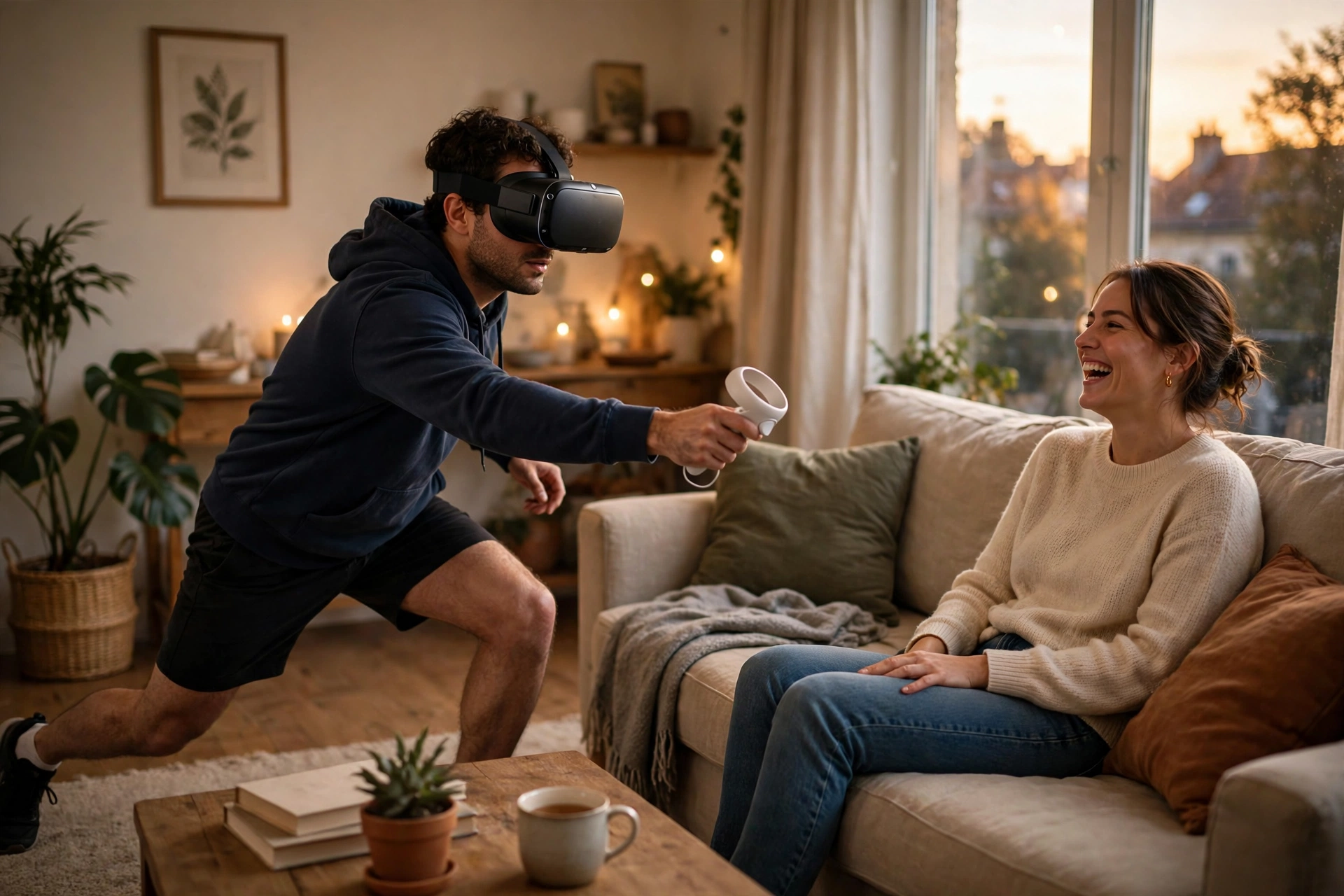
You don’t need much space, but you do need enough. Clear an area about two metres by two metres, move the coffee table, and check the ceiling — an overhead smash under a low light fitting is a collision waiting to happen. Use the headset’s guardian boundary and respect it; the game warns you near the edge, but a fast rally can carry you past it before you notice.
Wear the wrist straps. Every VR sports player has a story about a controller flying across the room, and a badminton swing is exactly the kind of fast, loose motion that causes it. Take a break every 20 minutes or so, especially at first. VR badminton is a genuine workout, so keep water nearby and stop if you feel dizzy or queasy.
FAQs
Do I need a powerful PC to play VR badminton?
No. Most run natively on standalone headsets like the Meta Quest 2 and 3, with no PC needed. A few simulation titles are PC-only, so check the store page before buying.
Can VR badminton improve my real game?
It can help your timing, anticipation, and shot selection. Footwork and net touch improve much less, so pair it with real court time for the best results.
Is VR badminton safe for beginners?
Yes, with a clear play space, wrist straps, and short sessions at first. Start with the tutorial and the easiest AI opponent, and stop if you feel dizzy.
Which VR badminton game is best for training?
BadmintonXR and Badminton Training Simulator are the most training-focused, with drills and adjustable AI opponents. Badminton Time! is the better pick for arcade fun and multiplayer.
How much space do I need?
About two metres by two metres of clear floor, with nothing breakable at arm’s height and a ceiling clear of light fittings. Bigger is better if you like to lunge.
Conclusion
VR badminton works best when you know what it’s for. It’s a clever, fun way to practise timing and shots, work up a sweat, and play a match whenever you like — all without leaving the house. It won’t teach you real footwork or the feather-light touch of net play, but it doesn’t have to. Try a training app’s drills for a week, play a few matches with a friend online, and then take what you’ve learned back to a real court. That’s where the virtual rallies start paying off.