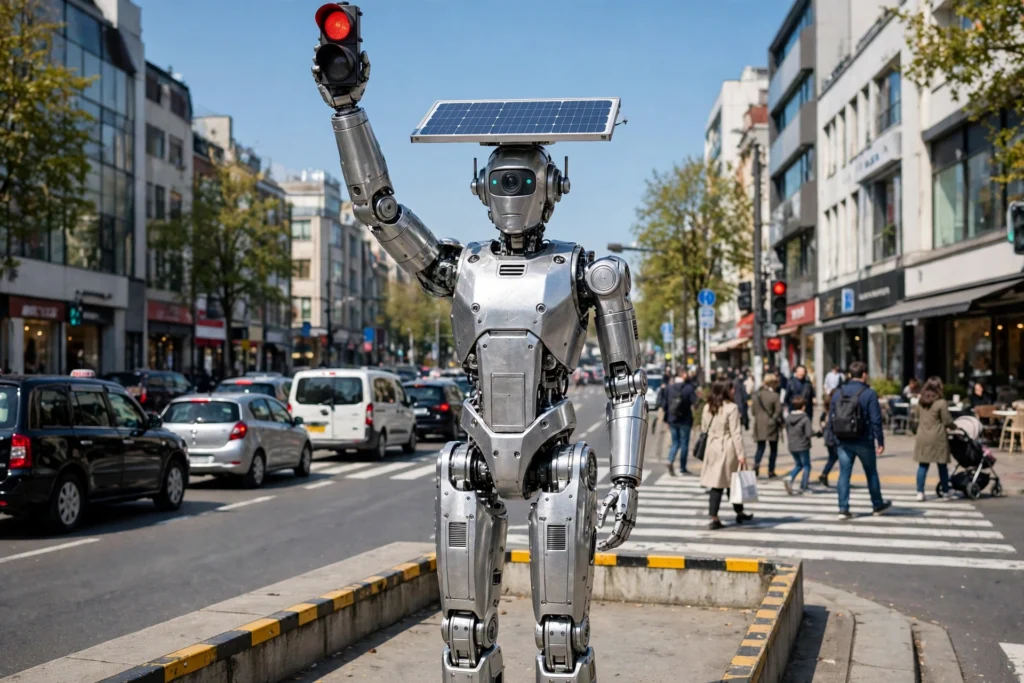
Traffic robots are machines that stand at a junction and do the job of a traffic officer: they raise an arm to stop one stream of cars, lower it to let another stream through, and use lights, cameras, and spoken messages to keep drivers and pedestrians moving safely.
Key Takeaways
- Traffic robots are fixed machines, not self-driving cars: they stay at one junction and direct the traffic around them.
- The best-known examples stand in Kinshasa, in the Democratic Republic of Congo, where they were first switched on in late 2013.
- They combine robot arms, cameras, LED lights, and spoken messages, and many run on solar power.
- They work best where drivers ignore signals, but they still need people to maintain them.
What exactly is a traffic robot?
A traffic robot is a machine built to control a road junction. The most famous ones look like people: about 2.5 metres tall, made of aluminium, with a torso that can swivel, arms that move like a police officer’s, and a solar panel on top of the head. Each one is fixed to a platform at a single crossroads, and its whole job is to manage the traffic passing that spot.
Inside, the parts are fairly ordinary. Cameras watch the lanes, a small computer runs a timing programme, motors move the arms and torso, and LED lights on the chest and hands show red or green. Some models also carry a speaker, so they can tell pedestrians when it is safe to cross.
How does a traffic robot decide when to stop cars and let them go?
Most traffic robots work on a simple cycle, much like a normal traffic light. The computer runs a timed pattern: one direction gets a green signal while the other waits, then the arms swap over.
The cameras add a second layer. They can spot when a lane is backed up or when the road is clear, and newer models can send that footage to a police control room in real time. Officers can see what is happening at the junction without standing in the middle of it, and they can review the recordings if someone breaks the rules. The robot itself does not chase anyone or hand out fines — it records, signals, and leaves enforcement to people.
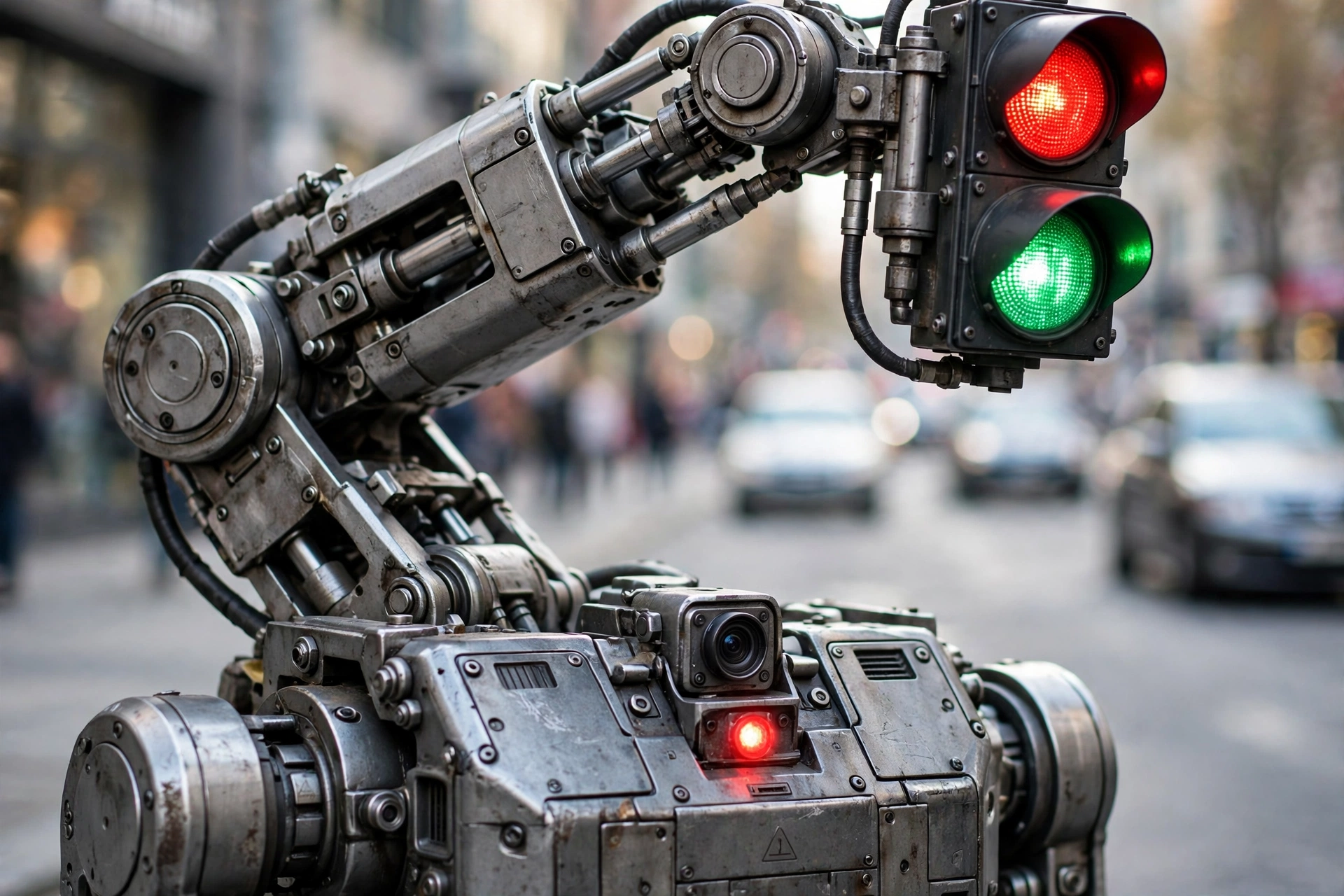
Why do the Kinshasa robots look like people?
The human shape is deliberate, not decoration. The robots were designed by Congolese engineer Thérèse Izay Kirongozi and her team at Women’s Technology, a small association of engineers in Kinshasa. The idea grew out of frustration: drivers were speeding, running red lights, and bribing their way out of fines, while pedestrians were struggling to cross busy roads safely.
A plain traffic light is easy to ignore. A two-and-a-half-metre metal figure that turns its chest towards you, raises an arm, and speaks in a deep voice is much harder to miss. The human form also helps people understand the robot at a glance: a raised hand means stop, just as it does from a human officer.
The first two robots were placed at busy junctions in Kinshasa towards the end of 2013, and more followed — five in Kinshasa and one in Lubumbashi by 2015. Each first-generation machine cost about 15,000 dollars to build.
What powers a traffic robot through a long day?
Sunlight, in the Kinshasa design. A solar panel sits on top of the robot’s head and charges its batteries during the day, which matters in a city where whole districts still lack reliable mains power. The aluminium body is also a practical choice: it stands up to high temperatures, humidity, and heavy downpours.
That self-contained design is part of the point: no new power line needs digging to the junction, and the robot keeps working through a local outage. The trade-off is maintenance — the arms, motors, and cameras need regular checks, and a robot that stops mid-gesture is worse than no robot at all.
Traffic robots vs traffic lights: what’s the difference?
A traffic robot and a traffic light share the same job, but they go about it very differently.
| Feature | Traffic robot | Ordinary traffic light |
|---|---|---|
| Shape | Humanoid figure with moving arms | Fixed pole with coloured lamps |
| Signals | Arm gestures, lights, and spoken messages | Coloured lights only |
| Cameras | Built in, with footage sent to police | Usually separate, if present at all |
| Power | Often solar, with batteries | Mains electricity |
| Cost per junction | Thousands of dollars per unit | Much lower, once installed |
| Best for | Junctions where signals are ignored or officers are scarce | Almost every junction, as standard equipment |
The trade-off is clear. A traffic light is cheaper and simpler, and it is the right answer for most junctions. A traffic robot earns its place where drivers routinely ignore lights, where a human officer would be at risk, or where a city wants the extra presence of a machine that drivers cannot easily overlook.
Where else are traffic robots being tried?
Kinshasa remains the best-known example, and its robots have drawn attention from other countries. Engineers elsewhere have tested simpler versions: wheeled robots that roll to a junction, camera towers that speak to drivers, and smart signals that change timing based on live traffic.
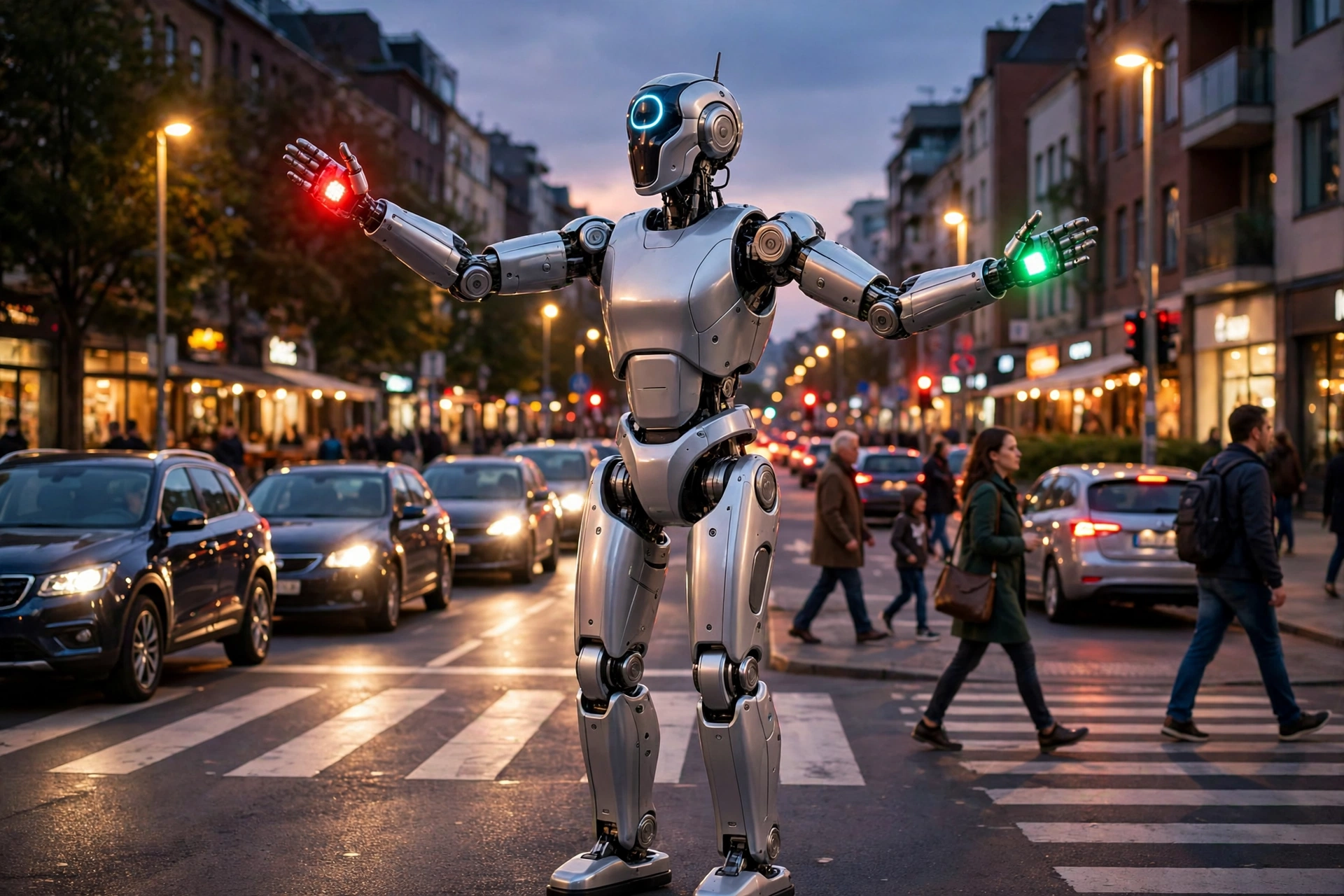
What are the limits of a traffic robot?
A traffic robot cannot think its way out of a strange situation. If a lorry breaks down in the middle of the junction, or an ambulance needs a path cleared, the robot keeps running its pattern until a person steps in. Heavy rain, dust, or a damaged camera can also confuse its sensors, so regular maintenance is not optional.
Cost is the other limit. Even a relatively simple robot costs far more than a traffic light, and a city with hundreds of dangerous junctions cannot afford one at each of them. Kinshasa has around 600 strategic and dangerous intersections, and its engineers have said openly that covering them all would take serious funding.
FAQs
Do traffic robots replace traffic police?
No. They take over the standing-and-signalling part of the job at one junction, but people still maintain them, watch the camera feeds, and deal with accidents and anything the robot’s programme does not cover.
Can a traffic robot fine a driver?
Not by itself. Its cameras can record a vehicle breaking the rules and send the footage to police, who then decide what happens next.
Are traffic robots only used in Congo?
The humanoid design is best known from Kinshasa, but other countries have tested robot-assisted traffic control in simpler forms, such as camera towers and spoken warnings at busy crossings.
What happens if a traffic robot breaks down?
It usually freezes in its last position or switches off, which is why a broken robot can be more confusing than a missing one. Technicians are kept on call, and officers cover the junction until it is fixed.
Could traffic robots work with self-driving cars?
In principle, yes. A junction robot that broadcasts its signal timing could talk directly to nearby vehicles, which is the same idea behind smart traffic lights. That kind of vehicle-to-infrastructure link is still being tested.
Conclusion
Traffic robots are a simple idea with a striking shape: take the signals of a traffic light, add the gestures of a police officer, and put the whole thing on a solar-powered machine that drivers cannot ignore. They have worked well at Kinshasa’s busiest junctions, where the human form and the spoken warnings do something a plain light could not. They will not replace traffic lights everywhere — cost and maintenance see to that — but at the junctions where rules are ignored and officers are scarce, they are a practical, proven fix.
If your city has a junction where drivers treat red lights as optional, look at what Kinshasa did first. The machine has to be visible, understandable, and reliable before drivers will respect it — and a two-and-a-half-metre figure that raises its hand is hard to miss.