
AI customer support uses artificial intelligence to answer customer questions, sort incoming requests, and solve everyday problems without making every person wait for a free agent. You have probably met it already: the chat window on a shop’s website, or the assistant that checks your parcel.
Key Takeaways
- AI customer support handles routine questions instantly; human agents take the complicated and emotional cases.
- A support chatbot reads what you type, works out what you want, checks company records, and either answers or routes the chat.
- The handoff matters more than the bot: a good system passes your details and the full conversation to the agent, so you never repeat yourself.
- Check the answer before acting on it, and ask for a person when money or a complaint is involved.
What happens when you message a company?
Picture a Tuesday evening. Your parcel was due yesterday, so you open the shop’s chat and type, “Where is my order?” A reply appears within a second, and after you paste in the order number, the bot checks the delivery system and tells you the new date. The whole exchange takes about a minute, and no human was involved.
Behind that short conversation, several pieces of AI customer support are working together. First, natural language processing reads your message and works out your intent — tracking a delivery, say, rather than returning one. Then the system pulls the facts from the company’s order records and drafts a reply in plain language.
How does a support chatbot understand what you mean?
A support chatbot is a specialised kind of AI chatbot. It starts with natural language processing, which breaks your sentence into its intent and its details — “track order”, say, plus the order number — and matches that intent against the things it is allowed to do.
Modern bots go a step further. Instead of picking from a fixed list of canned replies, many now use large language models to write a fresh answer each time, drawing on approved company documents. This technique, known as retrieval-augmented generation, is why a good bot can quote the returns policy rather than inventing one. Our guide to how AI chatbots work explains this in more detail.
A bot can also remember what you said earlier in the same conversation, so you do not have to type your order number twice — though it generally cannot remember you from last month.
Chatbot, human agent, or both?
No single option wins every time:
| AI chatbot | Human agent | Hybrid (bot first, human next) | |
|---|---|---|---|
| Speed | Answers in seconds | Minutes to hours, depending on the queue | Seconds for simple questions, then a short wait |
| Best at | Order tracking, FAQs, password resets | Complaints, refunds, unusual cases | Most everyday support |
| Weakness | Struggles with emotion and edge cases | Slower and costlier per chat | Needs a smooth handoff |
The hybrid column is where most good support now lives. The bot clears the queue of routine questions, which leaves human agents with the time — and the patience — for the cases that actually need a person.
What does a good handoff to a human look like?
A handoff is the moment the bot passes your conversation to a person, and it is where support most often goes wrong. You have felt a bad one: the agent greets you with “How can I help?” and you explain the whole problem again, including the order number you already typed twice.
A good handoff tells you clearly that you are now talking to a person, passes the full chat history and the order details to the agent before they say hello, keeps you in the same chat window, and sets an expectation — a wait time, or a callback — rather than leaving you staring at three dots.

You should always be able to reach a person, and the system should say when you are talking to AI. The honest test is simple: type “speak to a person” and see what happens.
Where AI customer support goes wrong
Bots are only as good as the documents they can read: if the returns policy changed last week and nobody updated the help pages, the bot will confidently repeat the old one. They are also poor judges of tone, and they can invent details — so check any oddly specific date or price against the company’s own help page.
There is a privacy side too: a support chat may hold your name, address, and order history, so check whether the company says the conversation is used to train its AI. Never share a full card number or password in chat — a genuine support team will never ask for them there.
Gartner has predicted that agentic AI, combined with conversational chatbots, could autonomously resolve 80% of common customer service issues by 2029 — which would make the human part of support, judgement and empathy, more valuable rather than less.
A worked example: the late parcel, step by step
Maya orders wireless earbuds on a Friday, with delivery promised for Monday. On Tuesday, nothing has arrived.
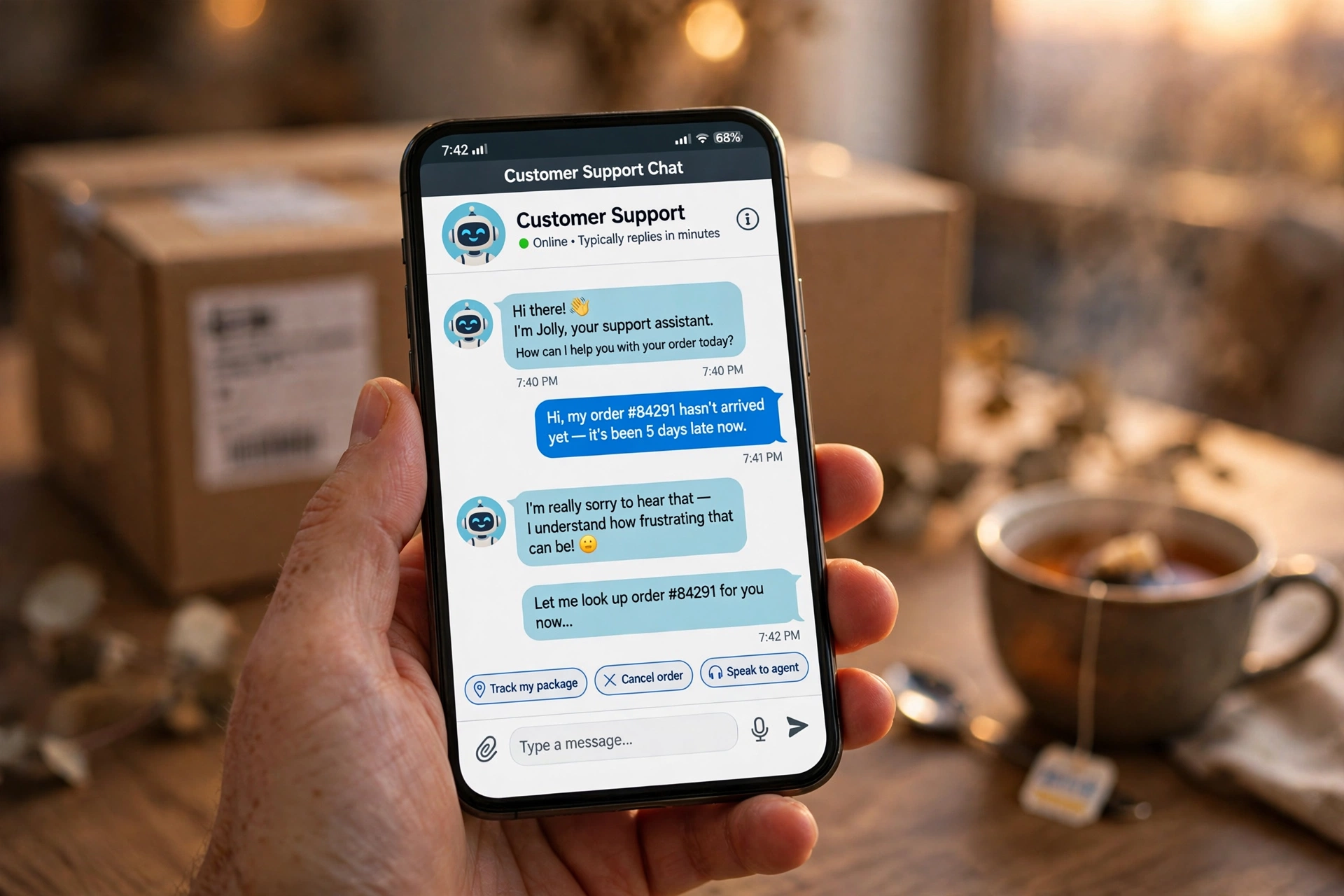
- 7:42 pm, Tuesday. Maya opens the shop’s chat and writes, “Hi, my order #84291 hasn’t arrived yet — it’s been 5 days late now.”
- Seconds later. The bot greets her, apologises, and confirms it will look up the order — it already has the order number, so it does not ask again.
- The bot checks the delivery system and finds the parcel is delayed at a sorting facility, with a new estimated date of Thursday. It offers three buttons: track my package, cancel the order, or speak to an agent.
- Maya taps “speak to an agent.” The bot passes the order, the delivery status, and the whole conversation to Alex, a human agent, who greets her by name and confirms Thursday.
- Thursday. The earbuds arrive.
Five steps, and a person exactly where a person was needed. That is AI customer support done properly.
Frequently Asked Questions
Is AI customer support the same as a chatbot?
Not quite. A chatbot is one tool inside AI customer support; the wider system also covers intent detection, order lookups, suggested replies for agents, and routing to the right team.
Can AI customer support issue refunds?
Sometimes, for small and clearly defined cases such as a late delivery credit. Larger refunds, disputed charges, and anything involving fraud usually still go to a human, because the decision needs judgement and a record a person can stand behind.
Will AI replace human support agents?
For routine questions, much of the work has already moved to machines. But the evidence so far points to a partnership: bots take the repetitive volume, and agents handle the cases that need empathy or accountability. AI agents are pushing this further.
How do I get to a human faster?
Say so plainly: type “speak to an agent” or “human please” early, rather than answering the bot’s questions for several rounds. Have your order number ready, and keep your first message short and specific.
Is my chat with a support bot private?
It depends on the company. Most support chats are stored for quality checks and, in some cases, to train the AI. Avoid sharing passwords, full card numbers, or identity documents in chat.
Conclusion
AI customer support is at its best when it does the simple things instantly and gets out of the way for the hard things: a bot that tracks your parcel in seconds is genuinely useful, while a bot that blocks you from a person is not.
Next time you open a support chat, give the bot one clear message with your order number and what you need, use the handoff the moment the question turns complicated, and check any date or price against the company’s own help page before you rely on it.
Further reading: IBM’s guide to AI customer service chatbots and Nextiva’s customer support chatbot guide.