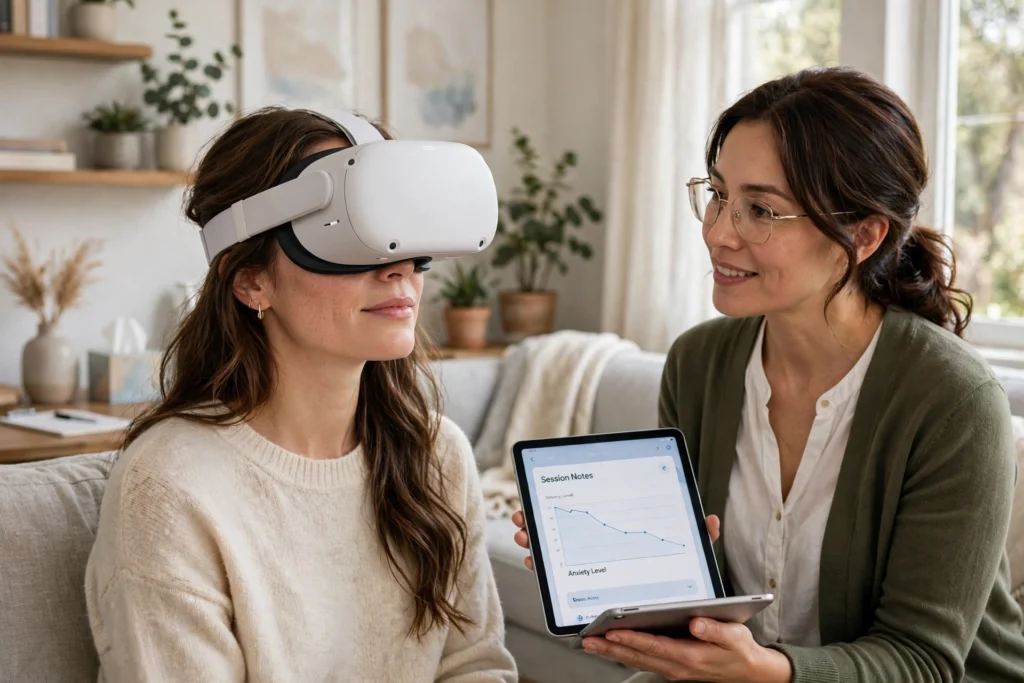
VR exposure therapy is a guided treatment in which a person faces a feared situation inside a virtual scene instead of in real life. Wearing a headset, they might stand on a virtual balcony or sit in a virtual aeroplane, while a trained therapist stays beside them and controls how intense the scene feels.
This article is general information only, not medical advice. Exposure therapy should be arranged with a qualified health professional, who can judge whether it fits your situation and how it should be paced.
Key Takeaways
- VR exposure therapy pairs a classic idea, facing a fear in small steps, with a virtual scene a therapist can adjust in real time.
- Sessions usually start gently, then build slowly as each step becomes easier to sit with.
- It is most often used for specific phobias, fear of flying, fear of heights, social anxiety, and some trauma-related symptoms.
- The headset creates a sense of presence, so the body reacts much as it would in the real situation.
- It is not a gadget to use alone; the therapist, the plan, and the follow-up practice matter most.
Why does a fear stick around?
Avoidance feels sensible in the moment. If lifts make you anxious, you take the stairs. If flying terrifies you, you stay home. The trouble is that every avoided lift or cancelled flight teaches your brain the same lesson: that situation really was dangerous, and avoiding it kept you safe.
Exposure therapy turns that lesson around. By staying in a feared situation in small, manageable doses, you learn that the anxiety rises, peaks, and then eases, and that the feared outcome does not happen. VR gives therapists a practical way to set up those doses.
How does a VR exposure session work?
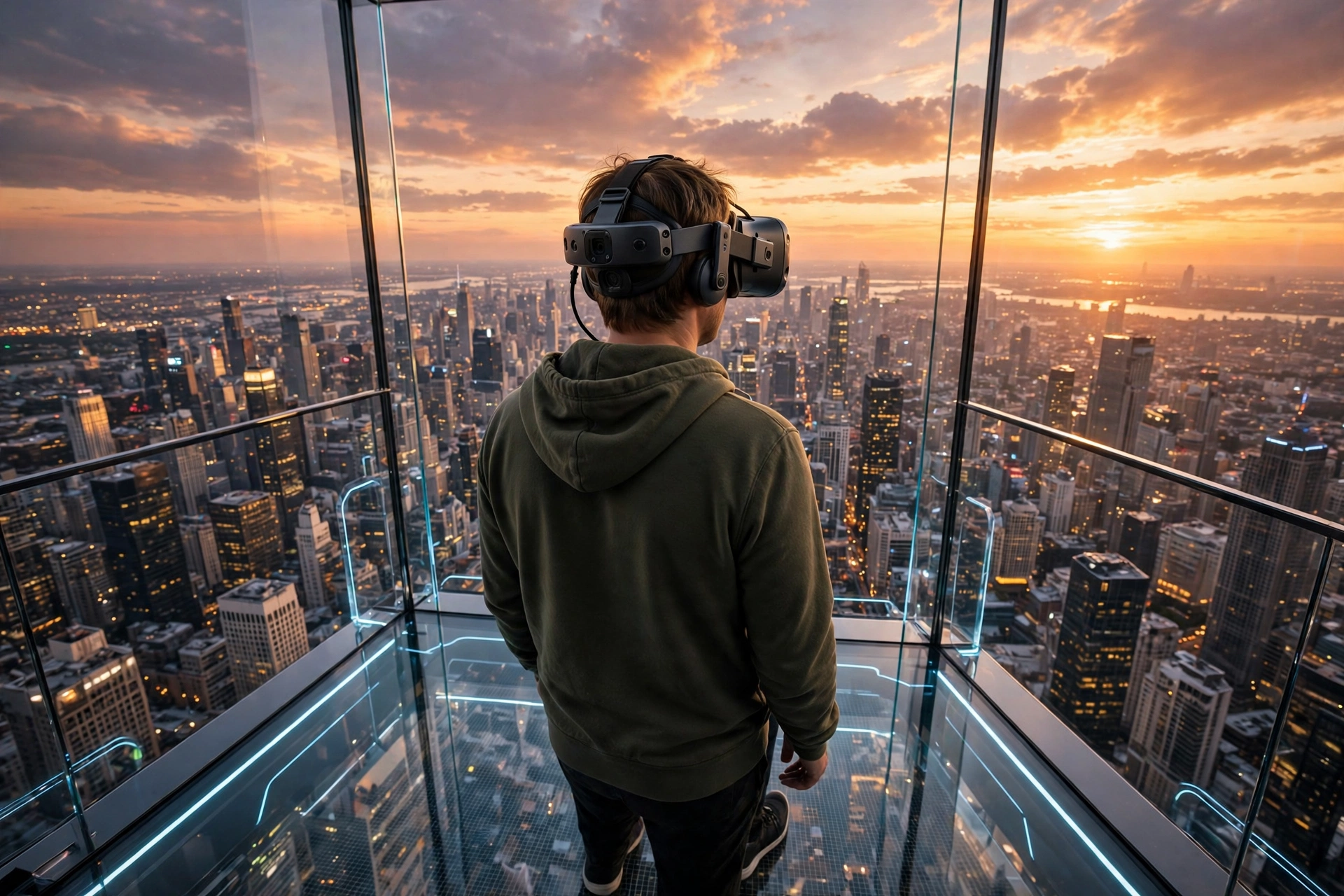
A first session rarely involves a headset at all. The therapist talks through the fear and helps you build a ladder of steps from easiest to hardest — for a fear of heights, perhaps a first-floor balcony, then a higher floor, then a glass walkway.
When the headset goes on, the therapist watches the same scene on a screen and talks you through it. They can raise the height or add crowd noise — or dial everything back if the anxiety spikes too fast. Most sessions last under an hour, with short stretches of exposure and pauses to breathe and talk.
Between sessions, the therapist often sets small real-world steps too. That matters, because the goal is not to get good at virtual balconies. It is to feel steadier on a real one, at a real airport, or in a real crowded room.
What can VR exposure therapy help with?
The strongest use is for specific phobias: heights, flying, spiders, lifts, driving, and crowded places. These fears have clear triggers, which makes them easier to recreate as virtual scenes. A person afraid of flying can practise boarding, take-off, and turbulence again and again without booking a single ticket.
It is also used for social anxiety, where the scene might be a meeting room or a small audience, and for some trauma-related symptoms, where carefully chosen virtual cues are used alongside other treatments at a gentle pace.
Therapists also use the same controlled scenes for medical training and for public speaking practice. It is not a cure-all. It suits fears with a clear trigger far better than vague worry, and works best as part of a wider plan, often alongside talking therapy.
How is VR exposure different from real-life exposure?
Real-life exposure has one clear advantage: it is the real thing. But it is often awkward to arrange — you cannot summon a thunderstorm or a turbulent flight on demand, and you cannot pause real life. VR fills those gaps.
| Feature | VR exposure | Real-life exposure |
|---|---|---|
| Control over intensity | Therapist adjusts the scene live | Hard to control once it starts |
| Repeatability | Same scene, as often as needed | Each real situation is different |
| Cost and planning | One room, one headset | Travel, tickets, and timing |
| Stopping | Scene can pause at once | Leaving may take time |
| Real-world transfer | Needs follow-up practice | Direct, by definition |
Many therapists mix the two, starting in VR and moving to real life once the fear has softened. That handover step is where the gains usually stick.
What does the headset add that imagination cannot?
Imagined exposure asks you to picture the feared scene in your head. Some people can do that vividly; others find their mind goes blank. A headset removes that guesswork: the scene is in front of your eyes, the sound is in your ears, and your head movements change the view.
That sense of presence is why the body reacts. Your heart rate may rise on a virtual balcony even though you know you are standing on a carpet in a therapy room. That reaction is the point: you are practising with the real feeling, not just thinking about it. Our guide to how VR headsets work explains the screens, lenses, and tracking behind that sense of presence.
Who is it for, and who should be cautious?
VR exposure therapy suits adults and older teenagers who can describe their fear, follow a plan, and tolerate some discomfort. It can help people who have avoided a fear for years, or whose fear is tied to a situation that is hard to practise in real life, such as flying.
It needs more care for some people. Those who get travel sick or dizzy in VR may find sessions uncomfortable, and people with certain eye conditions, epilepsy, or severe dissociation should talk it through with their clinician first. Anyone in the middle of a crisis needs a fuller assessment first — VR exposure is a planned treatment, not an emergency tool.
Cost and access vary: some clinics include VR in their normal fees, others charge extra, and in some places it is still hard to find.
For the gentler side of the same technology, see our guide to how VR meditation works.
FAQs
What is VR exposure therapy in simple terms?
It is a treatment where you face a feared situation inside a virtual scene, with a therapist beside you controlling the intensity. You stay in the scene until the anxiety eases, then repeat the step until it feels manageable.
Does VR exposure therapy really work?
Reviews of trials for specific phobias and post-traumatic stress have found VR exposure can reduce fear, with results broadly similar to real-life exposure for many people, especially when followed by real-world practice.
Is VR exposure therapy safe?
For most people it is, when a trained professional runs it. Some people feel dizzy or travel sick in a headset, and sessions can be emotionally tiring, so a therapist should screen for those risks and stop the scene whenever you need a break.
How many sessions does it usually take?
Many courses run for several weekly sessions, each building on the last. A therapist should give you a rough idea after the first assessment, and adjust the plan as you go.
Can I try VR exposure therapy on my own at home?
Home VR apps exist, but they are not a substitute for treatment. Without a therapist, it is easy to push too hard or practise the wrong thing, so speak to a professional about a proper plan.
Conclusion
VR exposure therapy takes an old, well-tested idea — facing a fear in small, steady steps — and gives it a setting a therapist can shape, repeat, and pause. For a fear with a clear trigger, from heights to flying to crowded rooms, it offers a practical middle step between imagining the situation and living through it.
If a fear is shrinking your life, the practical next step is a conversation, not a purchase. Speak to your GP or a qualified therapist, describe the situations you avoid, and ask whether exposure therapy could be part of your plan.