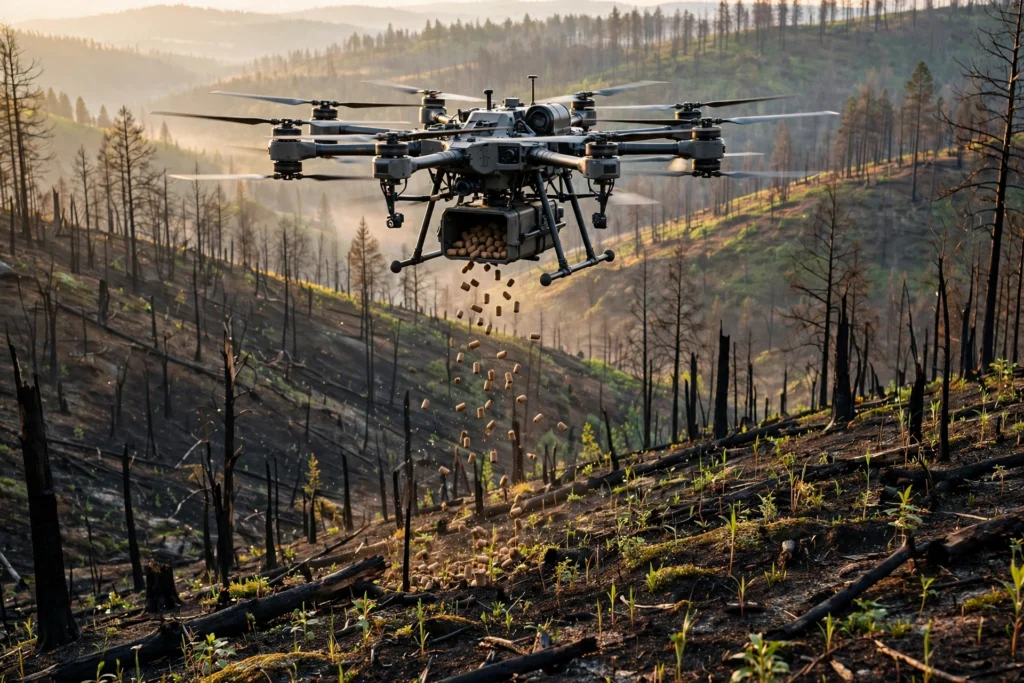
Yes. Tree-planting robots can already put new forest in the ground, mostly by flying over land that people and tractors cannot reach easily. Drones map a burned hillside, then fire seed pods into the soil at spots chosen for the best chance of growth, while tracked ground planters dig in young seedlings.
Key Takeaways
- Tree-planting robots come in two main kinds: seed-firing drones and tracked ground planters that set out seedlings.
- Mapping comes first. A survey drone builds a 3D map, and software picks where each seed or seedling should go.
- Seeds travel inside biodegradable pods filled with nutrients, giving them a better start than a bare seed dropped from the air.
- The machines are fast, but survival is the real test. A planted seed still has to germinate, take root, and survive drought, grazing animals, and weeds.
- Planting is only half the job. The same drones often return months later to check which seedlings lived.
How do tree-planting robots work?
A tree-planting job runs in stages, and the robot is only the middle of the story. First, a mapping drone flies high over the site — sometimes more than 300 feet up — with cameras and laser scanners. It records the shape of the land, the soil, and what is already growing there, and software turns that scan into a planting map: which species go where, and which spots to skip.
Then the planting machines arrive. Seed-firing drones fly low, about six feet above the ground, following the map on their own. Each carries a store of seed pods and fires them down with a puff of pressurised air, hard enough to push each pod into the soil. One operator can supervise several drones at once. These planting drones are close cousins of drone robots used in farms and warehouses — the same mix of GPS, sensors, and autonomous flight, pointed at a forest instead of a field.
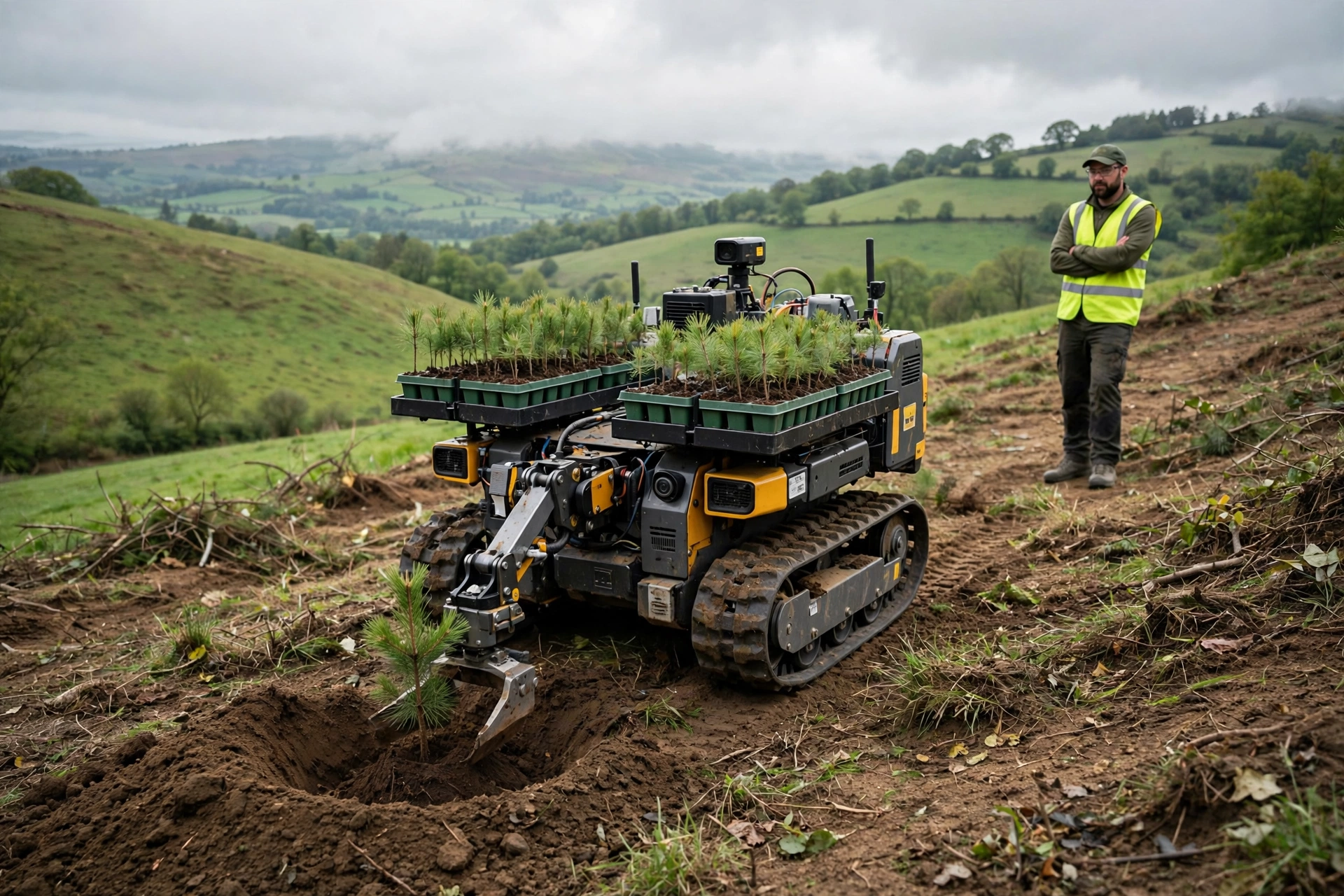
Ground planters work differently. These tracked machines, built a bit like small tractors, carry trays of nursery-grown seedlings, dig a hole at each marked spot, place a seedling, and firm the soil around it. They are slower than drones, but a seedling a few months old has a head start over a seed.
What is a seed pod, and why does it matter?
A seed pod is a small biodegradable capsule holding a germinated seed — one that has already started to sprout — packed in a nutrient-rich gel. The gel feeds the young plant in its first days and cushions the seed when the pod hits the ground.
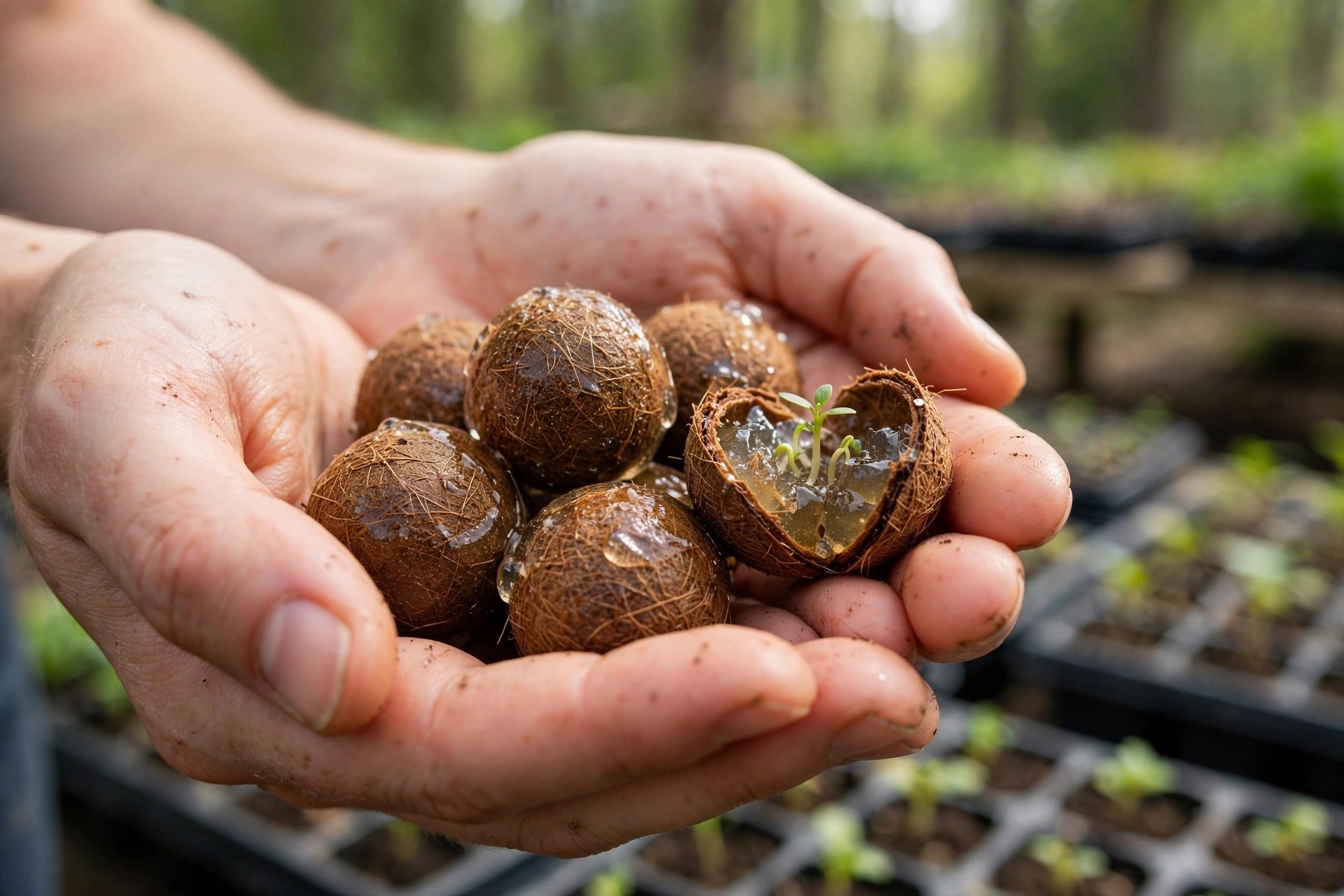
The pod is what makes drone planting work at all. Scattering bare seeds from the air is cheap, but most of them land on rock, dry out, or get eaten. A pod puts the seed into the soil, in a chosen spot, with food and moisture around it. BioCarbon Engineering, one of the early pioneers, says its drones can plant as many as 100,000 trees in a single day, roughly ten times faster than planting by hand. Those figures describe planting speed, not surviving trees.
Drones or ground planters — which is better?
Neither wins outright. They suit different ground, different budgets, and different stages of a forest’s recovery.
| Approach | Best for | Speed | Main weakness |
|---|---|---|---|
| Seed-firing drones | Steep, burned, or remote land | Very fast | Lower survival per seed |
| Ground planters | Flat or gentle cleared land | Slower, but seedlings are established | Cannot reach steep or boggy ground |
| Planting by hand | Small sites and sensitive ground | Slowest | Labour-intensive at scale |
Most projects use a mix: drones for the wide, difficult areas, ground machines or people for the spots where a seedling needs a careful start.
Where are tree-planting robots already working?
The best-known projects are in reforestation after wildfire and mining. In Canada, the startup Flash Forest flies heavy-lift drones over land burned by wildfires, aiming to plant one billion trees by 2028. In Australia, BioCarbon Engineering tested its drones on an abandoned coal mine, planting into ground too rough and unstable for crews to walk safely.
The idea has spread beyond forests. The same approach restores mangroves along coastlines, where pods must survive being fired into wet, salty mud. In farming country, the technology overlaps with seeding robots — farm machines that place crop seeds precisely in tilled fields. The difference is the ground: seeding robots work neat rows on flat farmland, while tree-planting robots work wild, uneven land that was never a field, and the wider farm work belongs to agricultural robots.
What are the limits of tree-planting robots?
The honest limit is survival. A seed that is planted is not a tree, and a drone cannot water it, weed around it, or keep deer away from it. Germination rates vary a lot with the season, the soil, and the weather after planting — a dry month after a big planting day can wipe out much of the work.
There are practical limits too. Drones carry a limited weight of pods, so they fly back and forth to reload, and wind and rain ground them like any aircraft. Ground planters need access tracks and firm soil, which rules out the steepest slopes — the very places drones are most useful. The whole system also depends on good seed: local species, collected nearby, matched to the site. Cost is a quieter limit: the machines are expensive, and the pitch only holds if enough seeds actually grow.
What happens after the robots leave?
The part of the job that gets the least attention is also the longest: looking after the young forest. The teams that run these projects say the crucial work is post-planting monitoring, not the planting itself. Drones return to photograph the site, count green shoots, and map where growth is thin, using the same camera-and-sensor kit that crop-spraying robots use to read plant health from the air. Local crews then clear weeds, protect seedlings from grazing animals, and replant the gaps. The robots do the reaching and the repetition; people do the judgement and the care.
FAQs
Can a drone really plant a whole forest?
Not on its own. A drone can put seeds in the ground across a large area, but a forest needs years of growth, watering by rain, and protection from grazing and weeds. Drones start forests; they do not finish them.
How many trees can a tree-planting drone plant in a day?
It depends on the machine and the site. BioCarbon Engineering says its drones can plant as many as 100,000 trees in a single day, with one operator managing up to six drones. Treat that as planting capacity, not surviving trees.
Are seed pods bad for the soil?
The pods are designed to break down in the soil, and they are filled with nutrients meant to help the seedling. Projects choose pod materials that rot away rather than leaving plastic behind, and the species are normally native to the area.
Could I use a tree-planting drone in my garden?
Not really. These are industrial machines built for large, wild sites, and they need survey maps, seed supplies, and permits to fly. For a garden, a spade and a nursery seedling remain the better tools.
Conclusion
Tree-planting robots are a genuine tool for putting forests back, not a magic one. Drones and ground planters can reach land that crews cannot, plant far faster than hands alone, and return to check what survived. What they cannot do is guarantee a forest — that still depends on good seed, the right species, and years of care after planting day.
If the idea interests you, the practical next step is closer to home than a drone fleet: look at what your local area is planting. Community tree-planting days need volunteers for exactly the work robots cannot do — choosing the right tree for the spot, planting it carefully, and coming back to water it.
Further reading: National Geographic — Drones Spray Tree Seeds From the Sky to Fight Deforestation · Advexure — How Seed-Planting Drones Are Restoring Forests