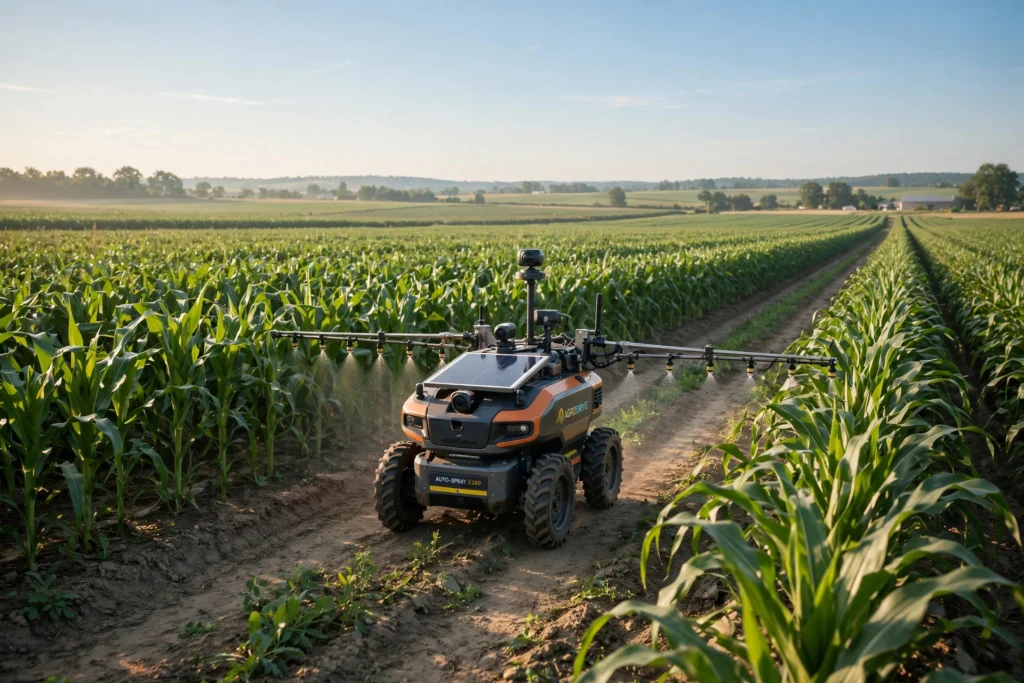
Crop spraying robots work by driving themselves through crop rows, using cameras and sensors to tell crops apart from weeds, then opening only the nozzles above the plants that need treatment. A computer on board decides how much spray each spot gets, so the field gets the protection it needs with far less chemical than a blanket tractor spray.
Key Takeaways
- A crop spraying robot spots weeds and sick plants with cameras, then sprays only those spots instead of the whole field.
- Precise GPS, row-following cameras, and wheel sensors keep it centred between the rows.
- Each nozzle switches on and off on its own, so the dose changes plant by plant.
- The robot carries its own tank, pump, and battery, and returns to refill or recharge when it runs low.
- They suit neat rows and flat ground best, and still need a person to plan, check, and maintain them.
How does a crop spraying robot know what to spray?
It starts with sight. Cameras mounted low on the robot photograph the plants passing underneath, several times a second. Software trained on thousands of labelled images compares leaf shapes, colours, and sizes, and works out which plants are the crop and which are weeds. Row geometry helps too: when a crop is planted in straight, even rows, anything growing between the rows is almost certainly a weed.
It is not perfect. When the software is unsure about a plant, most robots leave it alone and flag it on the field map for a person to check later. Like other agricultural robots, a spraying robot earns trust by being careful, not by being bold.
What parts make a spraying robot work?
A spraying robot is really three machines in one: a vehicle, a set of eyes, and a sprayer. The vehicle is usually a small four-wheeled base with a battery, built low to pass under leaves. The eyes are its cameras and sensors: plant cameras, depth sensors, and a satellite receiver that places the robot to within a few centimetres. Wheel sensors measure distance travelled, and laser scanners watch for obstacles. Britannica’s robotics overview explains the sensors and control systems these machines share.
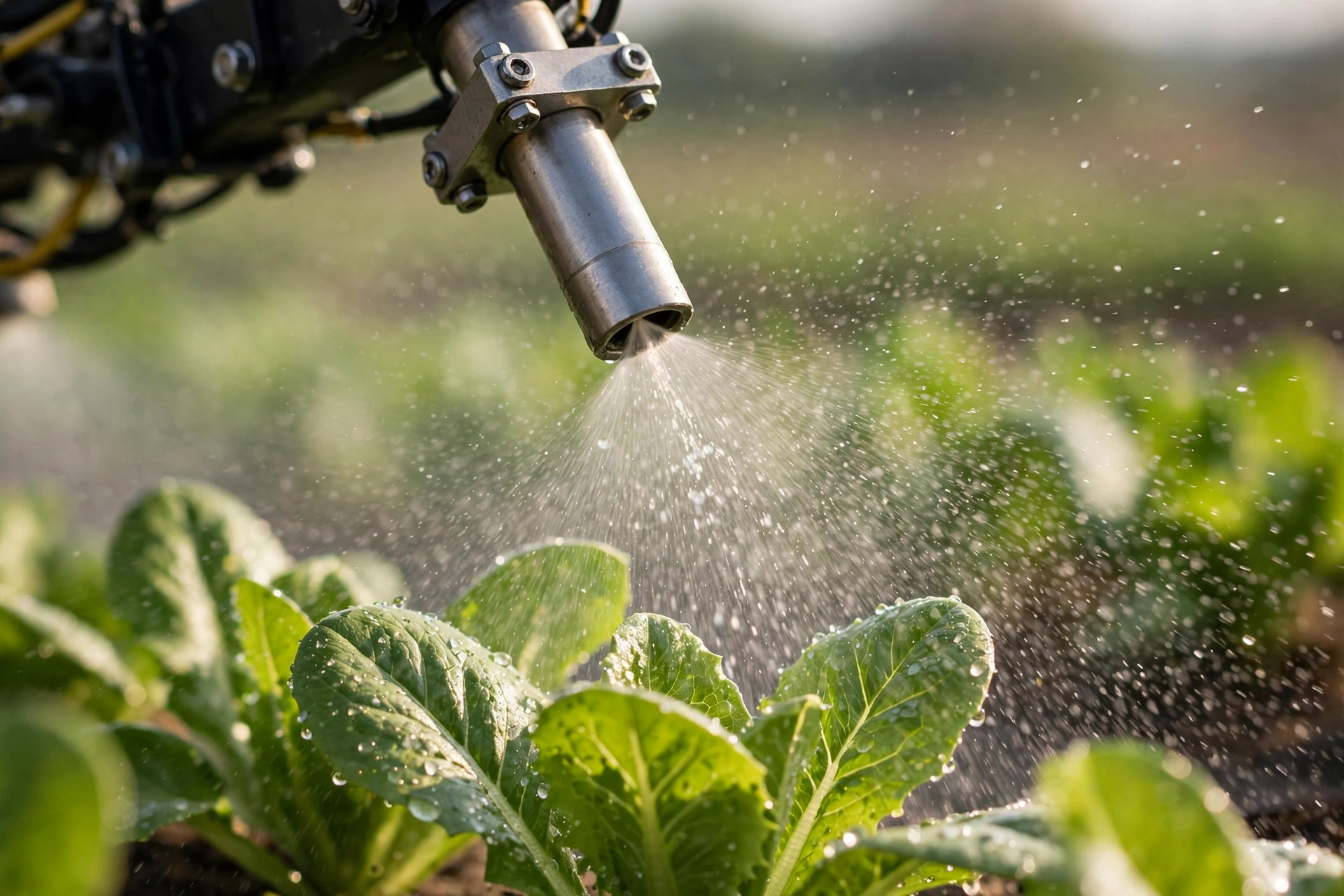
The sprayer is the working end: a tank, a pump, pipes, and a boom carrying the nozzles. The pump pushes liquid to the nozzles at steady pressure, and small valves open and close each nozzle in a fraction of a second. Nozzles shape the liquid into droplets of a chosen size — fine ones cover a leaf evenly, coarser ones drift less in the wind.
How precise is the spraying, really?
Precision works at two levels. First, where the spray lands: each nozzle switches independently, so the robot can spray a weed and skip the crop plant a few centimetres away. On a patchy field, most of the ground may get no spray at all on a given pass.
Second, how much is applied: the robot changes the dose with its speed and valve timing, so a heavy weed patch gets more than a light one. This differs from weeding robots, which pull or zap weeds without chemicals — a spraying robot still uses a chemical, just far less of it, and only where needed.
Precision has limits. Wind can carry fine droplets sideways, so many robots stop in strong gusts or switch to coarser droplets. Bumpy ground shakes the boom and changes nozzle height. And a camera can only judge what it can see: a weed hidden under a crop leaf is missed until the next pass. The best results come from running the robot often, while weeds are still small.
What happens when the tank runs out or the battery dies?
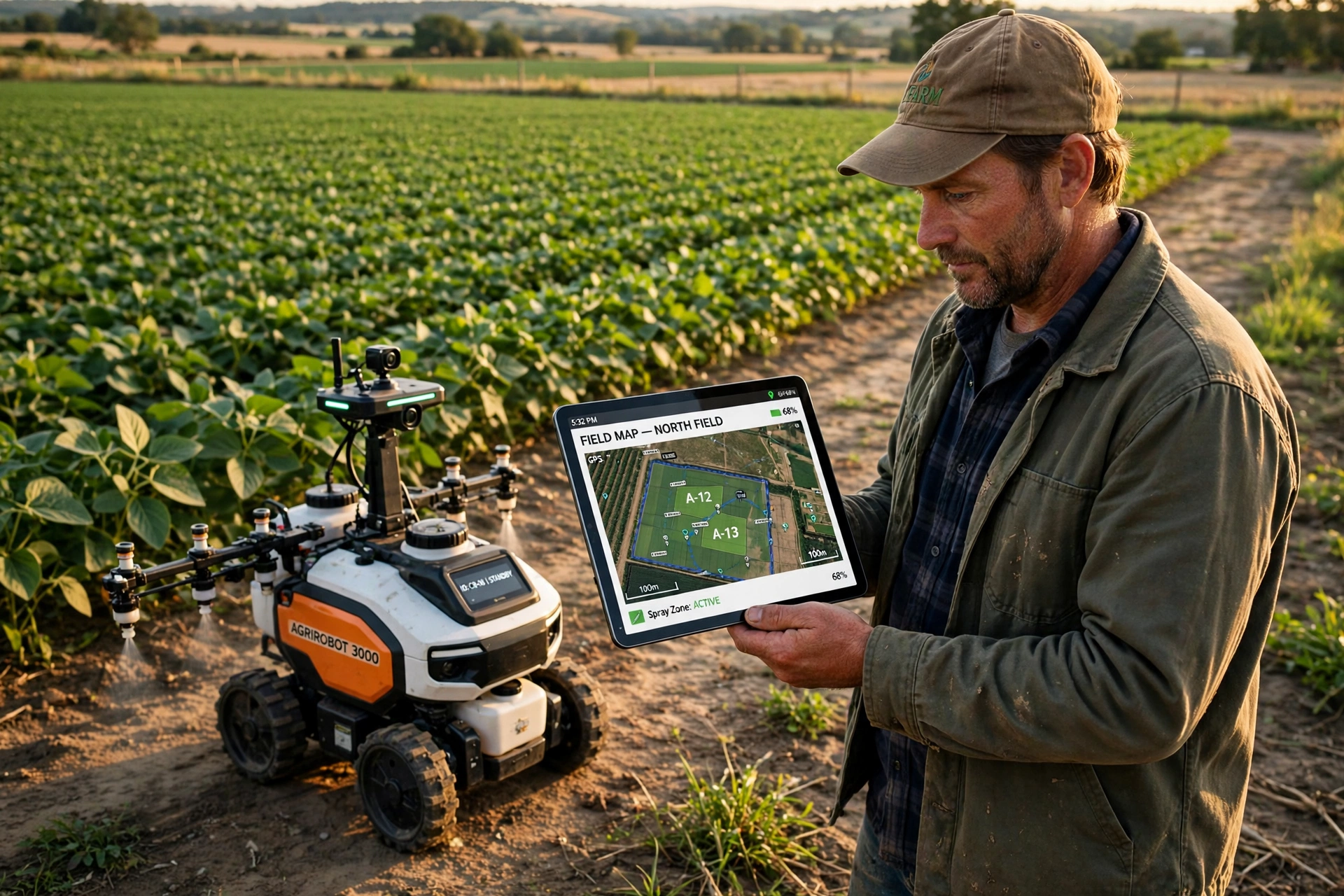
The robot tracks both. Tank sensors measure the liquid left, and the battery is watched the same way. When either gets low, the robot stops or drives itself back to the field edge and sends an alert to the farmer’s phone or tablet.
Refilling is a person’s job: top up the tank, swap or charge the battery, and check the nozzles for clogs before sending it out again. The robot remembers where it stopped, so the next run picks up from the same row. Cleaning matters too — leftover spray can clog a nozzle, so most machines are flushed with clean water at the end of the day.
Are spraying robots safe for crops, people, and the environment?
Used properly, they are safer than blanket spraying in three ways: less chemical overall, because only the spots that need it are treated; spray aimed low, close to the plants, which cuts drift onto neighbouring fields and waterways; and nobody walking the rows with a sprayer, so the operator spends less time near chemicals.
Safety still depends on the person in charge, who chooses the product, dose, and weather window; local rules about buffer zones near water still apply. A robot does not remove those responsibilities, it just makes them easier to follow. The machine should also stop when it detects a person in its path, and most models have a clear emergency stop button.
Cutting chemical use is a real benefit, but spraying robots do not make farming chemical-free. Some growers pair them with mechanical weeding or crop rotation to reduce spraying further — the robot is a tool for using less, not a reason to stop thinking about what is sprayed.
Where do spraying robots work best — and where do they struggle?
They work best where the field is kind: flat ground, straight rows, one crop at an even height, and good satellite coverage. Market gardens, vegetable fields, and wide-row orchards are the natural home, and they suit farms that spray often, since frequent light passes keep weeds small.
Rough ground is the main enemy: steep slopes, deep ruts, and mud can throw off steering or clog wheels, and tall crops block the cameras’ view below. Dust coats lenses too, and a camera that cannot see clearly cannot judge a plant.
Cost is the other honest limit: a capable robot is a serious purchase, needing charging, maintenance, software updates, and someone who can fix it mid-season. That is why some companies sell spraying as a service, charging per acre, so a small farm can try it without buying the machine.
FAQs
Can a spraying robot tell a weed from a crop?
Yes, usually. Cameras and software compare leaf shape, colour, and position, and row geometry helps: plants between the rows are almost always weeds. When unsure, most robots leave the plant alone and flag it for a person to check.
How much chemical does a spraying robot save?
It varies a lot. On a field with patchy weeds, a robot spraying only the weed spots can use far less than a tractor spraying everything. The saving shrinks on a badly weeded field. Ask for a trial on your own field before trusting any figure.
Do spraying robots replace tractor sprayers?
Not yet, and not everywhere. A tractor sprayer covers a large field far faster, which matters when a whole crop needs treating at once. A spraying robot is slower but more precise, suiting regular passes on weed patches and high-value crops.
Can small farms use spraying robots?
Sometimes. Small machines for market gardens exist, and some companies offer spraying as a service charged per acre, lowering the upfront cost. The case is strongest where hand weeding is expensive and rows are neat; rough, sloping ground makes it harder to justify.
What happens in rain or wind?
Rain washes spray off leaves and turns soil to mud, so most robots stop in heavy rain. Wind carries fine droplets off target, so the robot pauses or switches to coarser droplets. Calm, dry days are the best spraying weather, for robots and people alike.
Conclusion: start with one field, not the whole farm
Crop spraying robots work by combining simple ideas — cameras that spot the target, precise steering, and nozzles that open only when needed — into a machine that treats weeds one plant at a time. They are slower than a tractor sprayer and do not suit every field, but for neat rows they can cut chemical use in a real way. They sit alongside other farm machines: fruit picking robots handle delicate produce, and pollination robots visit flowers one bloom at a time. For background, see the Wikipedia article on agricultural robots.
If you grow crops in neat rows, the practical next step is a small trial: one field, one weed problem, one season. Compare what the robot uses against your usual sprayer, and let that season’s results, not a brochure, decide whether it earns a permanent place.