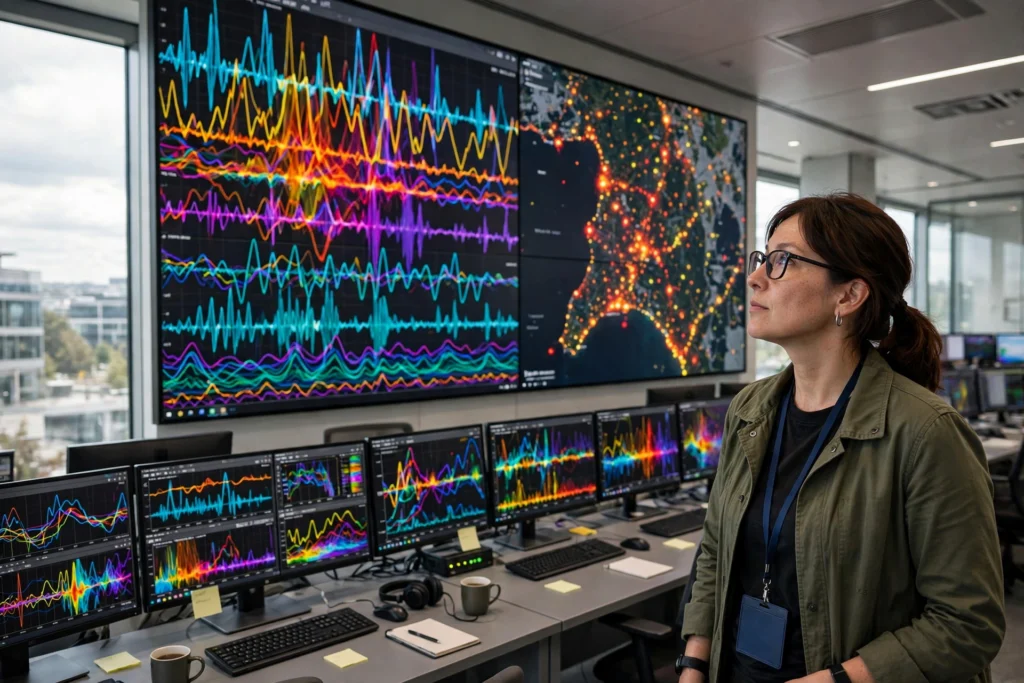
No — not in the way most people mean it. No AI system today can tell you that a magnitude 6.5 earthquake will strike a city next Tuesday at 3 p.m. But AI is improving at two nearby jobs: spotting faint signals that sometimes precede a quake, and giving people a few extra seconds of warning once one has started.
Key Takeaways
- A true prediction needs date, time, place, and magnitude — and no system delivers all four reliably.
- In a 2023 trial in China, a University of Texas AI forecast 14 of 15 earthquakes a week ahead, but also raised eight false alarms.
- AI’s most useful job today is early warning: detecting a quake’s first waves and alerting people seconds before the strong shaking arrives.
- The models learn from years of seismic recordings and lab experiments on stressed rock.
Why is earthquake prediction so hard?
An earthquake happens when stress built up along a fault finally wins, and rock slips. The trouble is that the fault is kilometres underground, out of sight, and the forces involved are tangled in ways scientists still don’t fully understand.
The US Geological Survey puts it bluntly: no scientist has ever predicted a major earthquake, and it doesn’t expect that to change soon. Its scientists can only calculate the probability of a significant quake in a given area over a number of years — a hazard map for building codes, not a warning to leave the house on Thursday. Weather forecasts work because the atmosphere is visible and measured constantly; the inside of the Earth is not.
What did the UT Austin trial actually show?
The most encouraging result so far came from the University of Texas at Austin. Their AI was trained on five years of recordings from 150 monitoring stations in southwestern China, a system called AETA that records acoustic and electromagnetic signals from the ground.
During a seven-month live trial in 2021, the AI forecast each week which earthquakes might happen and how strong they would be. It correctly predicted 14 of the 15 that occurred, each within about 200 miles of its estimated location. It missed one quake — and predicted eight that never happened.
Seventy per cent correct, a week in advance, is a real milestone — the team came first out of 600 entries in an international competition. But eight false alarms in seven months is a real problem: a warning system that cries wolf too often gets ignored. And the trial covered just one region of China; nobody yet knows whether the same approach works elsewhere.
How does AI look for warning signs?
The UT Austin model listened for statistical bumps in the Earth’s background rumblings — patterns too subtle for a person to track. It pulled 95 features from every ten minutes of sensor data, then used a machine learning model called a random forest to decide whether a quake was likely in the coming week.
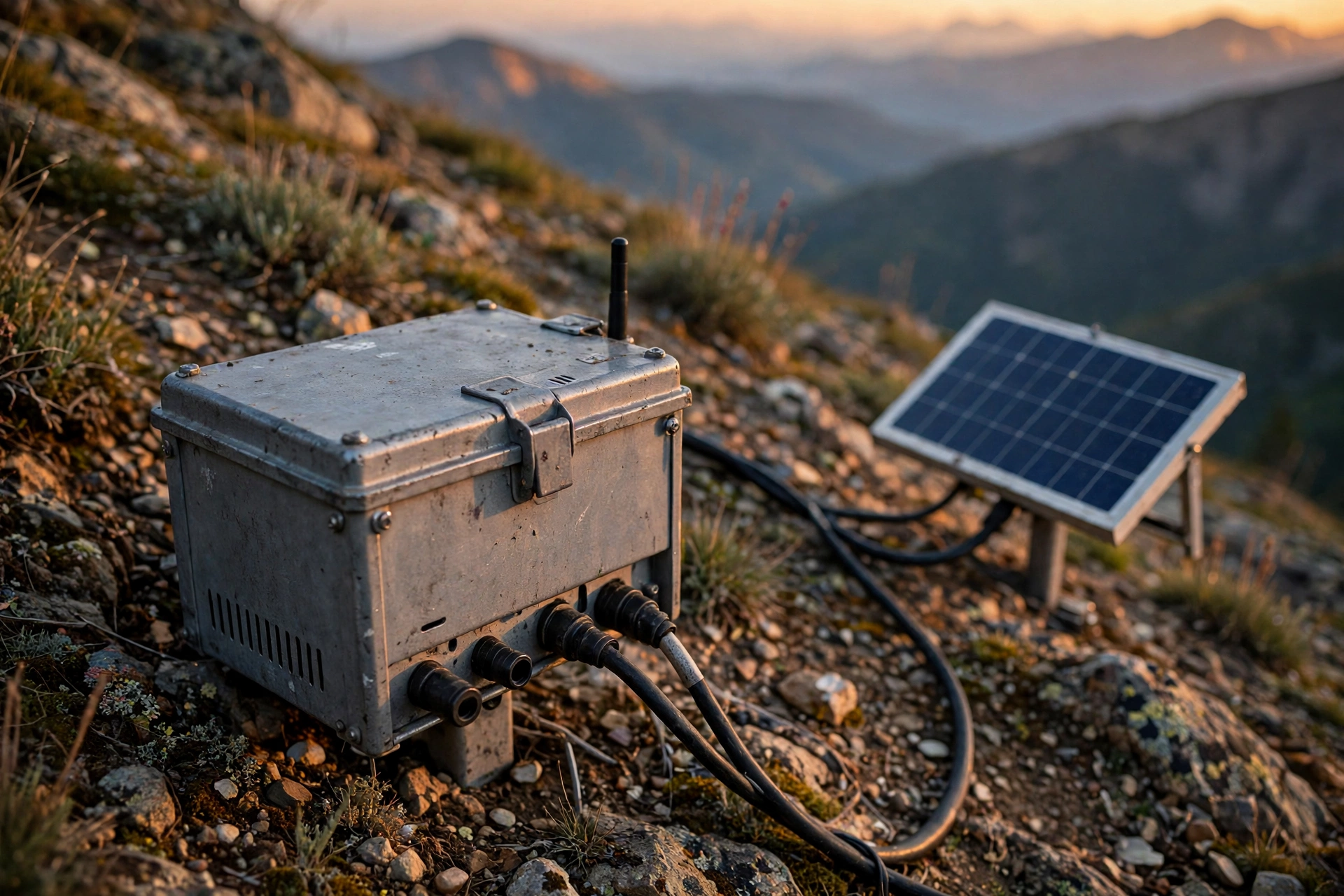
Other teams teach AI in the lab. At Los Alamos National Laboratory, researchers squeeze pieces of rock until they fracture, creating tiny artificial earthquakes, and record the faint acoustic signals the rock gives off as it strains. Signals once dismissed as noise turned out to predict when the rock would slip.
A third strand of work doesn’t try to predict quakes at all. It uses deep learning to read seismic waves faster once a quake has begun, so warnings reach people sooner — a 2025 model called ENGINet, for example, estimates ground-shaking intensity from raw sensor data in real time.
Prediction, forecasting, and early warning: what’s the difference?
These three words get mixed up constantly, and the confusion is half the reason headlines about AI and earthquakes mislead:
| Approach | What it promises | Where AI stands |
|---|---|---|
| Prediction | The exact date, time, place, and size of a quake | Not possible today; one promising trial, not yet repeated elsewhere |
| Forecasting | The odds of a quake in an area over weeks or years | Improving; AI finds patterns in seismic data that sharpen the odds |
| Early warning | Seconds of warning after a quake has started | Working now; AI makes it faster and more accurate |
Early warning is the quiet success story. When a quake starts, fast, weak P-waves arrive first, followed by slower, damaging S-waves. Sensors near the epicentre detect the P-waves, and automated systems can then alert phones, slow trains, and shut off gas lines before the shaking arrives further away. Systems in Japan, Mexico, and parts of the US west coast already give people roughly 30 to 60 seconds to take cover — and AI helps by reading those first waves faster.

Forecasting sits in the middle: it can’t name the day, but it can say a fault is more likely to slip this year than last, or where aftershocks will cluster. AI helps by chewing through decades of recordings for correlations traditional models miss.
Where is AI already helping today?
Beyond the headline trials, AI is doing practical work in seismology right now. It sorts through the flood of data from seismic networks and picks out real earthquakes from the noise of traffic, construction, and ocean waves. It maps aftershocks quickly after a major quake, which helps rescue teams decide where to look first. And it helps estimate damage: by combining shaking data with maps of buildings and soil, models can sketch out which neighbourhoods are likely worst hit before survey teams arrive.
What would it take before we trust an AI forecast?
Three things need to happen before an AI earthquake forecast could be trusted like a weather forecast. First, the results need repeating in other places — California, Italy, Japan, Greece, Turkey — with the same success rate. Second, false alarms need to come down sharply; a system that warns eight times for quakes that never happen will be switched off. Third, scientists need to understand why the model works, not just that it works. AI has turned earthquake prediction into a genuine research frontier — but solvable in principle is a long way from a warning you can set your watch by.
Frequently Asked Questions
Can AI predict earthquakes today?
No, not reliably. No system can give the date, time, place, and magnitude of a future quake. The best results so far are weekly forecasts in one region — with false alarms.
What was the UT Austin earthquake AI?
An AI trained on five years of seismic data from 150 stations in China. In a seven-month trial it predicted 14 of 15 earthquakes a week ahead, but also gave eight false warnings.
How much warning do earthquake early warning systems give?
Usually 30 to 60 seconds, once a quake has started. Sensors detect the first, fast seismic waves and alert areas further away before the stronger shaking arrives.
Why can’t AI just learn from past earthquakes?
It can — and does. But big earthquakes are rare, so there aren’t many examples to learn from, and every fault behaves a little differently.
What should I do if I live in an earthquake zone?
Know your local alert system and switch its notifications on. Practise drop, cover, and hold on. Keep a small emergency kit — water, a torch, a first-aid kit — somewhere you can reach quickly.
The bottom line
AI can’t predict earthquakes yet. What it can do is listen harder than any human to the ground’s faint signals, give us a few more seconds of warning when a quake starts, and sharpen the odds for the weeks and years ahead. That’s real progress — just not a crystal ball. The most useful thing you can do today is to check whether your phone’s earthquake alerts are on, and to know what you’ll do in the first ten seconds after one sounds.
Further reading: UT Austin — AI-Driven Earthquake Forecasting Shows Promise in Trials and AVEVA — Predicting earthquakes with AI