
If you have ever wondered how a soundbar works, the answer is refreshingly simple. It takes over from your TV’s built-in speakers: the TV sends its audio to the bar over a single HDMI cable, a processor splits the sound into channels, and each channel goes to its own amplifier and driver.
Key Takeaways
- A soundbar packs several speakers, amplifiers and a sound processor into one slim cabinet under your TV.
- It connects with one cable, usually HDMI ARC or eARC, though optical works too.
- Clearer dialogue comes from a dedicated centre channel, not from turning the volume up.
- Bass comes from a subwoofer; the best bars pair with a separate wireless one.
- Placement matters: blocked drivers ruin the effect.
Why TV speakers sound so thin
Modern TVs are a triumph of thinness, and that is exactly the problem. A flat panel leaves almost no room for a speaker, so makers fit tiny drivers that fire backwards or downwards. The result is familiar: muffled dialogue, hollow music, and action scenes with no weight.
A soundbar fixes the geometry. It puts the speakers back where they belong — facing you, at ear height, under the screen. The bar is long and shallow, wide enough to hold several drivers spread across the TV’s width, yet slim enough to sit on the stand or hang on the wall. Our guide to how a smart TV works covers the screen itself; the bar takes care of everything you hear.
The three-stage journey of TV sound
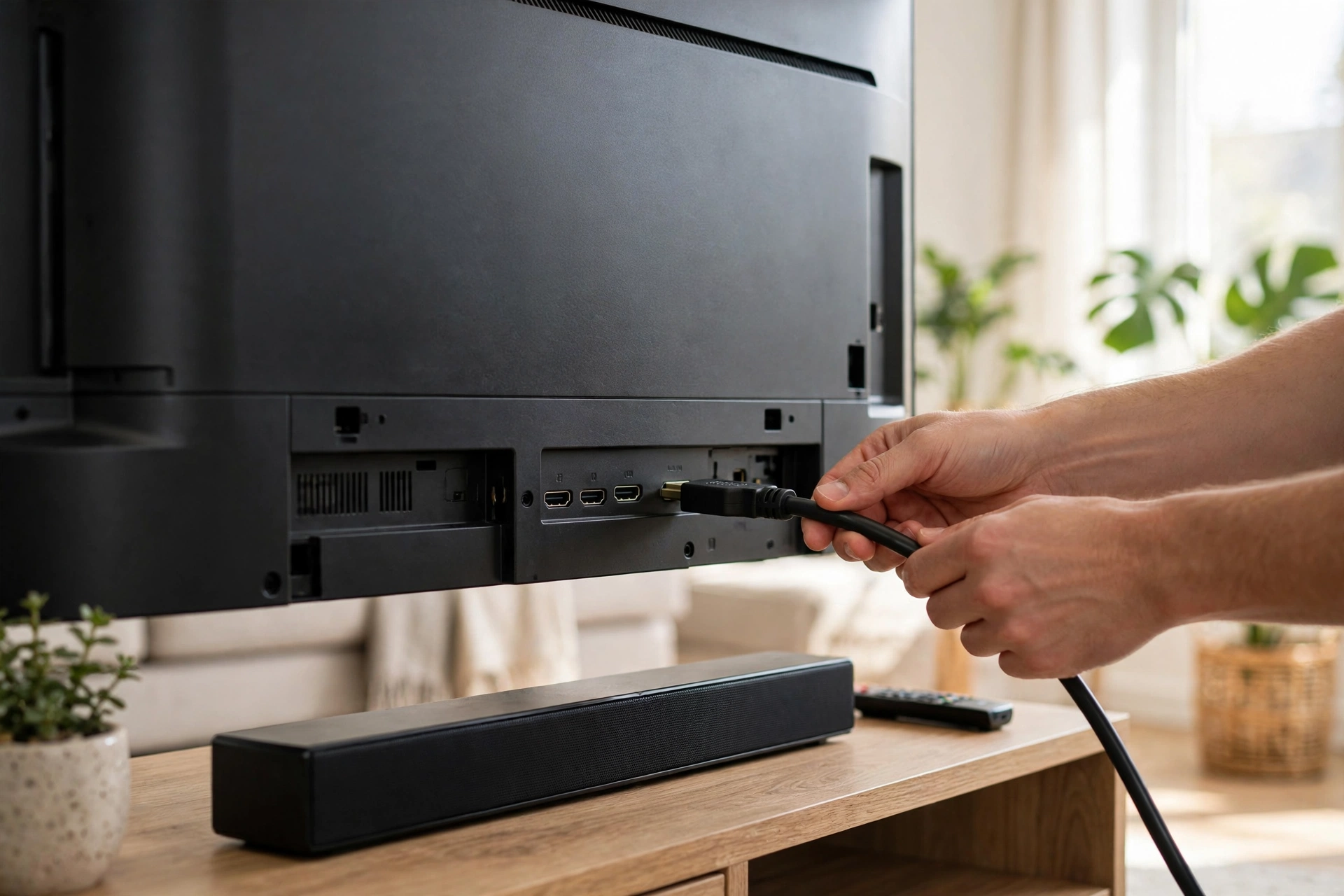
Everything a soundbar does happens in three stages. First, the TV sends its audio out, usually through a single HDMI cable plugged into a port labelled ARC or eARC — audio return channel. Older TVs use an optical cable instead, which does the same job with light rather than copper.
Second, the bar’s processor takes that signal apart. It decodes the format the TV sent — stereo, surround, or Dolby Atmos on better models — and splits it into separate channels: left, right, centre, and the low-frequency channel for bass. It also applies small delays and balance tweaks so the sound feels wider than the cabinet it comes from.
Third, each channel goes to its own amplifier and driver. An amplifier gives the signal enough power to move a speaker cone; in a soundbar the amplifiers are built in, so the bar needs its own power cable but no separate receiver box. Each driver then turns its channel’s signal into sound waves.
Inside the bar
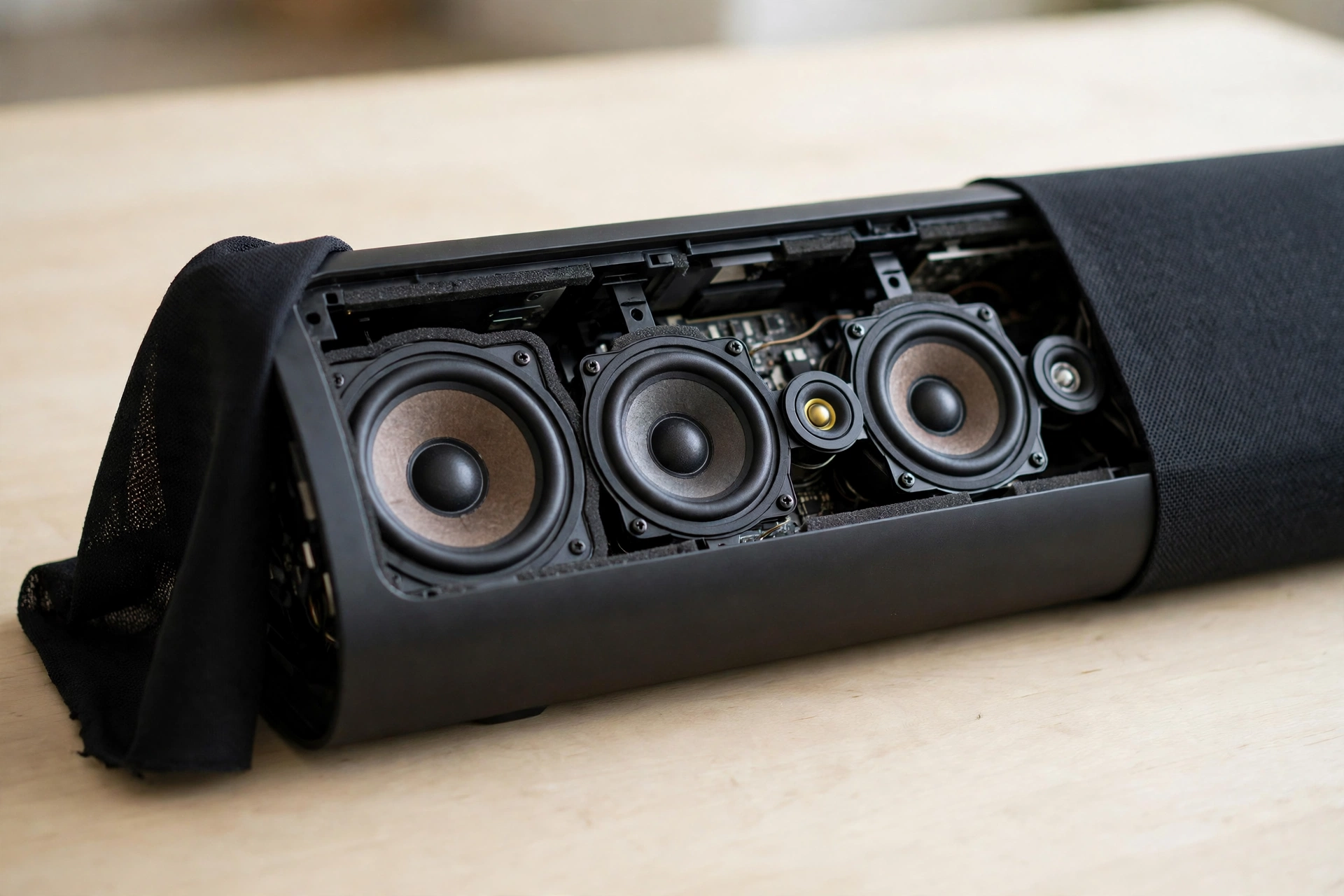
Open up a soundbar — figuratively, please — and you will find three kinds of driver doing three different jobs. Tweeters handle high frequencies, like the hiss of a cymbal. Mid-range drivers are the workhorses, carrying most of the dialogue and music. Woofers handle the low end, though small ones can only go so far, which is where a subwoofer comes in.
Most bars hold between two and four drivers, covering the left, right and centre channels. The centre channel carries almost all the dialogue in films and TV. A dedicated centre driver is the single biggest reason voices suddenly become easy to follow once a soundbar is plugged in. The principle is the same one behind a desktop computer speaker, just scaled up and spread across the width of your TV.
The processor is the part you never see, but it does the most interesting work. It decodes the incoming audio, balances the channels, and on many bars runs a room-tuning feature: a short test tone played through a microphone, used to measure the room and adjust the sound to suit it.
Where the bass comes from
Bass is the one thing a slim bar struggles with, because deep sound needs a big speaker cone moving a lot of air, and a slim cabinet has no room for one. Cheaper bars build small woofers into the cabinet and do their best with digital processing: better than a TV, but still thin on explosions and music with real low end.
Better bars come with a separate wireless subwoofer — a boxy speaker, usually on the floor near the TV, that receives the bass channel over a wireless link and does nothing else. If you watch a lot of films, the subwoofer is worth paying for: dialogue clarity comes from the bar, and the rumble comes from the box on the floor.
The wide-sound trick
A good soundbar sounds wider than it is, thanks to a trick borrowed from cinemas. Some drivers fire sideways, bouncing sound off your side walls so it arrives at your ears a fraction later, from the side rather than the front. Your brain reads that delay as width, and the soundstage stretches beyond the edges of the TV.
Bars with Dolby Atmos add drivers that fire upwards. Their sound bounces off a flat ceiling and comes back down, which your brain reads as height — rain falling from above, a helicopter passing overhead. It works best with a flat ceiling between about 2.3 and 4.3 metres high. None of this replaces a full set of surround speakers, but it gives a convincing sense of space from a single box.
Plugging it in
Setup is one of the soundbar’s real strengths: a single cable and a power plug. Connect the bar’s HDMI output to the TV’s HDMI ARC or eARC port, switch the TV’s audio output to the external speaker, and you are done. The TV remote will usually control the bar’s volume through the same cable.
If your TV has no ARC port, an optical cable is the fallback. It carries the same sound, though it cannot carry the highest-quality formats or let the TV remote control the bar. Check which ports your TV has before you buy.
Bluetooth is available on many bars too, handy for playing music from your phone, but it is a poor choice for TV sound, because the slight delay puts lips out of sync with words. Some bars also include a voice assistant, much like a smart speaker, so you can change the volume or start music without reaching for the remote.
Getting the placement right
Centre the bar under the TV, at roughly ear height when you are sitting down, with nothing in front of the drivers. A soundbar tucked behind a row of books or a games console sounds muffled, because the sound hits the clutter before it reaches you. If the bar has up-firing drivers, keep the space above it clear too — a shelf directly overhead blocks the ceiling bounce that creates the height effect.
If you have a wireless subwoofer, try it in a few spots. Corners make bass louder and boomier; pulling it a short distance out from the wall usually tightens it up. Trust your ears and move it until films sound right.
Choosing the right bar for your room
You do not need the most expensive bar, but you do need the right one for your room. A small bedroom is well served by a simple two-channel bar; a large open-plan living room needs more power and probably a subwoofer. Measure your TV stand first — a bar wider than the stand looks awkward.
Check the connections before you buy: does your TV have HDMI ARC or eARC? If it only has optical, make sure the bar you pick has an optical input. And listen to dialogue if you can: play a quiet conversation over background music and see whether you can follow every word. That test tells you more than any specification sheet.
FAQs
Do I need a subwoofer with a soundbar?
Not always, but it makes the biggest difference to films and music. A bar on its own improves dialogue and clarity; a subwoofer adds the deep bass a slim cabinet cannot produce. If you mostly watch news, skip it; if you watch films, buy the bundle.
Is HDMI ARC better than optical for a soundbar?
Yes, for most setups. HDMI ARC carries higher-quality audio formats, lets your TV remote control the bar’s volume, and needs only one cable. Optical is a solid fallback, but it cannot carry Dolby Atmos.
Will a soundbar work with any TV?
Almost any TV made in the last decade will work, as long as the bar and the TV share a connection — HDMI ARC, eARC or optical. Check the ports on the back of your TV before buying.
Can a soundbar replace a full surround sound system?
It can replace the front speakers and give a convincing sense of width and height, but it cannot truly match separate rear speakers placed behind you. For most living rooms, that trade is worth it.
Why does my soundbar sound quiet even at high volume?
The usual cause is a mismatch in settings, not a faulty bar. Check that the TV’s audio output is set to the external speaker rather than its own speakers, and that any night mode or volume-levelling setting is switched off. Also check nothing is blocking the drivers.
Conclusion
A soundbar is the simplest meaningful upgrade you can make to a TV. It takes the thin, distant sound of built-in speakers and replaces it with clear dialogue, real bass and a sense of space, all from one slim box and one cable. Before you buy, check your TV’s ports and measure your stand. Then plug it in and centre it under the screen — your next film night will sound like a different room.