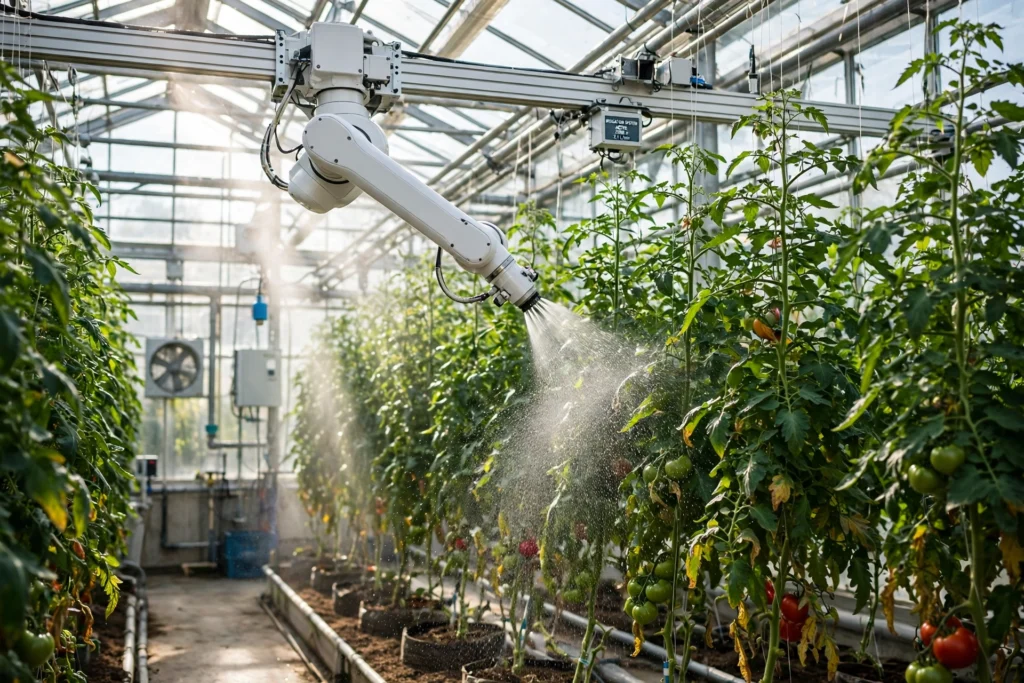
A greenhouse robot is a machine that works inside a glasshouse, watering plants, checking their health, and picking ripe fruit. It moves slowly along the rows, uses cameras and sensors to tell a ripe tomato from an unripe one, and follows a map so it never crushes a plant. It does the repetitive jobs that take growers hours.
Key Takeaways
- Greenhouse robots handle slow, repetitive jobs: watering, scanning crops, pruning, and picking.
- Cameras and sensors judge ripeness, spot disease early, and check how much water each plant needs.
- Most move on rails, wheels, or a fixed track between the rows, following a map of the building.
- They work best with one crop in neat rows, such as tomatoes, cucumbers, or strawberries.
- People are still needed for decisions, repairs, and jobs the robot was not built to do.
What jobs can a greenhouse robot actually do?
A greenhouse is a controlled space, which makes it a good home for a robot. The rows are straight, the floor is flat, and the temperature stays fairly steady — very different from an open field, where mud, wind, and uneven ground make a robot’s life much harder.
Inside the glasshouse, robots take on the jobs that repeat every day. Some carry a sprayer and water each plant with just the amount it needs. Others roll along the rows with cameras, photographing leaves so software can flag stress or disease. A few cut away dead leaves, and the most advanced ones pick ripe fruit and place it gently in a tray. One machine rarely does all of this. For a broader view of the field, see Britannica’s robotics overview.
How does a greenhouse robot move around without damaging plants?
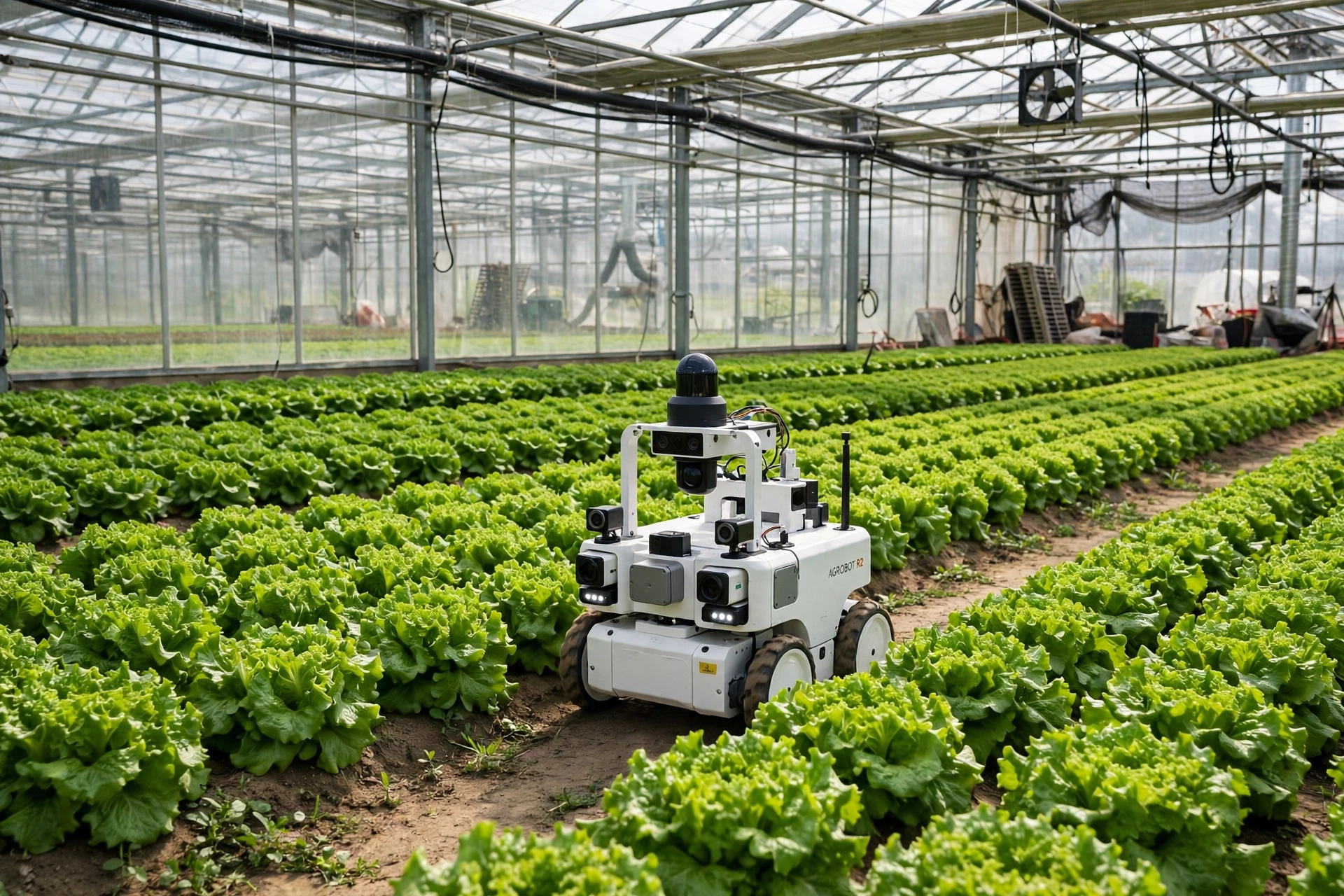
There are three common ways a greenhouse robot gets about. The simplest is a rail fixed above the rows, which a spraying or picking arm slides along. The second is a wheeled base that drives slowly down the path between two rows, steering with a map and sensors. The third is a track set into the floor, which keeps the robot on a fixed line and out of the plants.
Whatever the method, the robot knows where it is at all times. Before its first shift, someone maps the rows, turning points, doors, and charging station. The robot follows that map, and its sensors watch for anything unexpected, such as a hose on the path or a worker stepping into the row. If it meets an obstacle, it stops and waits rather than pushing through — a single wrong turn can flatten a row of young plants.
How does a robot know when a tomato is ripe?
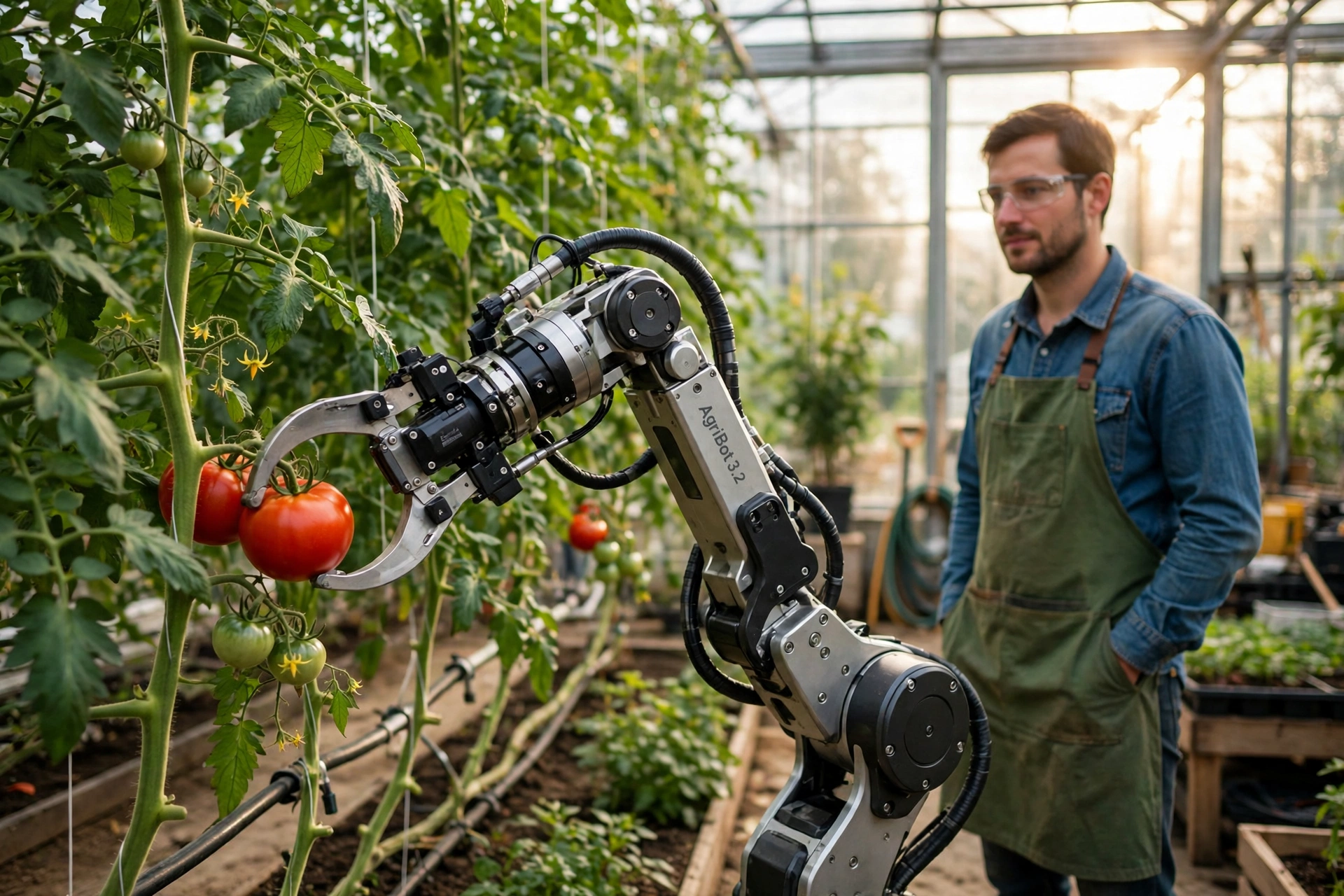
Ripeness is mostly a colour and size question, and cameras are good at both. The robot photographs each fruit, and software compares the colour against what a ripe tomato should look like. A deep red tomato is ready; a green one is left for another day.
This is harder than it sounds: light changes through the day, leaves hide fruit, and two tomatoes on one plant ripen at different speeds. So picking robots pass the same row several times a week, taking only what is ready. A person can pick faster, but the robot can work through the night without tiring.
How does a robot pick fruit without bruising it?
A robot cannot just grab a tomato the way you would in a supermarket. Its gripper is built for the job: soft fingers, a gentle suction cup, or a small cutter that snips the stem instead of pulling. The gripper closes just enough to hold the fruit, then twists or cuts it free and places it in a tray.
Force sensors keep the grip short of bruising pressure, and the arm moves slowly. Even so, soft fruit such as strawberries and raspberries remains a challenge, and many picking robots are still limited to firmer crops such as tomatoes, cucumbers, and peppers. For background on how farm robots developed, see the Wikipedia article on agricultural robots.
What about watering, pruning, and pollination?
Watering is one of the easiest jobs to automate. Sensors in the soil or on the plants report how dry things are, and the robot delivers water to the plants that need it, rather than soaking the whole row.
Pruning is trickier. Cutting away a dead leaf sounds simple, but the robot has to tell a dead leaf from a healthy one and cut in the right place without harming the stem.
Pollination is another job robots are starting to help with. In a tomato greenhouse, a small robot can vibrate each flower, mimicking the buzz of a bee, so the flower sets fruit. Pollination robots, fruit picking robots, and seeding robots each cover one part of the growing cycle.
What are the limits of greenhouse robots?
Greenhouses suit robots better than open fields, but the limits are real. First, the robot only works well with crops grown in neat rows and at a steady height; a mixed bed of herbs will confuse it. Second, warm, humid air is hard on electronics, and condensation can fog cameras. Third, a picking robot is slow compared with a skilled worker, so it only pays for itself when labour is scarce or expensive. Finally, someone must clear jams and restart the system, and no robot judges quality like an experienced grower. The grower stays in charge; the robot is a helper, not a replacement.
FAQs
Do greenhouse robots work at night?
Yes, many do. Their cameras and sensors do not need daylight, and working at night lets them cover more rows without getting in the way of daytime staff. Growers often run watering and scanning overnight and save picking for the day.
Can a greenhouse robot work with any crop?
No. Most are built for one crop, such as tomatoes, cucumbers, strawberries, or lettuce. The gripper, camera settings, and picking pattern are all tuned to that crop, so switching to another usually needs new parts or software.
What happens if a greenhouse robot breaks down?
It stops safely and waits for help. Most systems send an alert to the grower’s phone, and a staff member can often fix it by clearing a jam or restarting the robot. For bigger faults, the supplier’s technician is called.
Will greenhouse robots replace farm workers?
Not entirely. They take over repetitive, tiring jobs such as watering and picking, but growers are still needed to plan, check quality, fix problems, and handle anything unusual. Most greenhouses use robots alongside people, not instead of them.
Conclusion: start with one small, repetitive job
If you run or work in a greenhouse, the practical next step is to pick one repetitive job that eats up hours each week, such as watering or scanning for disease, and look at a robot built for that single task. Ask for a trial in your own glasshouse, watch how it handles your rows and your crop, and check the cost against a season of hired help.