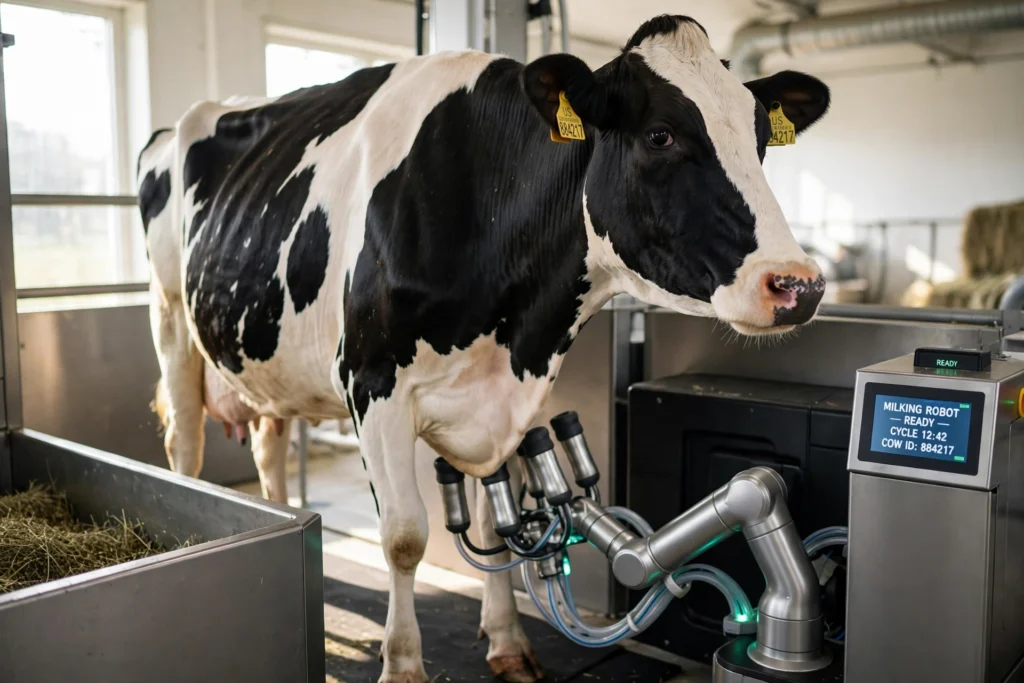
Milking robots work by letting cows choose when to be milked, identifying each cow automatically, and using a robotic arm, cameras, and sensors to clean the teats, attach the milking cups, monitor the milk, and release the cow without a person holding the equipment. Instead of a fixed milking time for the whole herd, a milking robot gives each cow its own visit, records what happened, and alerts the farmer only when something needs attention.
Key Takeaways
- Milking robots identify cows with an ear tag or collar transponder, so each visit is linked to the right animal and its history.
- A robotic arm finds the teats, cleans them, and attaches the cups gently, using lasers or cameras to guide the movement.
- Sensors check milk flow, yield, temperature, and quality during milking, and can divert milk that should not go into the bulk tank.
- Cows can visit more often than in a twice-a-day parlor, which can support comfort, routine, and steadier milk production.
- A milking robot still needs daily checks, cleaning, good cow traffic, and a plan for power, water, and service.
How Do Milking Robots Identify Each Cow?
When a cow enters the milking stall, the system reads its identification tag. That tag tells the robot who the cow is, when it was last milked, how much milk it usually gives, and whether it has any health or feeding notes. If the cow was milked too recently, the robot may offer a small feed reward and let it leave without milking. If it is due, the gate closes, the cow settles into position, and the milking routine begins. This individual record is one of the biggest differences from a traditional parlor, where the focus is on moving a large group through on a schedule.
The idea belongs to a wider family of farm automation. For a related example, see how agricultural robots use sensors and navigation for field work, and read the general background on robotics from Britannica.
How Do the Cups Attach to the Teats?
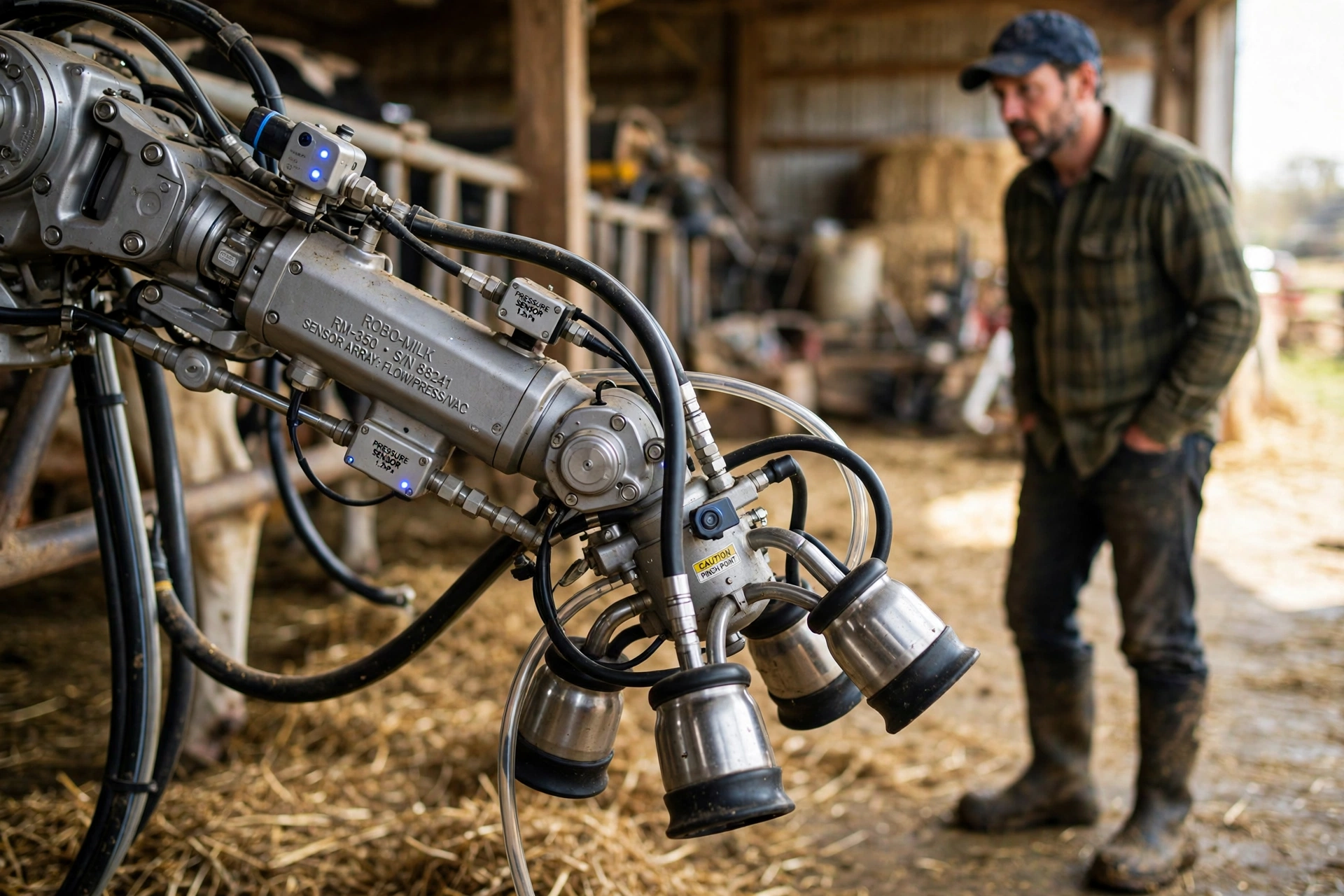
Attachment is the most delicate part of the job. First, the robot cleans each teat, often with brushes or a cleaning cup, and discards the first small amount of milk. Then a camera or laser scans the udder to build a three-dimensional picture of teat position. Because every cow is shaped a little differently, and because a cow may shift its weight, the arm must adjust in real time rather than follow one fixed path.
Once the position is confirmed, the robotic arm places a separate cup on each teat. Gentle vacuum draws the milk through the cup, while pulsation alternates pressure so the teat is not under constant suction. If a cup slips, the system can try again or stop that quarter and record the event. When milk flow from a quarter falls below a set level, the robot removes that cup on its own, so the cow is not over-milked. This careful, quarter-by-quarter control is similar in spirit to precision work in other fields, such as robot arms that must place tools accurately and adapt to small changes.
How Do Sensors Monitor Milk Quality and Cow Health?
While the cow is being milked, sensors measure yield, flow rate, milk temperature, and other indicators for each quarter. Unusual readings can point to a possible health issue, a change in feed, or a problem with the equipment. Many systems also track activity, rumination, and visits to the robot, which helps farmers spot a cow that is eating less, moving less, or visiting less often.
Milk that fails a quality check can be diverted away from the main tank. That protects the rest of the milk and gives the farmer a clear record to follow up. Over days and weeks, the data builds a picture of each cow, including yield trends, milking frequency, and behavior changes. The farmer still makes the management decisions, but the robot supplies far more frequent and consistent measurements than manual observation alone. Automatic milking is described in more detail on Wikipedia.
What Happens After Milking?
After the cups come off, the system often applies a teat dip to help protect the teats. The exit gate opens, the cow leaves, and the robot cleans and rinses the cups and lines before the next visit. Milk flows to a cooling tank, just as it does in a conventional dairy, where it is stored until collection. Meanwhile, the visit is logged: cow identity, start and finish times, yield by quarter, any alarms, and any milk that was diverted.
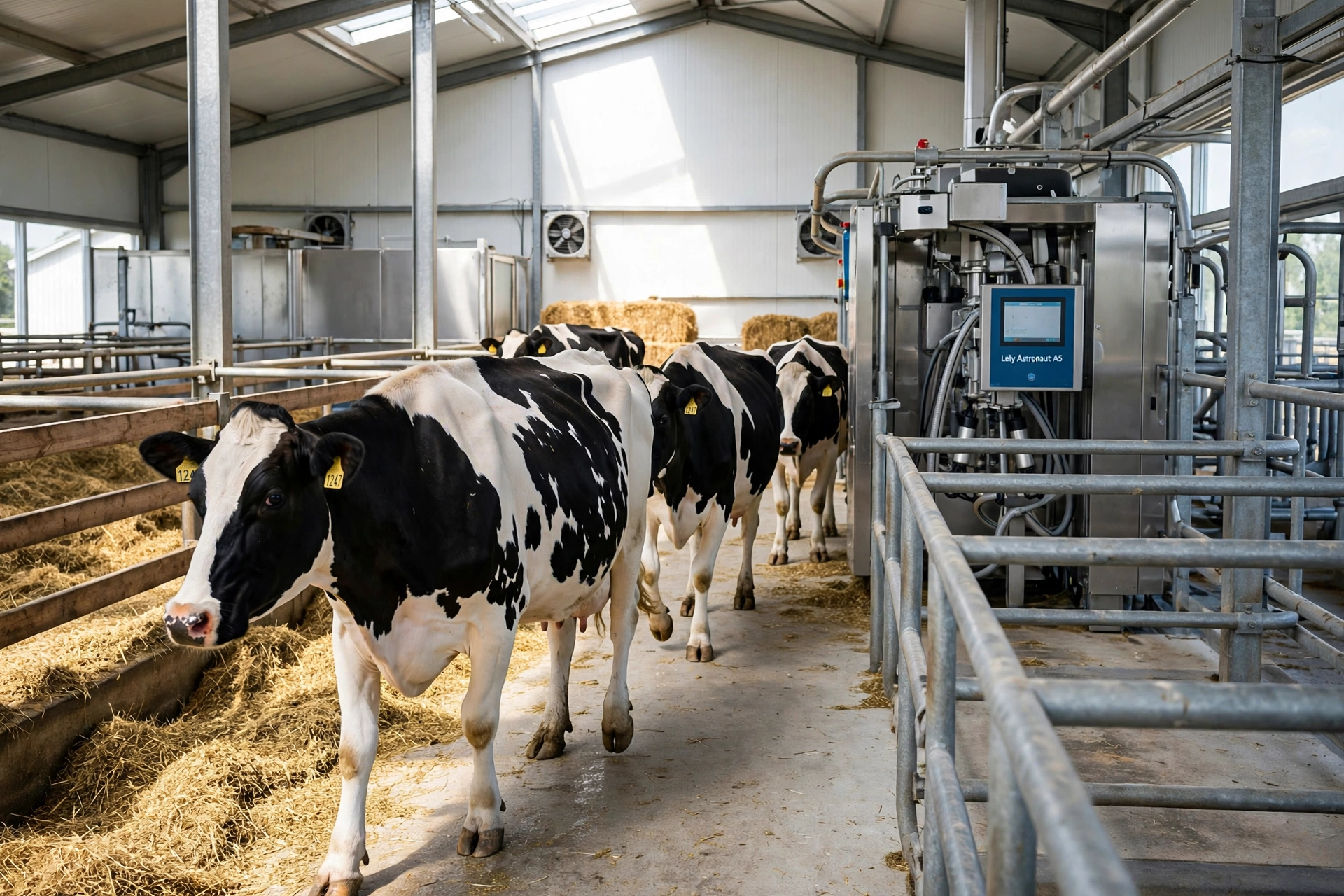
Because cows can visit around the clock, the barn needs clear routes. In a free-traffic layout, cows move between resting areas, feed, water, and the robot. In a guided layout, gates direct cows toward the robot at certain times. Either way, calm handling matters. Cows that feel rushed or crowded are less likely to visit willingly, so lighting, flooring, feed placement, and quiet routines all support the system.
What Are the Benefits and Limits of Milking Robots?
The main benefit is flexibility. Farmers are less tied to two or three fixed milking sessions, and cows can follow a more natural routine. Labor shifts from repetitive milking work to monitoring data, checking animals, maintaining equipment, and managing feed and housing. For some farms, that change improves work-life balance and makes it easier to manage a herd with fewer milkers.
There are limits too. A milking robot is a major investment, and it needs reliable electricity, clean water, service support, and spare parts. A breakdown during a busy period can affect many cows, so a backup plan matters. Robots also work best when cows are trained, the barn layout is suitable, and the herd is healthy and consistent. They do not replace good stockmanship: a farmer still needs to walk the barn, notice subtle changes, and handle sick or special-needs animals.
Similar trade-offs appear in other automated workplaces. Warehouse robots speed up repetitive movement but still need layout planning and maintenance, and construction robots can help with heavy or hazardous tasks while still relying on human supervision and site preparation.
What to Check Before Installing a Milking Robot
Before choosing a system, work through this checklist with your supplier, veterinarian, and electrician:
- Herd size and layout: confirm how many cows one robot can serve well for your breed, yield, and milking frequency.
- Cow traffic: plan routes for feed, water, rest, and the robot so cows can move calmly and willingly.
- Power and water: check supply, backup options, drainage, and cleaning routines for the robot and milk lines.
- Service and parts: ask about response times, routine maintenance, software updates, and local support.
- Data and training: make sure staff can read alerts, use the herd software, and train cows gradually.
- Total cost: compare purchase, installation, maintenance, consumables, and energy costs with your current labor and parlor costs.
- Animal health plan: agree how diverted milk, sick cows, fresh cows, and treated cows will be handled.
Frequently Asked Questions
Do cows like milking robots?
Many cows adapt well because they can choose when to visit and often receive feed during milking. Training, calm handling, and a comfortable barn help most cows learn the routine, although some individuals take longer than others.
How often can a cow be milked by a robot?
It depends on the cow, its stage of lactation, and the farm settings. Many herds aim for two to three visits per day, with the system deciding whether a cow is due based on time since the last milking and expected yield.
Do milking robots work at night?
Yes. A milking robot can run around the clock, which is one reason cows are not limited to fixed daytime sessions. The farmer still reviews alerts and checks the barn, but does not need to be present for every milking.
Can a milking robot detect illness?
It can flag warning signs, such as a drop in yield, a change in activity, or unusual milk readings. Those alerts help the farmer check the cow sooner, but they do not replace a veterinary examination or a diagnosis.
Is a milking robot worth it for a small farm?
It can be, but the answer depends on herd size, labor costs, barn layout, and service availability. A careful cost and layout review, plus a trial visit to a working farm, is the best way to judge whether the investment fits.
Conclusion
Milking robots work by combining identification, gentle robotic handling, and constant sensing. The cow arrives when it chooses, the system confirms its identity, the arm cleans and attaches the cups, sensors track milk and behavior, and the visit is recorded for the farmer. When the barn, herd, and support plan are right, that combination can reduce rigid milking schedules and give farmers better information about each cow. When any of those pieces is missing, the robot will still need close human attention. The technology is most useful when it supports good dairy management, not when it is expected to replace it.