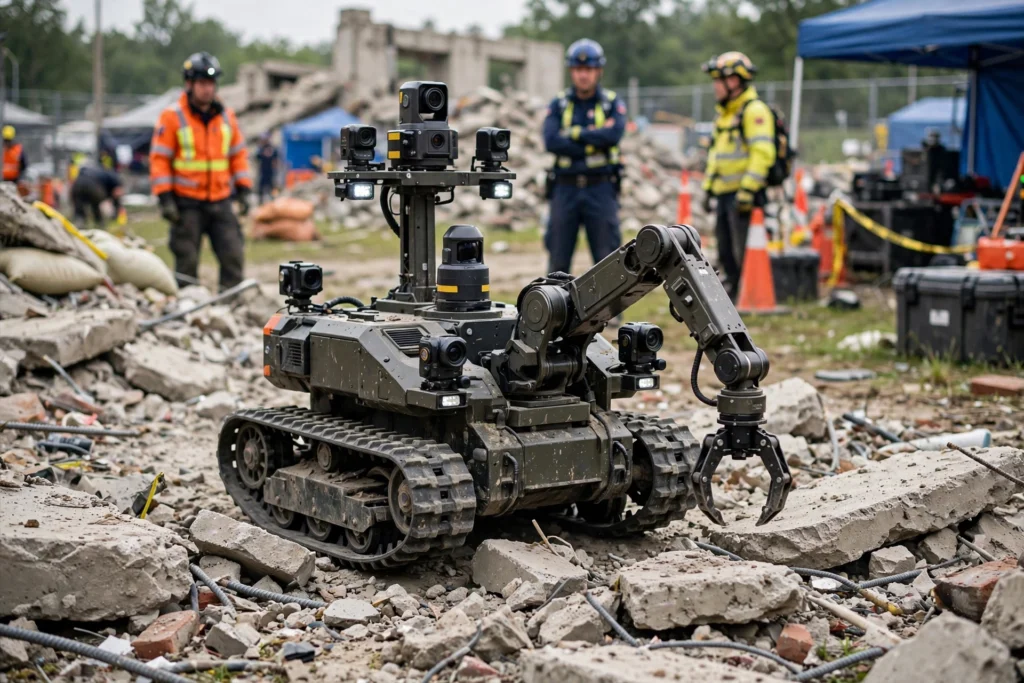
A rescue robot is a rugged machine that goes first into places too dangerous, narrow, or unstable for a person, usually after a collapse, flood, or fire. It crawls over rubble, sends back live video, senses for signs of life, and lets a trained operator decide next steps from a safer distance.
Key Takeaways
- Rescue robots are mainly search tools: they find and report, while human teams plan and carry out the rescue.
- Tracks, cameras, lights, and sensors let them enter rubble, voids, and smoke-filled spaces.
- Most are driven remotely by an operator, sometimes with help from semi-autonomous navigation.
- They can carry cameras, microphones, speakers, and small tools, but they cannot lift heavy debris.
- Dust, water, weak signals, and rough ground still limit them, so training and teamwork matter as much as the machine.
What exactly is a rescue robot?
Picture a tough, low-slung box on tracks, roughly the size of a large suitcase, with cameras on a mast, bright lights, and sometimes a small arm or gripper. Some are wheeled, some fly, and some swim, but the ground search robot is the most familiar type. It is built to be dropped, bumped, and dusted over, and to keep working in places where a phone or laptop would fail quickly. Its job is not to replace firefighters or search teams. Its job is to give them eyes, ears, and reach in the first risky minutes, when information is scarce and every wrong step could shift a pile of rubble.
How does a rescue robot move through rubble?
Tracks are the usual choice, because they spread the robot’s weight and grip uneven surfaces better than small wheels. Flipper-style tracks can tilt to climb over a slab, bridge a gap, or right the robot if it tips. The operator drives slowly and deliberately, watching the camera feed for loose concrete, exposed rebar, water, or a sudden drop. Speed is not the point; stability is. A robot that rushes in and gets wedged in a void helps nobody, and may block the very gap a team hoped to use. When the ground is too steep, too soft, or too tangled, the honest move is to stop, reverse out, and try another approach — or report that this route is closed.
How does it find someone who is trapped?
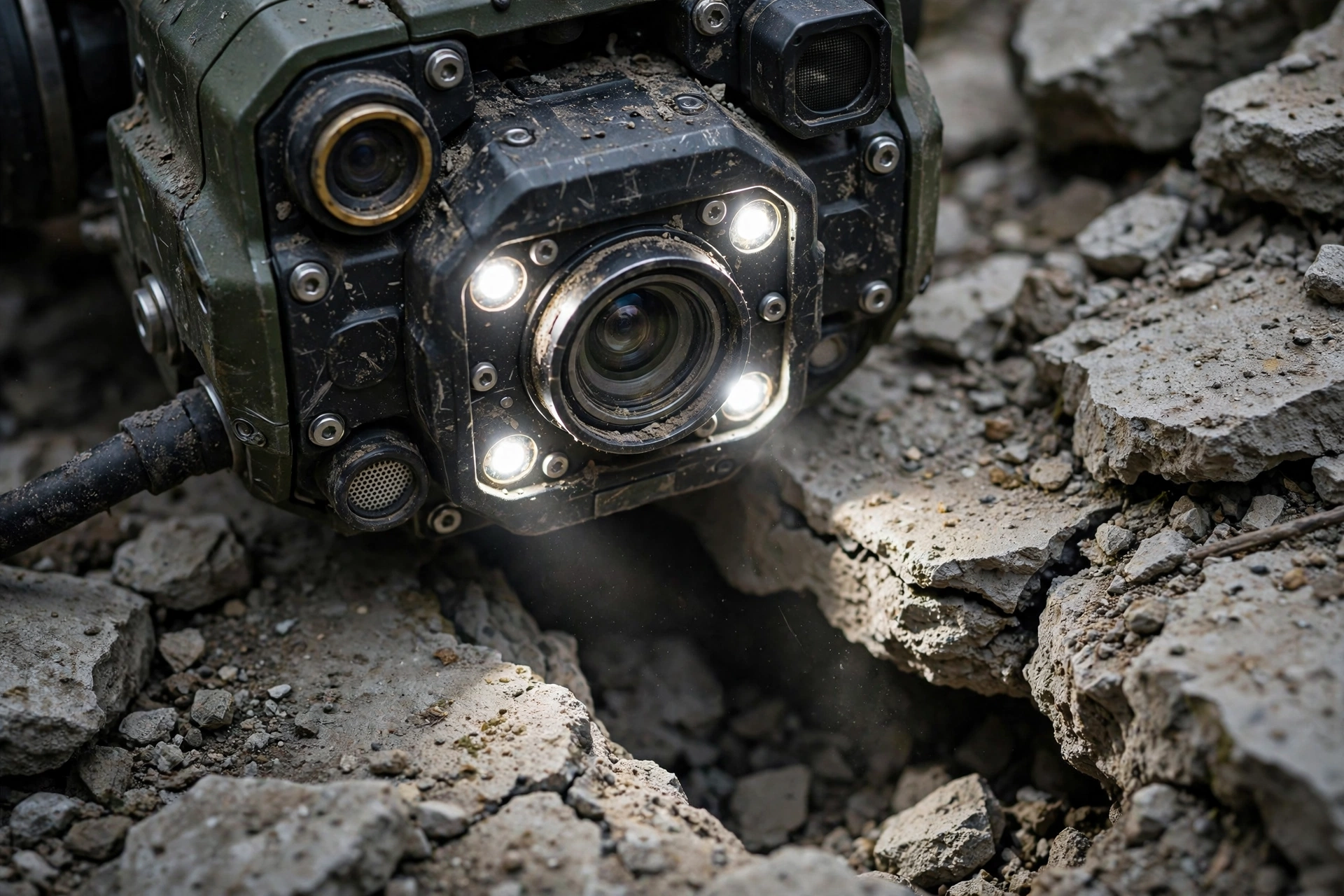
It uses several senses at once, because no single sensor is reliable in rubble. Cameras show the operator what is ahead, including colour, shape, and movement, and thermal cameras can pick up body heat through dust or in the dark. Microphones listen for tapping, calls, or breathing, and a speaker lets the operator talk to a survivor, ask them to tap back, and reassure them that help is on the way. Some robots also carry gas sensors or carbon dioxide sensors, which can hint at a person nearby or warn of a dangerous atmosphere. None of this is a guarantee: a survivor may be unconscious, buried too deep, or behind a slab that blocks sound and heat. That is why teams treat a robot’s signal as a clue to investigate, not as proof on its own.
Who controls it, and how far away can they be?
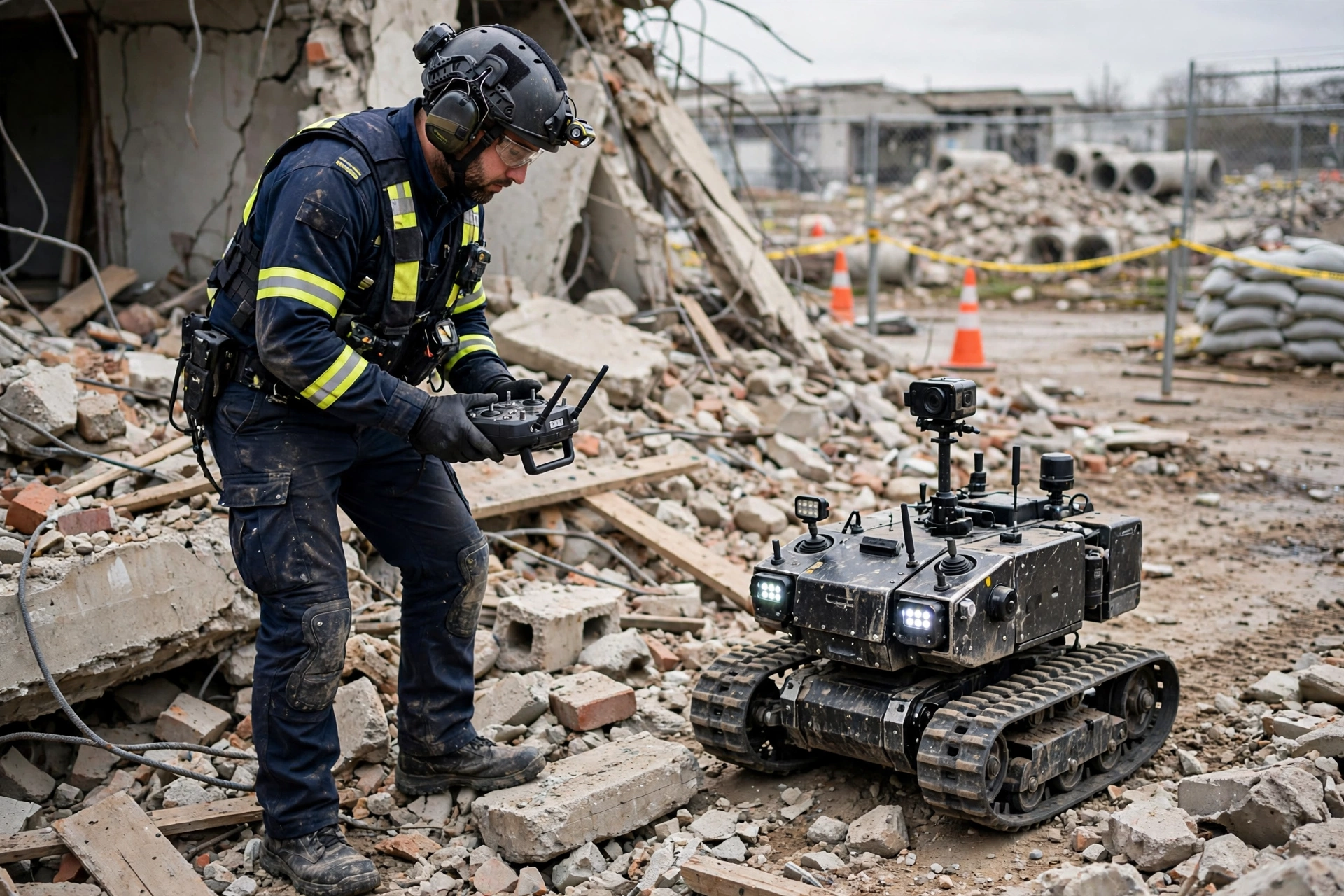
In most operations, a trained operator drives the robot from a safe spot nearby, using a controller and a screen that shows the live video feed. The link may be a cable, a radio signal, or a mix of both. A cable is reliable and cannot be jammed easily, but it can snag on rubble. A wireless link gives more freedom, but walls and concrete weaken it fast, so the operator usually stays within sight or within a short, tested range. Some robots can follow a simple path, hold a heading, or return along their own tracks on their own, which frees the operator to study the video instead of steering every centimetre. Even then, a human stays in charge of the decisions that matter: where to go, when to stop, and what to report.
What can a rescue robot carry into a void?
It depends on the model, but the payload is usually small and chosen for a purpose. A camera and lights are standard. A microphone and speaker turn a search into a conversation. A small arm can move a light object, drop a bottle of water, or place a radio near a survivor. Some robots carry a spool of cable, a first-aid pouch, or a sensor that checks air quality before a person enters. What they cannot do is just as important: they cannot lift a concrete slab, shore up a wall, or carry a person out. When people imagine a robot heroically digging someone free, the reality is quieter and more useful — it finds the person, stays in contact, and guides the human team to the right spot with the right equipment.
How do flying and swimming rescue robots help?
Ground robots are only part of the picture. Small drones can survey a damaged area from above, map a flooded street, or look for people on a roof, and they can do it faster than a ground team walking the same ground. Underwater robots, similar in spirit to the machines used for deep-sea work, can inspect a flooded basement, a culvert, or a riverbank without sending a diver into murky, fast-moving water. Each type has its own limits: drones struggle in high wind and heavy rain, and underwater robots need a clear tether and a trained pilot. Used together, though, they give a rescue team a fuller map — air, ground, and water — before anyone steps into the riskiest zone.
What limits rescue robots in a real disaster?
Plenty, and teams plan around them. Battery life is often measured in hours, not days, and recharging in the field is not always simple. Dust clogs lenses and sensors, rain soaks electronics, and cold saps batteries. Radio signals fade inside concrete, so a robot may lose contact just when it reaches an interesting void. Rough ground can flip it, trap a track, or snap a cable. And even a perfect machine cannot solve the human problems: a site may be too unstable to enter at all, access may be blocked by traffic or debris, or survivors may be in a place no machine of that size can reach. Rescue robots are most useful when teams train with them regularly, know their limits, and treat them as one tool among many — alongside dogs, listening devices, shovels, and, above all, experienced people.
FAQs
Are rescue robots fully autonomous?
Usually not. Most are driven remotely by a trained operator, sometimes with features like obstacle avoidance, path following, or returning to a starting point. Full autonomy in unpredictable rubble is still very hard, and human judgement is needed for safety decisions.
Can a rescue robot talk to a trapped person?
Many can, through a microphone and speaker. The operator can ask simple questions, listen for taps or replies, and let the person know that rescuers are working. That contact can also help the team judge where the person is and how urgent their situation may be.
Do rescue robots work in fires or floods?
Some are built for heat, water, or smoke, but each model has limits. A robot made for dry rubble may fail in deep water, and a drone may be grounded in high wind. Teams choose the right machine for the conditions, and they stop using it when the risk to the machine or the mission outweighs the benefit.
Why don’t rescue robots just dig people out?
They are too small and too light for heavy lifting, and moving rubble carelessly can make a collapse worse. Their strength is searching, sensing, and communicating. Digging, shoring, and lifting are done by trained teams with proper equipment, guided by what the robot found.
Where are rescue robots used outside disasters?
The same skills transfer well. They inspect sewers, tunnels, and industrial sites, check structures after fires, and support training exercises where teams practise searching without putting people in danger. That regular, low-risk work is also how operators stay sharp for a real emergency.
Rescue robots will not end disasters, and they should not be sold as if they could. Their value is narrower and more honest: they go first into places that are unsafe or unreachable, they report what they see and hear, and they give human rescuers the information and time to make better decisions. If you ever see one at work, the best thing you can do is give the team space, follow their instructions, and let the machine do its quiet job — finding people, so people can save people.