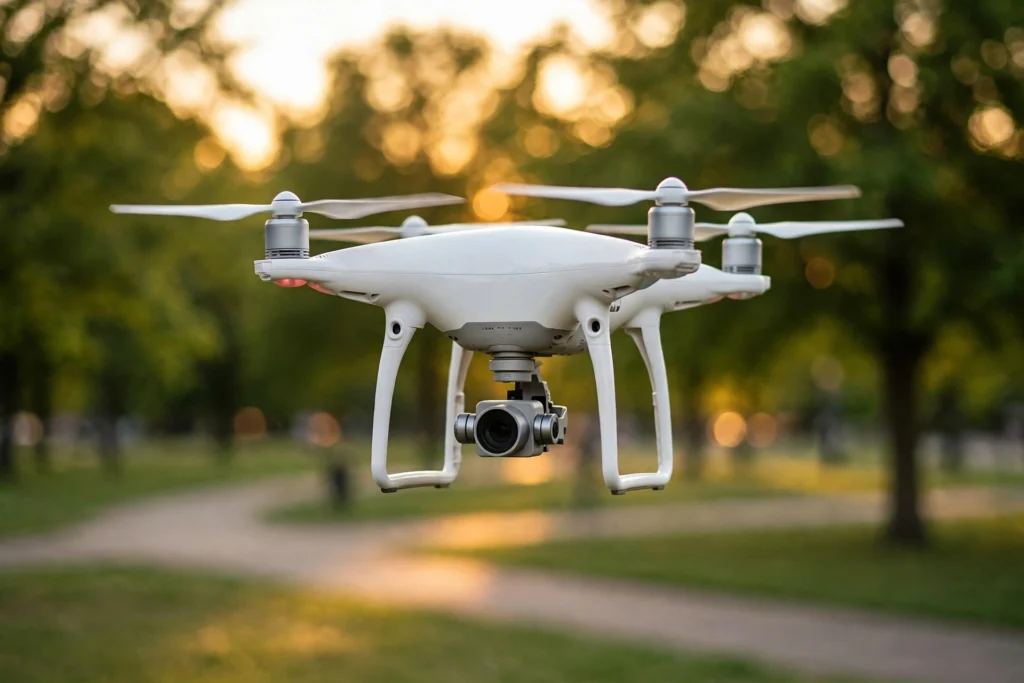
A drone flies because its spinning propellers push air downwards, and the push back lifts the aircraft into the air. A small flight computer adjusts each motor’s speed to keep it level, while GPS, sensors, and a radio link tell it where it is and where to go.
Key Takeaways
- Four propellers push air down for lift; changing their speeds steers the drone.
- A flight controller reads motion sensors many times a second to hold it steady.
- GPS gives the drone its position, so it can hover and fly home alone.
- The controller links to the drone over radio, and a phone shows the live camera view.
- Battery life limits flight time to well under an hour for most casual flights.
What makes a drone lift off the ground?
Most consumer drones are quadcopters: four arms, each with a motor and a propeller. When the propellers spin fast enough, they push a column of air downwards. The air pushes back up, and once that upward push beats the drone’s weight, it leaves the ground.
Two spin clockwise and two anticlockwise, cancelling the twisting force so the drone does not spin like a top. To climb, all four motors speed up together; to descend, they slow and gravity takes over.
How does a drone stay steady in the air?
A drone never sits still on its own: wind, vibration, and small differences between motors keep nudging it off balance. What keeps it steady is a flight controller — a small computer board that reads motion sensors hundreds of times a second and tweaks each motor to compensate.
The gyroscope senses rotation and the accelerometer senses changes in speed and direction. If a gust tips the front down, the controller speeds up the front motors a fraction and slows the rear ones, levelling the drone before you would notice. GPS adds steadiness outdoors, checking its satellite position several times a second to hold its spot.
What do the motors and propellers actually do?
The motors are brushless electric motors that change speed very quickly. Each one takes orders from the flight computer through a speed controller. Push the stick forward and the flight controller speeds up the rear motors slightly more than the front ones, tilting the drone forward so it moves that way.
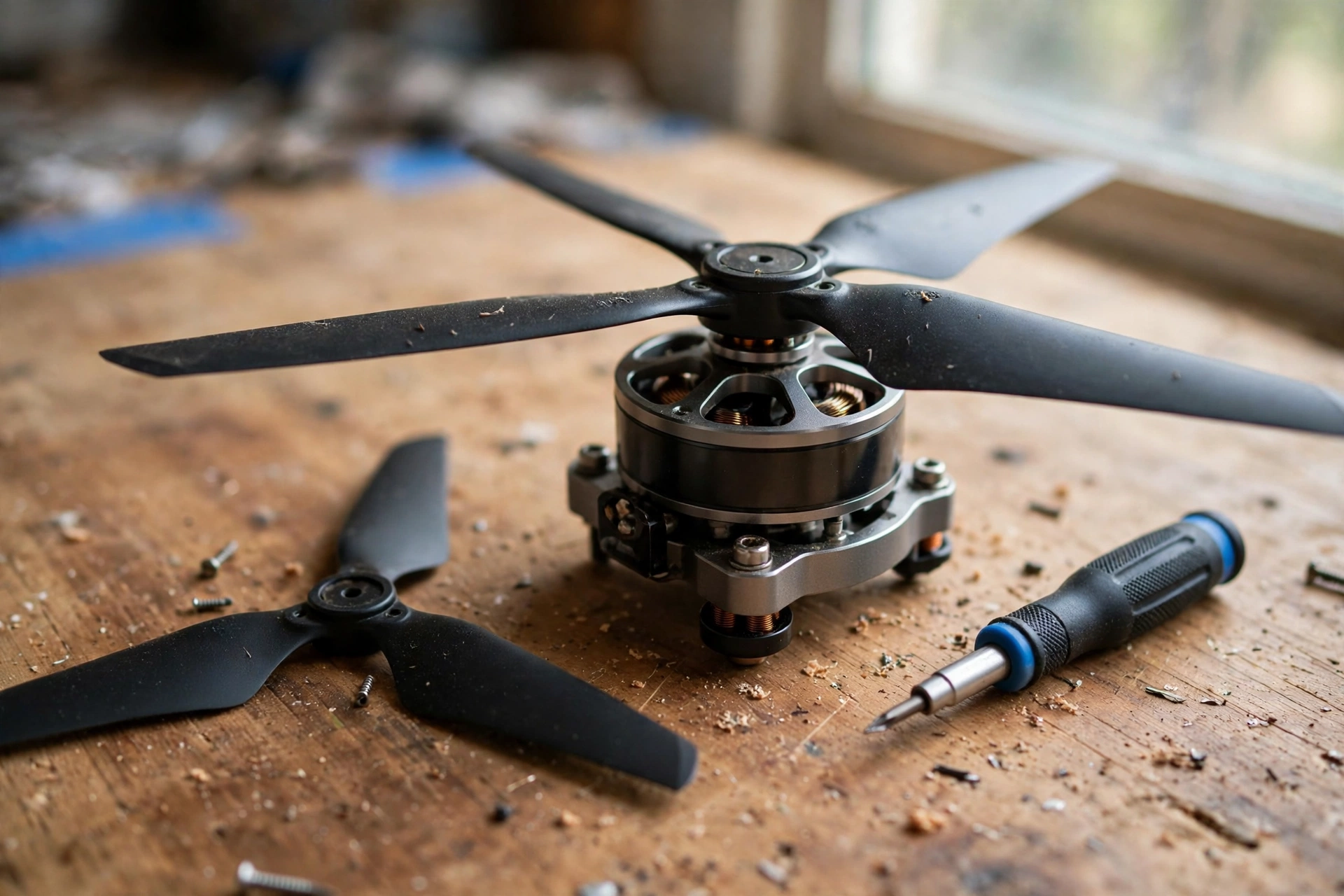
Propellers matter more than they look. Their size, shape, and pitch — the angle of the blades — decide how much air each spin moves. Longer, slower-spinning propellers are usually quieter and more efficient, which is why camera drones often have fairly large props. Check propellers before every flight: a small nick can unbalance a blade and shake the whole drone, so carry a spare set.
How does the controller talk to the drone?
The controller sends your stick movements to the drone over a radio link. Most modern systems use a dedicated radio band rather than your home Wi-Fi, because a dedicated link is more reliable at distance and suffers less interference. The ideas overlap with everyday wireless tech: our guide to how Wi-Fi works explains the radio basics, and many drones also use Bluetooth to pair a phone.
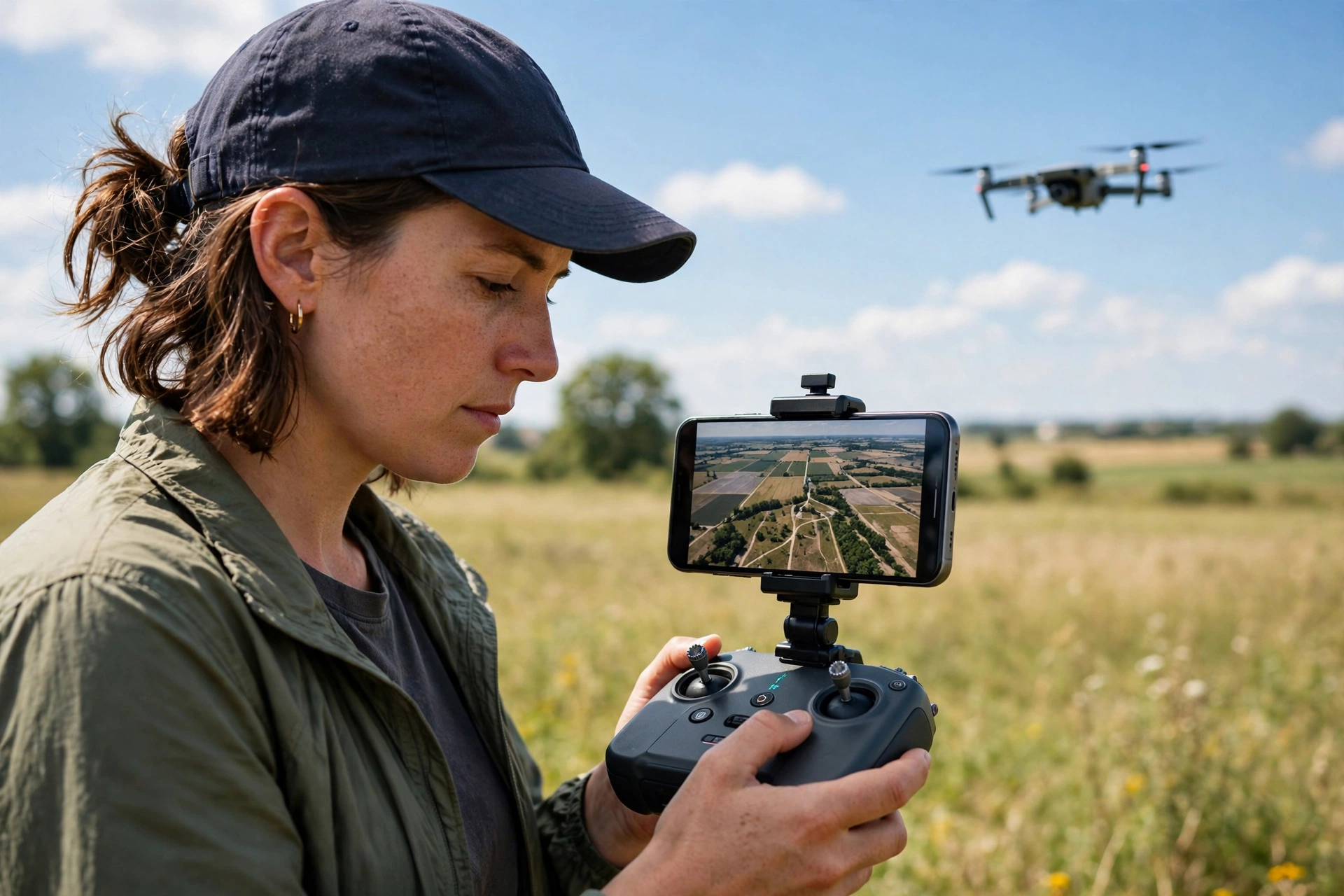
The controller usually has two sticks: one for height and rotation, the other for moving in any direction. A phone clipped to the controller shows the live view from the drone’s camera, plus height, distance, speed, and battery level. If the link drops, most drones hover briefly, then fly back to their take-off point and land. The camera usually sits on a small motorised gimbal that keeps it level while the drone tilts, so the footage stays smooth.
How does a drone know where it is?
GPS is the main answer outdoors. The drone listens to timed signals from satellites and works out its position from them — the same principle behind the blue dot on your phone, explained in our guide to how GPS works. With a good lock, a drone can hold position, follow a planned route, and fly home if the battery runs low or the signal is lost. Some drones add obstacle sensors that can spot a wall or a branch and stop before hitting it, but thin branches and wires can be hard for them to see, so treat them as a backup.
How long can a drone fly on one battery?
Most consumer drones fly for about 20 to 35 minutes on a charge, depending on the model, the wind, and how hard you fly. Hovering in calm air sips power; fighting a headwind uses far more. Cold weather shortens flight time too, because batteries deliver less energy when cold. The battery is a lithium-polymer pack, like the cells in a power bank or a phone: charge it with the maker’s charger and let it cool before recharging. Spare batteries are the simplest upgrade a new pilot can buy, and our guide to how wireless charging works covers the same lithium battery ideas in a simpler device.
What should you check before your first flight?
Start with the rules where you live. Many countries ask you to register larger drones, keep them below a set height and away from airports and crowds, and keep the drone in sight. The US Federal Aviation Administration’s drone pages are a good starting point for American flyers, and Wikipedia’s overview of unmanned aerial vehicles gives useful background on how drones are classed. Then run a quick pre-flight check: propellers undamaged and firmly attached, battery charged and clicked in, enough satellites locked for GPS, and a clear take-off spot away from people, roads, and trees. Take off slowly, hover for a few seconds, and check it holds still and answers the sticks.
FAQs
Can a drone fly in wind?
Yes, within limits — most handle a light to moderate breeze. Strong gusts drain the battery and can push a small drone off course, so if branches are swaying hard, stay on the ground.
Do drones need GPS to fly?
No, but flying without it is harder. Without GPS, the drone cannot hold its position or fly home on its own, so it drifts with the wind and you must correct it constantly. Beginners should wait for a solid GPS lock before taking off.
What happens if a drone loses signal?
Most modern drones return to their take-off point and land, or hover and then land, when the link is lost. Check that behaviour is switched on before take-off.
Do I need permission to fly a drone?
It depends on where you fly and how big the drone is. Parks, nature reserves, and airports often restrict flying, and heavier drones usually need registration. Check the rules for your exact location before you fly.
Conclusion
A drone combines simple physics with fast electronics: propellers push air down, a flight computer balances the motors, and GPS tells it where it is. None of those parts is magic on its own — it is the way they work together that makes a small machine hover, film, and fly home by itself. If you want to try it, pick a calm morning and an open field, and fly your first battery in short, gentle moves close to the ground.