
AI sentiment analysis reads a piece of text — a review, a tweet, a support message — and works out whether the writer feels positive, negative, or neutral about it. It does this by spotting emotion-carrying words, weighing how they combine, and comparing the result against patterns it learned from thousands of labelled examples.
Key Takeaways
- AI sentiment analysis sorts text into positive, negative, or neutral, and sometimes into finer emotions such as joy or anger.
- Most systems use word lists, machine learning models, or a hybrid of the two.
- It works best on plain opinions and struggles most with sarcasm, slang, and mixed feelings.
- Businesses use it to track reviews and social media, but the results are a guide, not a verdict.
What is AI sentiment analysis?
Sentiment analysis, also called opinion mining, is a branch of natural language processing that studies the feeling behind words. Where a search engine asks what a text is about, sentiment analysis asks how the writer feels.
Take a hotel review: “The room was spotless but the staff were rude.” A person hears two feelings at once — praise for the room, annoyance at the service. A good sentiment system tries to do the same, splitting the review by topic instead of forcing one label on the whole thing. That matters because opinion text arrives in volumes no team could read by hand.
How does AI sentiment analysis actually work?
Almost every sentiment tool follows the same four steps: clean the text, break it into pieces, score it, and label it.
Cleaning strips out links and extra spaces and turns everything to lower case, so “Great” and “great” count as the same word. Next, the text is split into tokens — words and short phrases — and the system watches their order, because “not happy” means the opposite of “happy”. Then comes scoring, and here the three main methods part ways.
The word-list method
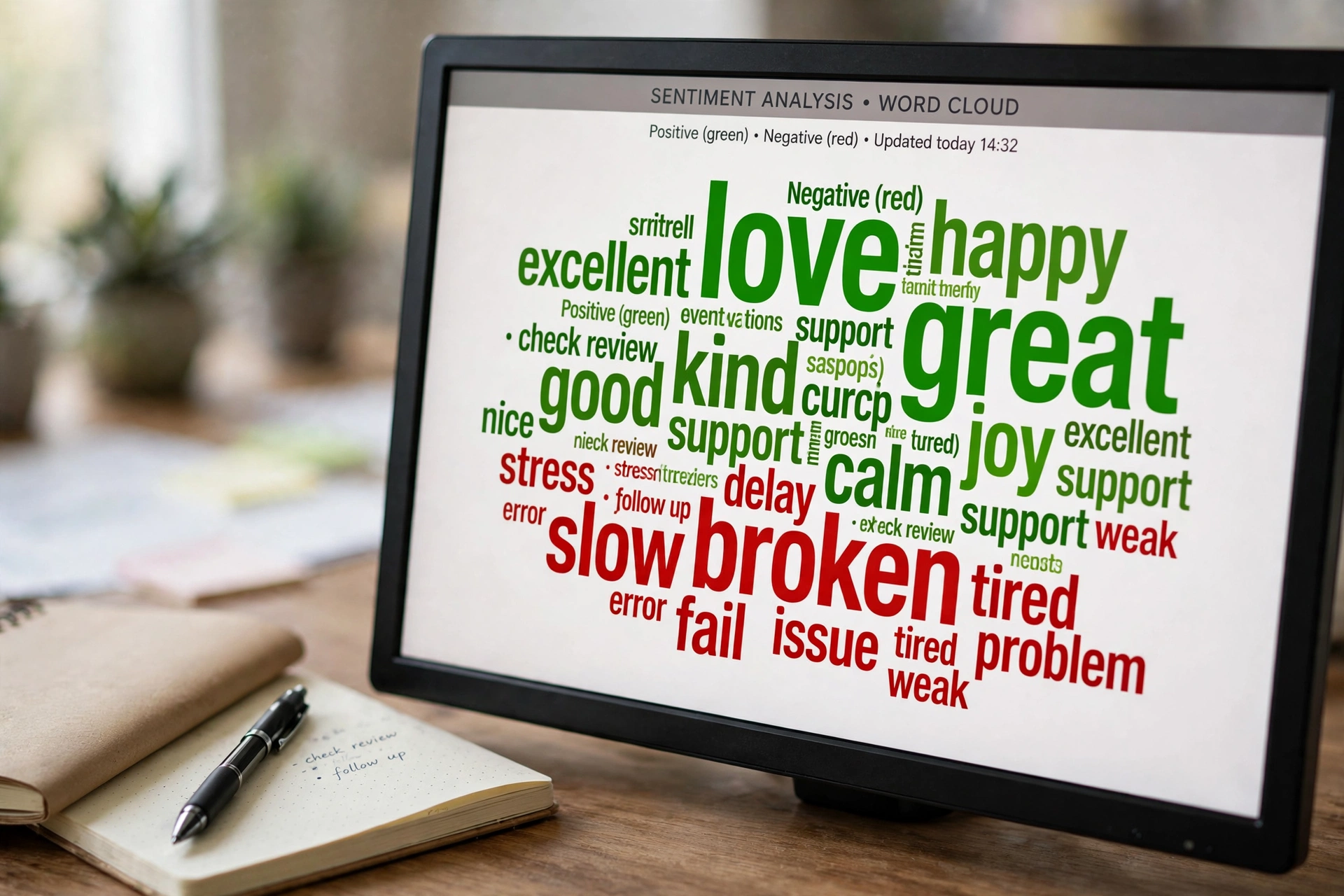
The oldest approach keeps lists of words with a score attached: “love” and “excellent” might each score +3, while “terrible” and “broken” score -3. The system adds up the scores and calls the result positive or negative. It is fast and easy to explain, but it breaks easily — it cannot tell that “sick” is praise in “that guitar solo was sick” and a complaint in “I felt sick after the meal”.
The machine learning method
Modern systems learn from examples instead. They are shown thousands of reviews that humans have already labelled positive or negative, and a machine learning model works out which word patterns tend to go with each label. Deep learning models read whole sentences, so they catch word order and context — which is how they learn that “not bad at all” is praise, not criticism. These models are more accurate and cope better with slang, but they need a lot of labelled training data.
The hybrid method
Many real products combine both ideas: a machine learning model does the heavy lifting, while word lists and rules handle edge cases such as negation (“never again”). This is the most common setup in tools you can buy today.
What kinds of sentiment can AI detect?
The simplest systems give one of three labels: positive, negative, or neutral. Finer systems go further: fine-grained analysis grades feeling on a scale, and aspect-based analysis splits a review by topic, so a phone review can be positive about the camera and negative about the battery in the same breath. Emotion detection tries to name the specific feeling — joy, anger, frustration — which is useful in support chats. The finer the label, the more likely the system is to miss.
Where is sentiment analysis used?
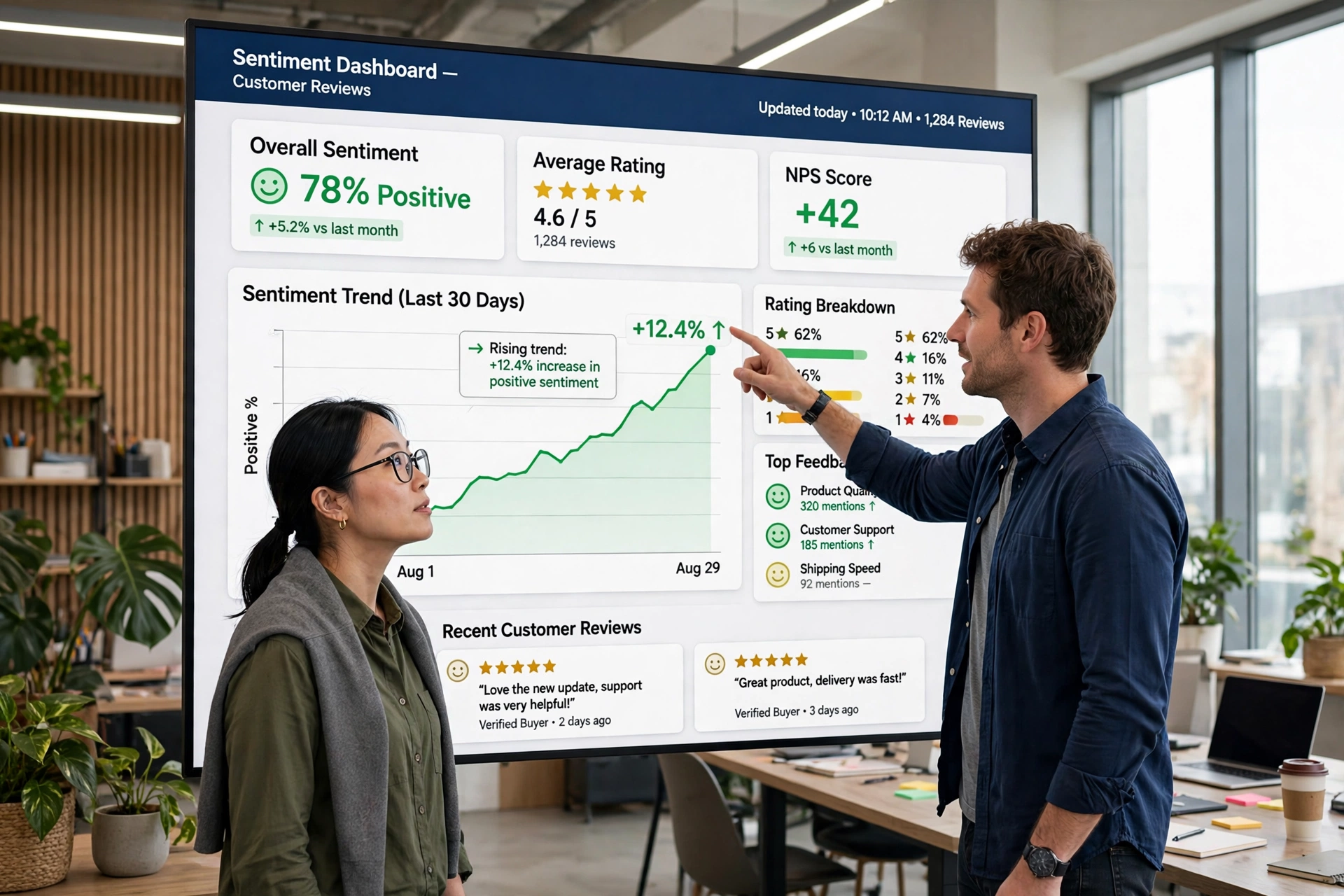
The most common use is customer feedback. Shops and apps feed reviews and survey answers into a sentiment tool to see which products people love and which features frustrate them. A sudden rise in negative mentions of “delivery” after a logistics change is the kind of signal that would take a person days to spot by reading. Like other practical uses of artificial intelligence, it saves teams hours of manual reading.
Support teams use it to sort tickets: a message that reads angry can be pushed to the front of the queue. AI chatbots use the same trick to decide when to hand a conversation to a human agent, and brands watch social media to track how people talk about a launch in near real time.
Why does sentiment analysis get things wrong?
Sarcasm is the classic failure. “Great, another delayed flight — just what I needed” is dripping with annoyance, but a system counting positive words will cheerfully call it praise. Tone of voice carries sarcasm for people; plain text carries none of it. Slang is a similar problem — words pick up new meanings fast online, and a model trained last year may read this year’s slang wrong.
Negation trips tools up too: “I wouldn’t call the service fast” sounds, on a quick scan, as if it contains the word “fast” in a good way, and only models that track word order catch it reliably. Mixed feelings are another weak spot: “The food was wonderful but the wait was endless” holds a clear positive and a clear negative, and a single overall label will always lose half the message.
How accurate is AI sentiment analysis?
For straightforward text — a clear five-star review, a plain complaint — modern tools are usually right most of the time. Accuracy drops sharply on sarcasm, mixed feelings, very short texts such as “fine.” or “meh”, and on topics the model was never trained on. Treat sentiment results as a signal, not a score to quote as fact.
FAQs
Can AI sentiment analysis detect sarcasm?
Usually not reliably. Sarcasm depends on tone and context, neither of which survives well in plain text. Some newer models trained on social media do better, but sarcasm remains one of the weakest areas for sentiment tools.
Does sentiment analysis work on languages other than English?
Yes, but quality varies. English has the most training data, so English models tend to be the most accurate, while less common languages have fewer trained models and lower accuracy.
What is the difference between sentiment analysis and emotion detection?
Sentiment analysis answers whether feeling is positive, negative, or neutral. Emotion detection tries to name the feeling itself — joy, anger, fear, frustration — which is the harder task, because the same words can express different emotions depending on context.
Can I use sentiment analysis on my own reviews?
Yes. Many tools let you paste in a batch of reviews and get a summary within minutes, and several offer a free tier for small volumes. Start with a small sample and check the labels against your own reading before trusting it on a large set.
Conclusion
AI sentiment analysis works by breaking text into words, weighing the feeling each word carries, and comparing the pattern against examples it learned from. Word lists are simple and fast, machine learning models are smarter about context, and hybrid systems mix the two. It is genuinely useful for spotting trends across thousands of reviews and posts — and genuinely unreliable on sarcasm, mixed feelings, and slang.
If you want to try it, pick a small set of your own reviews, run them through a free sentiment tool, and read the labels against the original text. The gaps you spot will tell you more about what the tool can and cannot do than any feature list will.