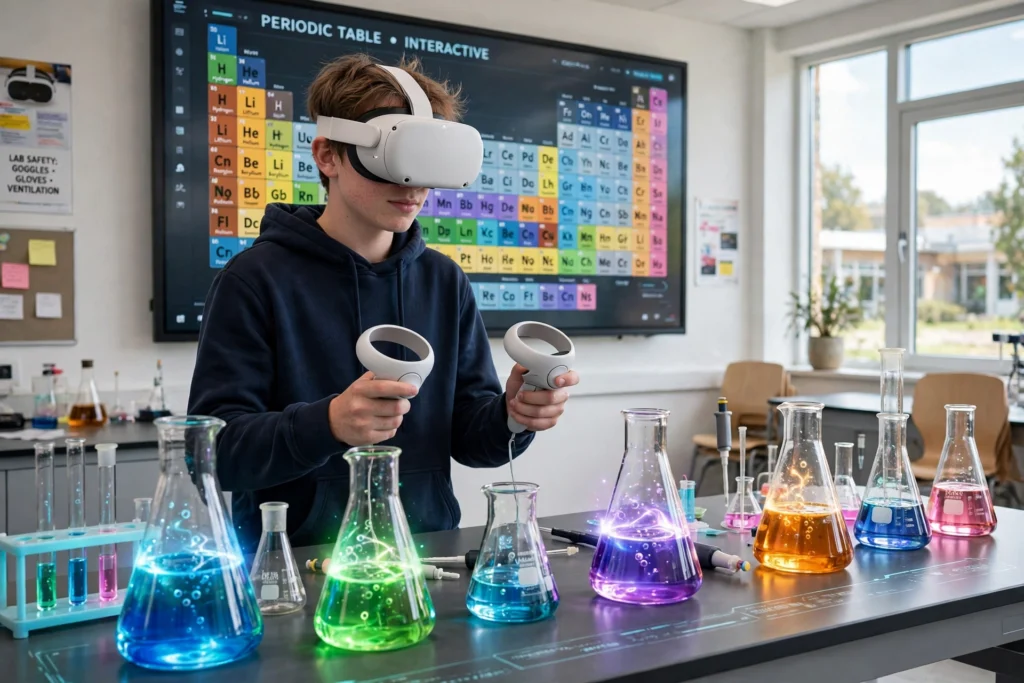
VR science labs let students carry out experiments inside a virtual laboratory instead of a physical one. Wearing a headset, a student can mix chemicals, use a microscope, or examine a virtual specimen, while the software tracks every step and flags mistakes. Nothing spills, nothing breaks, and the experiment can be repeated as many times as needed.
Key Takeaways
- A VR science lab is a 3D simulation of a laboratory that students enter with a headset and controllers.
- Students practise real lab skills — measuring, pouring, heating, and observing — without handling dangerous chemicals.
- Chemistry, biology, and physics suit VR labs best, especially experiments that are costly, risky, or hard to see.
- VR labs work best alongside real labs, not as a full replacement for hands-on bench work.
- A school needs headsets, enough floor space, and lab software matched to its curriculum.
What happens inside a VR science lab?
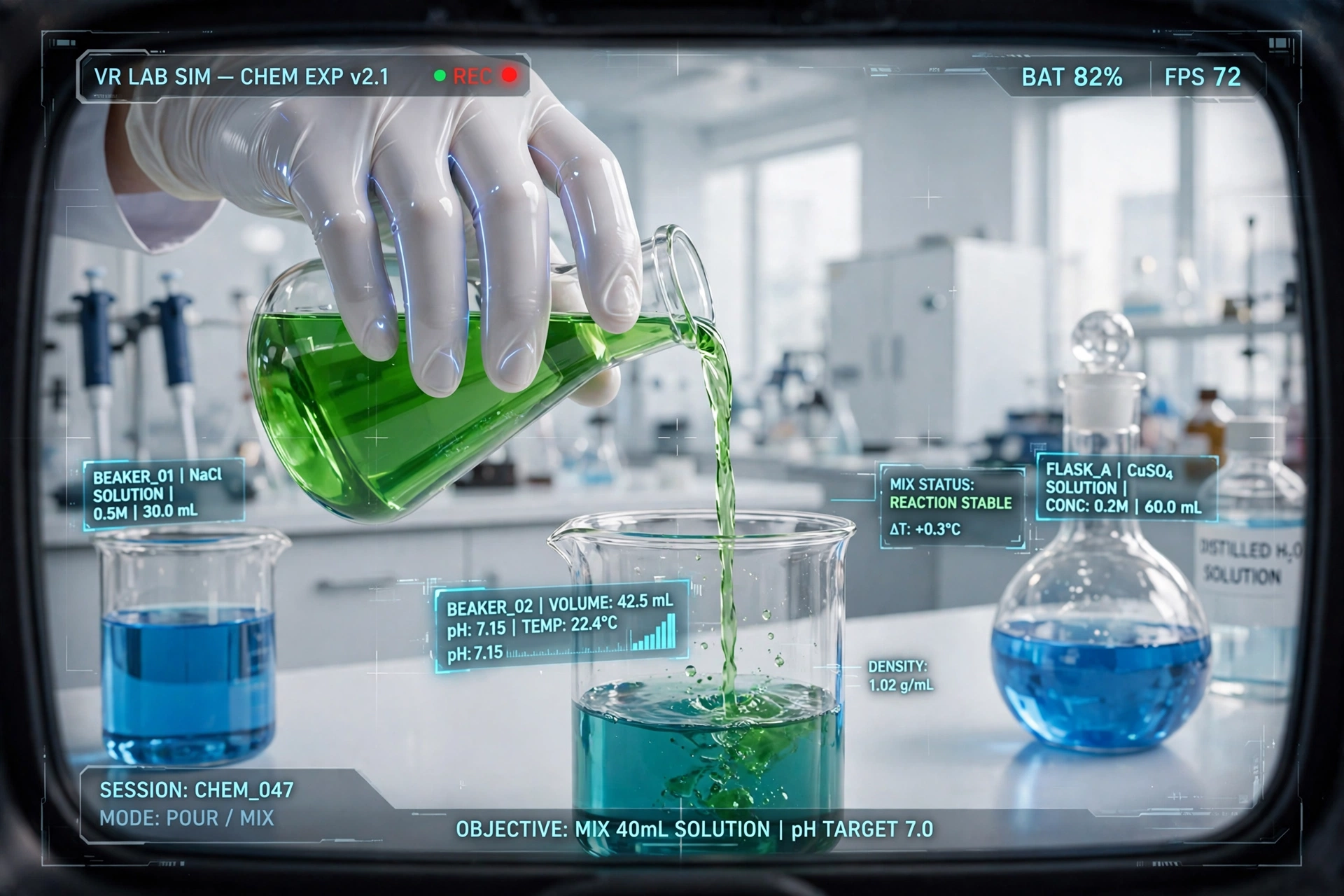
Put on the headset and you are standing at a lab bench. A floating panel shows the task: measure 40 millilitres, heat the solution, and record what changes. You pick up a beaker with a controller, pour, and watch the liquid change colour. If you pour too fast or skip a step, the simulation pauses and explains what went wrong.
The experience feels hands-on because the headset tracks your head and hands in real time. Turn your head and the bench moves with you. For a closer look at the hardware behind this, see how VR headsets work.
How do students handle virtual chemicals and equipment?
VR controllers act as hands. A trigger grip picks up a flask, a button opens a tap, and a squeeze pours. Some programs add haptic feedback, so the controller buzzes lightly when you touch a surface or pick up a tool. It is not the same as feeling real glass, but it is close enough to build the habit of careful handling.
Measurements work the same way. A student reads a virtual scale, sets a pipette to the right volume, and checks the result on screen before moving on. Because the software knows the right answer, it catches a wrong reading straight away — a big advantage over a textbook diagram.
What subjects work best in VR labs?
Chemistry leads the way. Mixing acids, heating solutions, and watching reactions are exactly the tasks that are risky or expensive in a real school lab, and they translate well to a simulation. Biology comes next: students can explore a beating heart, walk inside a cell, or carry out a virtual dissection.
Physics fits too, especially for things that are hard to see in a classroom. A student can watch forces act on a bridge, change gravity, or follow an electric current through a circuit in slow motion. Fine motor skills and fieldwork still belong in the real lab. VR in education covers the wider classroom picture, including how teachers plan these lessons.
How does a VR lab keep students safe?
Safety is the clearest win. No real chemicals means no burns, no fumes, and no broken glass. A student can try a reaction that would be far too dangerous in a school lab and simply watch the simulated result. If something goes wrong, the program resets and the student tries again.
That safety also changes who gets to practise. Students who missed a lab session, or schools without a fully equipped lab, can still run the same experiment. Teachers still set the rules, though: sessions are usually kept short, with breaks to avoid eye strain or motion sickness.
Can VR labs replace real labs?
Not entirely, and most teachers would not want them to. A virtual lab teaches the steps, the thinking, and the safety habits, but it cannot teach the feel of real equipment — the weight of a full beaker, the smell of a reaction, or the patience needed when a real experiment runs slowly.
The honest answer is that VR labs are a strong partner for real labs. Schools often use them first, so students arrive at the real bench already knowing the procedure, and then use the real lab for the final, hands-on version.
What does a school need to run VR science labs?
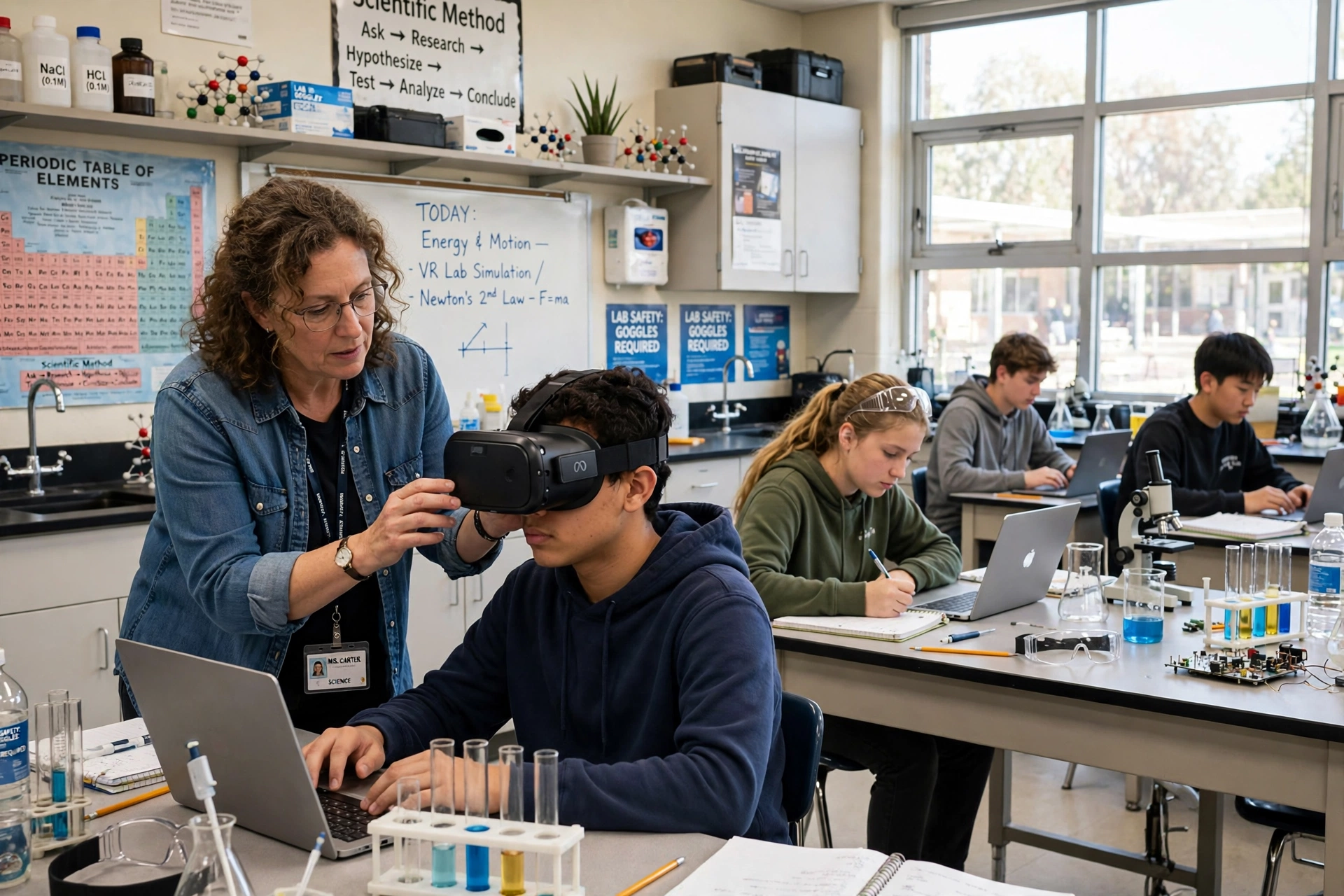
The starting point is a set of standalone headsets — the kind that do not need a gaming computer. Most schools buy a smaller set and rotate students through in groups while the rest work on worksheets or the real bench. Controllers come with the headsets, and VR room mapping keeps students from bumping into desks while they move.
Software is the second piece. Lab programs are usually sold per subject or as a library of simulations, and the best ones match the school’s curriculum rather than offering a random set of experiments. Before buying, check the room: a clear space of about two metres square per student, good Wi-Fi, and somewhere to charge and store the headsets.
What are the limits of VR science labs?
Cost is the first limit. Headsets, software licences, and upkeep add up, and a small school may only afford a handful of devices. Motion sickness is another: a few students feel queasy after ten or fifteen minutes, so sessions are kept short and nobody is forced to continue.
Finally, a simulation is only as good as its design. A poorly made lab can teach the wrong idea — for example, showing a reaction that looks instant when the real one takes minutes. Good programs are built with science teachers — platforms such as Labster build virtual labs with educators — so try a demo before committing. For background on the technology itself, see Britannica’s guide to virtual reality.
Frequently Asked Questions
Do students still need a real lab as well?
Yes. VR science labs are best used to prepare for, and practise alongside, real lab work. They build confidence and teach procedures, but real equipment still matters.
How much does a VR science lab cost?
It varies widely. A single standalone headset costs roughly what a mid-range laptop does, and lab software is usually sold as an annual licence per student or per school.
Can VR labs work for younger students?
Yes, with care. Younger children can enjoy simple virtual experiments, like exploring the solar system or watching a plant grow, but sessions should be short and supervised.
Do VR science labs help students remember more?
Doing something usually sticks better than reading about it, and VR labs give students more chances to practise. Good teaching still matters: a VR experiment followed by a class discussion beats one on its own.
What headsets work best for science labs?
Standalone headsets are the usual choice for schools because they need no computer and are easy to pass between students. The exact model matters less than comfort, battery life, and whether the lab software runs on it.
Conclusion
VR science labs give students a safe place to practise experiments they could not otherwise try — mixing chemicals, exploring cells, and making mistakes that cost nothing. They do not replace the real lab, but they make the time in it count for more, because students arrive knowing the steps and the safety rules. If your school is curious, start small: try one lab simulation with one class, ask the students what they learned, and decide from there whether to expand.