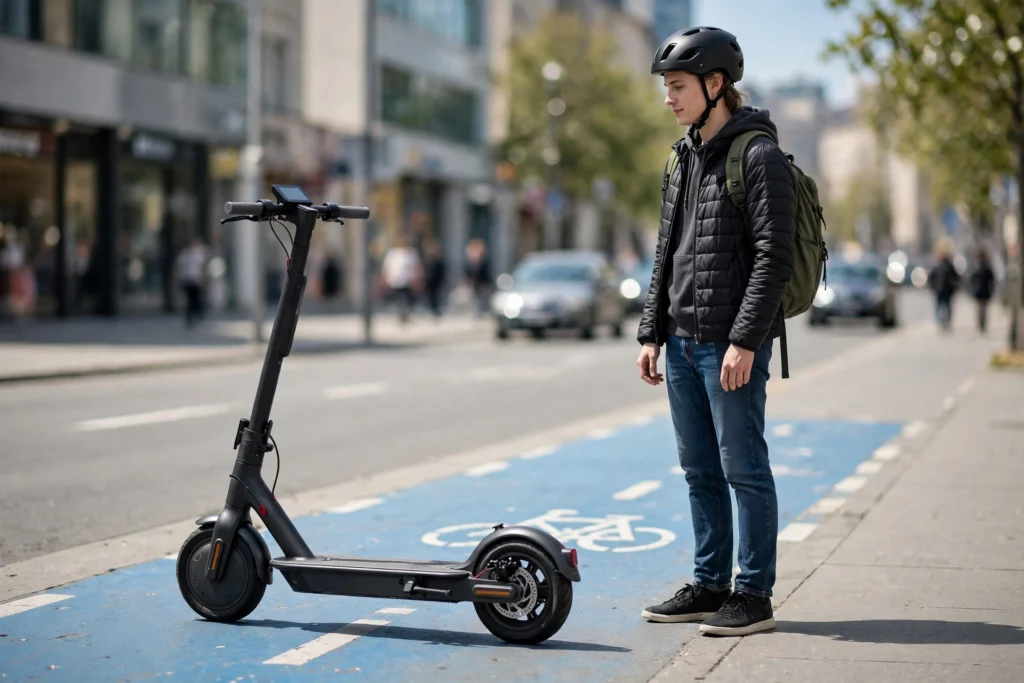
An electric scooter works by sending power from a rechargeable battery to a small motor in one of its wheels. You twist the throttle, a controller feeds electricity to the motor, and the wheel turns. There is no engine, no gears, and no petrol — just a battery, a controller, and a motor working together.
Key Takeaways
- A battery stores the energy, a controller manages it, and a hub motor turns it into motion.
- Most scooters are push-to-start: give a small kick, then twist the throttle.
- Brakes usually combine an electronic brake with a disc or drum brake.
- Range depends on battery size, rider weight, hills, and speed.
- Rules for where you can ride vary by city and country, so check local laws first.
How does an electric scooter move?
It starts with the throttle, usually a small lever or twist grip on the right handlebar. When you press it, the throttle sends a signal to the controller, a small computer hidden inside the deck. The controller decides how much power to draw from the battery and sends it to the motor.
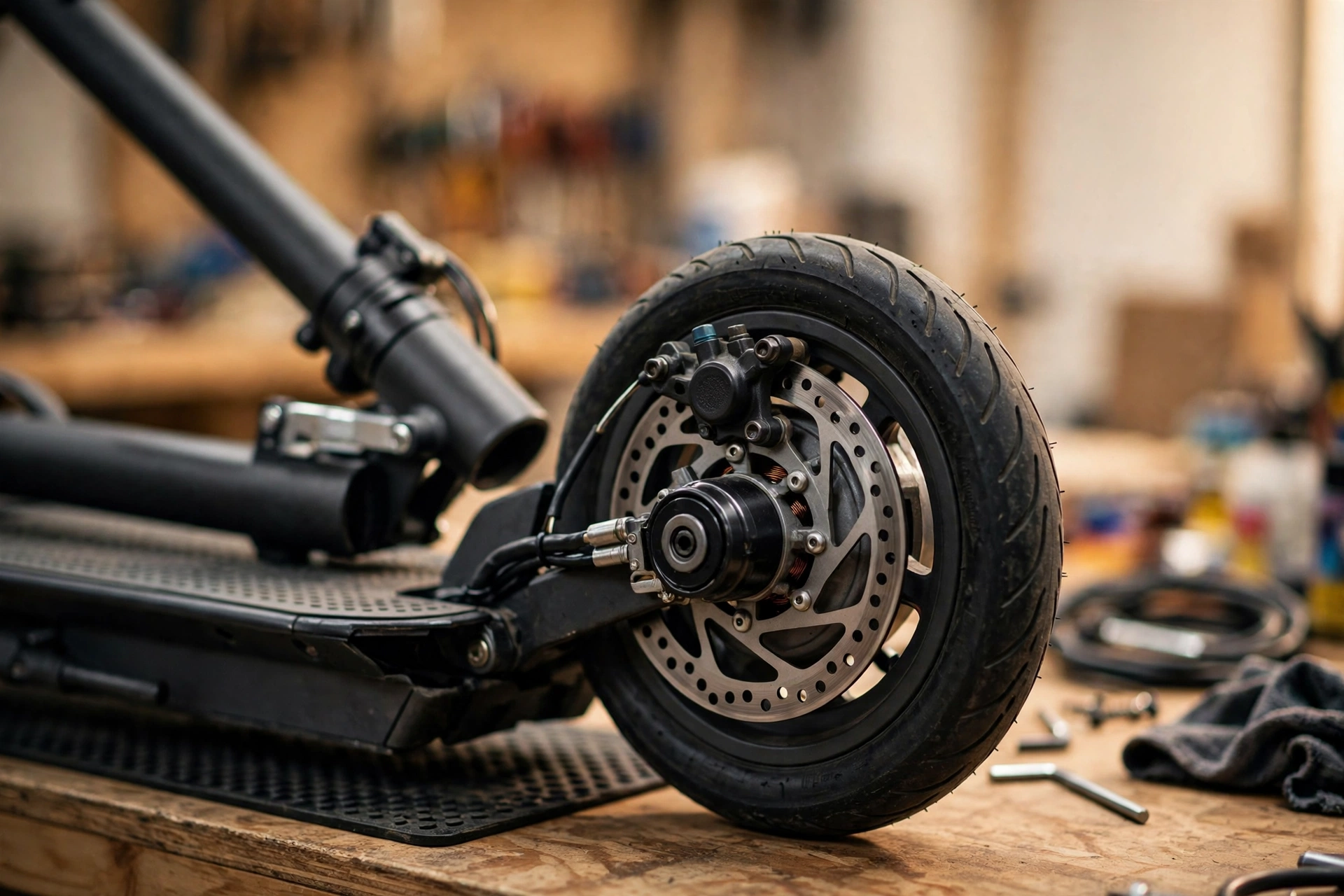
Most modern scooters use a brushless hub motor built right into the front or rear wheel, with no gears or chains in between — the motor is the wheel’s hub, so when it spins, the wheel spins. Motor power, listed in watts, shapes how the scooter feels: a lower-powered motor suits flat streets, while a stronger one handles hills and heavier riders.
You usually cannot just twist and go from a standstill. Most scooters need a small push first, so the scooter cannot shoot off if the throttle is bumped by accident. Once you are rolling at walking pace, the motor takes over.
What powers an electric scooter?
The battery sits inside the deck you stand on, which keeps the scooter’s weight low and balanced. Almost all modern scooters use lithium-ion batteries, the same kind of rechargeable cells found in a power bank or a laptop, just in a much larger pack. The battery’s capacity, measured in watt-hours, is the best guide to how far the scooter can go on one charge.
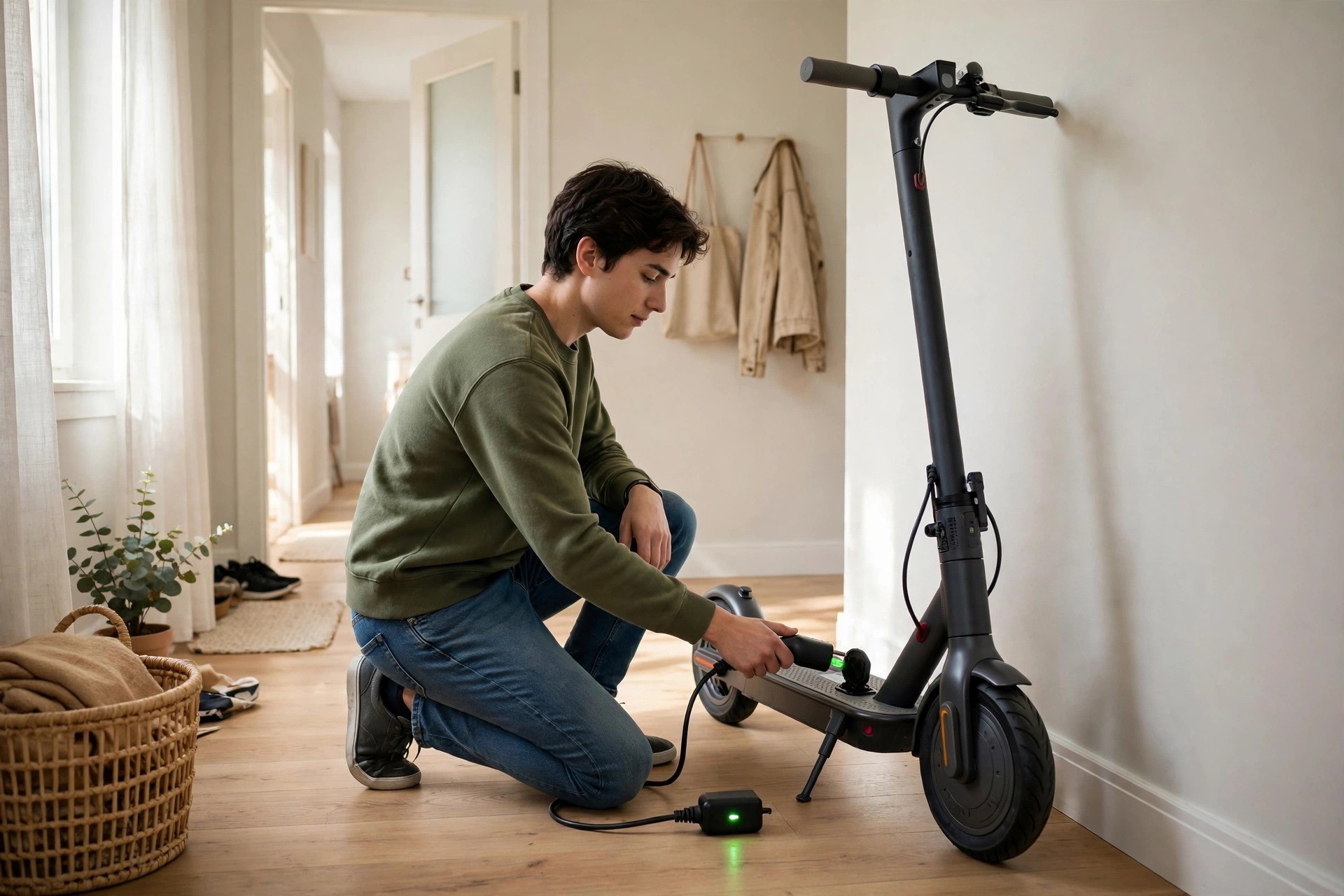
A battery management system watches over the cells, keeping them from overcharging, overheating, or draining too far. Charging usually means plugging the supplied charger into a port on the deck and waiting a few hours. A few newer models support wireless charging, but most still use a cable.
How do the brakes work?
Scooters stop in two ways at once. Squeezing the brake lever works a mechanical brake — usually a disc brake, sometimes a drum brake — that clamps down on the wheel and slows it by friction. At the same time, many scooters use regenerative braking: the motor briefly acts as a generator, turning some of the scooter’s motion back into electricity for the battery.
Regenerative braking alone is not strong enough to stop you quickly, so it works as a helper rather than the main brake. Good brakes matter more than top speed: small wheels and a standing rider mean stopping distances are longer than many new riders expect, especially on wet roads.
What do the display and app do?
The small display on the handlebars shows your speed, battery level, and riding mode. Most scooters offer two or three modes — often called eco, standard, and sport — which limit the top speed and how sharply the motor responds. Eco mode stretches the battery; sport mode gives quicker acceleration.
Many scooters also connect to a phone app over Bluetooth, much like wireless earbuds pair with a phone. The app can lock the scooter, track rides, and update the scooter’s software. If the scooter will not pair, turn Bluetooth off and on again and check the app is up to date — our guide to how Bluetooth works explains the basics.
How far can an electric scooter go?
A typical commuter scooter covers somewhere between a short trip across town and a full day of errands on one charge, but the advertised range is measured in ideal conditions: a light rider, flat ground, and steady low speed. Real life is less generous. Hills, headwinds, cold weather, and a heavier rider all shorten the range, and riding at top speed drains the battery much faster than cruising gently. If range matters to you, look at the battery size in watt-hours rather than the headline range figure.
Is it safe to ride an electric scooter?
It can be, with the right habits and gear. A helmet is the single most useful safety item, since falls at scooter speeds can cause serious head injuries. Ride at a speed that leaves room to stop, keep both hands on the bars, and watch for potholes and drain covers — small wheels catch on things a bicycle wheel would roll over.
Where you are allowed to ride varies a lot. Some cities allow scooters on roads and cycle lanes, some restrict them to private land, and rules can differ between rental scooters and ones you own. Check the local rules before you ride.
What should you check before buying an electric scooter?
Start with the motor and battery. A motor around 250 to 350 watts suits flat city riding, while hillier routes call for more power. Battery size in watt-hours tells you more about range than any marketing claim. Then check the weight if you will carry it upstairs or onto a bus.
Look at the brakes — a disc brake plus regenerative braking is a good combination — and at the tyres, since solid tyres mean no punctures but a rougher ride. Check whether the scooter folds, how it locks, and whether spare parts are easy to buy. Finally, think about connectivity: scooters that link to an app over Wi-Fi or Bluetooth can be locked and updated remotely, which is handy if you park in public.
FAQs
How fast does an electric scooter go?
Most commuter scooters top out at speeds similar to a fast cyclist, and many countries cap them by law. Faster models exist, but speed is limited by local rules as much as by the motor.
How long does an electric scooter battery last?
A well-kept battery usually lasts a few years of regular use before its range noticeably drops. Storing the scooter indoors and avoiding full discharges help it last longer.
Can you ride an electric scooter in the rain?
Light rain is usually fine, since most scooters have some water resistance, but heavy rain and deep puddles are a bad idea. Wet brakes stop less well, and water can damage the battery and controller.
Do electric scooters need a licence?
It depends where you live. Some places treat them like bicycles, others require a driving licence, and some do not allow private scooters on public roads at all. Always check the rules for your city before buying one to ride on the road.
Why does my scooter feel slower than it used to?
The usual causes are a cold battery, low tyre pressure, or a worn battery that no longer holds a full charge. Check the tyres first, then the battery health in the app if your scooter shows it.
Conclusion
An electric scooter works by turning battery power into motion through a controller and a hub motor, with brakes and a display to keep the ride under control. The details — battery size, brakes, tyres, and local rules — decide whether a scooter suits your daily trips. If you are thinking of buying one, try a short test ride first, check the rules where you live, and pick a model whose battery and brakes match the roads you actually ride.