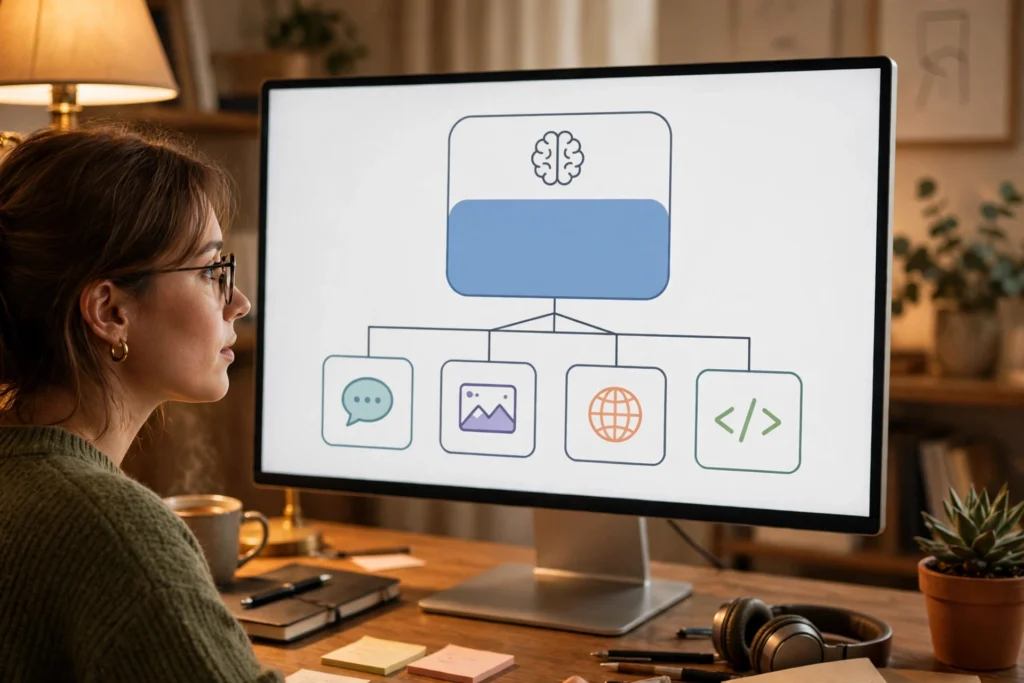
A foundation model is a large AI model trained on a broad range of data so that it can later be adapted to many different tasks, instead of being built for just one job. Think of it as a well-stocked base: you train it once on general patterns, then shape it for drafting, summarising, coding help, image description, or translation.
That simple idea changed how a lot of AI gets built. Before, a team that wanted a spam filter, a document summariser, and a chatbot often built three separate systems from scratch. Now, teams frequently start from the same kind of base model and adapt it three ways. It saves time, but it also means a flaw in the base can show up in every tool built on top of it.
Key Takeaways
- A foundation model is trained on broad, general data first, then adapted for specific tasks.
- The same base can support chat, summarising, translation, coding help, and image tasks.
- Adaptation usually needs far less task-specific data than training from scratch.
- A foundation model is not a finished product on its own — it still needs shaping, testing, and safeguards.
- Because many tools share one base, its biases and mistakes can spread widely.
How is a foundation model trained?
Training usually happens in two broad stages. First comes pre-training, where the model works through huge amounts of general material — text, images, code, or a mix — and learns patterns. It is not usually taught with neat labels for every item. Instead, it learns by predicting what comes next, filling in a missing piece, or matching related items. That is why this stage is often called self-supervised learning: the data itself supplies the practice task.
The result is a general-purpose model that “knows” a lot of patterns but is not yet good at any one job. It might write fluent sentences yet give shaky answers, or describe an image in general terms but miss the detail you actually need. That is normal. Pre-training builds breadth, not precision.
This stage is also the expensive part. It needs a lot of computing power and data, which is one reason only a relatively small number of organisations build the biggest base models, while many more teams adapt them. If you have ever wondered why so many AI tools feel similar under the surface, this shared starting point is a big part of the answer.

How does one model get adapted to so many tasks?
Adaptation is where the general becomes useful. The most common route is fine-tuning, which we covered in our guide to fine-tuning: the base model is trained further on a smaller, task-specific set of examples so it behaves the way you want for that job. A customer-support version learns the company’s tone and answers; a coding version learns to favour working, well-explained code.
Another route is prompting. You give the model clear instructions and a few examples inside the prompt itself, and it follows the pattern without any extra training. This works well for quick experiments and for jobs that change often, though it can be less reliable than fine-tuning for a task you will run thousands of times a day.
A third route connects the model to outside information at answer time, so it can look facts up rather than relying only on what it memorised during training. Retrieval-augmented generation is one version of this idea. In practice, teams often combine routes: fine-tune for tone and format, prompt carefully for each request, and ground answers in trusted documents where accuracy matters.
The key point is that adaptation is still real work. A foundation model gives you a head start, not a finished answer. The team adapting it still has to choose the data, test the results, and decide what the tool should refuse to do.
What kinds of foundation models are there?
Not every foundation model works with words. Language models are the best known, because chatbots and writing tools made them visible. But there are also vision models trained on images, models trained on code, and multimodal models that handle more than one kind of input — text plus images, for example.
Some models are general and open-ended. Others are built for a field, such as models trained on scientific papers or geospatial data. A field-specific base can be a better starting point when your task needs specialist vocabulary, even if it is less flexible overall. Size is not the whole story either: smaller, well-adapted models can be faster, cheaper to run, and easier to check — and for a narrow job, they may do just as well.
Why do foundation models matter for everyday users?
For most people, the benefit shows up as tools that arrive faster and feel more flexible. A small business can adapt a base model to draft product descriptions, answer common questions, or summarise long documents, without hiring a team to build a model from nothing. That is the same reuse idea behind transfer learning: knowledge gained in one setting carries over to another. There is a trade-off, though: when many products share a base, they can share its blind spots too, so testing an adapted tool on your own examples matters more than trusting the base model’s reputation.
What are the limits and risks?
First, a foundation model can sound confident while being wrong. It predicts plausible patterns, so its answers can read smoothly even when a fact is off. That is why checking important answers against a trusted source is still essential, especially for health, money, or legal questions. This article is general information, not professional advice for any specific decision.
Second, its training data shapes its behaviour. If that data over-represents some groups or viewpoints and under-represents others, the model may reflect that imbalance. Adaptation can reduce the problem, but it rarely removes it entirely, and it can introduce new biases if the adaptation data is narrow.
Third, the model is incomplete by design. Stanford researchers who popularised the term stressed that a foundation model is a base, not a whole house. It needs guardrails, evaluation, and human oversight before it is safe to rely on in high-stakes settings. A demo that looks impressive is not proof that a tool is ready for real customers.
Finally, there are practical costs: running large models uses energy and computing resources, and adapting them well takes skilled time. “Just use a foundation model” sounds cheap; doing it responsibly usually is not free.

How can you judge a foundation model fairly?
Start with the job, not the hype. Ask what task the adapted tool must do, what a good answer looks like, and what a harmful mistake would cost. Then test it on examples from your own work, including awkward cases — unclear wording, unusual names, edge cases — not just the clean examples in a demo. Also check how the tool handles uncertainty: does it say when it does not know, and does it cite sources you can open and check? For factual work, those habits matter more than fluency.
FAQs
Is a foundation model the same as a large language model?
Not quite. A large language model is one kind of foundation model — one that works mainly with text. The foundation-model idea is broader: it also covers models for images, code, audio, and combinations of these. Every large language model used as a reusable base fits the description, but not every foundation model is a language model.
Do I need to train my own foundation model?
Almost certainly not. Training a base model from scratch is expensive and data-hungry. Most teams and individuals adapt an existing model instead, through fine-tuning, prompting, or connecting it to their own documents. Building your own makes sense only when you have a very unusual data need and the resources to do it properly.
How is a foundation model different from traditional machine learning?
In traditional machine learning, you often trained a separate model for each task, using labelled examples for that task alone. With a foundation model, you train once on broad data, then adapt the result many times. That is why our machine learning guide and our transfer learning guide pair naturally with this one: the base model is the thing being transferred.
Can a foundation model keep learning after it is released?
Some systems are updated regularly by their providers, and some tools learn from feedback or from documents you connect to them. But a released model does not usually learn continuously from every user interaction in the way people do, and any updating needs care: new data can improve a model, but it can also introduce fresh errors if it is not checked.
Are foundation models safe to use?
They can be useful and reasonably safe for low-stakes tasks when they are adapted carefully, tested on real examples, and used with human checking. For high-stakes decisions — medical, financial, legal, or safety-critical work — treat their output as a draft to verify, not as a final answer, and keep a person in charge of the decision.
Conclusion
A foundation model is best understood as a starting point: broad training first, careful adaptation second. That two-step pattern explains both its power and its risks. It lets small teams build capable tools quickly, and it also means a single base model’s strengths and weaknesses can echo across many products.
If you want to go further, start with our complete guide to artificial intelligence, then read our guides to machine learning, transfer learning, and fine-tuning. Then try a practical next step: pick one small, low-stakes task, adapt a model for it, and test it on twenty of your own examples before you trust it with anything bigger. That short test will teach you more about a foundation model than any demo can.