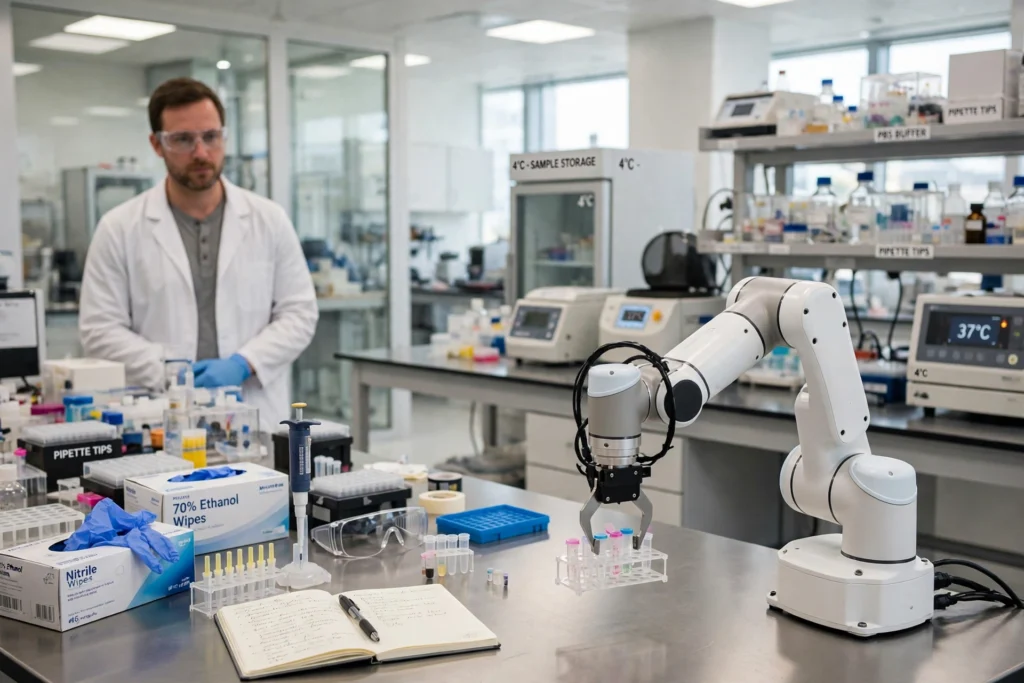
Laboratory robots move samples, measure liquids, and repeat precise steps so scientists can focus on decisions, checks, and results. They do not replace lab staff. Instead, they handle the fiddly, repetitive work — opening a rack, picking up a tube, adding a measured drop, and placing a plate in exactly the same spot, time after time.
That consistency is the point. A tired human hand can wobble, miscount, or lose track halfway through a long plate. A robot follows the same plan, records what it did, and flags anything that looks wrong. When a step needs judgement, a person steps back in.
Key Takeaways
- Laboratory robots combine arms, grippers, sensors, and software to move samples and liquids with repeatable precision.
- Most systems work in a fixed sequence: identify a sample, move it, process it, check it, and store or send on the result.
- Pipetting robots reduce manual handling, but they still need correct tips, volumes, and clean plates to work well.
- Safety comes from enclosed work areas, clear paths, locked sample identities, and human checks — not from speed alone.
- Robots are best for repetitive, well-defined tasks. Unusual samples, broken seals, and unexpected results still need a person.
What does a laboratory robot actually do?
Think of it as a careful pair of hands with a very good memory. It starts with a job list: which samples to test, which wells to fill, and what volume each well should receive. Barcodes or labels on tubes and plates help it match the right sample to the right test. If a label cannot be read, a good system stops and asks for help rather than guessing.
From there, the robot moves in small, controlled steps. A bench-top arm may lift a rack from a storage position, present it to a pipetting head, and then move the finished plate to a reader or an incubator. A mobile robot may carry a sealed tray between benches or rooms, following a marked route and pausing for people in its path. Larger systems link several machines together, so a sample can travel from arrival to analysis without being carried by hand at every stage.
How do laboratory robots move samples without mixing them up?
Sample identity is the whole game. A mix-up early in a workflow can waste a run or, worse, produce a confident-looking result for the wrong sample. That is why labs lean on labels, racks with fixed positions, and software that tracks each tube and plate.
A typical sequence looks like this. First, the system reads a barcode and checks it against the job list. Then it picks up the tube or plate from a known position — not by searching around, but by moving to coordinates it has been taught. Grippers are chosen for the job: a gentle grip for a light tube rack, a firmer hold for a sealed transport box. After the move, sensors confirm that the item arrived where it should. If a grip fails or a position is empty, the run pauses instead of carrying on blindly.
This is similar to how other robots handle repeatable work, but the stakes and the scale are different. A robot arm in a factory may move heavy parts, while a lab arm moves millilitres and millimetres. For a closer look at the arm itself, see how robot arms work, and for moving goods around a larger site, warehouse robots follow a related logic of known positions and tracked loads.
How does robotic pipetting work?
Pipetting is where many lab robots earn their keep. Manual pipetting is slow, and doing it hundreds of times in a row is hard on hands and concentration. A robotic pipetting head uses one or more channels to draw up a set volume and release it into a plate, tube, or well.
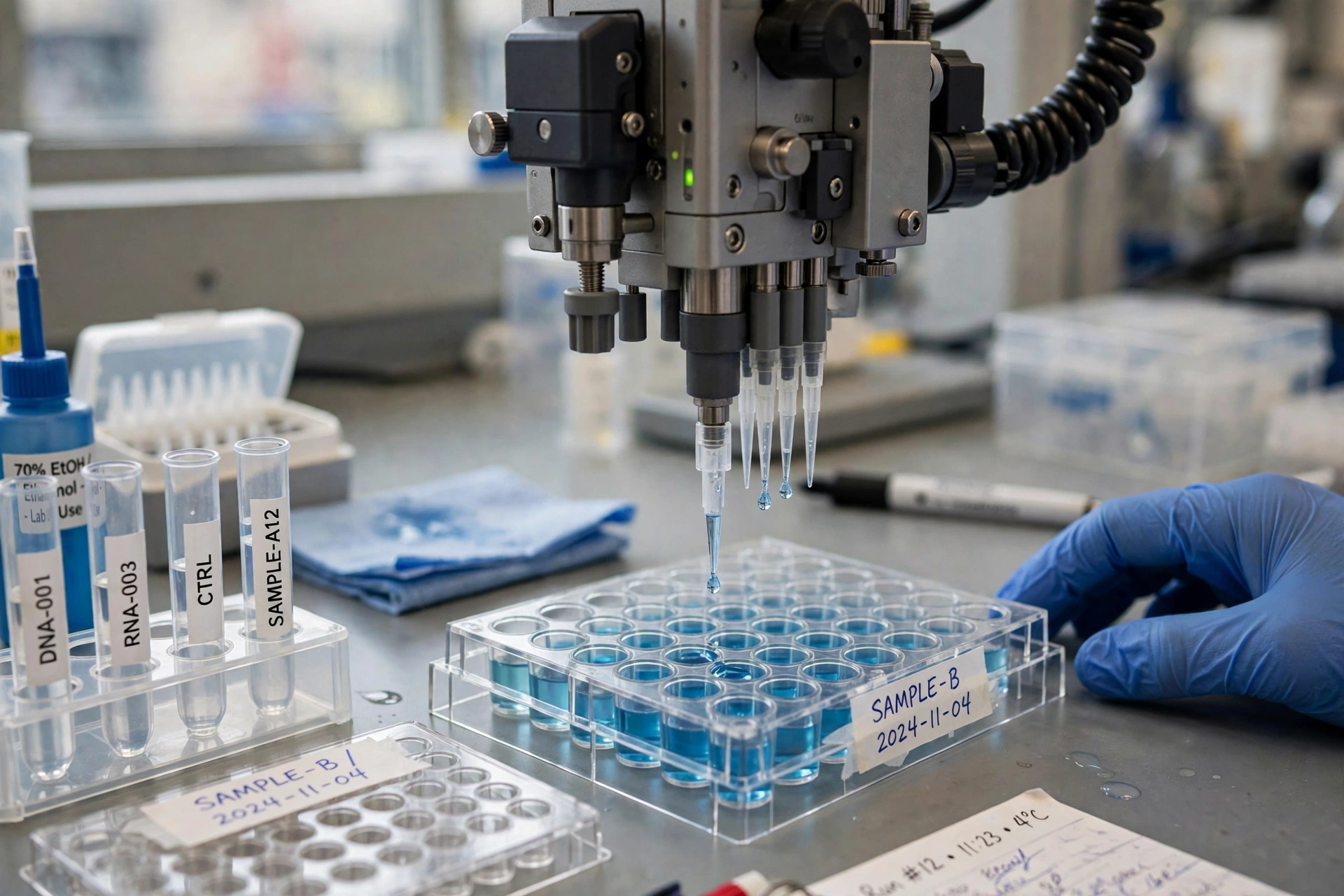
Accuracy depends on details that are easy to overlook. The tip must fit properly, the liquid must not be too thick or foamy for the setting, and the plate must sit flat in its holder. Good systems change tips between samples when cross-contamination is a risk, and they may use filtered tips for sensitive work. Some also check liquid levels or watch for bubbles, because a bubble can mean the volume delivered was not what the plan expected.
What sensors and software keep a lab robot on track?
A laboratory robot is only as good as its feedback. Position sensors tell it where its arm is. Force sensors help it grip without crushing a tube or dropping a plate. Cameras can read labels, check that a plate is present, or spot a missing tip. Temperature and timing controls matter too, especially when a sample must stay cold or a step must happen within a set window.
Software ties these parts together. It holds the job list, the layout of the bench, and the rules for what to do when something goes wrong. In a simple setup, that software runs one machine. In a larger lab, it may coordinate several machines and pass sample information from one step to the next. Even then, the human role remains central: staff approve the plan, watch the first runs, and investigate errors.
How do laboratory robots stay safe around people and samples?
Lab safety starts before the robot moves. Work areas are often enclosed or guarded, so hands cannot enter a moving arm’s path during a run. Mobile robots use clear routes, slow down near people, and stop when something blocks their way. Collaborative-style designs, which are made to share space more closely with people, still rely on limits on speed and force, plus clear stop controls.
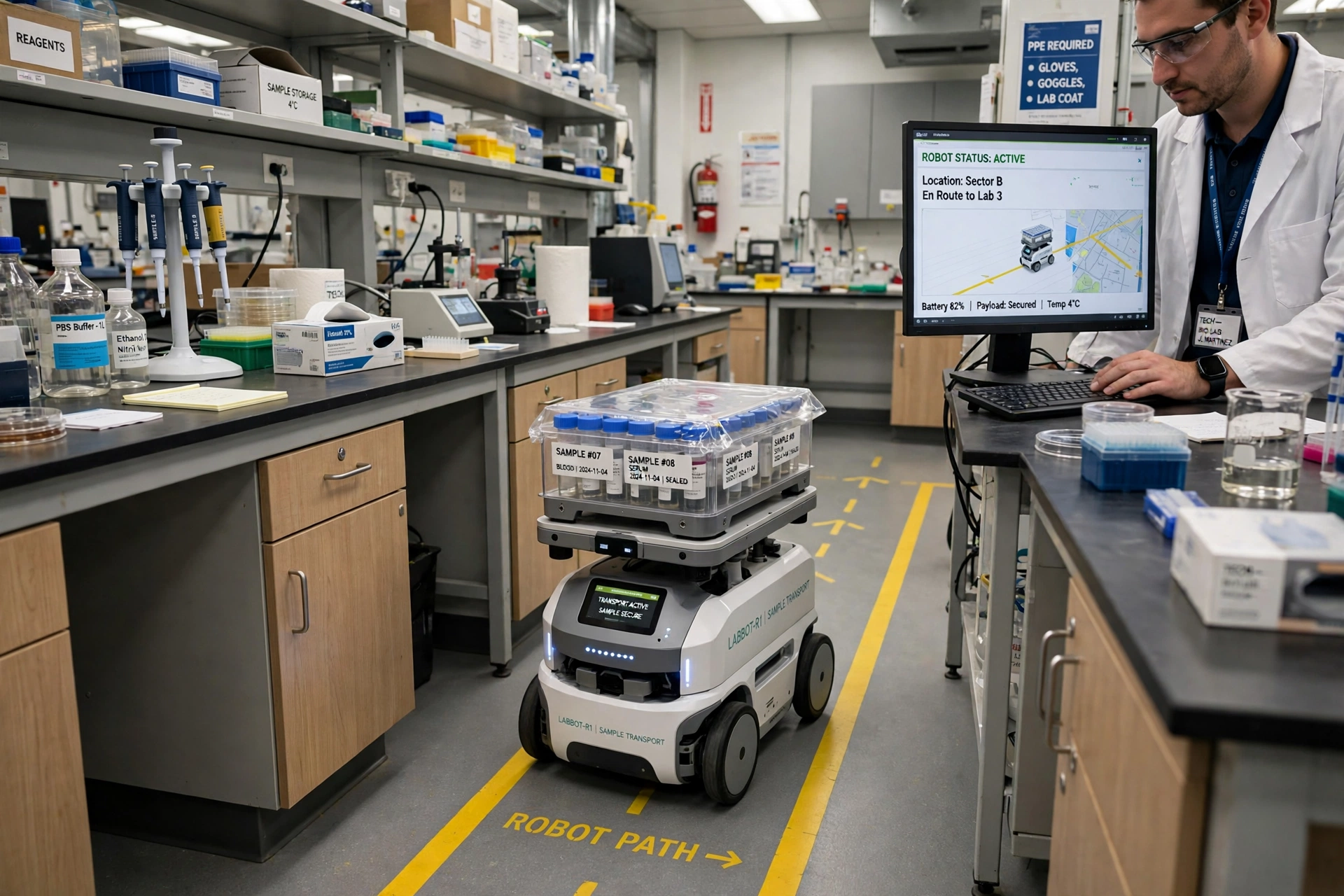
Sample safety is just as important. Sealed containers, covered plates, and controlled transport reduce spills and exposure. Waste tips and used plates go to the right bins, and cleaning steps are built into the routine rather than left to memory. If a sample is hazardous, the robot system must fit the lab’s existing safety rules — it does not replace them.
Where are laboratory robots used?
You will find them in clinical testing, research, quality control, and drug discovery, among other places. In clinical work, they may prepare many similar samples for testing, where consistency and traceability matter most. In research, they may run repeated plates so a team can compare conditions fairly. In quality control, they may test samples from a production line in a set order, with records that show exactly what was done.
What can go wrong, and how do labs catch it?
Most problems are ordinary, not dramatic. A tip does not seat properly. A label is smudged. A plate is placed slightly out of position. A reagent runs low halfway through a run. Good systems are built to notice these things: they pause, log the problem, and leave the sample in a known state.
FAQs
Do laboratory robots replace scientists?
No. They take over repetitive movement and measurement, while scientists design experiments, interpret results, handle unusual cases, and make safety decisions. A lab still needs people to set up runs, check controls, and act on findings.
Are laboratory robots only for large labs?
No. Compact bench-top systems suit smaller teams that repeat the same steps often. Large, linked systems make sense when sample numbers are high and workflows are stable. The best choice depends on volume, variety, and how much time repetition currently takes.
How accurate is robotic pipetting?
It can be very consistent when tips, volumes, liquids, and plate positions are set correctly. Accuracy still depends on calibration, liquid properties, and proper setup. Regular checks and control samples help confirm that results can be trusted.
Can a laboratory robot handle any sample?
No. Robots work best with standard tubes, plates, and containers in known positions. Unusual shapes, damaged seals, or samples that need visual judgement may need manual handling or a specially designed gripper and check.
What should a lab check before buying one?
Start with the workflow, not the machine. List the steps that repeat most, the sample types involved, and the records you need. Then check bench space, safety rules, maintenance, software compatibility, and how staff will be trained. A short trial with real samples is more useful than a feature list alone.
Conclusion
Laboratory robots work by combining precise movement, careful sample tracking, and software that follows a clear plan — then stopping, logging, or asking for help when something does not match. They are strongest on repetitive, well-defined tasks such as moving racks, pipetting set volumes, and carrying sealed samples between steps.
If you run a lab, or are thinking about automation, start small and practical. Pick one repetitive step, map it from sample arrival to result, and test a system on that step with real samples and real checks. Keep a human in the loop for unusual results, and review the first runs closely. That approach gives you the consistency robots offer without giving up the judgement that makes lab work reliable.
Related reading: Robot Arms, Warehouse Robots, Collaborative Robots, Fruit Picking Robots.
Further reading: Britannica on robotics, Wikipedia on laboratory automation.