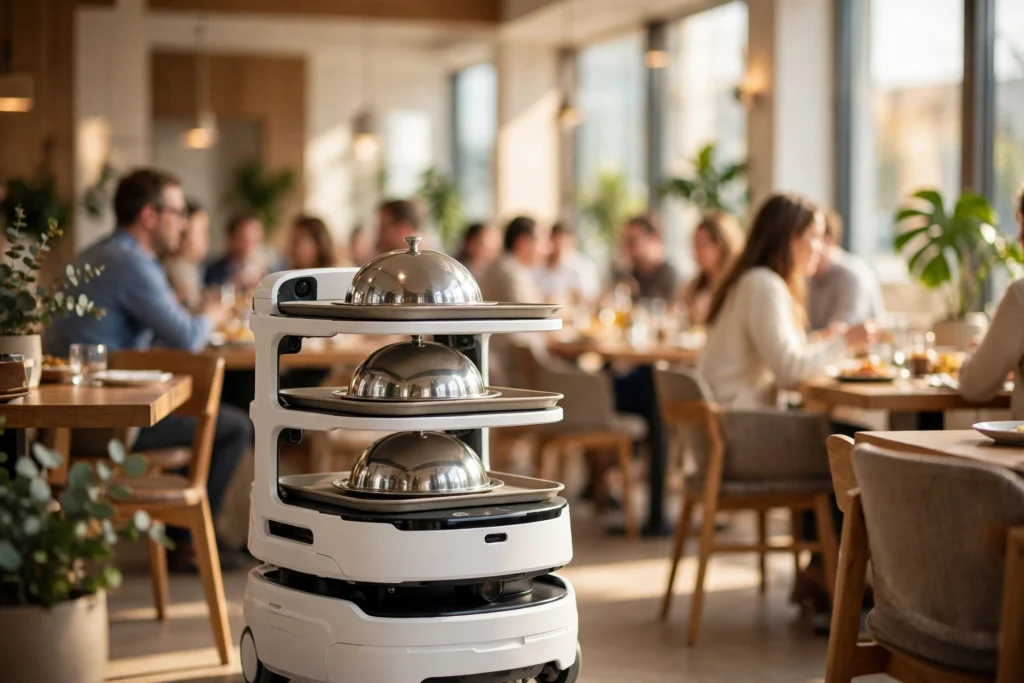
Restaurant robots work from a map of the dining room, sensors that spot people and obstacles, and software that follows a set routine: take an order, carry a dish, or clear a table. They roll along planned routes, slow down for passers-by, and return to a charging dock when their battery runs low. Staff handle the parts that need judgement.
Key Takeaways
- Restaurant robots handle repeatable jobs: delivering dishes, carrying dirty plates, and guiding guests to a table.
- They navigate with a stored map plus cameras, lidar, and bump sensors, stopping around people.
- Most robots take orders through a tablet or an app, rather than listening like a person.
- They work best in open, predictable dining rooms and struggle with stairs, spills, and surprises.
- Human staff still run the dining room. Robots are helpers, not replacements.
What do restaurant robots actually do?
A restaurant service robot is built for a small set of jobs it can repeat all evening without getting tired. The most common job is food delivery: the kitchen loads dishes onto its trays, a server taps a table number, and the robot rolls out while guests take their plates. Busser-style robots do the return trip, carrying dirty dishes back to the kitchen.
Some robots greet guests and lead them to a table, or run drinks and desserts. A few cook in a narrow sense — flipping burgers or frying chips — but most are carriers, not chefs. Like the hotel robots that deliver towels and room service, they are at their best on short, predictable trips.
How do restaurant robots take orders?
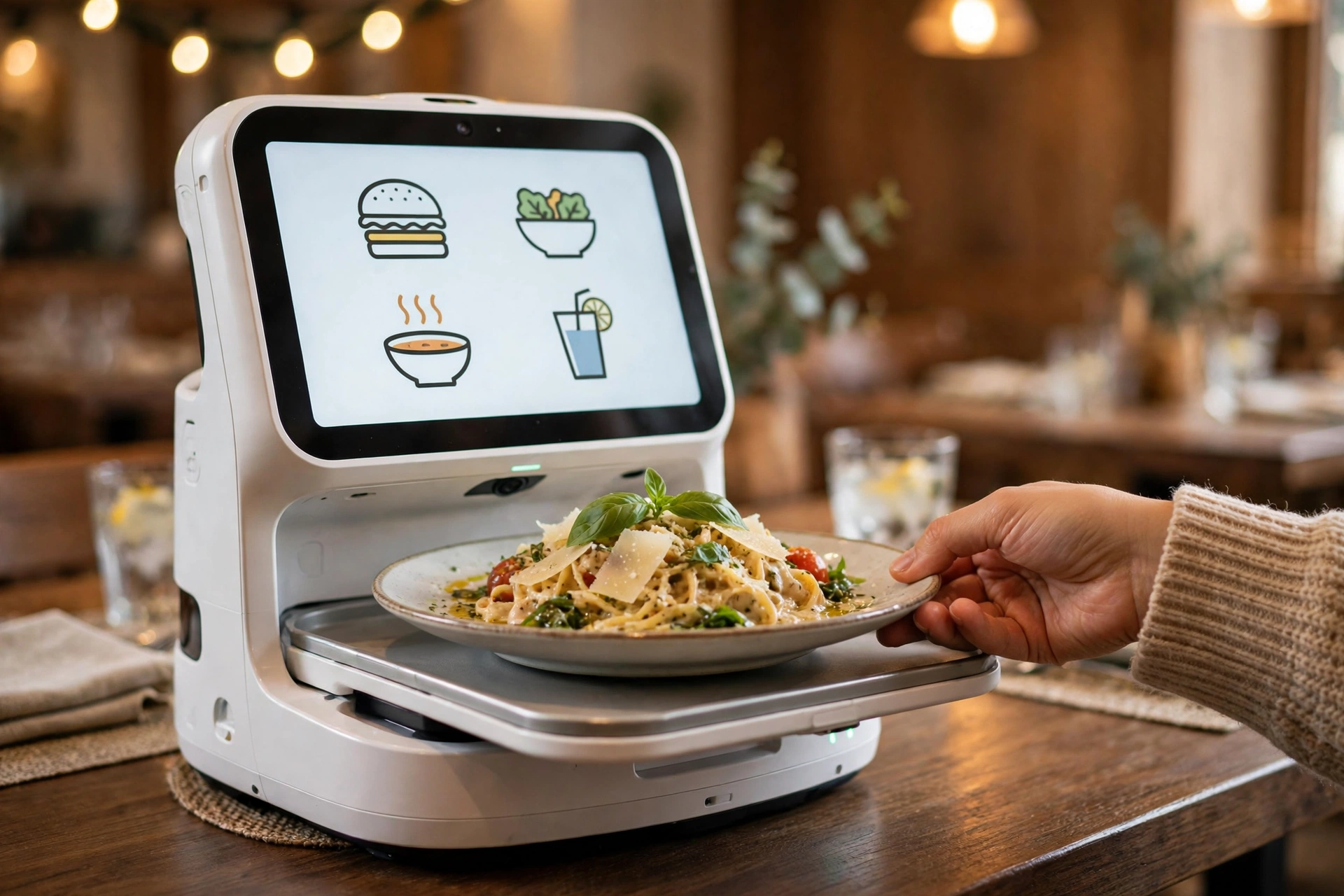
Most restaurant robots do not listen to you the way a waiter does. You order through a tablet on the table, a QR code that opens a menu on your phone, or a screen built into the robot itself. Your choices go straight to the kitchen display, cutting down on misheard orders.
A server usually still checks in at the table, because ordering is often a conversation: a guest asks whether a dish contains nuts, wants the sauce on the side, or needs a high chair. A tablet handles a standard order well, but it cannot read a hesitant face or notice an allergy worry. So the robot takes the order, and the human makes sure the order is right.
How do they find their way around a busy dining room?
Before its first shift, a restaurant robot learns the layout: staff walk it around the dining room while it builds a map with lidar, cameras, and wheel sensors. Tables, counters, and the kitchen pass are marked as fixed points, and the routes between them are saved.
During service, the robot follows those routes and watches its surroundings. Lidar measures distances, cameras spot chairs and people, and ultrasonic sensors catch low obstacles such as a bag beside a table. If someone steps into its path, the robot slows down, stops, or edges around them. If it gets stuck, it calls for help with a sound or a message, and a member of staff guides it free. The same mapping ideas show up in delivery robots that travel pavements, though a dining room is a smaller, flatter world.
What happens when a robot reaches your table?
Arrival is the part restaurants design most carefully — a robot that just stops silently would confuse everyone. When it pulls up, it usually plays a short chime, flashes a light, or shows a message such as “Your food is here — table 12.” Some trays light up to show which dish belongs to which guest.
Guests take their own plates off the tray, which takes a little getting used to. When the tray is empty, you tap a button, or the robot waits a few seconds and rolls back to the kitchen. That return trip is when a busser robot earns its keep: stacked trays of used plates are heavy and awkward for staff to carry, and the robot never minds the weight.
How do robots help in the kitchen?
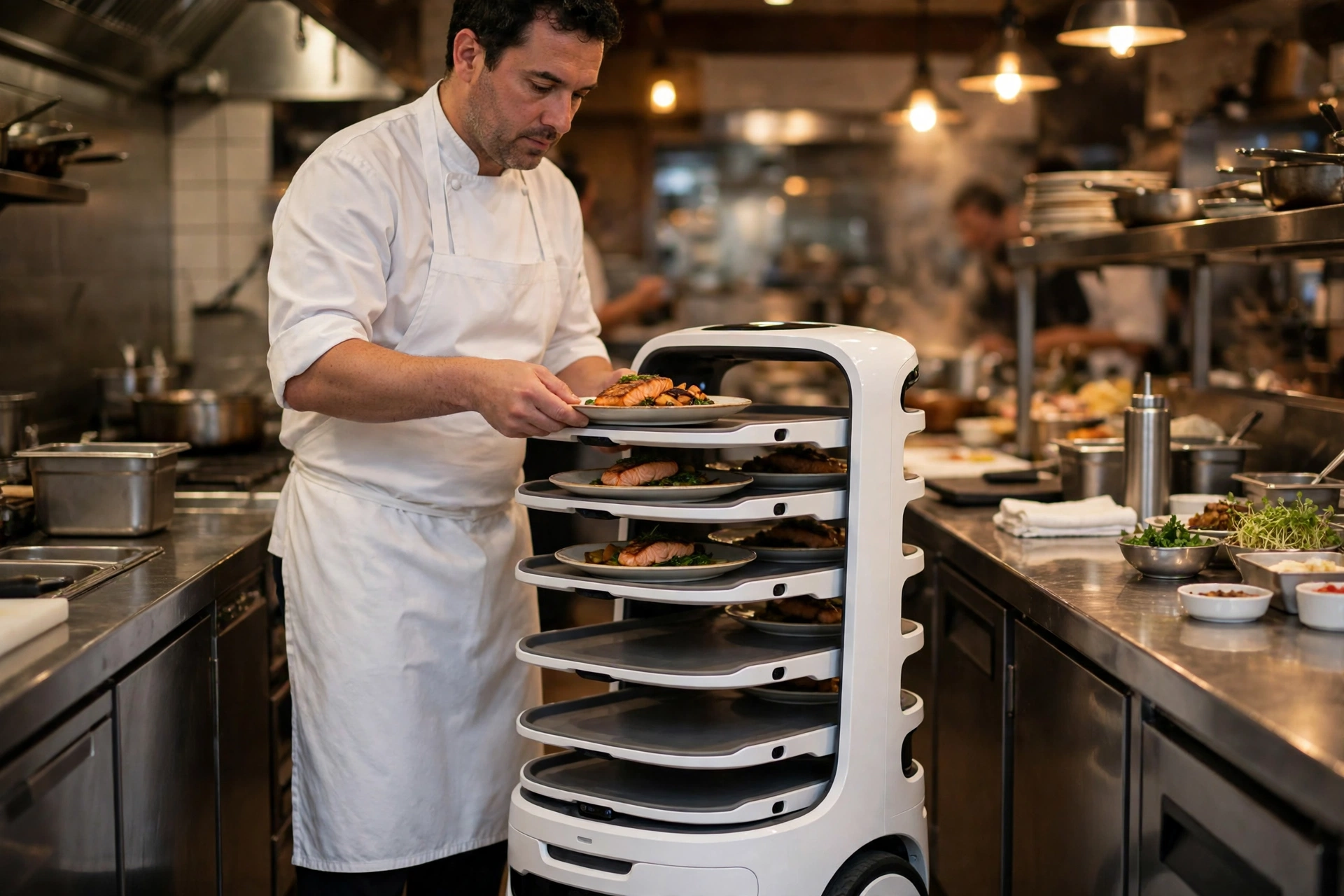
In the kitchen, robots mostly move things. A compact arm can pass plates from the pass to a tray, and a mobile robot can ferry ingredients from storage to a prep station. A few specialist machines do actual cooking tasks, such as flipping burgers. These jobs suit machines because they are hot and repetitive. You can read about the wider family of kitchen machines in our guide to cooking robots.
Even so, a kitchen robot cannot taste a sauce or improvise when an ingredient runs out. Chefs still decide, adjust, and plate, while the robot takes over the carrying and the repeating. The arms that load trays borrow from factory robotics and robot arms.
What can’t restaurant robots do yet?
Stairs are the biggest barrier. Most restaurant robots roll on wheels, so a dining room split across two floors, or a single step up to a raised area, can block them completely. Some venues install ramps, but many older buildings simply cannot use them.
Spills are another limit: a robot can detect a wet floor and stop, but it cannot mop it up. Crowds also test them — a packed dining room leaves little room to pass, and a robot that stops every few seconds slows service down instead of speeding it up.
Then there is the human side. A robot can deliver a plate, but it cannot remember your favourite table or smooth over a mistake with a smile. Restaurants that use robots well keep people doing the work that makes a meal feel special.
FAQs
Do restaurant robots cook food?
Mostly no. The majority carry food, clear tables, or guide guests. A few specialist machines fry or flip simple dishes, but the cooking is still done by people.
Do you tip a restaurant robot?
No. Tipping customs apply to human staff, so any tip you leave should go to the people serving you, not the machine.
Are restaurant robots safe around children?
They are designed to be: they move slowly, stop when something blocks their path, and have soft edges and bump sensors. Even so, children should not climb on them or chase them.
Why do some restaurants use robots?
The usual reasons are staff shortages, consistency, and the fact that carrying trays back and forth is tiring work. A robot can make the same trip all evening without slowing down, freeing staff to spend more time with guests.
Will robots replace waiters?
Not any time soon. Robots are good at carrying and repeating; they are poor at listening, judging, and making guests feel welcome. In restaurants that use them, robots handle the trips and people handle the service.
Conclusion
Restaurant robots work because they stick to what machines do well: following a map, carrying a load, and repeating the same trip. They take orders through a screen and navigate with sensors while staff focus on guests. They cannot climb stairs, clean up a spill, or replace a warm welcome — and that is the point. If you spot one on your next meal out, watch how it pauses for people — a small, practical glimpse of robots in everyday life. And if you run a restaurant, the sensible first step is a trial: one robot, one route, one busy weekend, and then decide whether it genuinely helps your team.