
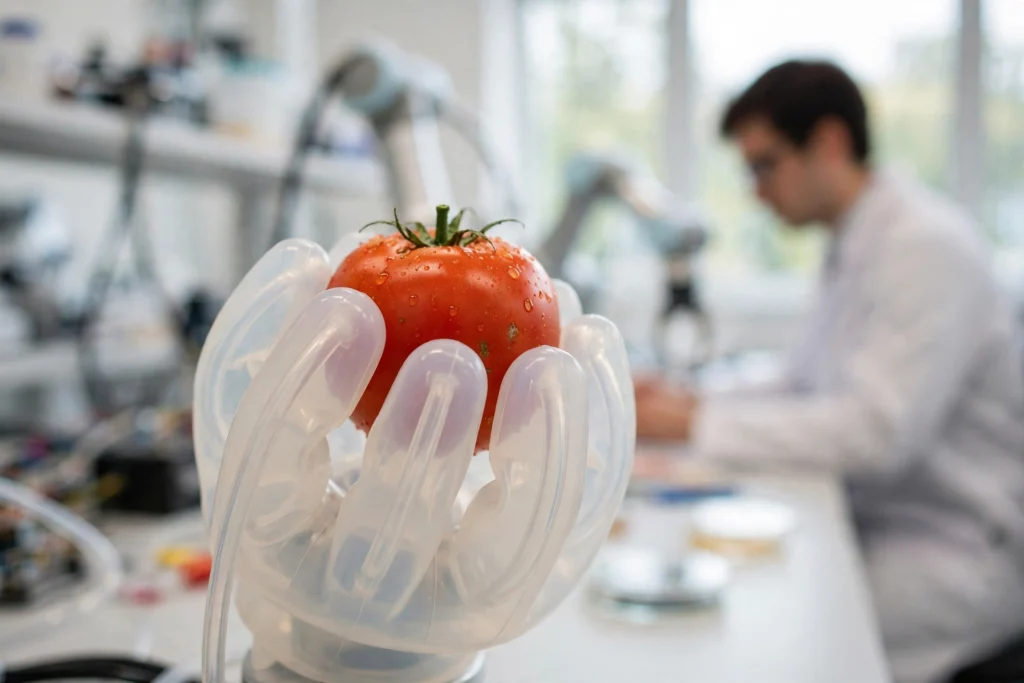
Soft robots work by bending and stretching flexible materials instead of swinging stiff metal joints. Pumps push air or liquid into soft chambers inside the body, and the robot curls, grips or crawls as those chambers inflate. The body itself is the mechanism, so it can hug a tomato without bruising it or squeeze through gaps a metal arm never could.
Key Takeaways
- Soft robots are built from silicone, rubber, fabric and gels, not steel.
- They move when air or fluid inflates chambers inside their bodies.
- Soft grippers mould around objects and handle fragile things gently.
- They are used in surgery, food handling, underwater research and rescue.
- Their trade-offs are weaker force, trickier control and a shorter working life.
What makes a robot “soft”?
A robot counts as soft when most of its body is made from compliant materials — substances that give way under pressure and spring back. Silicone rubber is the workhorse, with stretchy fabrics and water-filled gels also in use. The contrast with a conventional robot arm is stark: a steel arm has joints that rotate by fixed amounts, while a soft body has no real joints at all. It bends everywhere at once, like an elephant’s trunk or an octopus arm.
That flexibility changes what the robot can safely touch. A metal gripper must stop at exactly the right force, or it crushes what it holds. A soft gripper spreads its pressure across a wide, squishy surface, so mistakes are far more forgiving. Nature is the obvious inspiration, and the fuller background is on Wikipedia’s soft robotics page.
How do soft robots move?
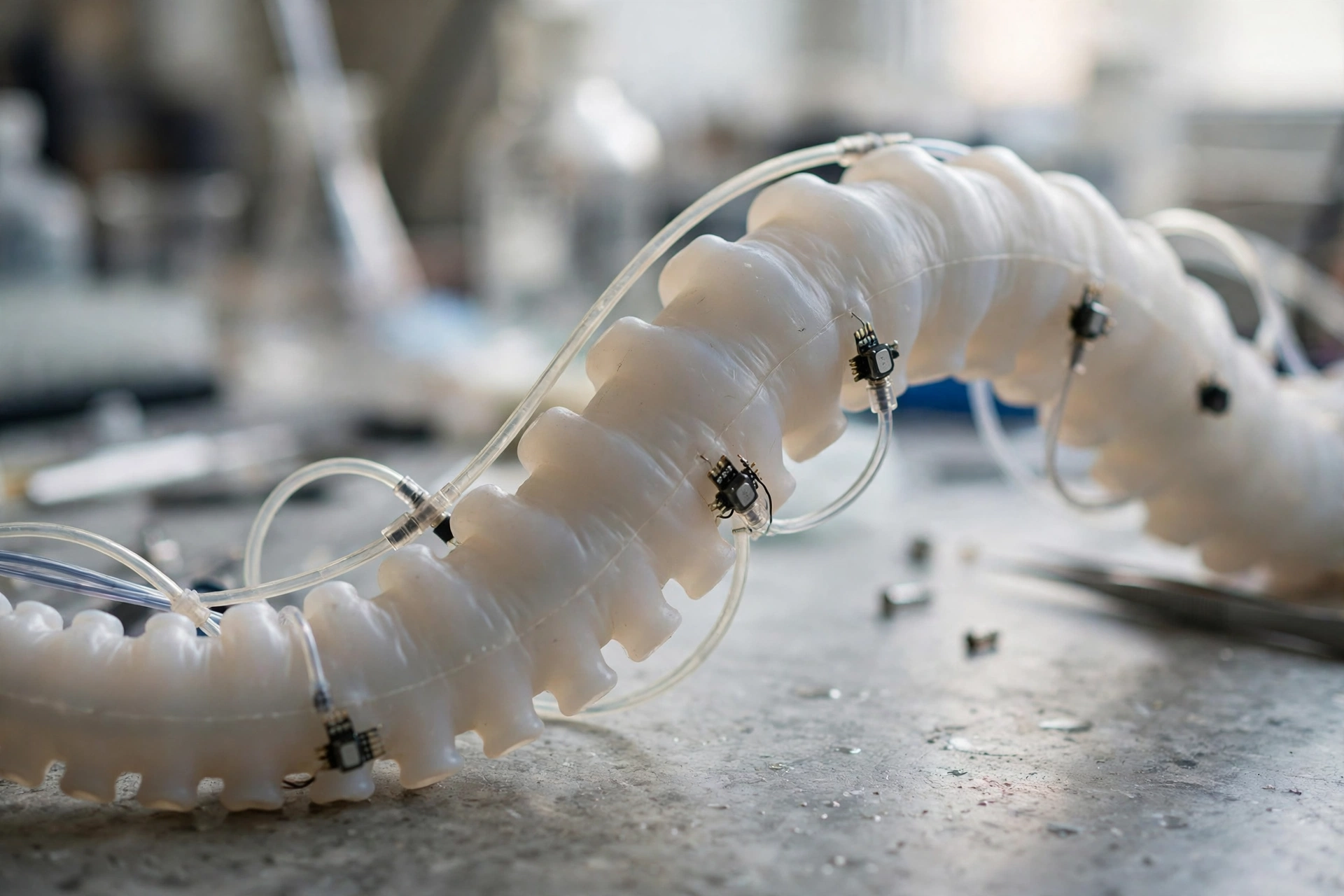
The most common trick is the pneumatic artificial muscle. Inside a soft limb sit hollow chambers, each connected to a thin air tube. A pump raises the pressure in one chamber, the silicone wall bulges, and the limb bends away from that side. Inflate the chambers in sequence and the limb curls, twists or crawls forward; let the air out and it relaxes back. Some use liquid instead of air, or thin cables pulled like a puppet’s strings.
Control is the hard part. A steel arm’s position can be calculated from its joint angles with simple geometry. A soft limb bends in a smooth curve that depends on pressure, load, gravity and how the material has aged, so the maths gets messy fast. Many soft robots therefore rely on feedback from built-in sensors rather than exact calculations, constantly adjusting pressure until the limb is where it should be.
How do soft robots sense and grip?
A soft robot needs soft senses to match its soft body. Stretch sensors made from rubber filled with conductive particles change their electrical resistance as they are pulled, telling the controller how far a limb has bent. Pressure sensors in a gripper’s fingertips report how hard it is squeezing. Together these signals let the robot feel its way around an object instead of relying on cameras alone.
Gripping is where soft robots genuinely shine. A classic soft gripper has three or four silicone fingers with air chambers inside. Pump them up and the fingers curl inward, wrapping around whatever sits between them. Because the fingers deform, they meet an oddly shaped object across a large contact area, spreading the force so nothing gets dented or bruised. The same gripper can pick up a strawberry, a light bulb and a spanner in turn without changing tools. The same gentle touch suits medicine: robotic prosthetics and soft exosuits sit comfortably against skin.
Where are soft robots already used?
Surgery is one of the most promising areas. Soft instruments can snake through the body along winding paths, reaching places a straight metal tool cannot, and their gentle touch lowers the risk of damaging nearby tissue. Trials are under way, though most are still experimental.
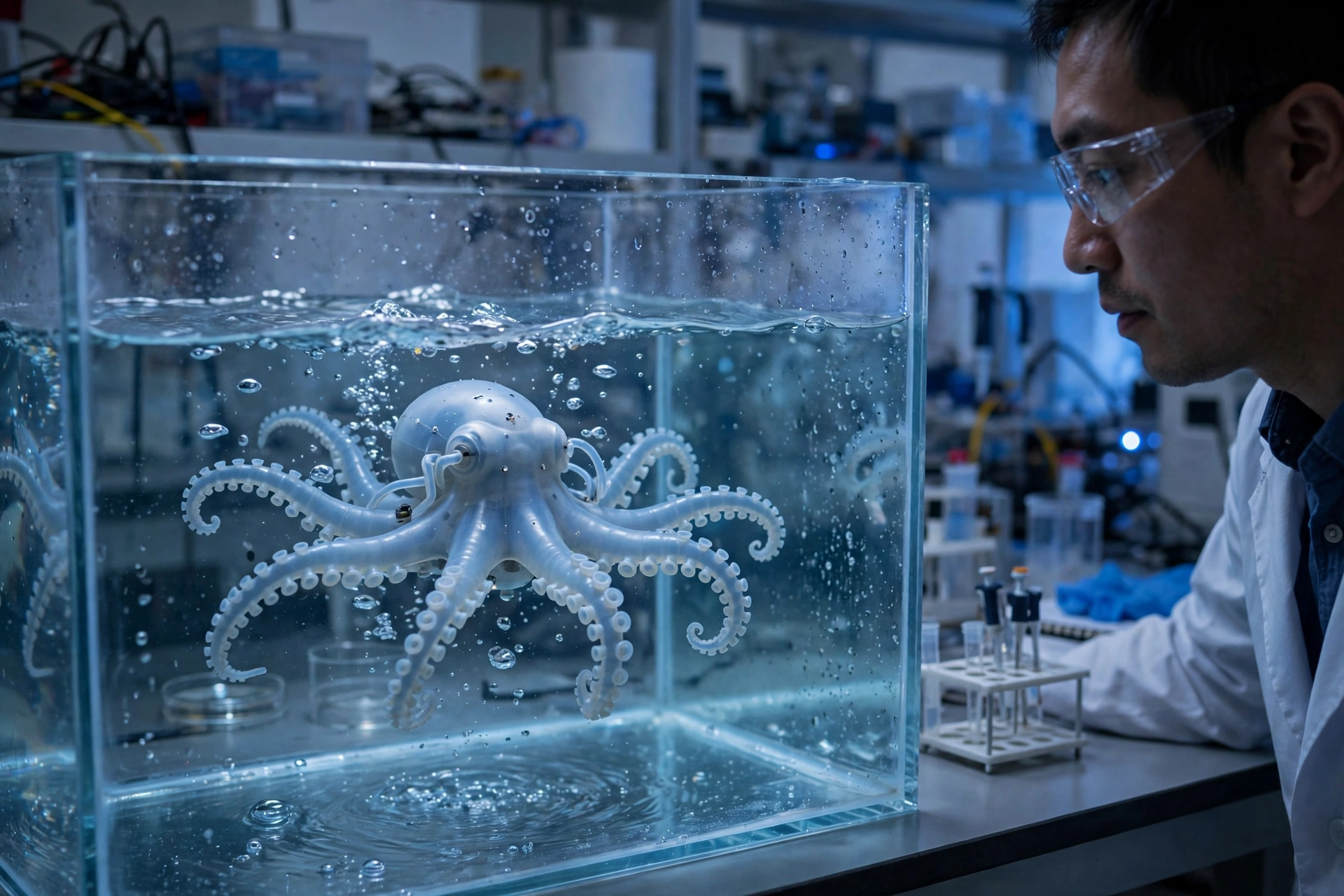
Food handling is further along. Packing lines use soft grippers to lift fruit, bread and eggs without marking them, and the same grippers cope with the natural variation in size and shape that makes rigid automation struggle. Underwater research is another fit: octopus-inspired soft robots can drift over a coral reef and take samples without scraping it.
Rescue teams value the squeezing: after an earthquake, a soft robot can crawl through rubble gaps too narrow for a person, carrying a camera to look for survivors. Wearable soft robots help people rather than replacing them: soft exoskeleton robots support a worker’s back or a patient’s legs with fabric and air muscles instead of a heavy metal frame.
What holds soft robots back?
Force is the biggest limit. A silicone limb can only push as hard as its material allows, and too much pressure makes it burst or tear. That rules soft robots out of heavy lifting for now — you will not see one welding a car body or stacking pallets any time soon. Precision is the second problem: a soft limb’s tip can wander by a centimetre or more — fine for fruit, useless for microchips.
Durability and power are the other concerns. Silicone fatigues with repeated stretching, air tubes can leak, and a sharp edge can puncture a chamber. Most soft robots also stay tethered to an external pump and compressor, which limits how far they can roam. None of this makes soft robots a dead end — it marks out where they make sense. Rigid machines keep the heavy, precise work: humanoid robots need rigid frames and powerful motors to walk and carry things, while soft robots win where delicacy, safety and squeezing into tight spaces matter more. The Britannica robotics overview covers both traditions.
Frequently asked questions
Are soft robots made entirely of rubber?
Not always. Most are mainly silicone or rubber, but many include rigid parts where it helps — a small pump, a camera, or a stiff spine inside a soft body.
Can a soft robot lift heavy objects?
Only light ones, for now. A typical soft gripper handles items weighing a few hundred grams to a couple of kilograms. Heavier loads still belong to rigid arms.
Are soft robots safe to work beside people?
They are among the safest robots to share space with. Their bodies give way on contact, so a bump feels more like a nudge from a cushion than a strike from a metal arm.
How are soft robots controlled?
Mostly by varying air or liquid pressure through valves, guided by feedback from stretch and pressure sensors. Controllers use sensor readings and learned models rather than the exact geometry rigid robots rely on.
Will soft robots replace normal robots?
No — they fill gaps rigid robots handle badly. Factories will keep steel arms for heavy, precise work, while soft robots take on delicate handling, medical tools and exploration.
Conclusion
Soft robots work by turning pressure into shape: air or liquid fills soft chambers, the body bends and grips, and sensors report back so the controller can adjust. They are weaker and less precise than steel machines, but they are safer around people and far gentler with fragile things. That makes them a practical tool, not just a curiosity.
The best next step is to watch one in action: a soft gripper handling fruit, or an octopus robot swimming. Once you have seen the whole body move at once, the difference from rigid robotics stops being abstract.