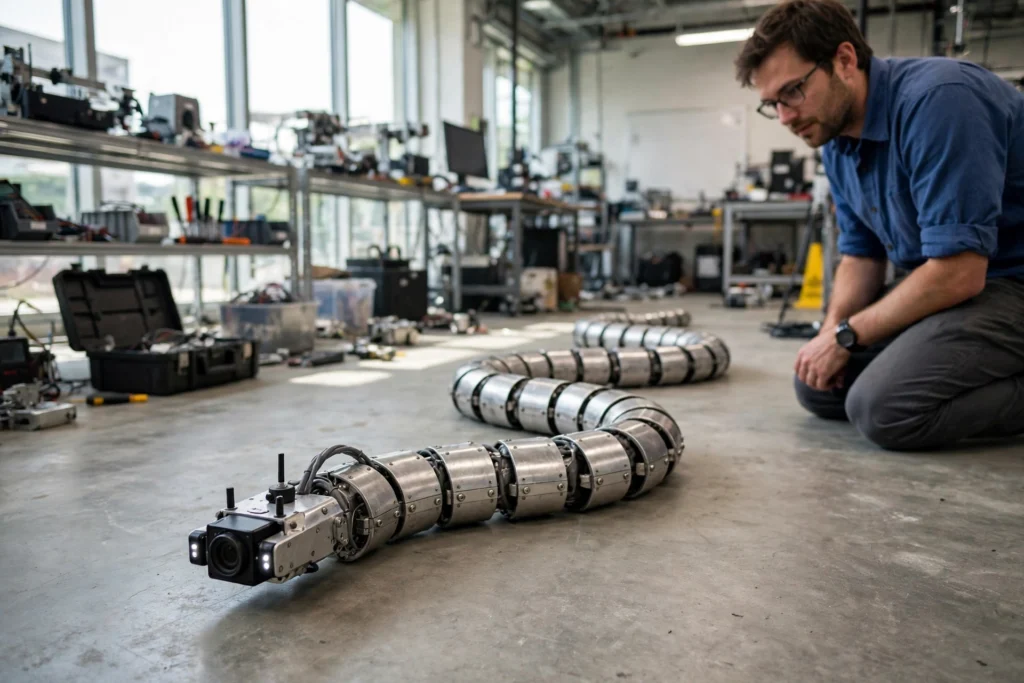
Snake robots work by linking dozens of small segments into one long, flexible body. Motors in each joint bend the chain into waves, so the robot slithers forward the way a real snake does. Cameras, touch sensors and a controller in the head guide it through rubble, pipes and other tight spaces where wheels and legs cannot go.
Key Takeaways
- A snake robot is a chain of identical segments, each with its own motor and joint.
- It moves by bending its body into waves, pushing against the ground or walls.
- Cameras, touch sensors and sometimes lidar in the head tell it where to go.
- They are used in search and rescue, pipe inspection and space exploration research.
- Their trade-offs are slow speed, limited strength and complex control.
What is a snake robot made of?
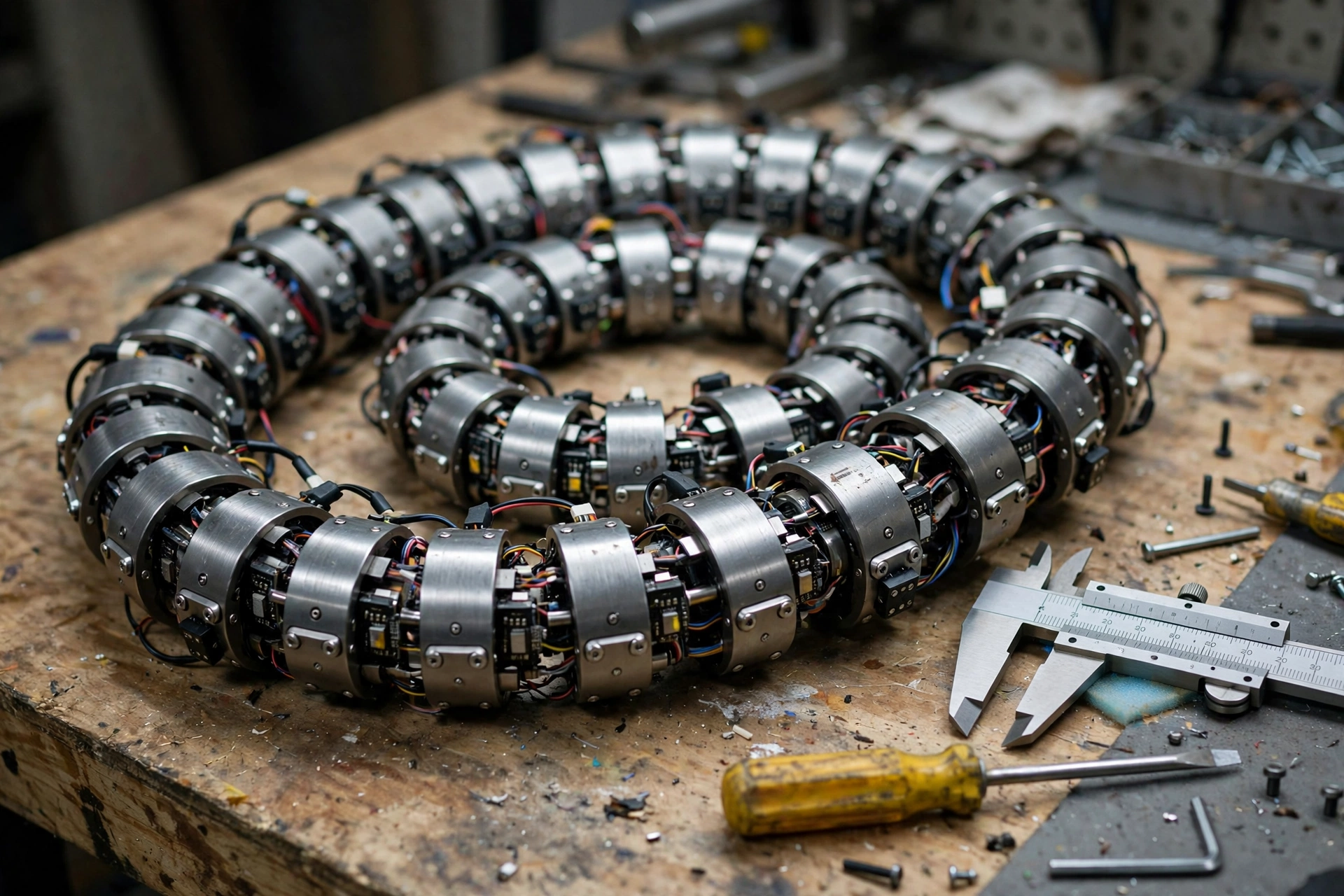
Picture a bicycle chain, then imagine every link is a small machine of its own. Most designs join ten to twenty identical segments end to end, each holding a motor, a joint, a small circuit board and wiring that runs the length of the body. The head segment carries the camera, lights and main sensors, while the tail may hold the battery or a tether connection.
The segments matter because they share the work. A wheeled robot has one body and a few motors; a snake robot spreads its motors along its whole length, so no single joint does all the bending. If one segment fails, the rest can often keep going.
How do snake robots move without legs or wheels?
A real snake has no legs, yet it crosses sand, climbs rocks and swims. It does this by changing its body shape in repeating patterns called gaits, and snake robots copy that trick. The controller sends a wave of small bends down the body, each joint turning slightly after the one before it. The curves press against the ground, and that push moves the robot forward, a pattern called lateral undulation.
Climbing is where things get clever. A snake robot can wrap itself around a pole or brace against both walls of a narrow shaft, gripping like a climber wedged in a chimney, then inch upward. It is slow, but no wheeled machine can do it at all.
Steering is the hardest part of the whole design. With dozens of joints, the controller must set every angle many times a second. Early snake robots were steered by a person with a joystick, watching the camera feed. Newer ones plan their own path from sensor maps.
How do snake robots see and sense their surroundings?
The head is where most of the sensing happens. A small camera gives the operator a view of what lies ahead, and LED lights brighten the darkness inside rubble or pipes. Many heads also carry lidar, which fires laser pulses and measures how long they take to bounce back, building a rough three-dimensional map of the space around the robot.
Touch matters just as much as sight. Force sensors in the segments report how hard the body is pressing against a wall or the ground, so the controller knows when to push harder and when to ease off. Some designs add temperature or gas sensors, which can pick up signs of a person trapped under rubble or a leak inside a pipe.
Where are snake robots used today?
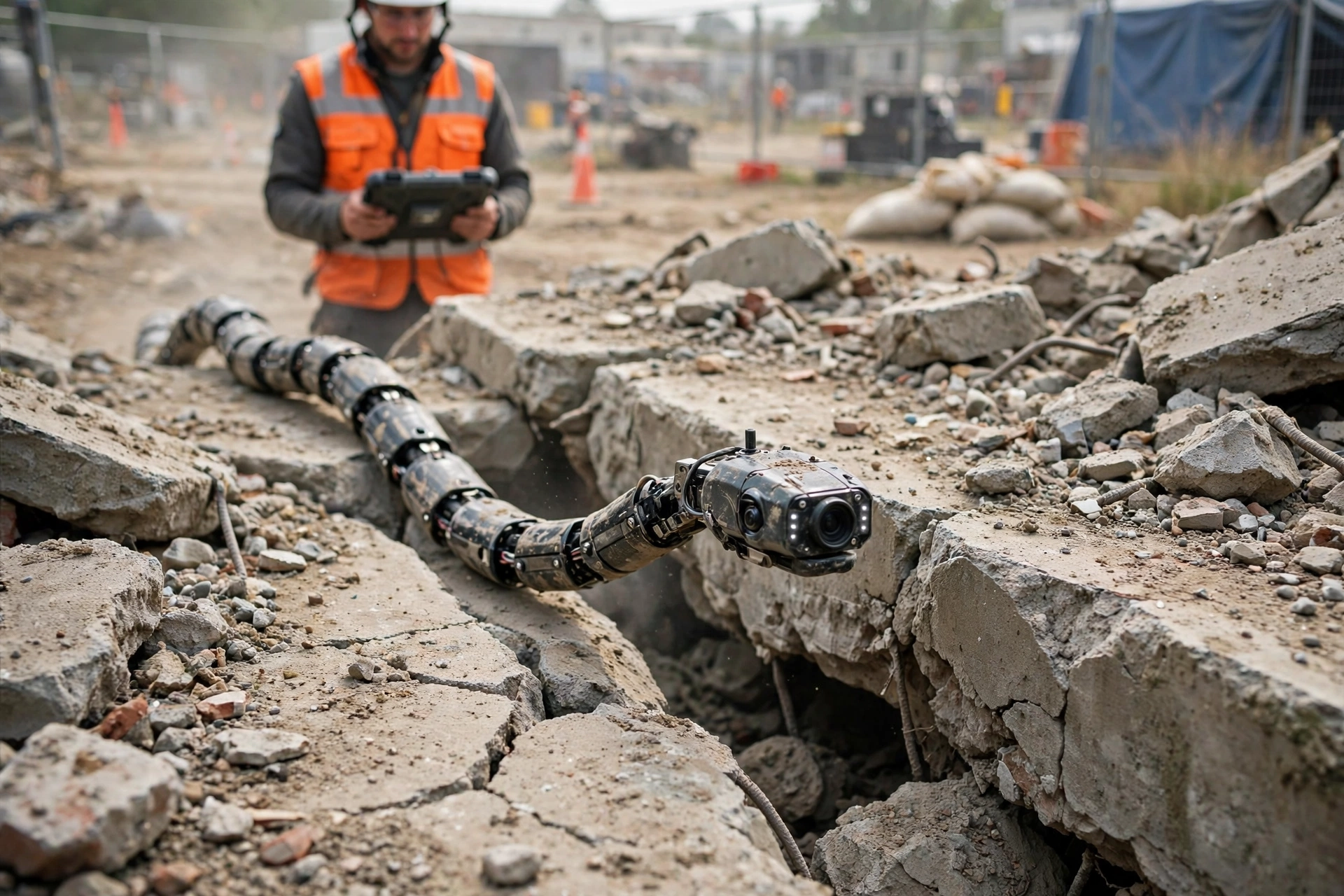
Search and rescue is the best-known job. After an earthquake in Mexico City in 2017, a snake robot from Carnegie Mellon University was sent into the rubble to look for survivors. A person could not fit through those gaps, and a wheeled robot could not climb the broken slabs, but the snake robot threaded its way in with a camera.
Inspection is the everyday use. A snake robot can crawl along a pipeline checking for cracks, or slide through a ventilation duct, reaching places too narrow for people and most machines.
Space agencies are watching the idea closely. NASA’s Jet Propulsion Laboratory is developing EELS, a snake-like robot meant to explore the icy moon Enceladus by descending narrow vents in its surface, where a wheeled rover would get stuck. The Wikipedia overview of snake robots lists these and other uses, and NASA’s own report on EELS explains how the robot maps its surroundings and picks its own route.
What limits snake robots?
Speed is the first limit. A snake robot crosses open ground far more slowly than a wheeled robot, so it is the wrong tool for covering distance. It earns its place only where the path itself is the problem.
Strength is the second. Dozens of small motors add up to a lot of weight and power draw, yet none of them is individually strong. A snake robot cannot lift heavy objects or push through thick debris. A robot arm does that job far better, and soft robots handle delicate gripping with a gentler touch.
Control is the third and trickiest limit. Coordinating twenty joints in real time takes serious computing, and mistakes can wedge the robot into a gap. That is why most snake robots today still have a human operator watching the camera feed, stepping in when the robot’s own judgement falls short. Cost rounds out the list: each segment is a small robot in its own right, so a snake robot has far more parts than a wheeled machine of the same size. That keeps them in specialist roles for now — rescue teams, inspection crews and research labs. Underwater robots face a similar trade-off, using a snake-like body only where a propeller-driven vehicle cannot reach.
Frequently asked questions
Are snake robots real or still experimental?
Both. Working snake robots already inspect pipes and help in rescue training, and one was used after a real earthquake in 2017. The more ambitious versions, like NASA’s EELS, are still in testing and are not part of any mission yet.
Can a snake robot climb?
Yes, in the right setting. It can wrap around a pole or brace itself between two walls and inch upward. It is slow and needs a lot of grip, so it works best in narrow shafts and on rough surfaces rather than on smooth, open walls.
How long can a snake robot be?
Research models are usually between one and four metres long, made of ten to twenty segments. Longer bodies reach further and bend more smoothly, but they are heavier, harder to power and more difficult to control.
Will snake robots replace search dogs?
No. Dogs are faster, cover far more ground and can smell a person through rubble in ways no sensor yet matches. Snake robots are a different tool: they go into gaps too small or too dangerous for a dog or a person, and they send back pictures from inside.
Conclusion
Snake robots work by turning a chain of small motors into a body that bends, grips and slithers where wheels cannot follow. Their cameras and touch sensors guide them through rubble, pipes and narrow shafts, and their modular build keeps them going even when a segment fails. They are slow and costly, so they will stay in specialist jobs rather than replacing everyday machines.
The best next step is to watch one move: search for footage of a rescue snake robot in a rubble pile, or of NASA’s EELS testing on sand and ice. Once you have seen the whole body ripple forward, the idea stops being abstract.