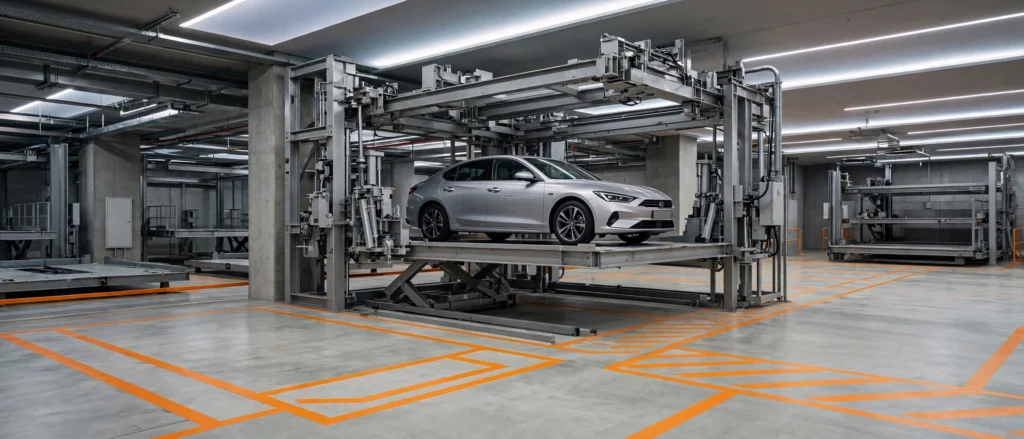
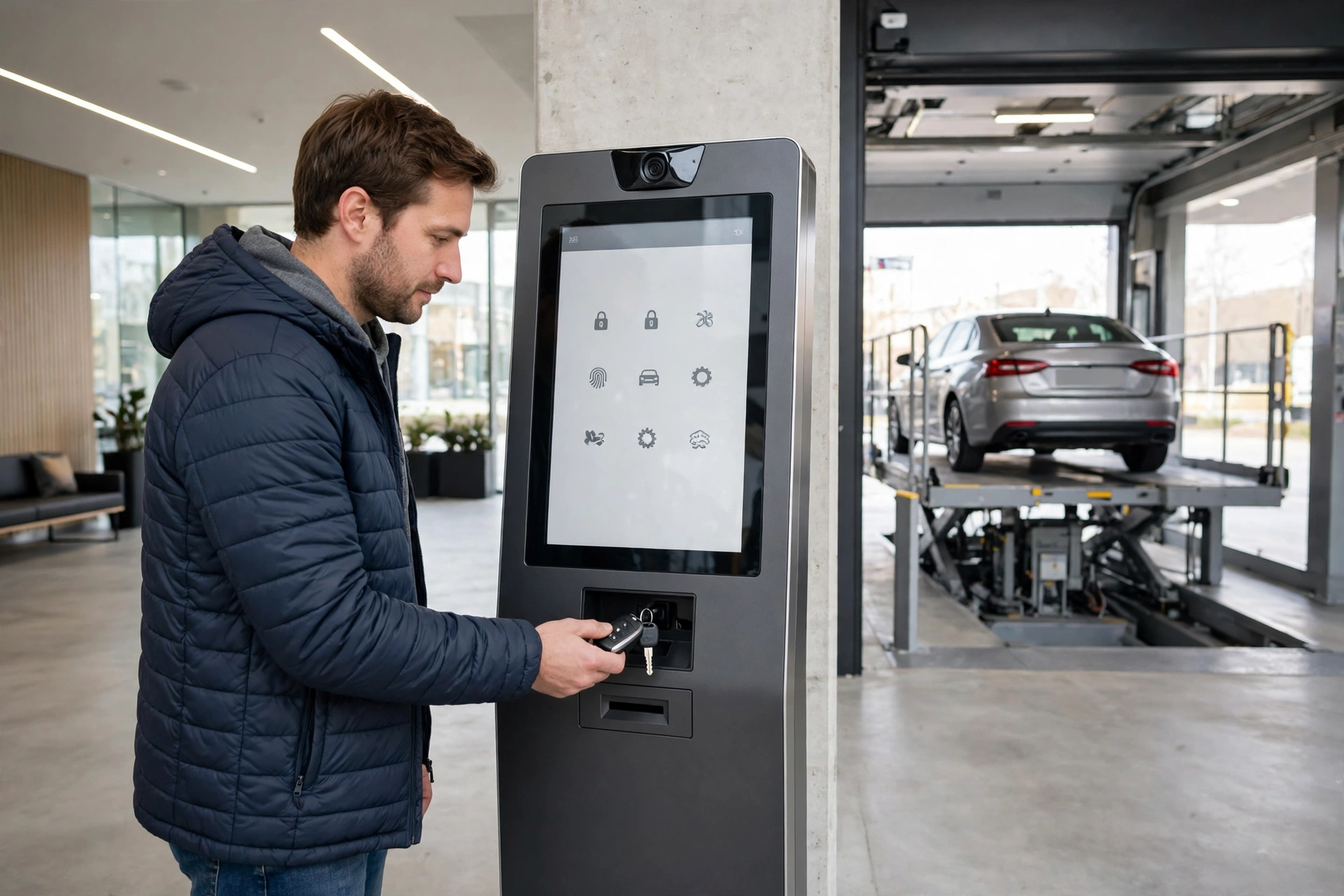
Parking robots work by taking your car at the entrance of a garage, lifting it onto a platform or pallet, and carrying it to a storage slot with lifts, conveyors, and sensors — no driver needed inside. You hand over the keys or tap a screen, and the system does the rest.
Key Takeaways
- Parking robots move cars with platforms, lifts, and shuttles instead of letting drivers hunt for a space.
- Sensors measure each car, check the way is clear, and stop the system if anything is in the wrong place.
- Cars sit closer together because the garage needs no driving lanes, ramps, or room for doors to open.
- Retrieval usually takes a few minutes, and your car is normally returned facing the exit.
- These systems suit steady traffic like offices and hotels better than sudden rushes like stadiums.
What exactly is a parking robot?
A parking robot is not one machine. It is a whole system: a transfer bay where you leave the car, a lift or shuttle that moves it, and software that remembers where every car sits. Some systems use a flat robot that slides under the car and carries it, a bit like a forklift on wheels. Others use a fixed platform — the car drives onto a pallet, and the pallet is lifted and slid into a rack. Mechanical garages date back to the early 1900s; modern sensors and software make them practical today. You can read a fuller history on Wikipedia’s automated parking system page.
How does a parking robot move a car?
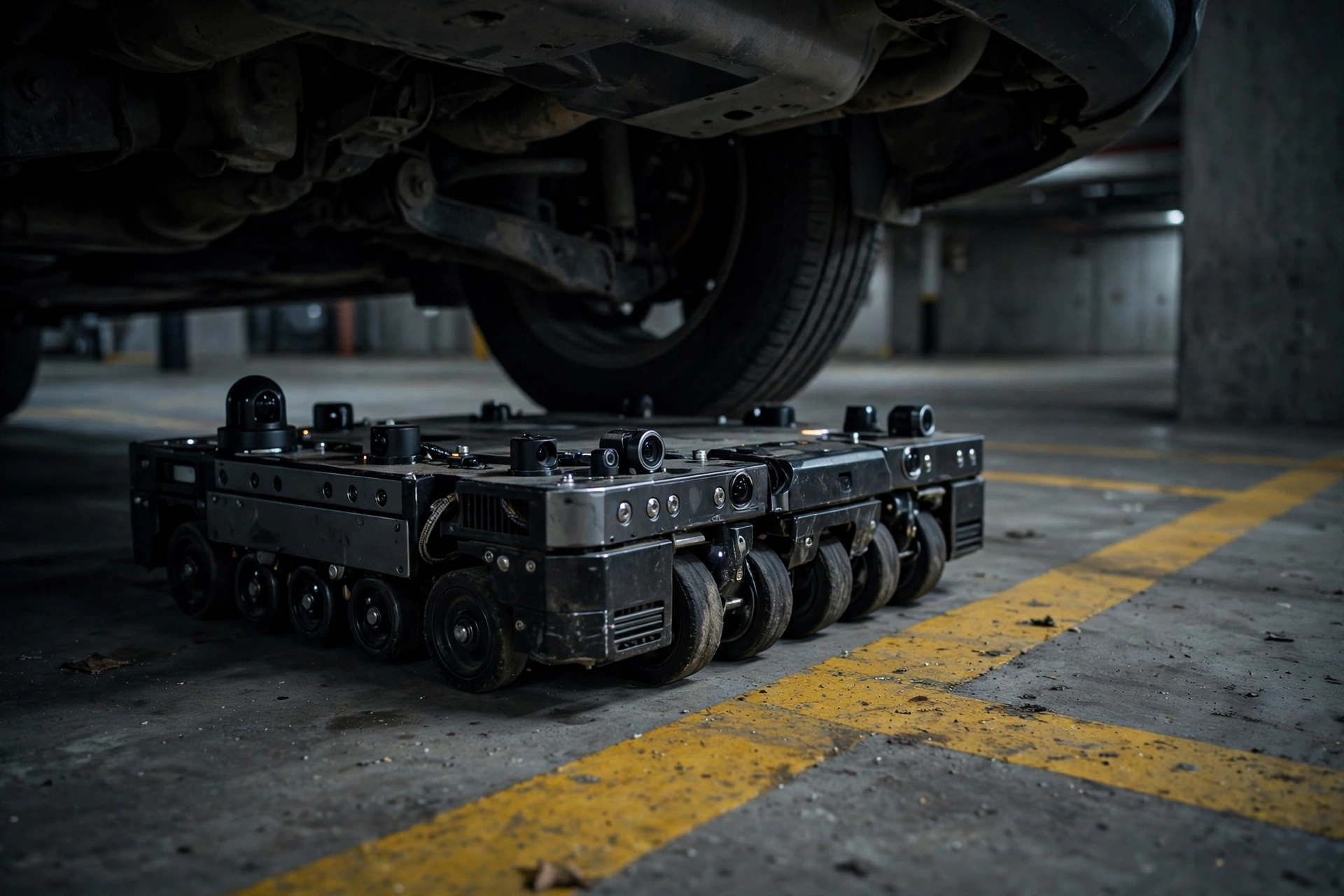
You stop on a marked platform in the transfer bay and get out. Sensors scan the car to check its length, width, and height, and to make sure nothing is left hanging out — a roof box, a bike rack, or a door left ajar can all cause a problem. In a shuttle system, a flat platform slides under the car, lifts it by the wheels, and drives it to a lift, which carries it to the right floor. In a pallet system, the car stays on its platform: a crane picks up the pallet and slots it into a rack, a bit like a warehouse storing boxes. Warehouse robots work in a similar way, moving pallets through tight aisles instead of cars. Either way, the car never drives itself — the robot does the moving, and the engine stays off.
What sensors do parking robots use?
Sensors are the system’s eyes. Cameras and laser scanners measure the car and map the bay. Weight sensors confirm the car is fully on the platform before anything moves. Proximity sensors watch for people, pets, or objects that should not be in the bay, and the system will not start while anything is detected.
Inside the garage, position sensors track exactly where each lift and shuttle is. If a shuttle is even slightly out of place, the software stops it and flags the fault. That certainty matters with a car weighing well over a tonne. Robot arms in factories use the same idea — sensors first, movement second.
Why do parking robots save so much space?
A normal car park wastes a surprising amount of room. Each space needs extra width so doors can open, plus driving lanes, ramps, and walkways for people. An automated garage removes almost all of that: cars sit closer together because nobody opens a door inside, ceilings can be lower because nobody walks between the parked cars, and ramps disappear because lifts do the vertical work.
The result is that the same building footprint can hold noticeably more cars — sometimes roughly twice as many. That is why these systems show up where land is expensive: city centres, airports, and hospitals. Airport robots face the same space pressure, moving luggage and guiding travellers through crowded terminals.
What happens when something goes wrong?
If a sensor reports something odd, the system stops that section and alerts an operator. Many garages keep a manual override so staff can move a car out by hand if the machinery fails. The most common problems are ordinary ones: a car that is too tall or too wide, a driver who leaves the handbrake off, or something left on the roof. That is why the entry scan matters — catching a problem at the door is far easier than fixing it three floors up.
On safety, the system is gentle with your car: nobody can open a door into it or scrape it while squeezing past, and the garage is closed to the public, so theft and vandalism are harder. The main downside is the wait — a fault or a busy peak can leave you waiting, so check how a garage handles faults and peak demand before relying on it for a tight schedule.
Where are parking robots used today?
You will find them most often where space is tight and traffic is steady: city-centre car parks, hospitals, hotels, office buildings, and airports. Japan has used automated parking for decades, and the idea has spread to Europe, the Middle East, and parts of North America.
They are less suited to places with sudden surges — a stadium emptying after a match, for example — because the lifts can only move so many cars per hour. If you want a broader view of how robots sense and move, Britannica’s robotics overview is a good starting point, and delivery robots show the same navigation ideas working out on the pavement.
FAQs
How long does it take a parking robot to return your car?
Usually a few minutes, depending on storage depth and how many people are collecting cars.
Can parking robots handle large cars and SUVs?
Limits vary by garage. The entry scan measures your car and will refuse it if it is too tall, too wide, or too heavy.
What happens if the power goes out while my car is parked?
The system stops safely and holds the car in place. Garages usually have backup power or a manual recovery procedure, but retrieval may be delayed.
Do parking robots work with electric cars?
Generally yes, though charging is a separate question. Some include charging points in their slots; others do not charge at all.
Are parking robots used in homes?
Rarely. A home version exists in some luxury developments, but the cost and machinery make it impractical for most houses.
Conclusion
Parking robots work by combining a simple idea — move the car instead of the driver — with careful sensing and software. You leave the car at the entrance, the system measures it, lifts it, and stores it in a tight slot, then brings it back facing the exit when you ask for it. The payoff is more cars in less space and fewer scrapes, at the cost of higher build prices and slower retrieval at peak times.
If you are curious, next time you visit a city-centre garage or airport car park, look for the transfer bay signs and size limits at the entrance. Trying one once will tell you more than any description.