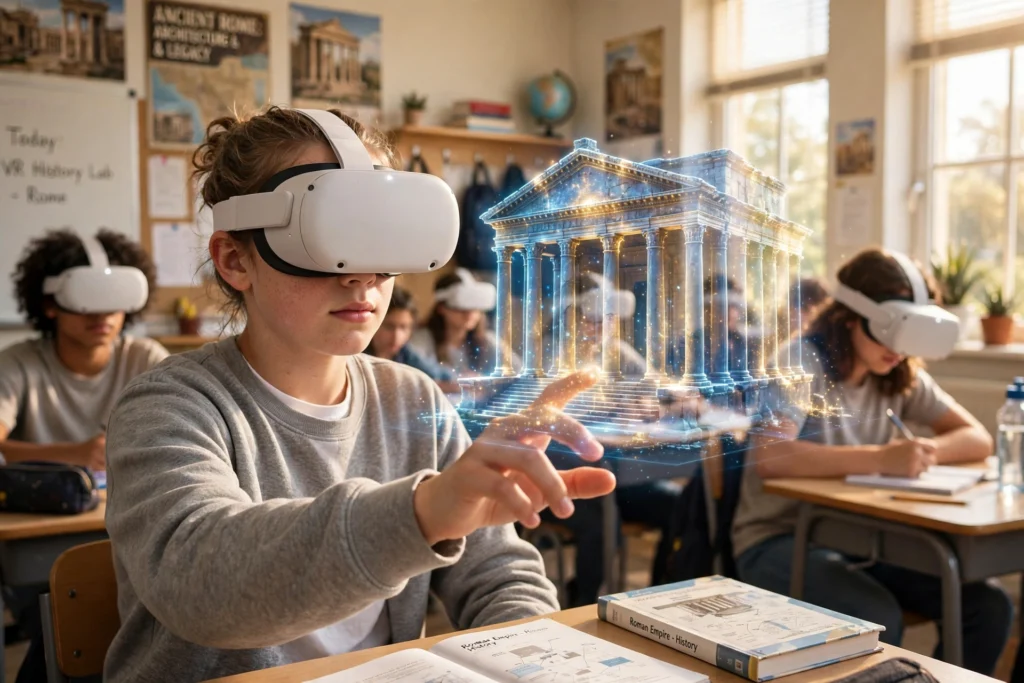
VR history lessons put students inside the past instead of asking them to picture it from a page. A headset replaces the classroom with a three-dimensional scene — a Roman street, an Egyptian temple — and tracks the student’s head and hands as they explore. The teacher still leads; VR simply gives the class somewhere to stand.
Key Takeaways
- A VR history lesson is a guided visit to a place or object, not a film played inside a headset.
- It works best for scale, distance, and fragile objects students could never handle.
- Reconstructions mix what historians know with educated guesses, and good lessons say which is which.
- Short, focused sessions with discussion afterwards beat long, unguided wandering.
What does a VR history lesson actually look like?
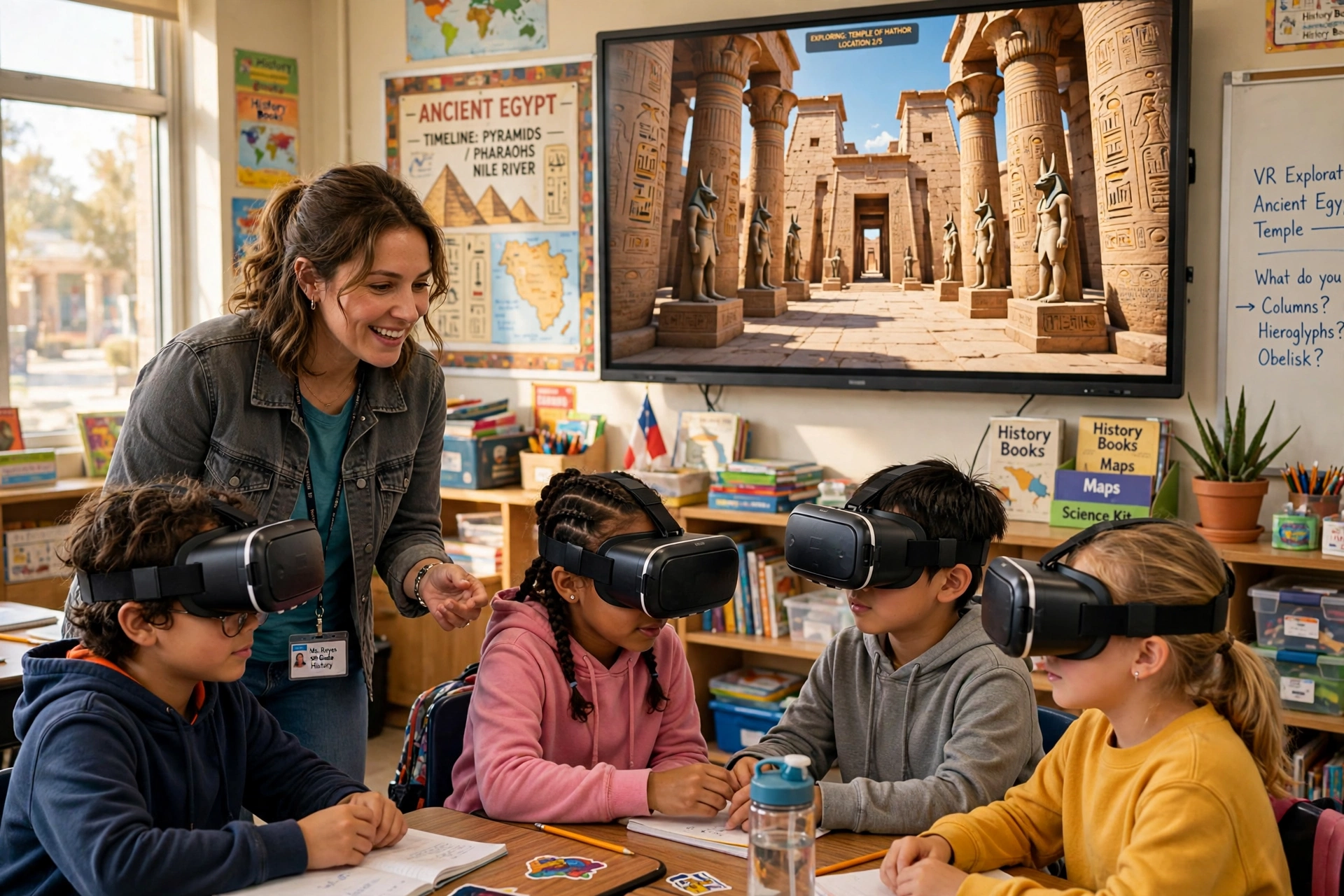
In many classrooms, one or two headsets are shared while the rest of the class watches on a screen. The teacher picks a scene — say, the forum of ancient Rome — and walks the class through it, stopping at a temple, a market stall, or a piece of graffiti. Everyone sees the same place at the same time, and the teacher can pause to ask questions, just as on a real school trip. Where every student has a headset, small groups follow a short task instead. Either way, the headset is only part of the lesson — the discussion afterwards is where learning settles.
What can students do with a virtual artifact?
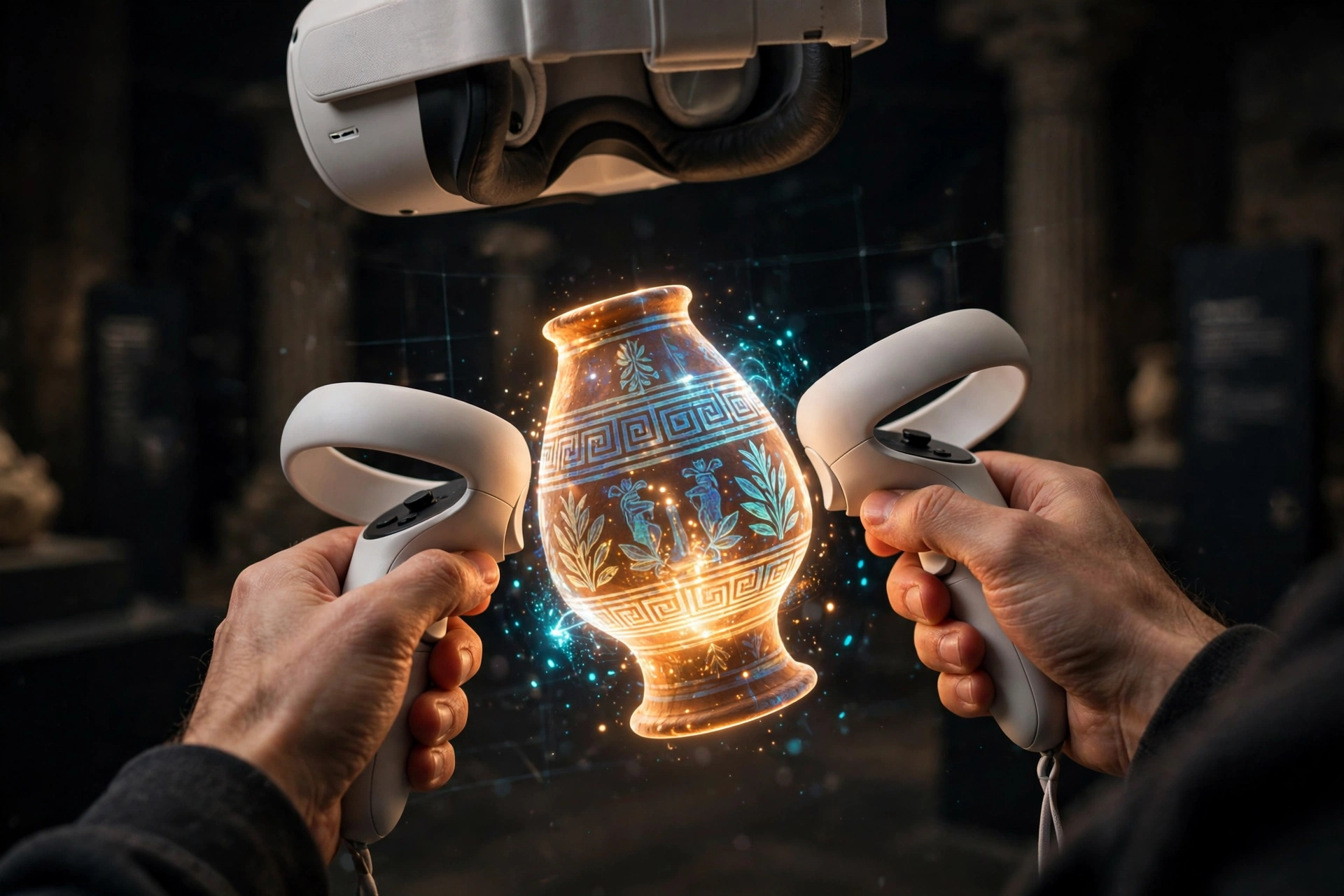
This is where VR earns its place in a history classroom. A real vase, manuscript, or tool may be too fragile, too rare, or too far away for a school group ever to touch. A digital copy has none of those limits. A student can pick up a virtual Greek vase, turn it over, and study the painted figures, the repairs, and the wear on its rim. A virtual gallery can also place pots from different regions side by side, even when the real items live on different continents. That hands-on feeling changes how students talk about evidence: instead of memorising that a pot “was used for storage,” they can work it out from its size, handles, and lid.
How do reconstructions handle what we don’t know?
Honestly — and that honesty is part of the lesson. No one knows exactly what colour a Roman house was painted. A reconstruction has to fill those gaps, and the choices it makes are worth discussing. When a VR scene shows a ruined temple complete, with columns, roof, and statues, students should know which parts come from surviving stone and which parts are an educated guess. Good VR makes that visible with labels, and some scenes let students switch between the ruin today and the reconstruction. Asking a class “what would you change about this scene, and why?” turns a passive tour into a proper history discussion.
What does VR do better than a textbook or a video?
Scale, mainly. A textbook can tell you a cathedral was tall; standing inside a virtual one, looking up at a ceiling that seems to go on forever, gives you a feeling for it that words struggle to match. The same goes for distance: a map shows that a trade route crossed a desert, but walking a virtual stretch of it makes the journey feel real in a way a line on a page does not. VR also helps with places a class could never visit — a temple on another continent, or a collection a student who cannot travel can still explore. The British Museum offers virtual tours of its galleries, for example. In a headset there are also no crowds or closing times, so a student can pause and take their time with one object.
What are the limits of a VR history lesson?
A virtual visit is not the same as standing in a real place. You miss the texture of stone, the hush of a large hall, and the chance to notice something unexpected on the way. A digital copy, however detailed, is still a copy. VR works best as a companion to real objects and real discussion, not a replacement for them. Some students feel dizzy, so short, seated sessions help, and students should always be able to stop and continue on a screen. Headset makers also give age guidance, and schools should follow it. Headsets need charging, cleaning, and looking after, and content can age as research moves on.
How should a teacher run a VR history lesson?
Start with the question, not the headset: how did people trade in this market, or what did this temple mean to the people who used it? The VR scene is chosen because it helps answer it. A short introduction first makes the scene far more interesting, because students know what is real, copied, or reconstructed. Keep sessions short and focused: ten to fifteen minutes inside VR, exploring one or two exhibits in depth, usually teaches more than a long tour of everything. Give students a task with a question in mind — turn the object over, compare it with a similar one. Finally, step out of VR and talk. Ask what surprised them, what they would like to see in person, and what the virtual version could not show. That conversation is where a virtual visit becomes real learning.
FAQs
Do students need their own headset for a VR history lesson?
Not usually — schools that offer VR provide the headsets, and many virtual tours also work on a computer or phone. One headset shared around a class works well for a guided lesson.
Is a virtual artifact the same as the real object?
No. A virtual artifact is a digital copy, often made from scans and photographs. It can show detail a glass case cannot, but it cannot replace the real object’s material, age, and history. Good lessons say clearly when students are looking at a copy.
Can VR history lessons replace a school trip?
They can complement one, but not replace it. A virtual visit cannot match standing in a real place or talking with a guide. Where VR helps most is before or after a trip — preparing students for what they will see, or letting them revisit a place they cannot return to.
What age is VR suitable for in history lessons?
It depends on the headset maker’s age guidance and the school’s own rules. Short, seated, supervised sessions suit younger pupils best, and a screen version should always be available for anyone who does not want to wear a headset.
How can a teacher tell if a VR history lesson is accurate?
Check whether the content names its sources and separates what is known from what is reconstructed. Content made with museums or historians is a good sign; if a scene presents every detail as certain, treat it with caution.
Conclusion
VR history lessons work when they help students look closer, understand context, and reach places they could not otherwise visit. A headset, controllers, and a careful reconstruction can turn a fragile artifact into something a student can examine and a ruined temple into a place they can enter. They work less well as a substitute for real places, real objects, and real conversation. Try one VR scene with a single question in mind, then talk about what you found — that combination of virtual closeness and real discussion is where VR earns its place in history teaching.
Further reading: How Does VR Work in Education? | How Does VR Travel Work? | How Do VR Art Lessons Work? | How Do VR Science Labs Work? | Britannica: virtual reality