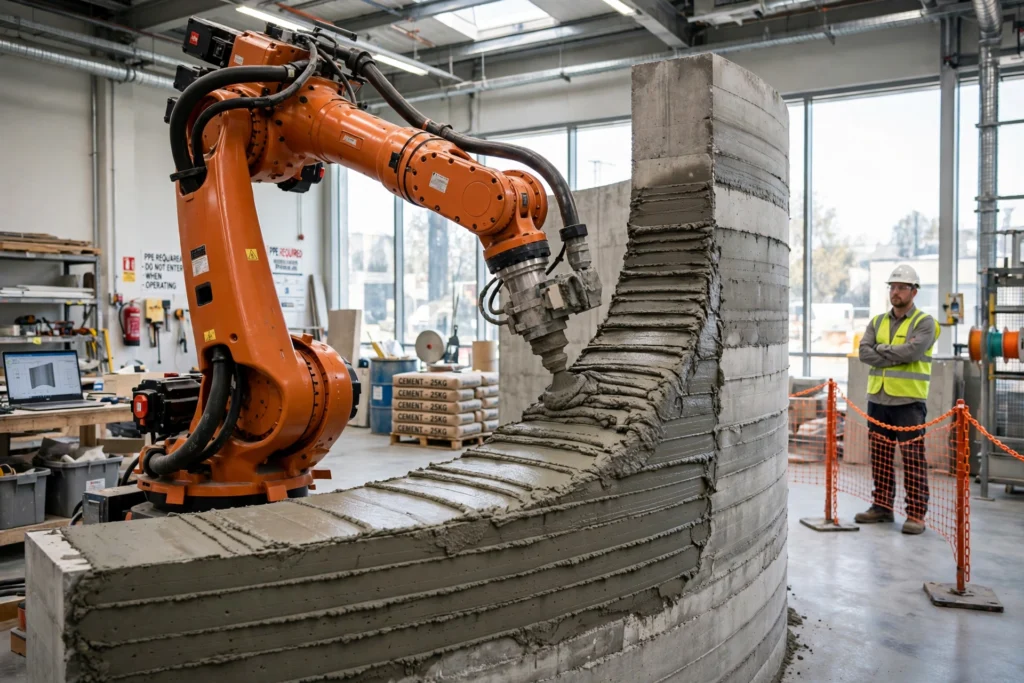
3D printing robots work by moving a print head along a path set by a digital design, laying down material one thin layer at a time until a solid object takes shape. A robotic arm gives the print head far more freedom than a desktop printer, so it can build large parts, print at angles, and reach around curves.
Key Takeaways
- A 3D printing robot is a robotic arm fitted with a print head instead of a gripper.
- It follows a digital model, laying down material layer by layer until the shape is complete.
- Robot arms can print at angles and on curved surfaces, which fixed printers cannot do.
- Common materials include plastics, metals, and special concrete mixes.
What Is a 3D Printing Robot?
A 3D printing robot is an industrial robot arm with a print head where a gripper would normally sit. The arm does the moving, the print head does the depositing, and software ties the two together.
A desktop 3D printer moves a nozzle back and forth over a flat bed, building an object from the bottom up. It works well, but it is stuck on a flat plane. A robot arm breaks that limit: it can tilt, rotate, and reach in from the side, so it can print onto a curved surface or build a shape that leans outward.
How Does the Arm Move the Print Head?
Everything starts with a 3D model, usually made in CAD software. That model is sliced into thin horizontal layers, and each layer becomes a path the nozzle must follow. The controller turns those paths into joint movements, working out how far each motor should turn and when.
A typical six-axis arm can approach a point from almost any angle. That matters when the print head needs to lay material on a slope, or when the object has an overhang that a flat-bed printer would need supports to hold up. The arm simply tilts the nozzle and prints along the curve.
Speed and precision are a trade-off. A fine plastic part might be printed slowly, with the nozzle moving a few centimetres a second, so each layer lands exactly where it should. A concrete wall is the opposite: the nozzle moves steadily, laying down a thick bead of mix, and small wobbles do not matter much.
What Materials Can They Print With?
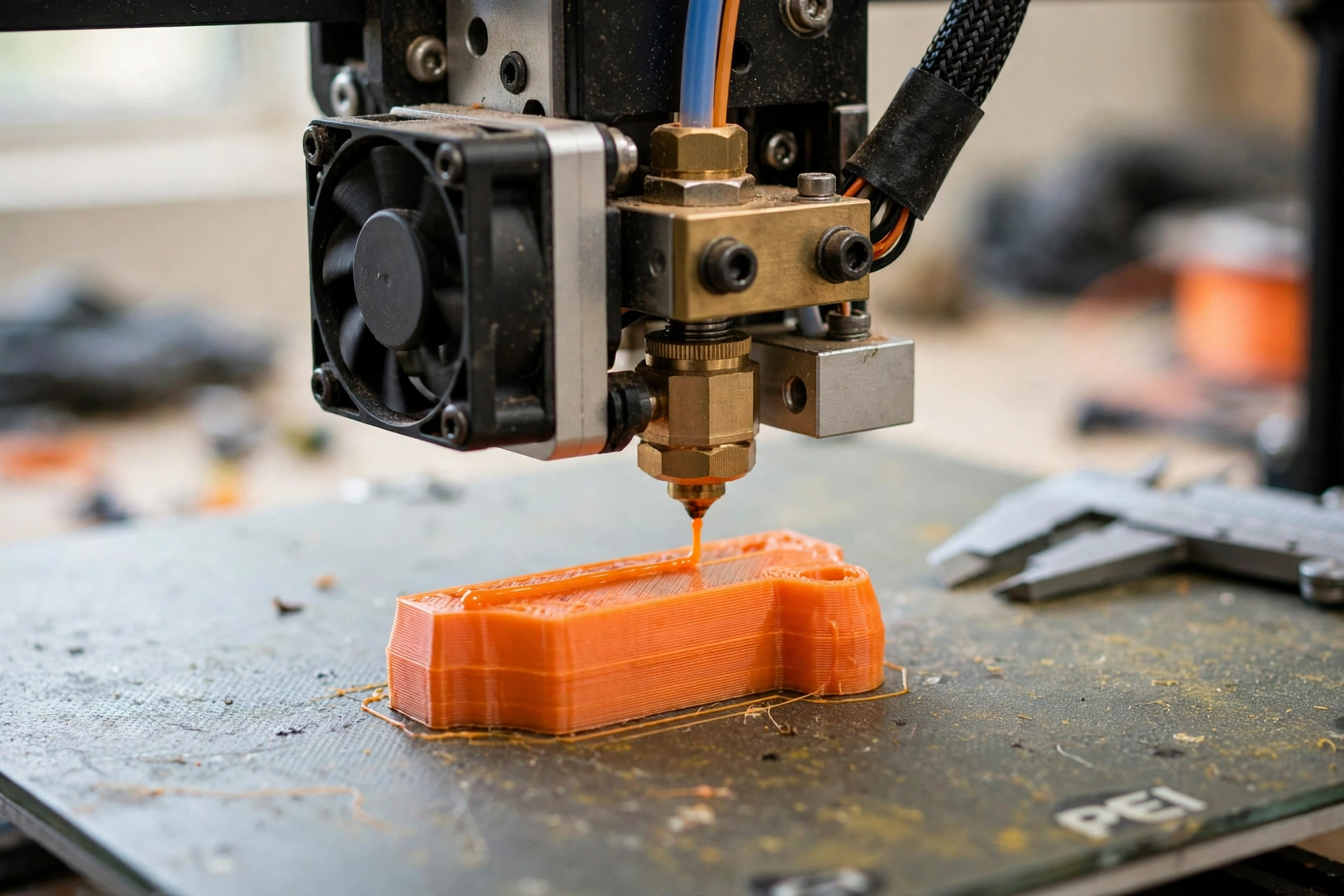
Plastics are the most common. Pellets or filament are heated until soft, pushed through the nozzle, and left to cool into a solid line. These are used for prototypes, furniture, and custom parts.
Metals need a different trick. Some systems melt metal wire with an electric arc or laser as it leaves the nozzle, building up a part weld by weld. Metal printing is slower and more expensive, but it can make strong brackets and repair parts that would be hard to machine.
Concrete is the one that draws the crowds. A pump feeds a special mix through a hose to a large nozzle, and the arm lays it down in thick layers to form walls or even whole house sections. The mix has to be just right: stiff enough to hold its shape, wet enough to bond with the layer below.
How Do They Build Layer by Layer?
First, the arm prints a base layer on the build surface or the floor, then lifts slightly and prints the next layer on top. The material must set quickly enough to support the next layer, but stay tacky enough for the layers to fuse.
Operators watch for a few classic problems. If the nozzle is too high, the bead of material lands loosely and the layers do not grip. If it is too low, the nozzle drags through the fresh layer and tears it.
Some systems leave the ridged layer texture as it is. Others add a finishing step, where the same arm swaps the print head for a milling tool and smooths the surface after the print cures. That swap is one of the real strengths of using an arm: one machine can print and finish.
Where Are 3D Printing Robots Used?
Construction is the most visible use. Large arms print wall sections and full houses, layer by layer, in days rather than weeks. The appeal is less labour on site and far less wasted material than cutting and pouring the usual way. These homes still need people for the roof, wiring, plumbing, and finishing, but the printed shell goes up quickly.
Manufacturing uses them for parts that are too big or too oddly shaped for a normal printer. Car makers print full-size design models and tooling, boat builders print hull sections, and aerospace workshops print brackets and ducts with complex shapes that would be difficult to machine from a solid block.
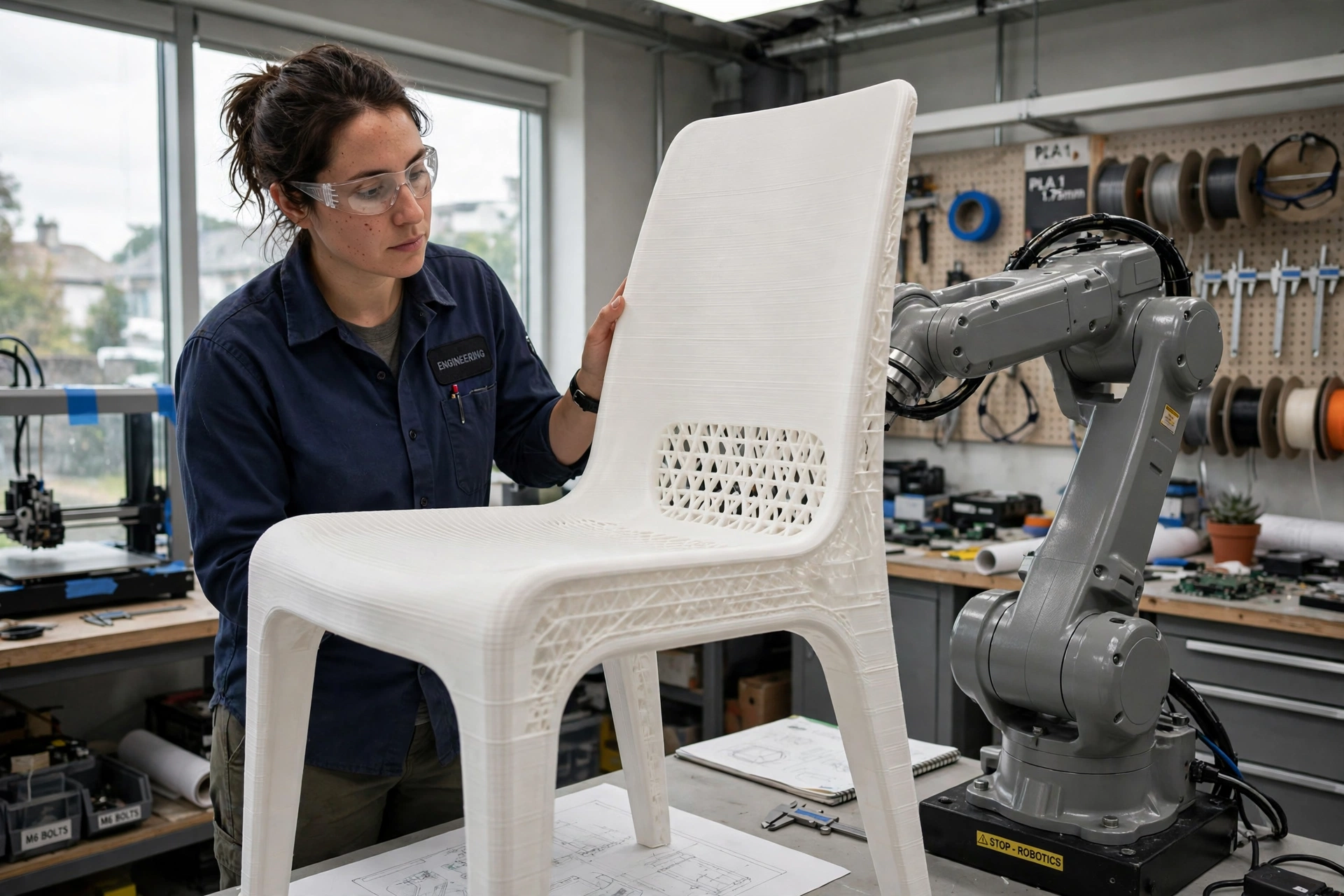
Furniture and design are a quieter success story. A robot arm can print a chair, a lamp, or a table in one piece, with curves and lattice patterns that traditional woodworking or moulding would struggle to match.
What Are the Limits?
Speed is the first limit. Printing layer by layer takes time, and a large object can take hours or days. A factory that needs ten thousand identical parts will still use moulding or casting, which are far faster at scale.
Size is a trade-off too. An arm can only reach as far as its joints allow, so very large prints need the arm mounted on a rail, or several arms working together. Moving the arm mid-print adds complexity, and a small error in position shows up in the finished object.
Strength can also vary. Because objects are built in layers, they are often weaker across the layers than along them, a bit like wood splitting along the grain. Designers get around this by choosing the print direction carefully.
Conclusion
A 3D printing robot is a robot arm that trades its gripper for a print head, then follows a digital model to lay down material layer by layer. The arm brings reach and angles that a fixed printer cannot match, which is why these machines are printing chairs, car parts, boat sections, and even house walls.
If you want to see one in action, look for a maker fair, university open day, or factory tour near you. Watching a wall or a chair grow layer by layer makes the whole idea click.
Frequently Asked Questions
How is a 3D printing robot different from a normal 3D printer? A normal 3D printer moves its nozzle on a fixed frame over a flat bed. A 3D printing robot uses an arm that can tilt and reach from many angles, so it can print larger objects and curved surfaces a fixed printer cannot reach.
Can 3D printing robots print a whole house? They can print the walls and structural shell of a house, and some projects have done exactly that. The roof, windows, wiring, and plumbing still need conventional building work.
What materials do 3D printing robots use? The most common are plastics, metals, and concrete. Plastics suit prototypes and furniture, metals suit strong functional parts, and concrete suits walls and large structures.
Are 3D-printed objects strong? They can be, but strength depends on the material and the print direction. Objects are often weaker across their layers than along them, so designers plan the print orientation to put the strength where the part needs it most.
Are 3D printing robots used in factories today? Yes, mostly for prototypes, custom parts, tooling, and large one-off pieces rather than mass production. They are best where the shape is complex or the run is small, and where printing beats machining or moulding on cost or time.
Further reading: How Do Robot Arms Work? — How Do Warehouse Robots Work? — How Do Packaging Robots Work? — How Do Construction Robots Work? — Britannica: Robotics — Wikipedia: 3D printing