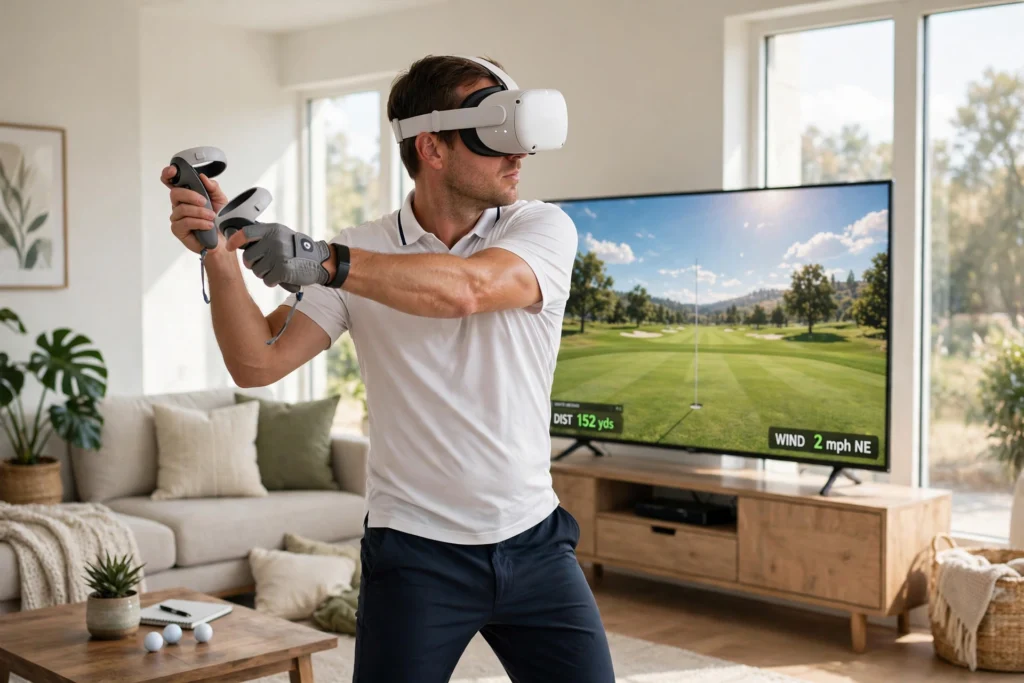
VR golf turns your living room into a golf course. You wear a VR headset, hold controllers or a club attachment, and swing at a virtual ball while the system tracks your hands, head, and club speed. The game shows where the ball flies, so you can play full rounds, practise putting, and work on your swing without leaving home.
Key Takeaways
- A VR headset and hand controllers track your swing; a club attachment adds a more natural feel.
- Play famous courses, practise on a driving range, or drill putting on a virtual green.
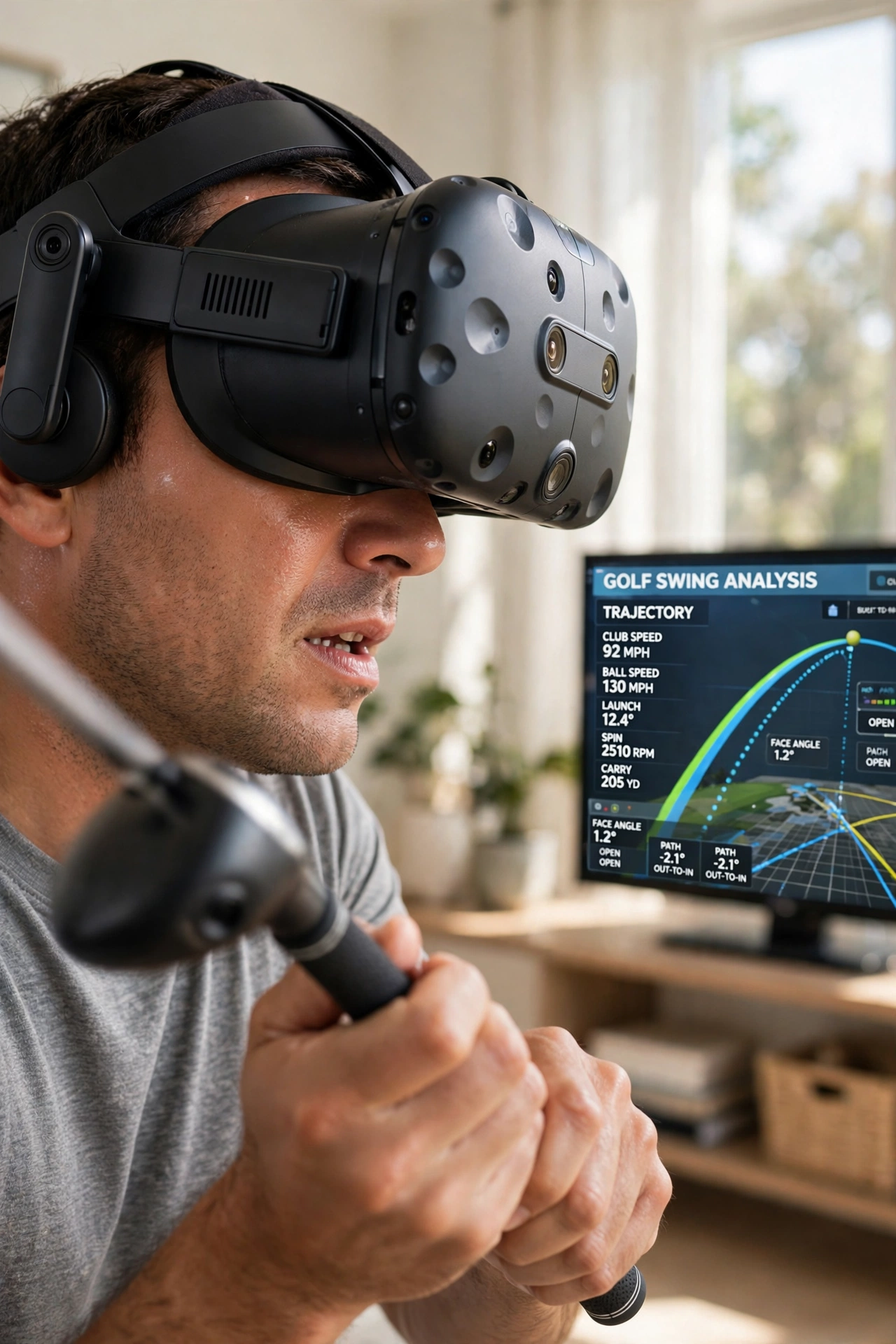
- Swing data such as club speed, face angle, and ball path helps you spot faults.
- VR golf builds rhythm, aim, and course sense, but it cannot copy a real club’s weight or real turf.
- Clear two metres of space, wear the wrist straps, and rest if you feel queasy.
What do you need to play VR golf?
You need surprisingly little. The core kit is a standalone VR headset, its two hand controllers, and a golf game or app. Most headsets are self-contained, so there is no PC or console to wire up: put the headset on, draw a safe play area, and you are on the first tee within minutes.
The controllers act as your clubs. In most games, one controller becomes the club: grip it like a handle and the game draws a virtual club in your hands. Some players add a club attachment, a short weighted handle the controller slots into, which feels closer to a real club. A small putting mat gives your feet a reference point, and if a TV is nearby, many headsets can cast the game to the screen so friends can watch. If you are new to headsets, our guide to how VR headsets work explains the screens, lenses, and tracking inside the device.
How does the headset track your swing?
Cameras on the front of the headset watch your hands and controllers many times a second. As you take the club back and swing through, the system records the path of your hands, how fast they move, and the angle of the controller at impact.
That data feeds a simple physics model. Club speed decides how far the ball travels, face angle decides whether it starts left or right, and swing path decides the curve. Hit it with a square face and a smooth tempo and the ball flies straight down the fairway. The best golf games show these numbers after every shot, so you can see exactly what changed between a good strike and a poor one. Your head matters too: the headset tracks where you look, so you can check the distance to the pin and read the break on a putt just by turning your head.
What can you actually play in VR golf?
A full round is the headline feature. Many VR golf games include recreations of well-known courses, so you can play 18 holes in an evening without booking a tee time or worrying about the weather. Wind, slopes, and hazards are all part of the game.
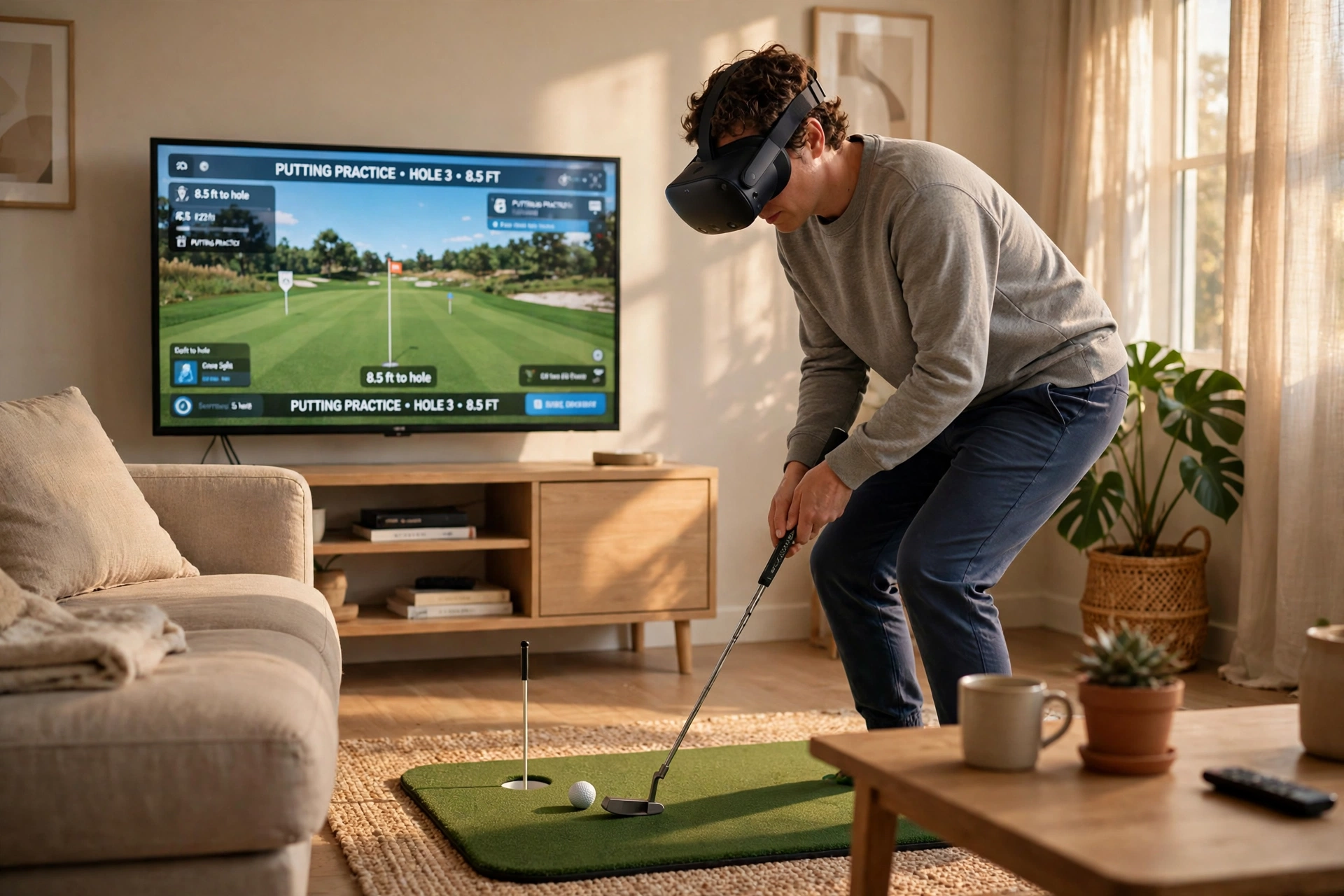
Shorter modes suit busy days. A driving range lets you hit ball after ball and watch the numbers, which is ideal when you want to work on one part of your swing. Putting greens let you practise reading breaks and judging pace. Some games also offer multiplayer rounds, so you can play a full 18 holes with friends who live in other cities. A full round is also a workout: our look at VR fitness explains how virtual exercise works.
Can VR golf really improve your game?
For many players, yes — with the right expectations. VR golf is strongest at building the parts of the game that depend on repetition and judgement. You can hit a hundred seven-irons in half an hour and learn how far each club really carries.
It also teaches course management: when to lay up, when to attack a flag, and how to judge the wind. Seeing your club speed, face angle, and ball flight after every shot turns practice into a loop: try something, see the result, adjust, and try again.
That said, VR golf is a training aid, not a replacement for real golf. The weight and balance of a controller are different from a real club, and there is no turf, no divot, and no real ball to strike. Treat virtual practice as a complement to real play, not a substitute for it.
What are the limits of VR golf?
The biggest limit is feel. In real golf, the club’s weight tells your hands where the clubhead is, and the ground tells you how cleanly you struck the ball. In VR, those signals are missing. You can still groove a swing, but the fine feedback of a real strike is not there, and some players find their real-world timing drifts after long VR-only sessions.
Space is another limit. A full golf swing needs room — about two metres in every direction, with nothing breakable in reach. A living room works if you move the coffee table, but a small bedroom will not. Motion sickness affects some players, though golf is gentler than fast-moving VR games.
How do you set up a safe space for VR golf?
Clear the floor, move anything fragile out of reach, and check the ceiling — a full follow-through can reach a light fitting faster than you expect.
Wear the wrist straps every time. They are the one thing standing between a controller and your television if your grip slips mid-swing. Tighten the headset so it stays put, and set the play-area boundary slightly inside the real edges of your room, so the warning appears before you reach the wall.
FAQs
Do I need a real golf club for VR golf?
No. The hand controllers work on their own, and most players start with them. A club attachment is an optional extra.
Is VR golf good for beginners?
Yes, it is a friendly way to start. There is no pressure from other players, no lost balls, and you can repeat the same shot as many times as you like. Pair it with time on a real course when you can.
Can I play VR golf with friends?
Yes. Many golf games include multiplayer rounds, so you can play the same course together from different homes.
How much space do I need for VR golf?
Aim for about two metres of clear space in every direction around where you stand, with a clear ceiling above.
Does VR golf make you feel sick?
It can for some people, but golf is one of the gentler VR experiences because you mostly stand still and move your head slowly.
Conclusion
VR golf brings the course home: real courses, honest swing feedback, and as many practice balls as you want, all without a tee time. It will not replace the feel of a real club or a real round, but it is a practical way to keep your swing warm through the winter and to learn the game at your own pace. If you are curious, start with a short session on a driving range, check your numbers after each shot, and see how quickly your tempo settles. For a change of pace, watching live sport in VR is another way to enjoy the headset.