
Robotic wheelchairs work by turning a user’s command — usually a small joystick — into precise movements of electric motors, while sensors watch the surroundings and slow or stop the chair before it hits something. A controller sits between the two, translating intent into safe motion, so the user stays in charge while the chair handles the tricky parts.
Key Takeaways
- A joystick, touchpad, or head switch tells the controller where the user wants to go.
- The controller converts that input into speed and direction for each drive wheel.
- Ultrasonic, infrared, and LiDAR sensors spot obstacles, kerbs, and drop-offs before the chair reaches them.
- Rechargeable batteries power the motors, and a full charge usually covers a day of ordinary use.
- Smart extras such as follow-me mode, seat lifts, and stair-climbing exist, but they are options, not standard on every chair.
What makes a wheelchair “robotic”?
A standard powered wheelchair already has motors and a joystick, so the line between “powered” and “robotic” is about how much thinking the chair does on its own. A robotic wheelchair adds sensors and software to the basic frame. At its simplest, it might slow down near a wall or refuse to roll off a kerb edge. More advanced models can follow a set route through a home, steer around furniture, or trail a companion walking ahead. The user still decides where to go; the chair just helps with the fine detail.
How does the joystick control the wheels?
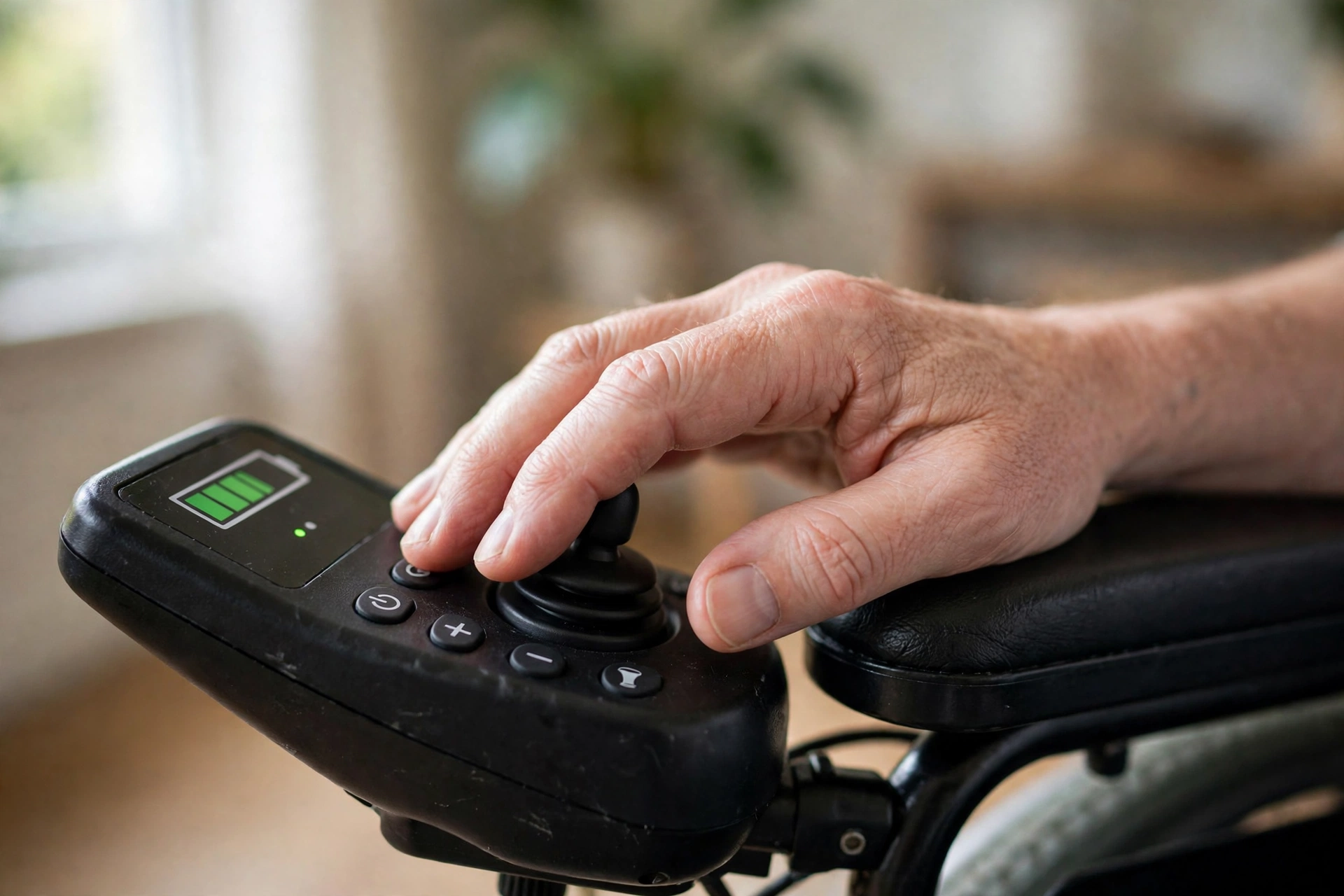
The joystick works like the stick on a game controller: push it forward to move forward, to one side to turn, and the further you push, the faster it goes. Under the armrest, it sends a signal to the chair’s controller, a small computer that reads each push and tells each drive wheel what to do. Most chairs have two powered wheels, one on each side, plus smaller castor wheels for balance. To turn on the spot, the controller spins one wheel forward and the other backward. It also smooths the motion, so the chair speeds up gently, and it can cap the top speed indoors.
Not everyone can use a joystick, so chairs also offer touchpads, chin switches, headrest pads, or sip-and-puff controls that respond to breath. The input changes, but the controller’s job stays the same.
What sensors do robotic wheelchairs use?
Sensors are what make the chair aware of its surroundings, and most chairs use a mix of several types, because each one is good at a different job. Ultrasonic sensors send out sound pulses and listen for the echo, much like a bat. They are cheap, reliable, and good at spotting nearby walls, furniture, and people. Infrared sensors work in a similar way with light, and are handy for short-range detection around the footrests and sides. LiDAR sensors spin a laser beam and build a rough map of the room, which lets the chair plan a path around obstacles instead of just stopping in front of them.
Wheel encoders count how far each wheel has turned, so the controller knows how far the chair has travelled, and tilt sensors watch for slopes. No single sensor does everything, so the controller combines their readings — if one is confused by a glass door or a shiny floor, the others fill in the gap.
How do robotic wheelchairs avoid obstacles and stairs?
Obstacle avoidance works in layers. First, the sensors spot something ahead and the controller trims the speed. If the object is close, the chair steers around it when there is room; if there is no room, it stops and waits for the user to choose a new direction. Drop-offs are trickier: a kerb edge or a stairwell is dangerous because there is nothing in front of the chair to bounce a signal off. Downward-facing sensors watch the floor ahead, and when the ground suddenly falls away, the chair brakes and refuses to move forward — the same idea as the cliff sensors on a robot vacuum, scaled up for a person’s safety.
Some chairs also build a map of places the user visits often, such as a home or an office, and can follow a remembered route to the kitchen or the lift. The user can take over at any moment by touching the joystick, which always has priority.
What powers a robotic wheelchair, and how far can it go?
Two rechargeable batteries, usually tucked under the seat, supply the power. Many modern chairs use lithium-ion batteries, while older or heavier models still use sealed lead-acid ones. How far a charge lasts depends on the user, the terrain, and the chair’s weight, but a day of ordinary indoor use — moving around a home, popping to the shops — is well within a full charge for most chairs. Hills and rough ground drain the battery faster, so the controller warns the user before it runs low. Charging is simple: plug the chair into a wall socket overnight, much like charging a phone.
Who benefits most, and what are the limits?
Anyone who finds a manual wheelchair tiring or hard to steer can benefit, but robotic features help most where control or awareness is limited. Someone with reduced hand strength may struggle with a joystick’s fine movements, so a chair that smooths the input and stops before collisions makes independent travel possible, and people with limited vision use the sensors as a second pair of eyes. It is not the right answer for everyone, though: active people with good upper-body strength often prefer a light manual chair.
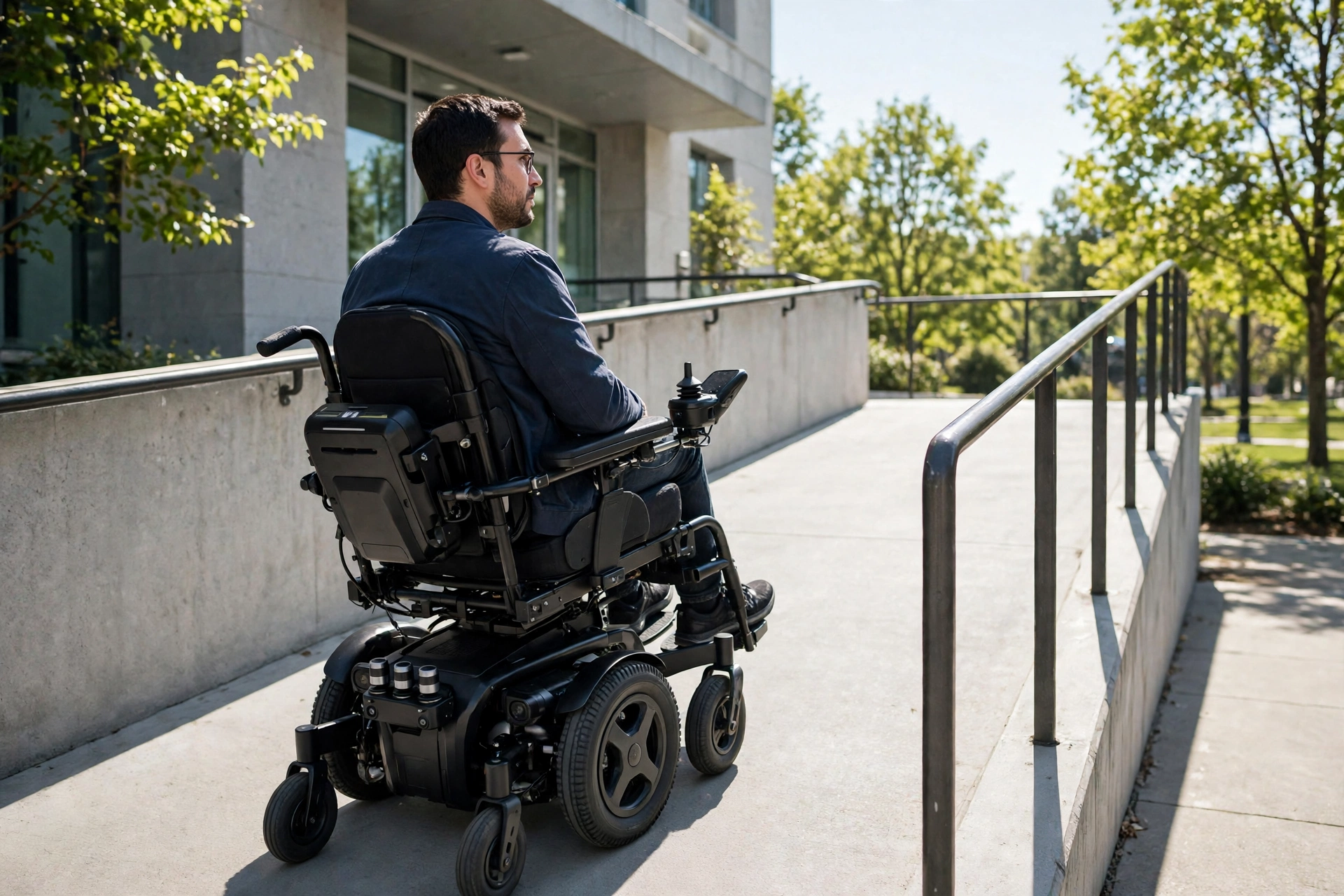
The biggest limit is the environment: a robotic wheelchair works best indoors or on smooth pavements, where its sensors get clean readings, while rain, snow, mud, and gravel can confuse them and strain the motors. A few specialised chairs can climb stairs or raise the user to a standing position, but they are costly exceptions rather than standard features. Cost is the second limit, and funding rules differ by country. Battery life is a third, since the chair can only go as far as its charge allows. Finally, no sensor setup is perfect — glass walls, mirrors, and cluttered rooms can still confuse a chair, which is why the user stays in control and why good training matters as much as good technology.
Frequently Asked Questions
How fast can a robotic wheelchair go?
Most travel at about walking pace, sometimes a little faster, and the speed can be turned down indoors. Faster speeds would mean longer stopping distances, so the limit is a safety choice as much as a technical one.
Do robotic wheelchairs drive themselves?
Some can follow a saved route or trail a companion, but the user is always in charge: touching the joystick takes over immediately.
How long does the battery last?
A full charge usually covers a day of ordinary use, though hills, rough ground, and extra weight shorten it. Most users charge overnight and check the gauge before a longer trip.
Can a robotic wheelchair be used outdoors?
Yes, on pavements, ramps, and smooth paths. Wet weather, mud, and rough ground are harder on the sensors and motors, so a chair with bigger wheels and weather protection suits regular trips outside.
How much does a robotic wheelchair cost?
Prices vary widely with the motors, sensors, seating, and smart features, and funding rules differ by country. The best step is an assessment from an occupational therapist or a wheelchair supplier.
Conclusion
Robotic wheelchairs work by pairing a simple control — usually a joystick — with a controller, motors, and sensors that watch the world and keep the ride safe. The user decides where to go; the chair handles the speed, the steering, and the stopping. Their purpose stays the same as the technology improves: giving people freedom to move on their own terms. If one sounds useful for you or someone you care for, book an assessment with an occupational therapist or a wheelchair supplier and try a few models in person.