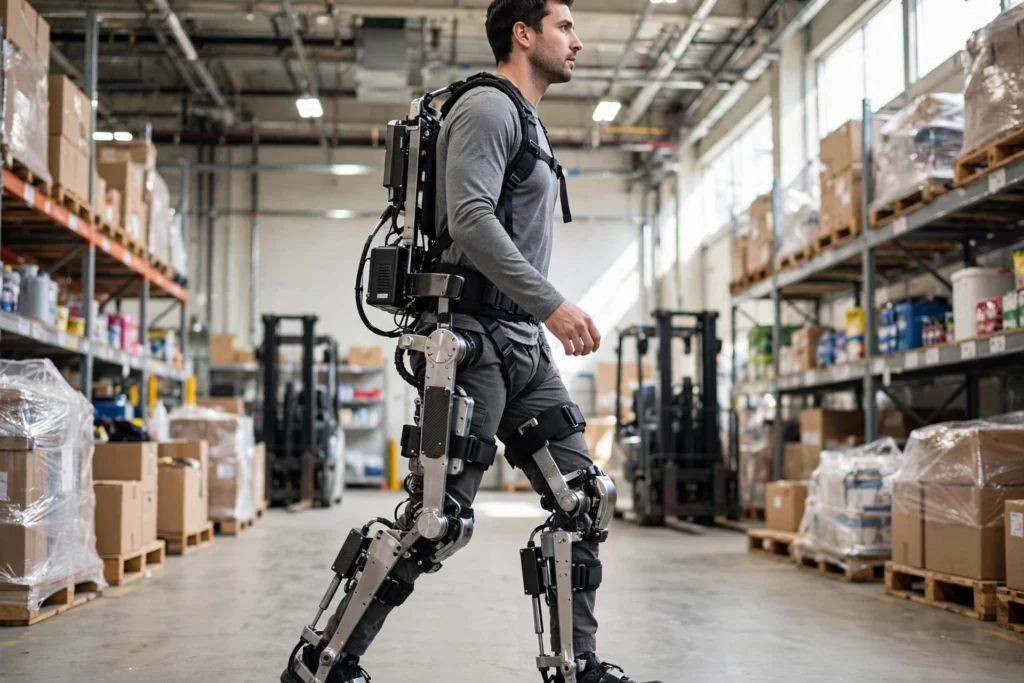
An exoskeleton is a wearable frame that moves with your body and shares some of the effort. Sensors read how you are moving, a small controller decides what help to give, and motors, springs, or cables apply that help at your joints. The result is not superhuman strength in the movie sense. It is steadier, less tiring movement — a lift that feels lighter, a step that feels supported, or a posture that is easier to hold.
That simple idea covers a wide range of devices. Some are light, spring-based supports worn over work clothes. Others are powered leg frames used in clinics. They look different because they solve different problems, but the basic loop is the same: sense, decide, assist, and repeat many times per second.
Key Takeaways
- An exoskeleton senses movement, decides how much help to give, and applies force at a joint.
- Powered exoskeletons use motors and batteries; passive ones use springs and elastic parts.
- Most devices help one task, such as walking, lifting, or holding the arms up, rather than doing everything.
- Fit, training, and safety limits matter as much as motor power.
- The best choice depends on the person, the task, and the setting, not on the most advanced model.
What is an exoskeleton, exactly?
Think of it as a tool you wear, not a machine you ride. A frame runs alongside your legs, back, arms, or shoulders, and straps hold it close so its joints line up with yours. When you bend a knee, the frame’s knee bends too. When you reach overhead, an arm support takes some of the weight.
This is different from a prosthesis, which replaces a missing limb, and from a robot that works on its own. An exoskeleton only makes sense with a person inside it. If the person stops, the useful movement stops too, even if the motors could keep running. That partnership is the point: the person provides balance, judgement, and intent, while the device provides extra force or support.
How do exoskeletons sense what you want to do?
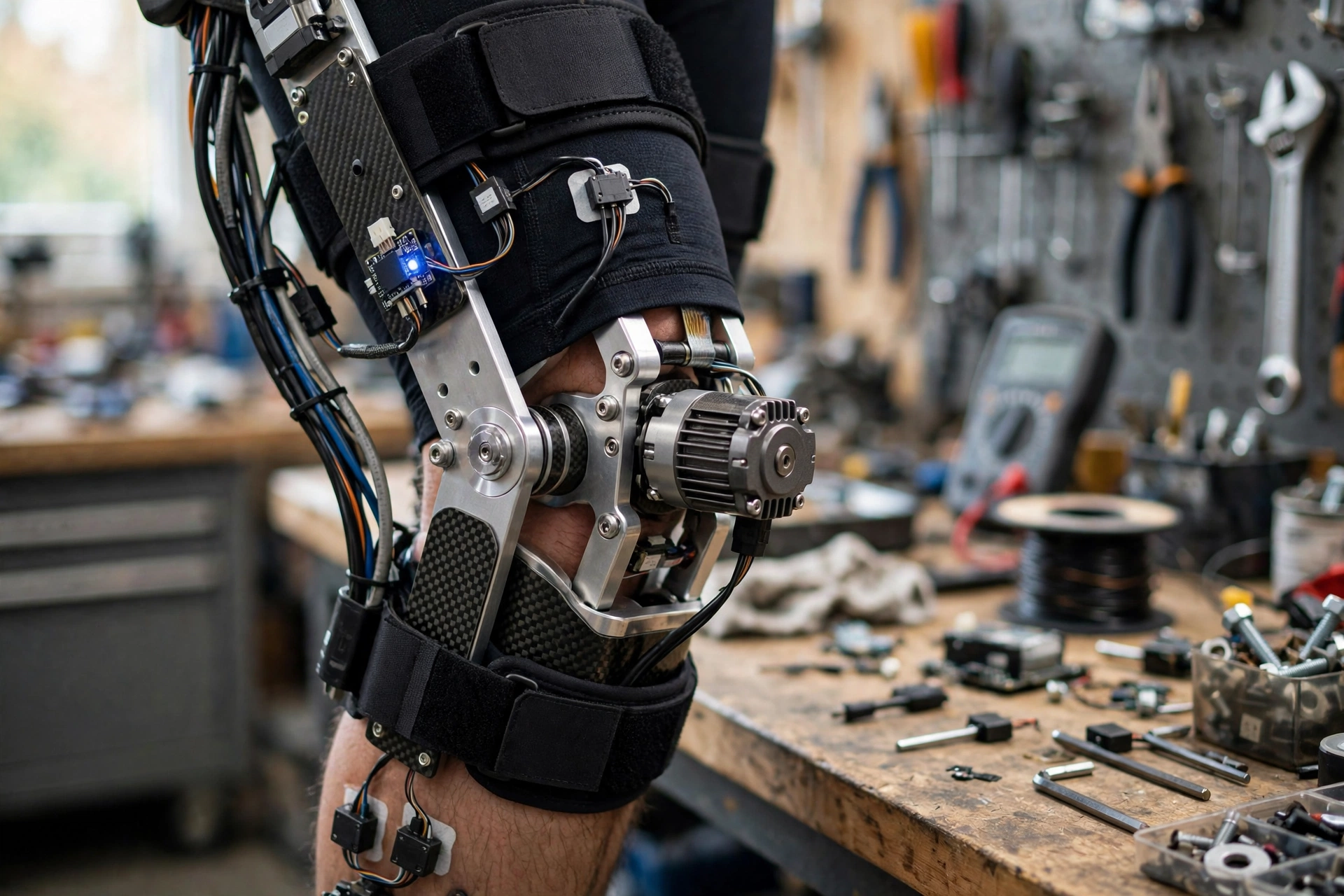
An exoskeleton cannot read your mind, but it can read useful clues. Joint-angle sensors track how far a hip, knee, or shoulder has moved. Pressure sensors in a footplate notice when weight shifts from one foot to the other. Some systems also pick up small muscle signals from the skin, which can show that a person is starting to lift or step.
The controller combines those clues into a guess about the next movement. Is this the start of a step, a squat, or a lift? Should the motor help now, hold steady, or stay out of the way? Getting that timing right matters. Help that arrives late feels clumsy. Help that arrives early can fight the wearer. Good designs therefore use smooth, gradual assistance and let the person stay in charge.
Powered or passive: what’s the difference?
Powered exoskeletons use motors, batteries, and software. They can push harder, adjust assistance on the fly, and support a wider range of movements. The trade-off is weight, cost, charging time, and complexity. A clinic device may be plugged in or used for short sessions, while a warehouse model must last a whole shift without getting in the way.
Passive exoskeletons use springs, elastic bands, or clever linkages instead of motors. They store energy when you bend and return it when you straighten up, a bit like a well-tuned brace. They are usually lighter, cheaper, and simpler, but they cannot change their behaviour as flexibly. For a repeated overhead task or a long period of bending, though, that steady spring help can be enough — and sometimes it is the smarter choice.
Many real products sit between these extremes. A device might have powered hips and passive knees, or a motor that only helps at one key moment in a lift. The label matters less than the question: does it help this specific movement, without creating a new problem?
How do exoskeletons help at work?
In warehouses, factories, and construction, the same movements repeat all day: lifting boxes, holding tools overhead, or bending to pick parts. Over time, that repetition can strain backs, shoulders, and knees. A back-support exoskeleton can take some load off the lower back during a lift, while a shoulder support can hold part of an arm’s weight during overhead work.
That does not mean workers can suddenly lift far heavier loads safely, and responsible guidance does not promise that. The aim is usually to reduce fatigue and awkward strain on familiar tasks. Like the mobile robots in our guide to How Do Warehouse Robots Work?, an exoskeleton works best when the job, the workspace, and the training fit together. A device that helps on a flat floor may be awkward on stairs, in tight aisles, or around moving machinery, so trials in the real setting matter.
How are exoskeletons used in rehabilitation?
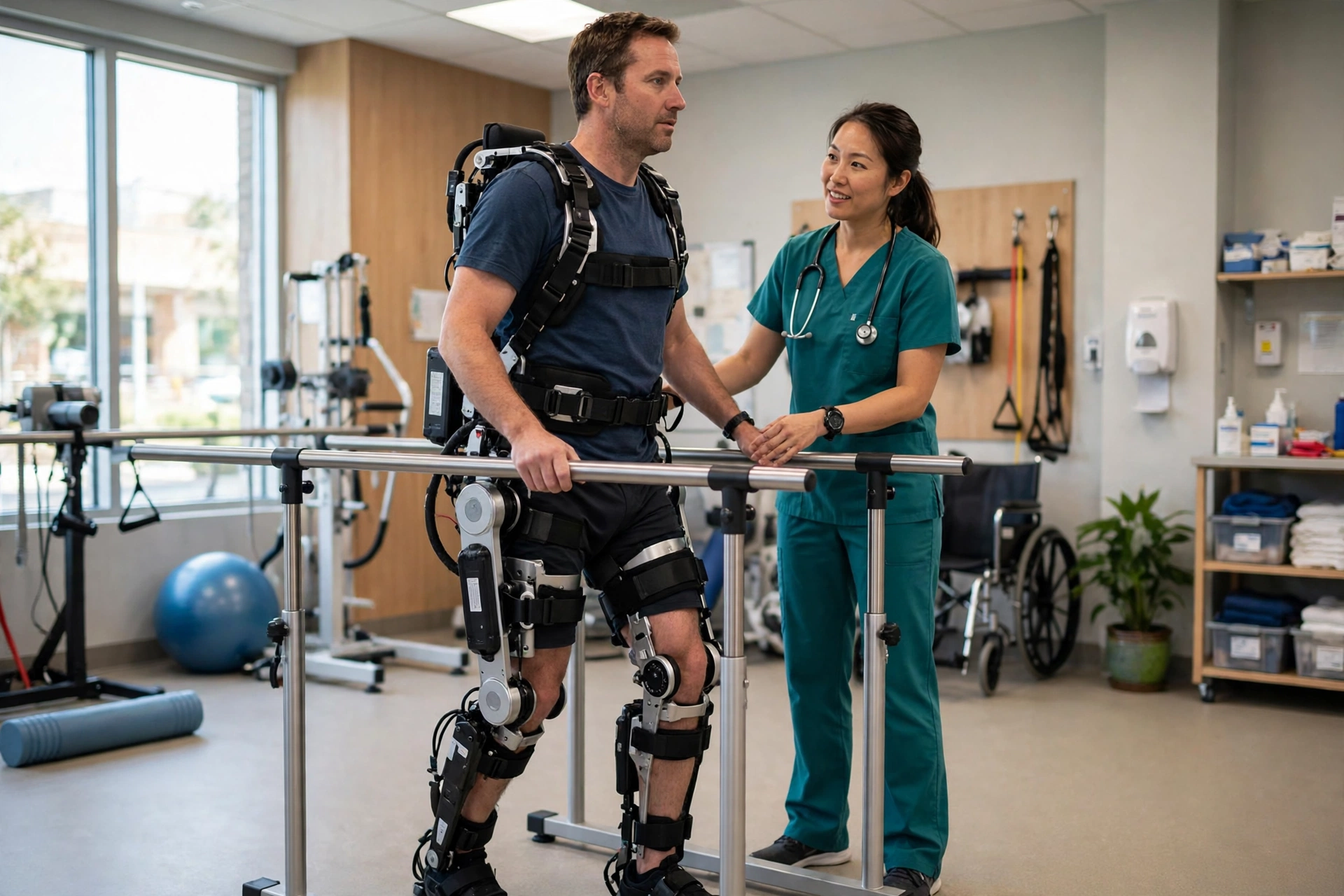
In a clinic, an exoskeleton can help a person practise walking, standing, or reaching after an injury or illness. The therapist sets the level of help, the pace, and the number of repetitions, and the device keeps the movement consistent from one repetition to the next. That consistency can be useful when a therapist’s hands alone would tire quickly.
Here, the goal is often training, not permanent dependence. Some sessions use high assistance at first, then gradually reduce it as the person gets stronger or more confident. Others use the device mainly for safety, so a person can practise balance with support nearby. Anyone considering this kind of use should talk to a clinician first, because suitability depends on the individual, the condition, and the device — this article is general information, not medical advice.
What are the limits and safety issues?
Exoskeletons have real limits. Batteries run out. Motors add weight. Straps can rub if the fit is poor. A device tuned for one body size may not suit another, and a person who relies too heavily on assistance may move less naturally over time. Heat, dust, rain, and uneven ground can also affect performance, just as they affect other robots.
Safety features therefore matter: limits on force and speed, an easy way to stop or remove the device, and clear training on what to do if it fails. Users should also keep an eye on comfort. Pain, numbness, skin redness, or a feeling of being pulled off balance are signs to stop and get the fit or settings checked, not to push through. A good exoskeleton should feel like help, not a fight.
How do exoskeletons compare with other robots?
An exoskeleton borrows ideas from other robots — joints, motors, sensors, and control software — but keeps the human in the loop. A robot arm repeats precise motions in a fixed spot, while a humanoid robot and a robot dog move on their own. With an exoskeleton, the person still provides balance, judgement, and intent.
What should you check before trying one?
Start with the task, not the gadget. What movement is hard, repetitive, or tiring? How long does it last, and in what environment? Then ask whether a passive support, a powered device, or a simpler change — a better workstation, a different tool, or a rest break — would solve the problem more directly.
If an exoskeleton still looks useful, check fit and adjustment, battery life for a full session, weight, cleaning, and maintenance. Ask how it is turned off, how it behaves if power is lost, and what training is included. For medical use, check clinical guidance first. For work use, involve the people who will wear it in a trial, and compare comfort and fatigue over days, not just minutes.
Frequently Asked Questions
Do exoskeletons make you stronger?
They can reduce the effort of a specific movement, but they do not give general super-strength. Most are built for one task, and their help is limited by motor power, battery, and safety settings.
Can you walk normally while wearing one?
With a well-fitted device and practice, many people can walk, bend, or lift fairly naturally, but movement often feels different at first. Training and gradual use help the wearer and the device learn to move together.
Are exoskeletons only for medical use?
No. They are used in warehouses, factories, construction, rehabilitation clinics, and research, and lighter consumer models are appearing for walking and hiking. Medical, occupational, and recreational designs differ a lot, so one device rarely suits all uses.
Do passive exoskeletons need charging?
No, passive models use springs or elastic parts and have no motor or battery to charge. That makes them lighter and simpler, though their assistance cannot be adjusted as flexibly as a powered system.
Are exoskeletons safe?
They can be safe when fitted correctly, used as intended, and maintained properly, but they are not risk-free. Poor fit, excessive force, or use on unsuitable ground can cause discomfort or a fall, so training and safety limits are essential.
Conclusion
Exoskeletons work by sensing movement, deciding when to help, and applying that help at the right joint at the right moment. Powered models offer flexible, stronger assistance; passive models offer lighter, simpler support. Neither replaces good training, good fit, or common sense about the task.
If you are curious, a practical next step is to identify one repeated movement that tires you or your team, then look for a device designed for that exact movement — and, for any medical use, discuss it with a clinician first. For background on robotics in general, the Britannica robotics overview and the powered exoskeleton guide are useful starting points. The most useful exoskeleton is rarely the flashiest one; it is the one that quietly makes a familiar task easier, day after day.