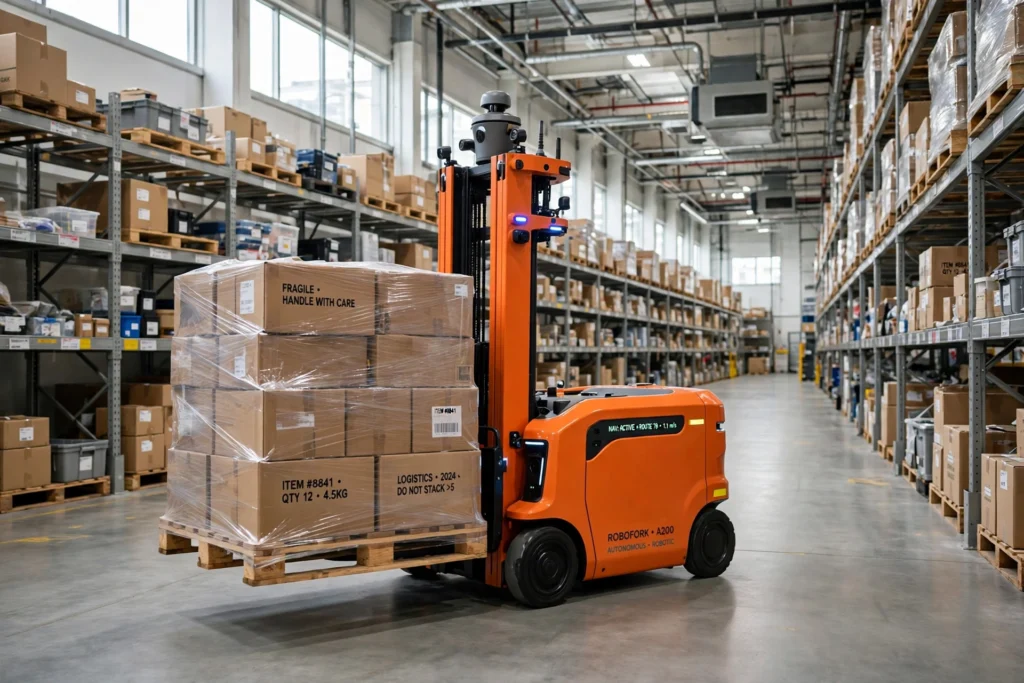
A robotic forklift is a driverless forklift that picks up pallets, carries them across a warehouse, and stacks them on racking without anyone in the seat. It finds its way with laser scanners, cameras, and a digital map of the building, then follows instructions from warehouse software about which pallet goes where.
Key Takeaways
- Robotic forklifts lift, move, and stack pallets with no driver in the seat.
- Most navigate by laser triangulation, camera vision, or SLAM mapping.
- AGVs follow fixed routes, while AMRs and autonomous forklifts plan their own paths.
- Safety scanners slow or stop the truck the moment a person steps in the way.
- They suit repetitive pallet work best, not one-off jobs or cluttered floors.
What is a robotic forklift, exactly?
A robotic forklift, also called an automated or autonomous forklift, is a standard lift truck with its driver replaced by sensors, motors, and software. The forks, mast, and hydraulics work the same way they do on a manual truck. What changes is the cab: no steering wheel, no pedals, and no seat, because the machine drives itself.
Most handle the same loads as the manual trucks they replace, often between one and three tonnes, and lift to the same rack heights. Some are built driverless from scratch; others start as ordinary forklifts and gain sensors and a control system later.
They rarely work alone: a robotic forklift usually sits inside a larger system with fleet software, charging docks, and a warehouse management system that hands out jobs.
How does a robotic forklift find its way around?
A robotic forklift needs to know where it is, where it is going, and how to get there safely. Different machines answer the first question in different ways.
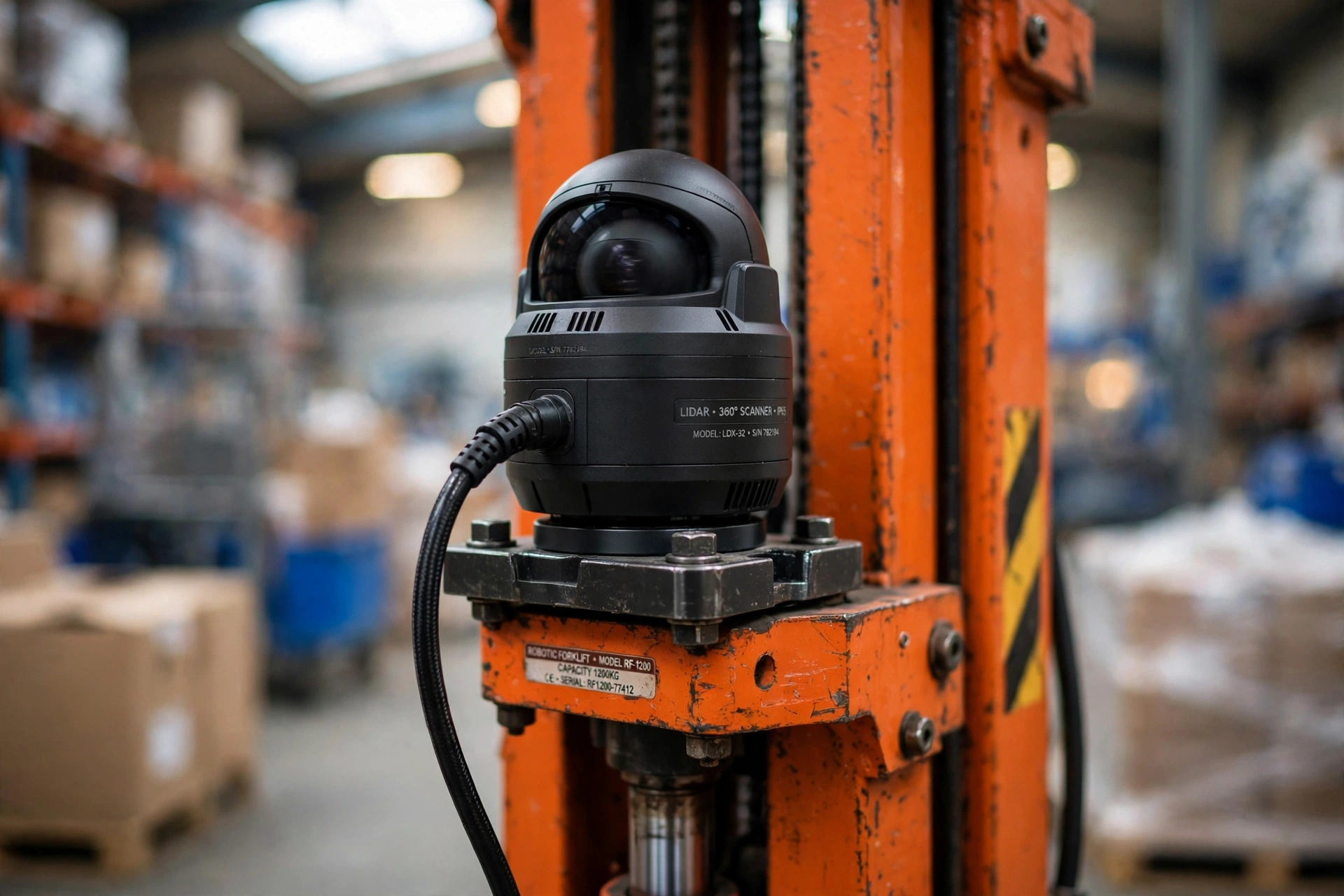
Laser triangulation is the oldest approach: a spinning laser scanner sits high on the truck and bounces light off reflectors fixed to walls and racking. By measuring the distance to at least three reflectors, the truck works out its position, much like GPS uses satellites — accurate, but the reflectors must be installed and kept clean.
Vision guidance uses cameras to recognise features of the building, such as rack uprights and door frames, and compares them with a stored 3D map. Natural navigation, often called SLAM, builds that map on the move, so it suits warehouses that keep changing.
The truck also carries safety sensors: scanners watch the floor ahead, cameras watch for people, and load sensors check the weight on the forks. If something unexpected appears, it slows down, stops, or steers around it. For a deeper look at how machines spot trouble, see how robots avoid obstacles.
AGV vs AMR vs autonomous forklift: what’s the difference?
The terms overlap, but the table below covers the usual meanings.
| Type | How it navigates | Best for |
|---|---|---|
| AGV (automated guided vehicle) | Fixed routes marked by magnetic tape, wires, or reflectors | Repetitive trips between the same points |
| AMR (autonomous mobile robot) | LiDAR, cameras, and SLAM to plan its own route | Flexible work in changing layouts |
| Autonomous forklift | Laser, vision, or SLAM, plus forks and a mast | Lifting, stacking, and moving pallets |
An AGV is the most predictable: it follows a set path, so it suits a warehouse where the same pallets travel the same route all day. An AMR is more flexible, working out its own route and dodging a parked pallet jack on the way.
The difference shows up when the warehouse changes: move a rack in an AGV site and someone must re-lay tape or move reflectors, while an AMR truck simply re-maps the floor on its next run.
What does a robotic forklift do on a normal shift?
Picture a pallet of bottled water arriving at the receiving dock. The warehouse system sends a transport order to the nearest free robotic forklift. The truck drives to the dock, lines its forks up with the pallet using cameras and fork sensors, lifts it, then carries it to the right aisle and slides it into the empty rack slot.
When the job is done, the truck tells the system it is free, and the next order arrives. Between jobs it checks its battery, and when the charge runs low it drives itself to a charging dock, tops up, and returns to work.
That steady rhythm is the point: no tired end-of-shift mistakes, no corner-cutting, and no lifting above its rating.
Are robotic forklifts safe to work beside?
Forklifts are one of the biggest hazards in warehouse work, and most accidents come from human error: speeding, turning too fast, or lifting a load the truck cannot handle. A robotic forklift removes those habits — it travels at a set speed and refuses a load above its rating.
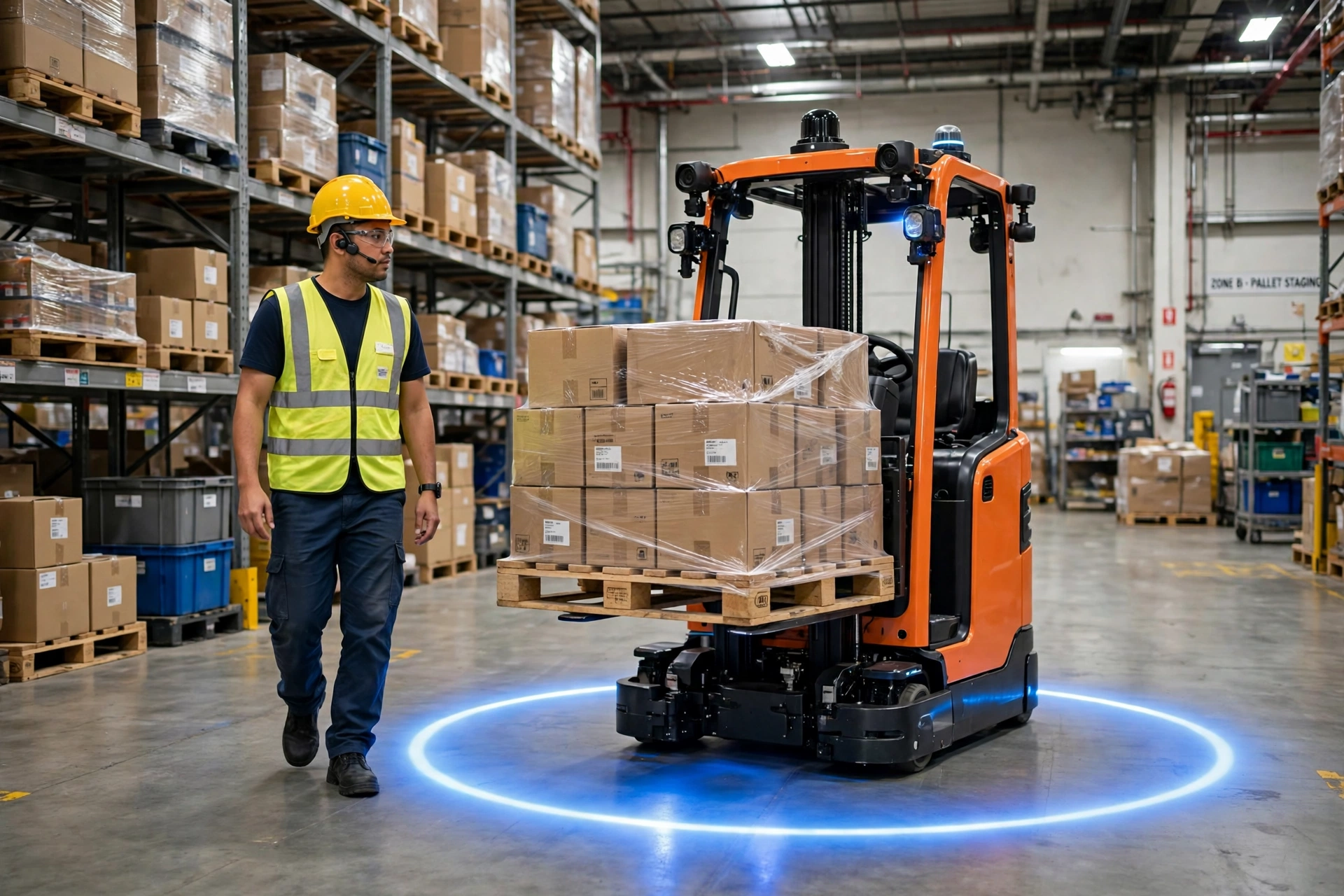
Its safety kit has several layers: laser scanners slow the truck as an object gets closer, bumpers stop it on contact, and cameras spot people stepping into its path.
That said, it is still a heavy machine carrying heavy loads. Workers should treat it like any other forklift: never walk under a raised load, and report damaged racking or spills, because a floor the truck cannot read is a floor it cannot trust.
Where do robotic forklifts struggle?
Robotic forklifts are good at repetition and poor at surprises: a floor covered in shrink wrap, a crookedly stacked pallet, or a racking bay blocked by a ladder can stop one in its tracks.
They also need a decent floor. Deep cracks, steep ramps, and outdoor yards with rain and mud are outside their comfort zone, so most work indoors on flat concrete.
Cost is the other limit: one robotic forklift costs far more than a manual one, before software, charging docks, and floor preparation. For a small warehouse moving a handful of pallets a day, that maths rarely works.
Frequently Asked Questions
How much does a robotic forklift cost?
Prices vary by size and navigation system, but a single machine commonly costs from around $45,000 to well over $200,000, before software and installation.
Can a robotic forklift work alongside human drivers?
Yes, and most sites run a mix: the robotic trucks follow strict speed and spacing rules, while human drivers handle the odd jobs machines struggle with.
Do robotic forklifts need special warehouse floors?
They need flat, clean concrete with visible racking and clear aisles. Magnetic tape or reflectors are only needed for older AGV-style navigation.
How do robotic forklifts charge themselves?
Most drive themselves to a charging dock when their battery runs low, top up, and return to work without anyone touching them. The fleet software schedules charging so trucks are not all offline at once.
What happens if a robotic forklift breaks down?
The truck stops safely, alerts the fleet software, and the system reassigns its jobs to the other trucks. Because the fleet shares the work, one truck down rarely stops the whole warehouse.
Wrapping up
Robotic forklifts are ordinary lift trucks with sensors, mapping software, and a steady work ethic. They shine where the same pallets move the same routes all day, cutting accidents, damage, and wasted trips — though cluttered floors and one-off jobs still belong to human drivers.
If your warehouse moves a lot of identical pallets, start small: trial a single truck on one repetitive route, such as dock to racking, for a few weeks. How it handles your pallets, your floor, and your people will tell you more than any brochure whether robotic forklifts fit your site.