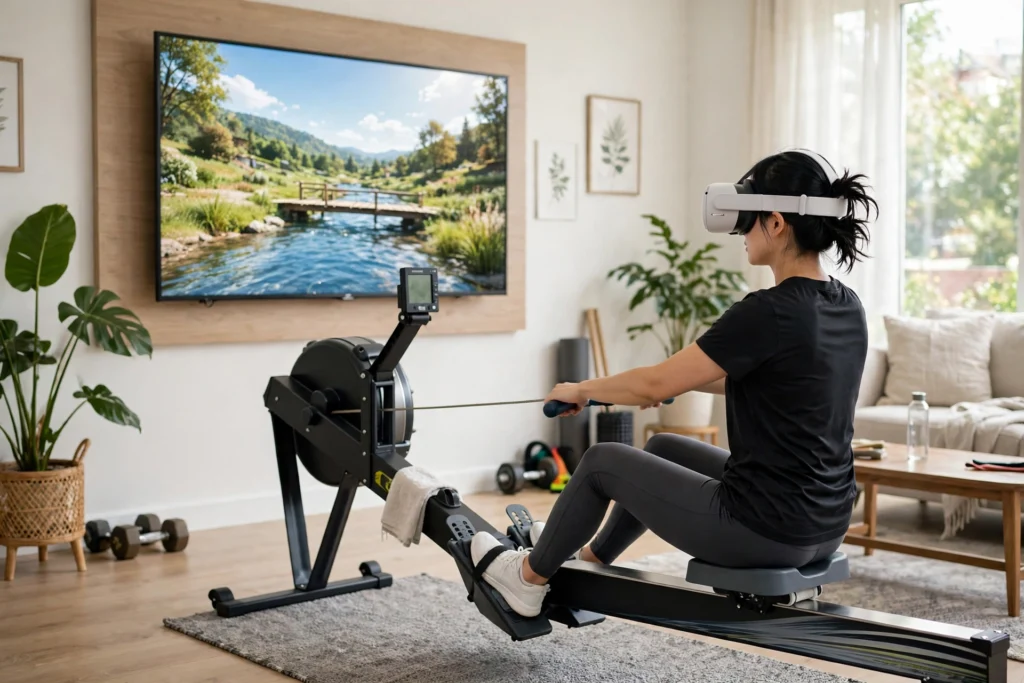
VR rowing pairs an indoor rowing machine with a VR headset, so every pull of the handle moves a virtual boat down a real-looking river. The machine measures your strokes, the app turns them into speed on the water, and the headset makes a spare room feel like the Thames at sunrise.
Key Takeaways
- VR rowing needs three things: a compatible rowing machine, a VR headset, and a rowing app such as EXR or HOLOFIT.
- The app reads your stroke rate and power from the rower and moves your boat to match, so harder pulls mean faster water.
- You can row solo through scenery, race friends online, or follow coached workouts with targets on screen.
- Start with short, easy sessions and check your form first — bad technique on a rower can strain your back.
What actually happens when you row in VR?
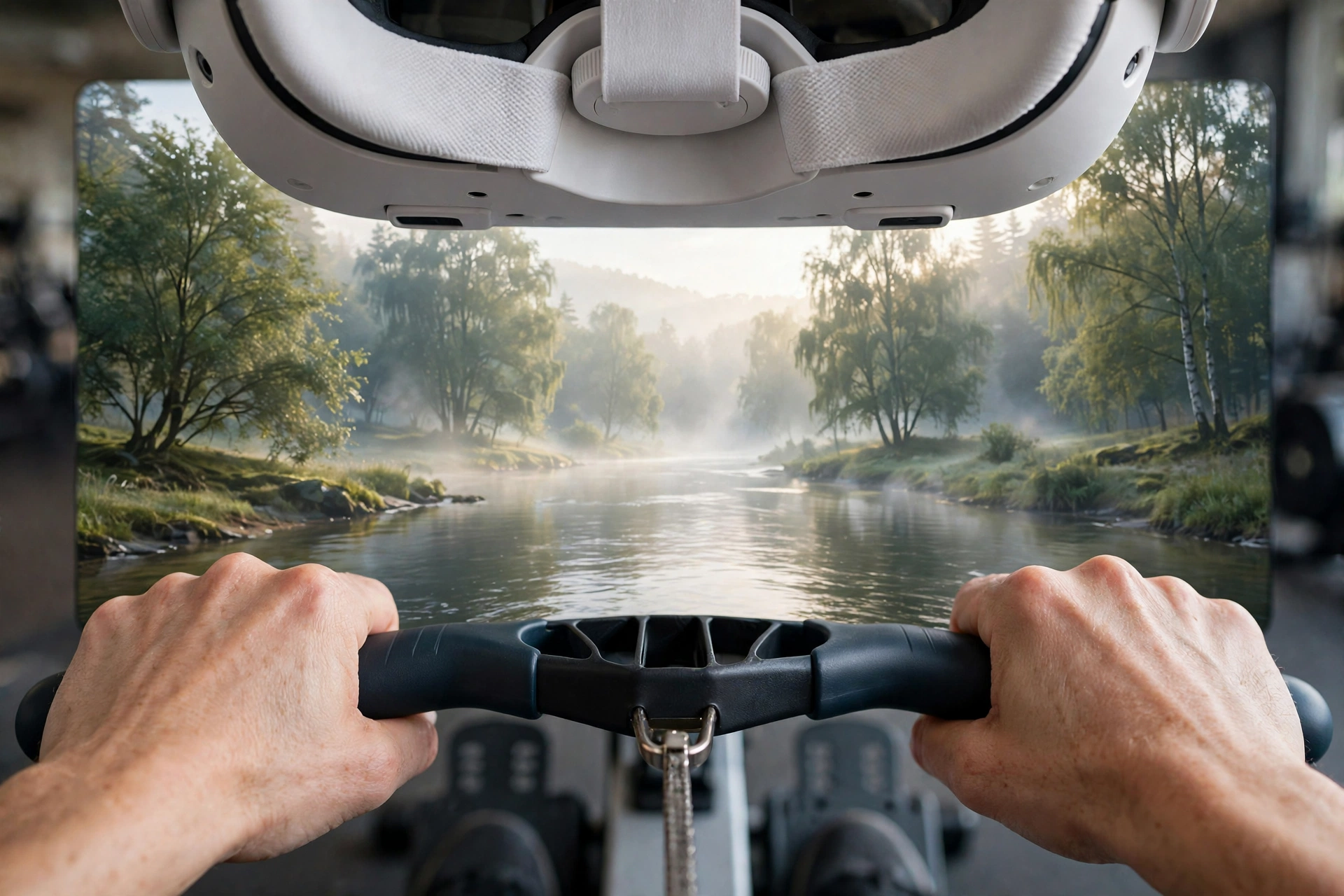
You sit on the rower, strap your feet in, and put the headset on. The app connects to the rower’s monitor over Bluetooth and reads each stroke: how hard you pull, how fast you slide back, and how many strokes you take per minute. That data drives a boat in the virtual world. Pull gently and you drift past the riverbank; pull hard and the boat surges forward.
Most apps show a small dashboard floating in your view — distance, split time per 500 metres, strokes per minute, and heart rate if you wear a monitor.
What do you need to get started?
Three pieces of kit, and you probably own one of them already.
A rowing machine with Bluetooth. The Concept2 RowErg is the one most apps are built around, but EXR also works with WaterRower, FluidRower, Technogym SkillRow, and other FTMS Bluetooth rowers. If your rower has no Bluetooth, check whether its maker sells a small add-on sensor — some do, and it’s cheaper than a new machine.
A VR headset. A standalone headset such as a Meta Quest works well because there’s no cable to trip over mid-stroke. Some apps also run on a phone or tablet, which is a cheaper way to try virtual rowing before buying a headset. Rowing needs no hand controls — your hands stay on the handle — but if you use the same headset for games, our guide to how VR controllers work explains the buttons and tracking.
A rowing app. The two names you’ll meet most are EXR and HOLOFIT. EXR recreates real rowing spots — the Charles River in Boston, Henley-on-Thames — and lets you race other rowers online. HOLOFIT leans into fantasy worlds: tropical forests, ancient ruins, Antarctica, with over a hundred workouts to pick from.
Which app should you pick first?
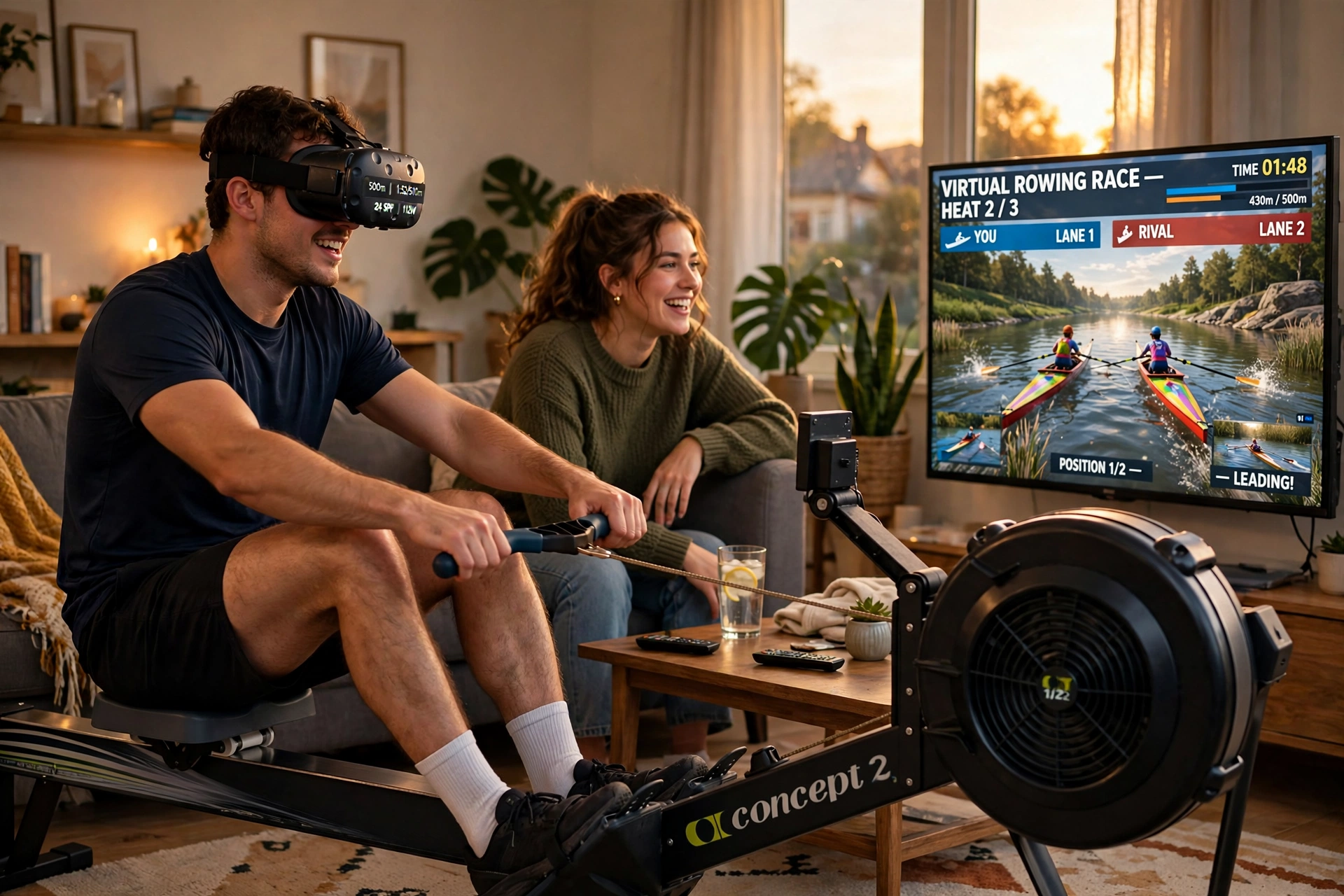
It depends what keeps you rowing. EXR suits people who like real places and real competition: live races, ghost boats of your own best times, and training plans built around a fitness test. HOLOFIT suits people who get bored easily: the scenery changes between sessions, and the workouts feel more like games than training.
| App | Best for | Rough cost |
|---|---|---|
| EXR | Real rivers and online racing | About $10 a month |
| HOLOFIT | Fantasy worlds and varied workouts | About $12 a month |
Both usually offer a free trial, so try before you pay for a year. What matters more than the price is whether the app supports your exact rower — check the compatibility list on the app’s site before subscribing.
Does VR rowing actually feel like real rowing?
Close, but not identical. The resistance, the slide, and the pull are all real, because they come from your actual machine. What VR adds is the reason to keep pulling: a riverbank sliding past, a rival boat creeping up beside you, a finish line 500 metres ahead. Rowers who struggle with motivation often find they row longer in VR without noticing the time.
What it can’t copy is the water itself. There’s no wind on your face and no need to balance a real boat. That’s fine for fitness — the workout is genuine — but it won’t teach you to handle a scull on a windy lake. Think of it as a very good gym session with a view, not a substitute for getting on the water.
A first session: what 20 minutes looks like
Picture a Tuesday evening. You clip into the rower, open EXR, and pick a gentle 2,000-metre row on the Charles River. The first few strokes feel strange — the boat lurches, then settles as the app picks up your rhythm. By 500 metres you’ve found a steady pace, around 24 strokes a minute. A ghost boat of your previous best time appears beside you at the halfway mark, and you pull a little harder to stay ahead of it.
You finish in about nine minutes, and the app shows your split time and a small map of where you rowed. Twenty minutes in total, no commute to a gym, and you’ve covered a route you’d never row in real life. That small loop — pick a place, chase a target, see the result — is what brings people back the next day.
What should you watch out for?
A few honest caveats. First, form matters more in VR, not less: when you’re watching a river instead of your own body, it’s easy to hunch or yank with your arms. Keep your back straight, drive with your legs first, and stop if your lower back complains. Rowing is low-impact, which is part of why VR suits older players too — see VR for seniors for more gentle ways to start.
Second, motion sickness can appear. If you feel queasy, switch to a slower course and take the headset off for a minute.
Third, space. A rower is about two and a half metres long, and you need clear floor around it. Measure before you buy. Finally, sweat and headsets don’t mix well — a washable face cover and a quick wipe after each session keep the headset in good shape.
FAQs
Do I need a VR headset, or can I use a TV?
You can start without one. Several rowing apps run on a phone, tablet, or TV and show the same virtual rivers on a flat screen.
Is VR rowing a good workout?
Yes — it’s the same full-body workout as normal indoor rowing, using your legs, back, arms, and core. The VR layer changes motivation, not the exercise itself. Build up gradually and stop if something hurts.
Can I race friends in VR rowing?
Yes. EXR runs live online races and lets you row alongside friends at your own pace, while HOLOFIT offers challenges and leaderboards.
How much does VR rowing cost to start?
If you already own a rower and a headset, just the app subscription — roughly $10 to $12 a month, with free trials available. Starting from scratch means buying a rower first, which is by far the biggest cost, so try a gym rower or a friend’s machine before committing.
The takeaway
VR rowing takes the most boring part of indoor exercise — staring at a wall while you repeat the same motion — and replaces it with rivers, races, and places you’d never otherwise visit. The workout stays honest: your legs and lungs do the work, and no headset can fake that. If you already own a rower that’s gathering dust, a headset and a free trial are the cheapest way to find out whether a virtual river gets you rowing again. Start with one easy session, check your form, and see if the boat pulls you back tomorrow.