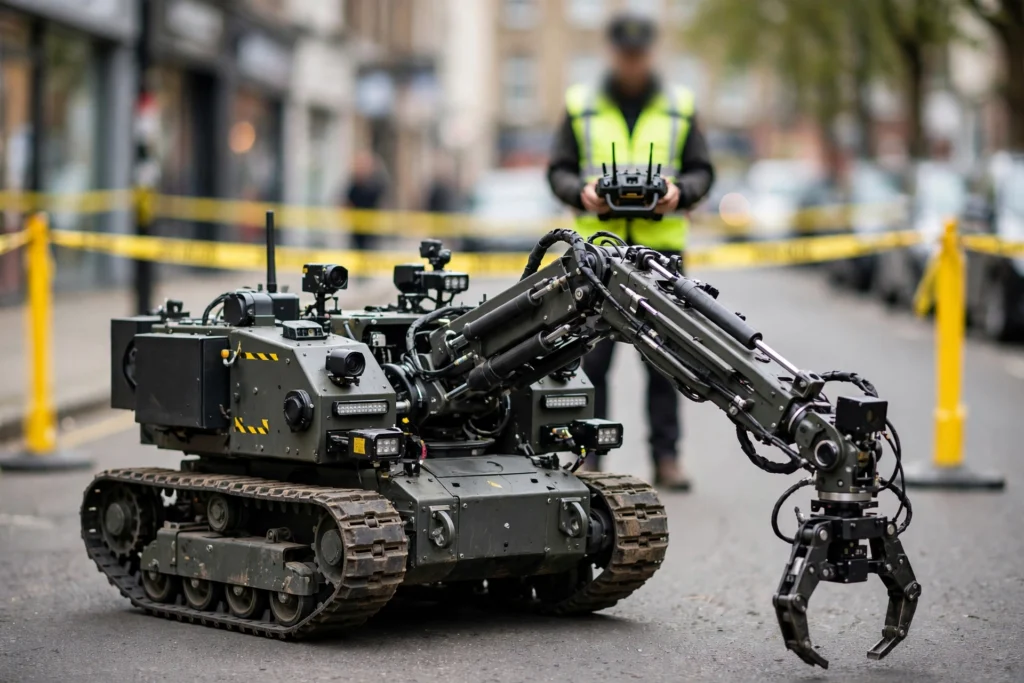
Bomb disposal robots work by letting a trained operator control a rugged, camera-covered machine from a safe distance. The robot drives up to a suspect device on tracks, inspects it with cameras and sensors, then uses its robotic arm and gripper to move it, X-ray it, or disrupt it — so no person has to stand beside something that might explode.
Key Takeaways
- A bomb disposal robot is remote-controlled, not autonomous: a trained human operator makes every decision.
- Cameras, lights, and sensors are the operator’s eyes and ears.
- The arm and gripper pick up, open, move, and X-ray suspect items, and can carry a water-jet disruptor.
- Tracks and a low centre of gravity let it climb stairs and cross rubble.
- It has real limits: it moves slowly, its link can drop, and it cannot replace human judgement.
What is a bomb disposal robot?
A bomb disposal robot is a remote-controlled vehicle built for one job: getting close to a suspect explosive device so a person does not have to. Police and military explosive ordnance disposal (EOD) teams use them for unattended bags, suspicious packages, and unexploded shells.
Most of them look a bit like a small tank. They sit low on tracks, with a boxy body full of electronics and a jointed arm at the front. The whole machine is built to be tough rather than fast — toughness matters far more than speed.
How does the operator control the robot?
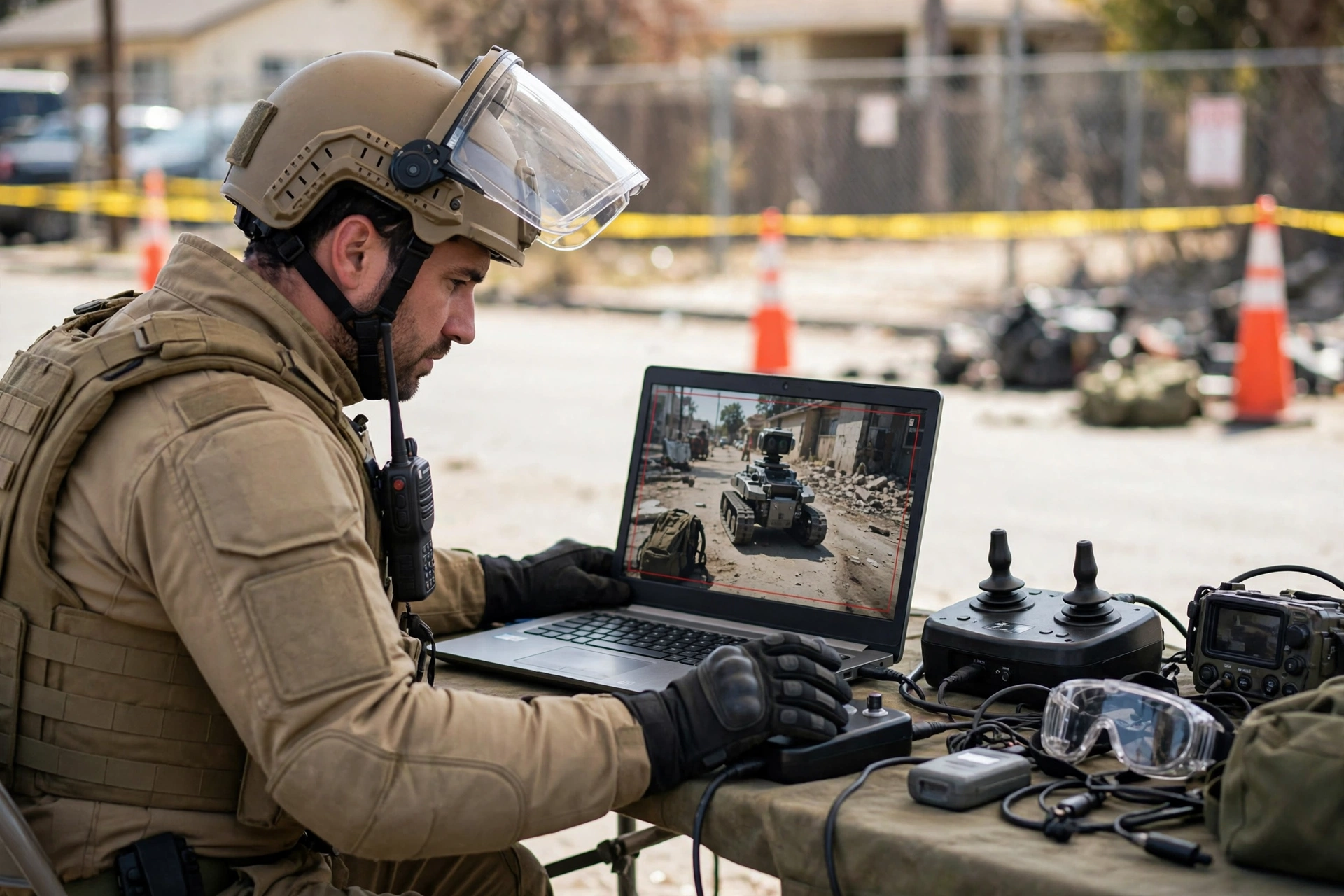
The operator drives the robot from a control station, usually a rugged laptop or a handheld controller with joysticks, a few hundred metres away. Commands travel by radio link, and the robot sends live video back the same way. Some also use a fibre-optic cable, which cannot be jammed and works through thick walls.
Driving takes practice: the operator watches several feeds at once — forward, arm, and sometimes rear — and there is a small delay between moving a joystick and seeing the result, so operators move slowly. If the radio link drops, most robots simply stop where they are rather than keep driving blindly.
How does the robot see and inspect a suspect device?
The robot’s cameras do the seeing, and there are usually several of them. A wide-angle camera on the body shows the scene ahead, a smaller camera on the arm lets the operator look closely at a bag’s zip, a wire, or a blinking light, and many also carry a pan-and-tilt camera.
Light matters too. Suspect devices often turn up in dark corners, so the robot carries bright LED lights and sometimes an infrared camera. Some add a microphone and a loudspeaker, so the operator can listen in and warn people nearby to move back. When a closer look is needed, the robot can carry a portable X-ray unit that shows what is inside a bag or box without opening it.
What can the robot’s arm and gripper actually do?
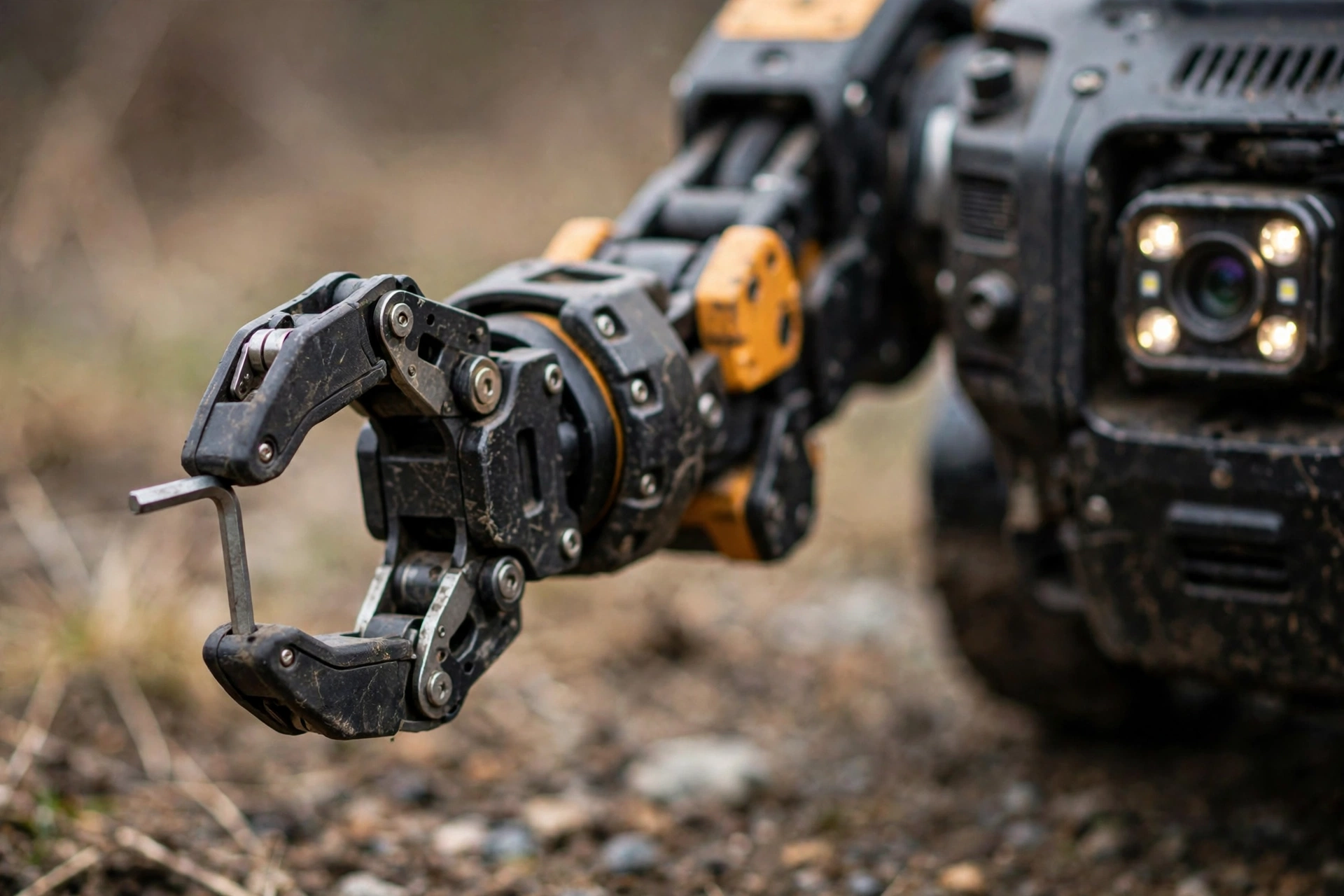
The arm is the robot’s most useful tool, and it works much like the robot arms used in factories — just slower and more careful. Most have five or six joints, so they can reach around an object and rotate the wrist to turn it over. The two-finger gripper closes gently, and the operator controls the squeeze.
With that arm, the robot can pick up a bag and carry it to a safer spot, unzip a case, lift a lid, or pull a wire aside. It can also hold tools such as a cutting blade, a hook, or a mirror. Precision is the hard part, since the operator is watching a flat screen, not standing next to the arm — but a good operator can pick up something as small as a phone without crushing it.
How does a disruptor make a device safe?
When a suspect device looks dangerous, the team may decide not to move it at all. Instead, the robot aims a disruptor at it: a short barrel that fires a high-speed jet of water at a precise point, meant to break the device apart and cut its wires before it can function as intended.
The robot carries the disruptor on its arm or mounted on its body, and the operator lines it up using the arm camera. The shot is fired remotely, and the team then sends the robot back in to look at the result. A disruptor does not make an explosive vanish; it breaks the device so it cannot work as designed, and the remains still have to be checked by the disposal team.
How do bomb disposal robots move over rough ground?
Tracks are the usual answer. A tracked robot spreads its weight across a wide area, so it can cross gravel, grass, and broken concrete without sinking or tipping. Many models have tracks that extend forward like flippers, which help them climb stairs and get over kerbs. Wheels would be faster on flat ground, but they struggle on rubble and stairs.
The low body keeps the centre of gravity down, and the battery carries enough charge for the job plus a reserve to drive back.
What are the limits of a bomb disposal robot?
They are impressive, but not magic, and the teams who use them are the first to say so. The robot moves slowly, often at walking pace or less, so reaching a device deep inside a building takes time. Its radio link can weaken inside concrete structures or underground.
The robot also cannot feel what it is holding, and it has no judgement of its own: every decision, from which wire to cut to whether a bag looks suspicious, is made by the human at the controls. Like drone robots, it is a remote-controlled tool, not a replacement for the team. The robot takes the physical risk; the people take the decisions.
FAQs
How far away can the operator be?
Several hundred metres is typical on open ground, though walls shorten the range inside buildings.
Can a bomb disposal robot climb stairs?
Yes, most tracked models can: their tracks extend forward to grip each step, and the arm acts as a counterbalance. It is slow work.
Do bomb disposal robots work on their own?
No — they are remotely operated, not autonomous, and a trained operator makes every decision.
What happens if the robot is damaged?
Robots are built to be repaired, and teams carry spare parts. If one is destroyed by a blast, it did its job by taking the hit instead of a person.
What should I do if I find a suspicious object?
Do not touch it, move it, or use a phone or radio near it. Move away, warn others, and call the emergency services — only trained disposal teams should deal with suspect devices.
Conclusion
Bomb disposal robots work by putting distance between people and danger: a tracked body carries cameras, sensors, and a careful arm to the device, while a trained operator watches and acts from a safe distance. They are slow and limited, and they cannot replace human judgement — but they let disposal teams inspect, move, and disrupt suspect devices without standing beside them.
If you ever come across something that looks out of place and possibly dangerous, the practical next step is simple: leave it alone, move well away, and call the emergency services. And if you want to see more of how robots handle risky jobs, read our guides to inspection robots and security patrol robots — and, for the wider picture, the robotics overview at Britannica.