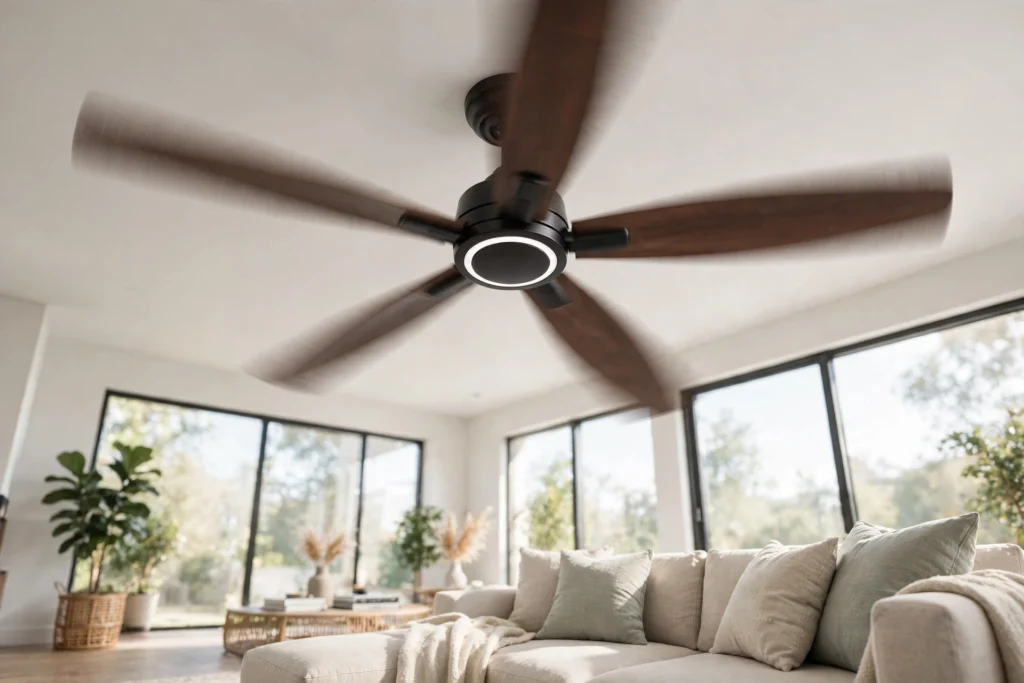
A ceiling fan works by spinning angled blades that push air around a room. An electric motor turns the blades, and because each blade is tilted, the spin creates a steady column of moving air. That breeze cools your skin by speeding up sweat evaporation, even though the room’s temperature barely changes.
Key Takeaways
- A ceiling fan moves air; it does not lower the room’s temperature.
- Angled blades and motor speed decide how strong the breeze feels.
- Anticlockwise in summer for a cooling downdraft; clockwise in winter to push warm air back down.
- A fan uses far less electricity than an air conditioner, so it pairs well with one.
- Turn the fan off when nobody is in the room — it only cools people, not empty space.
What are the main parts of a ceiling fan?
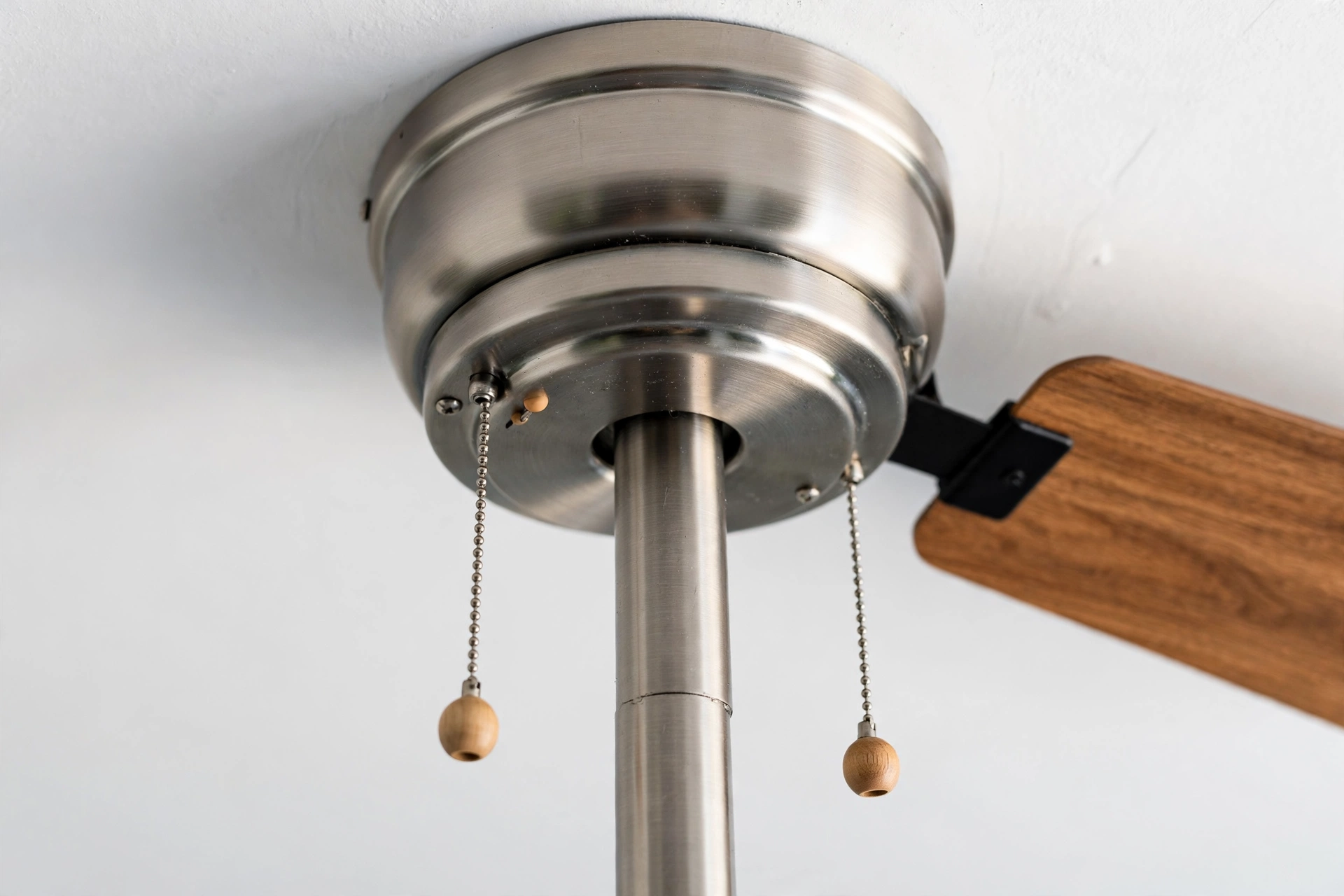
Four parts do most of the work. The motor sits at the centre and turns the blades — a standard AC motor, or a quieter, more efficient DC motor that usually comes with a remote instead of pull chains. The blades attach through short metal arms called blade irons. Most fans have three, four, or five blades — mostly a style choice. What matters more is blade pitch, the angle of each blade: around 12 to 15 degrees moves plenty of air without straining the motor.
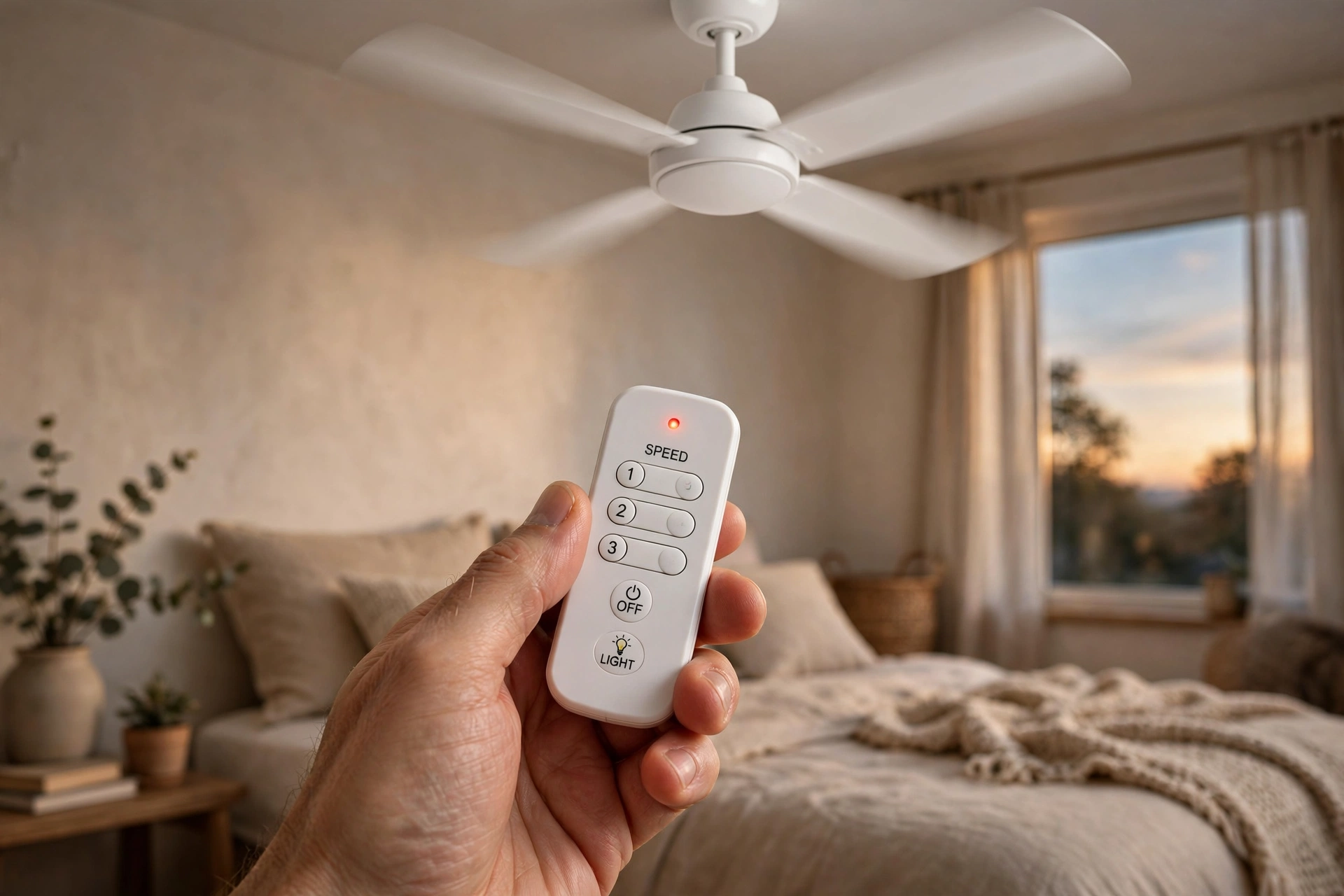
Above the motor sits the canopy, the cover hiding the wiring. On high ceilings, a downrod — a metal tube — hangs the fan lower so the blades sit about 2.1 to 2.4 metres above the floor. Speed and direction are set by pull chains, a wall switch, or a remote.
How do the blades actually move air?
Think of a blade as a flat wing tilted at a slight angle. As the motor spins it, the tilted surface pushes air downwards, like a propeller pushing a boat forward. Spin the blades fast enough and you get a wide column of air flowing from the ceiling towards the floor, then spreading across the room.
Blade pitch is the key detail: blades set almost flat barely stir the air, while blades tilted too steeply load the motor and get noisy. Speed settings change how much air moves — low suits a bedroom at night, high pushes a strong breeze across a living room, and medium is often the best balance.
Why does a fan make you feel cooler if it doesn’t cool the room?
This is the part most people get wrong: a ceiling fan does not change the temperature of the air. Left running in a sealed, empty room all day, it would leave the room very slightly warmer from the motor’s waste heat.
What changes is how your body feels. Moving air speeds up sweat evaporation and carries away the warm layer sitting against your skin, so a room can feel several degrees cooler than the thermometer says. It is also why a fan works so well alongside an air conditioner: the air conditioner cools and dries the air, the fan spreads it around, and many people can then set the thermostat a couple of degrees higher.
What does the reverse switch do in winter?
Most fans have a small switch on the motor housing that reverses the direction of spin. In summer, the blades should turn anticlockwise when viewed from below, pushing air straight down onto the people in the room — the cooling downdraft.
In winter, flip the switch so the blades turn clockwise and pull air upwards. Warm air gathers near the ceiling, so the updraft pushes that warm layer out towards the walls and gently back down to floor level, without blowing a draught onto anyone. Run the fan on its lowest speed in this mode. The first electric ceiling fan was built by Philip Diehl in 1882, and you can read more about that story on the Wikipedia ceiling fan page.
How much electricity does a ceiling fan use?
Very little. A typical fan draws between 15 and 75 watts depending on size and speed — roughly what a couple of LED bulbs use — while an air conditioner can draw a thousand watts or more. A toaster or a coffee maker pulls well over a thousand watts while it is on, and a dishwasher uses far more energy per cycle than a fan uses in a whole evening. The fan’s real cost comes from leaving it running in empty rooms, hour after hour, for no benefit — switch it off when you leave.
How do you pick the right size?
A fan with blades too small for the room will spin away without reaching the corners, while an oversized fan in a tiny bedroom can feel like a helicopter. As a rough guide, around 90 centimetres suits a small bedroom, 110 to 130 centimetres fits a standard living room, and larger rooms suit 140 centimetres or more. Blades should sit at least 2.1 metres above the floor, and on a high ceiling a longer downrod brings the fan down into the air it needs to move.
What usually goes wrong, and how do you fix it?
The most common complaint is wobbling, usually from a slightly bent blade, loose screws, or blades set at different angles. Tighten every screw first, then check each blade sits level. Many fans ship with a small balancing kit — a clip and a few weights — that you can move along a blade until the wobble stops.
Humming or buzzing is next. On a new fan it can be the lubricant settling in, and a day of running often clears it. If the remote stops working, change the battery first, then check the receiver inside the canopy. Anything involving the house wiring — a faulty wall switch, a burning smell, or a fan that trips a breaker — is a job for a qualified electrician. The HowStuffWorks ceiling fan guide has a useful checklist for the simple fixes.
Frequently Asked Questions
Does a ceiling fan cool a room?
No. A fan moves air and cools the people in the room through evaporation and wind chill, but it does not lower the air temperature. In an empty room it adds a tiny amount of motor heat, so switch it off when you leave.
Which direction should a ceiling fan spin in summer and winter?
In summer, anticlockwise from below, pushing air down onto you. In winter, clockwise on low speed, pulling warm air up and back down along the walls without a direct draught.
Can I leave a ceiling fan on all day?
You can, but there is little point if nobody is in the room — the cooling effect only works on skin. Leaving it on overnight in a bedroom is fine and common, especially on low speed.
Do more blades mean more air?
Not necessarily. Three blades can move as much air as five when the pitch and motor are right. More blades usually means quieter, smoother running and a different look, rather than a stronger breeze.
Can a ceiling fan be used outdoors?
Yes, but only if it is rated for outdoor use: sealed motors and weather-resistant blades that cope with damp air. An indoor fan on a porch may work for a while, but moisture will damage it sooner or later.
Conclusion
A ceiling fan is one of the simplest machines in the home: a motor, a set of tilted blades, and a switch. Yet it earns its place by doing one job well — moving air so people feel cooler in summer and warmer in winter, for very little electricity. The practical next step is a quick check of the fan you already have: set the direction for the season, tighten any loose screws, and wipe the blades. That five-minute job is often all it takes.