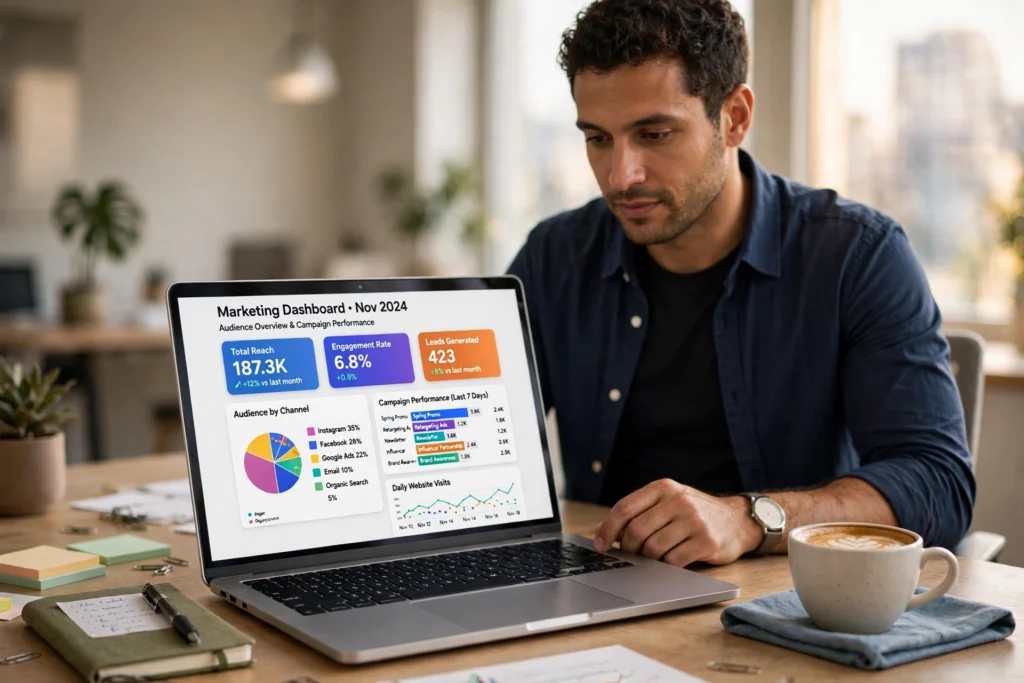
AI marketing uses machine learning to study customer data, spot patterns, and carry out marketing tasks faster than a person could by hand. It helps businesses find the right audience, show each person more relevant ads and emails, and measure which campaigns actually work, while people still decide the strategy and check the results.
Key Takeaways
- AI marketing analyses customer data to find audiences, predict interests, and personalise messages at scale.
- It is most useful for audience targeting, ad optimisation, email timing, and content drafts.
- It works best on clean, well-organised customer data.
- It does not replace marketers: people still set goals, check claims, and handle sensitive decisions.
- Privacy rules and honest data practices matter more, not less, when AI is involved.
What is AI marketing?
AI marketing is marketing that uses artificial intelligence to decide who to reach, what to show them, and when to reach them. Instead of one message sent to everyone, the software looks at past behaviour — what people clicked, bought, or ignored — and groups customers by what they are likely to want next.
It builds on the same ideas explained in our complete guide to artificial intelligence: machine learning finds patterns in data, and natural language tools read and write text. Salesforce’s guide to AI marketing describes the same split — predictive AI that spots patterns, and generative AI that drafts content — and both are now built into tools that small teams can use.
How does AI marketing find the right audience?
Good marketing starts with knowing who you are talking to, and that is where AI does its heaviest work. A business may hold thousands of customer records — purchases, website visits, email opens, support chats — and a model can sort them in minutes.
First, AI groups customers into segments. It might find that buyers aged 25 to 34 open emails on Sunday evenings, while another group only buys during sales. These groups come from real behaviour, so each group can receive messages that match what it actually does.
Second, it finds lookalike audiences. Once a business knows its best customers, the software looks for people with similar habits and suggests them as a new audience for ads. That is how a small shop can reach people it has never met without paying to show ads to everyone. It can also score leads, ranking potential customers by how likely they are to buy, so a sales team calls the warmest prospects first.
How does AI marketing personalise ads and content?
Personalisation is the part of AI marketing most people notice, because it is the part they see. When a shopping app shows trainers in your size, or a streaming service suggests a film in a genre you watch often, a recommendation model is at work: it compares your past choices with those of similar customers and picks the items most likely to interest you.
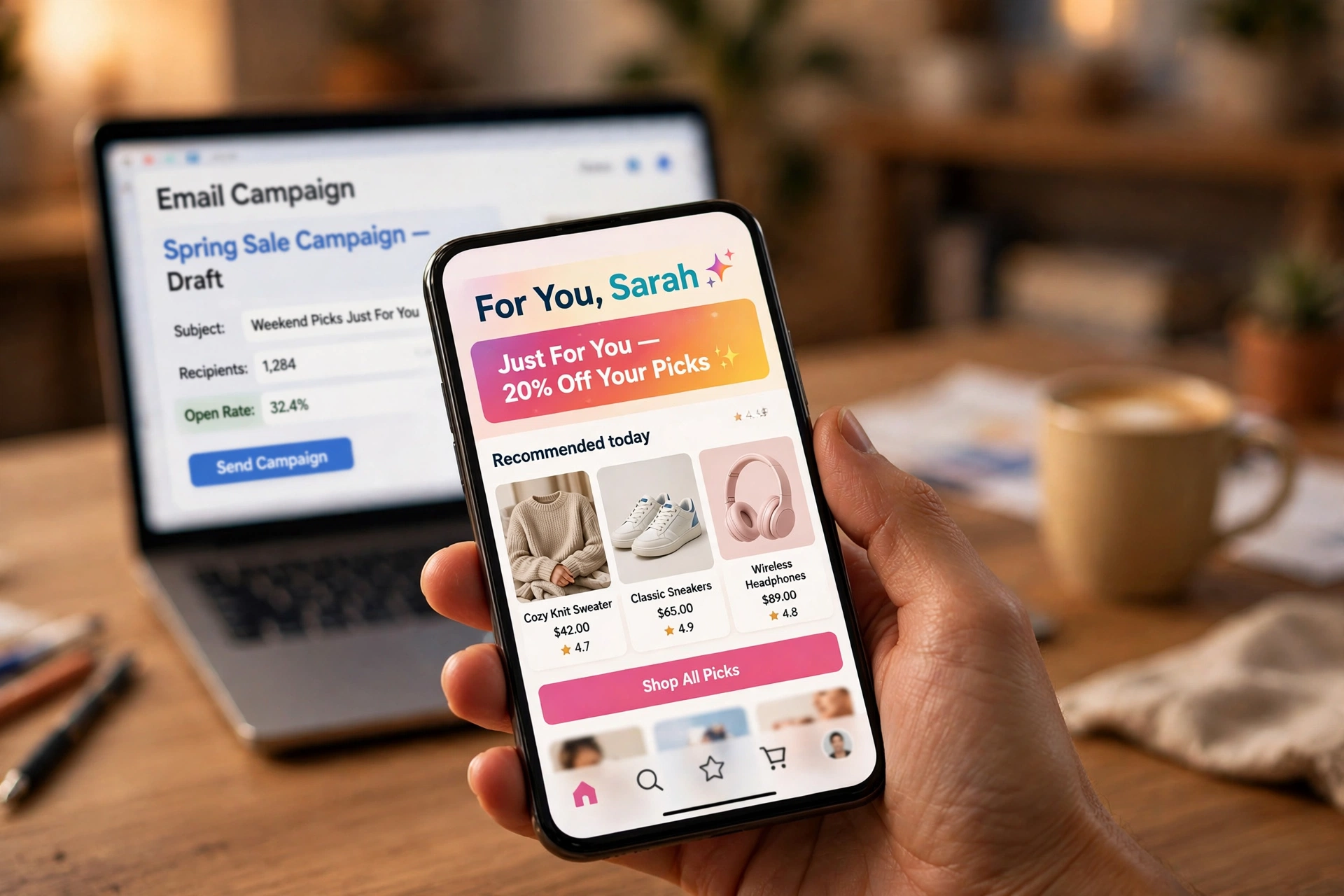
Email works the same way. AI can choose the best time to send each message, pick a subject line from several options, and test which version gets more opens. The winning version is then sent to the rest of the list.
Chatbots play a role here too. An AI chatbot on a website can answer common questions, suggest products, and pass a tricky question to a person. Our guide to how AI helps with customer service explains how those handoffs work: the bot handles the routine, and people handle the rest.
How does AI marketing create content?
Generative AI can draft blog posts, product descriptions, social media captions, and ad copy in seconds. For a small business with one person doing the marketing, that is a real time-saver, and AI for small businesses covers several of these low-cost uses.
But a draft is not a finished piece. AI tools sometimes invent facts, repeat tired phrases, or write in a tone that does not match the brand. Let the tool produce a first draft, then a person checks every claim, fixes the tone, and adds real examples.
How does AI marketing measure what works?
AI marketing tools track results as they happen: which advert got clicks, which email led to a sale, and which audience stopped responding. The software can then shift budget toward the advert that performs best and pause the one that does not.
Attribution is the tricky part. A customer might see an advert, read a blog post, and then buy a week later. AI models try to work out which touchpoint mattered most, so the business knows where its money is going. These estimates are useful, but they are not exact.

What are the limits and risks of AI marketing?
AI marketing has real limits. The first is data quality. If customer records are messy, outdated, or full of errors, the model’s suggestions will be too, so cleaning the data matters before any tool is switched on.
The second is privacy. AI marketing needs personal data to work, and customers are rightly careful about how theirs is used. Collect only what you need, explain clearly how it is used, and respect opt-outs. Rules such as GDPR in Europe set firm limits. Wikipedia’s overview of AI marketing notes the same tension: personalisation improves results, but it depends on data people trust you with.
The third is over-automation. An advert that follows a customer around the internet feels less like help and more like surveillance, so frequency caps — limits on how often one person sees the same advert — keep campaigns from turning people away. AI can also learn biases from old data, for example by showing a job advert mainly to one group, so regular checks of who sees each campaign catch that early.
Finally, email filters matter. The same AI that helps marketers also helps inboxes: spam filters learn what looks like junk and hide it. Our post on how AI detects spam emails explains how those filters work — a reminder that a pushy campaign may never reach its audience.
FAQs
Does AI marketing replace marketers?
No. It handles repetitive work — sorting data, testing versions, and scheduling sends — but people still set the strategy, write the final copy, and decide what is fair and honest to say.
How much does AI marketing cost?
It ranges widely. Many email and advertising platforms include basic AI features in their standard plans, so a small business may pay nothing extra. Larger tools with predictive analytics and custom models cost more.
Is AI marketing suitable for a small business?
Yes, and small businesses often gain the most, because one person can do work that used to need a team. Start with one tool you already use, turn on its AI features, and check the results for a month.
How do I start with AI marketing?
Start with your data. Gather customer emails, purchase records, and website visits in one place, clean up duplicates and old entries, and set a single goal, such as more repeat purchases. Then pick one use — personalised emails, say — and measure it for a few weeks.
Can AI marketing break privacy rules?
It can, if it is used carelessly. Collect only the data you need, tell customers how it is used, honour opt-outs promptly, and check the rules that apply where your customers live.
Conclusion
AI marketing is at its best when it does the heavy lifting — finding audiences, testing messages, and tracking results — while people make the decisions that need judgement. If you want to try it, pick one campaign, clean the data behind it, and let an AI tool personalise and measure that single campaign for a month. Compare the results with your previous campaign, keep what worked, and drop what did not.