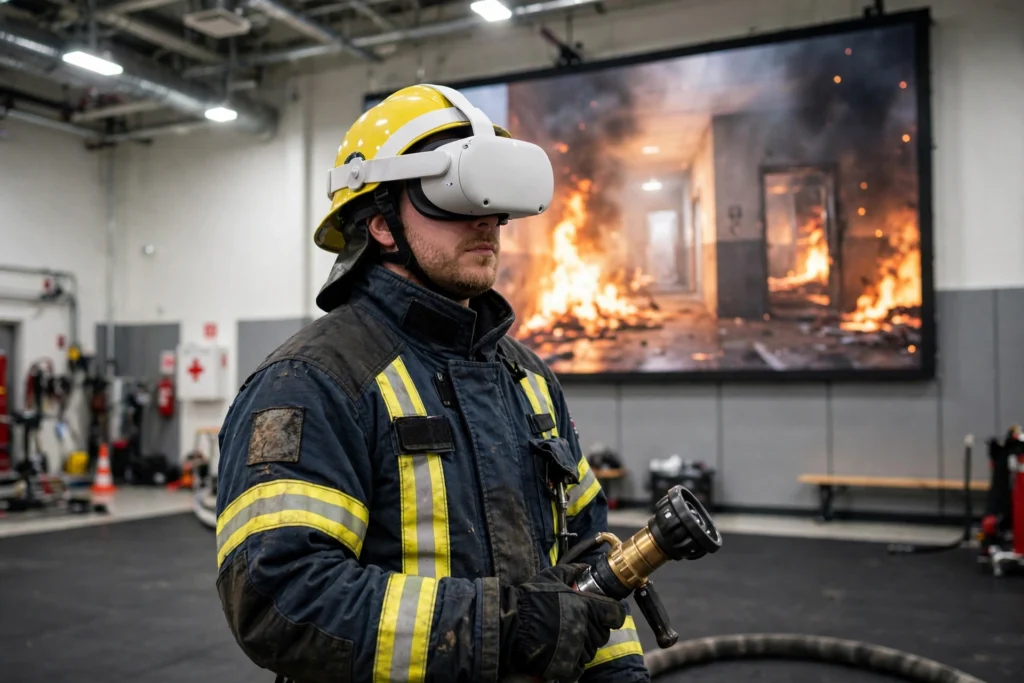
VR firefighter training puts a crew inside a burning building that isn’t really on fire. Wearing a headset and holding a real-feeling hose nozzle, a trainee walks through smoke, finds the seat of the fire, and practises the same decisions they’d make at a real call — without the heat, the falling debris, or the risk.
Key Takeaways
- VR firefighter training recreates burning buildings, smoke, and rescue tasks in a headset so crews can practise safely and repeat drills often.
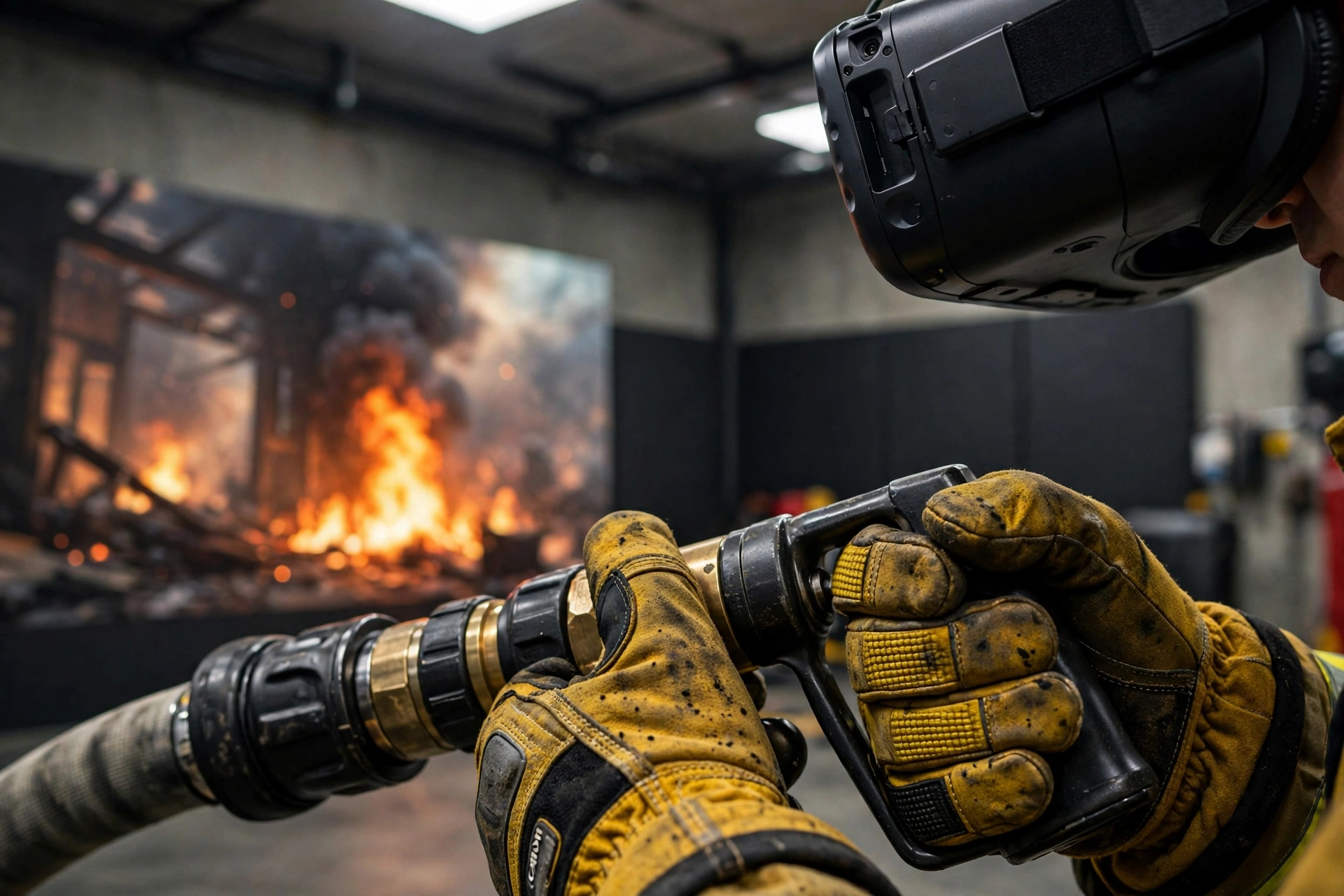
- The headset, controllers, and a tracked hose nozzle work together so the trainee’s movements match what they see in the virtual building.
- Heat vests, fans, and haptic feedback add warmth and hose pressure, though nothing in VR fully matches a real fire.
- Instructors can change the fire’s behaviour mid-drill, replay the session, and score decisions such as hose handling, search patterns, and radio calls.
- VR works best alongside live-fire training, not instead of it, because real heat, weight, and teamwork still need real practice.
What does a trainee actually see and feel inside the simulation?
Put the headset on and you’re standing in a hallway, not a training room. The smoke hangs low, the alarm is sounding, and the fire is spreading across the far wall. Turn your head and the view turns with you, because the headset tracks your head movements and redraws the scene to match — the same basic trick behind any VR headset, explained in our guide to how VR headsets work.
Your hands are tracked too. Most systems use hand controllers, or a replica hose nozzle with sensors built in, so when you aim the nozzle, the virtual water stream follows your aim. Some setups add a heat vest that warms as you near the flames, a fan that blows hot air, and a nozzle that pushes back when the water flows. None of this is a perfect copy of a real fire — the heat is milder and the air stays breathable — but it’s close enough that your body reacts: trainees crouch lower, move more carefully, and call out sooner, just as they would on a real job. The system also maps the training space first, so the virtual building lines up with the real floor; our guide to how VR room mapping works explains that part in more detail.
What kinds of drills can crews run in VR?
A typical session starts with a scenario: a kitchen fire in a flat, a car fire in a garage, or a search for a missing person in a smoke-filled office. The instructor picks the building, the fire’s starting point, and how fast it grows, and some scenarios add complications halfway through — a ceiling collapses, or a casualty appears behind a door.
Because the scenario is software, it can be run again and again with small changes — the same flat fire five times in an afternoon, each time with a different wind direction or entry point. That repetition is hard to arrange with live fire, where every burn needs a building, fuel, safety officers, and hours of preparation. VR also covers situations crews rarely meet in real life, such as a fire on the upper floor of a high-rise.
How do instructors change a drill while it’s running?
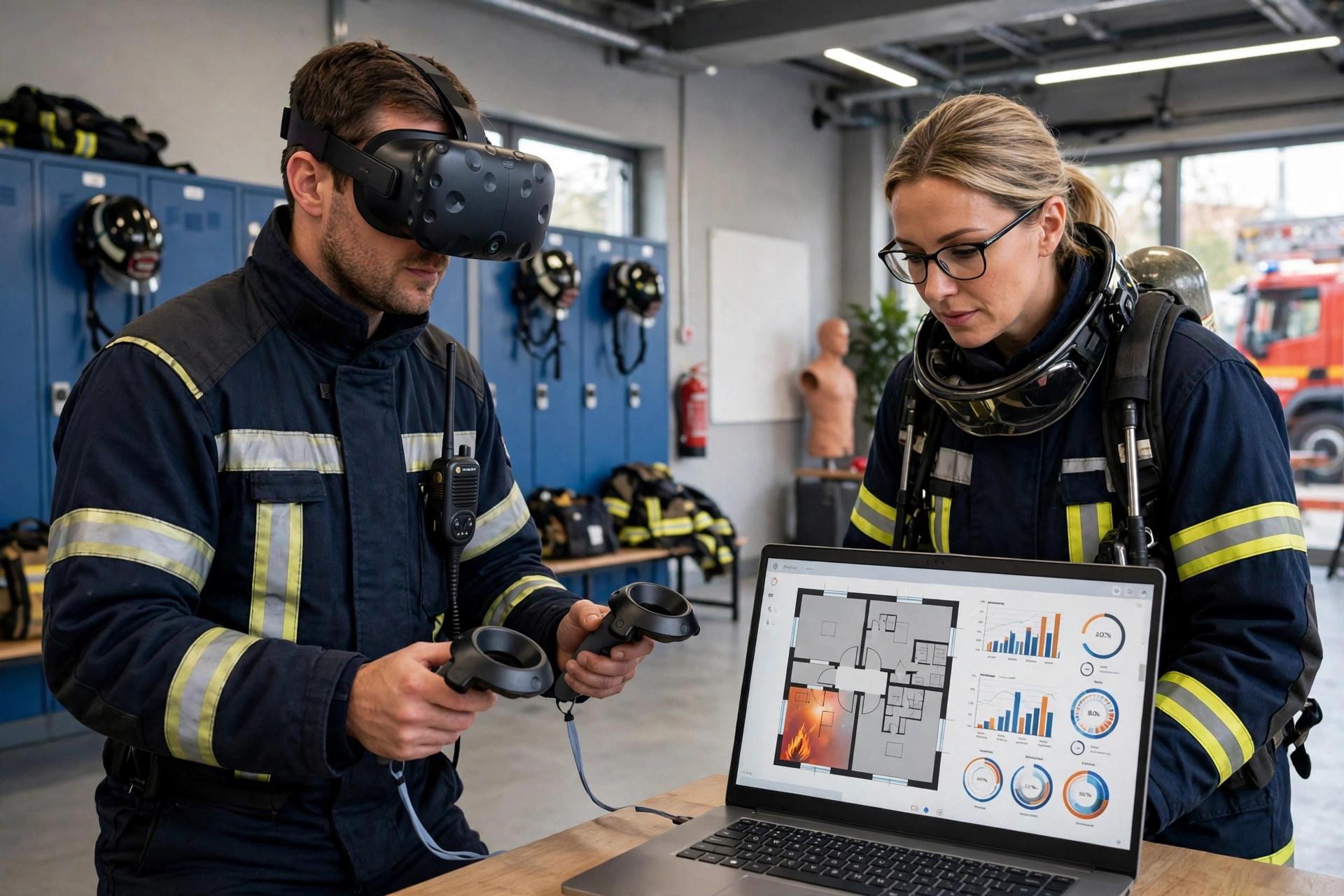
The instructor watches from a screen outside the headset, seeing what the trainee sees plus extra detail: where the trainee is standing, how much water they’ve used, and how long they’ve spent in each room. With a few clicks they can make the fire spread faster, cut off an exit, or send a radio message that a second crew is on the way.
This live control is what turns a VR session from a video game into training. A drill that goes too smoothly can be made harder on the spot, and a trainee who hesitates at a doorway can be given a reason to move — the smoke thickens, or a shout comes from the next room. The instructor can also pause the scene, freeze the fire, and talk the trainee through what just happened before restarting. Try doing that with a real fire.
How do instructors review a session afterwards?
When the drill ends, the system produces a replay. The trainee and instructor walk through the virtual building together and look at the key moments: where the hose was aimed, how long the search took, whether the trainee checked the door for heat before opening it, and whether radio calls came at the right time.
Many systems score the session automatically — time to find the fire, water used, rooms searched, and safety checks completed. The numbers aren’t the whole story: a fast time with sloppy technique is worse than a slower, careful run. Good instructors use the score as a starting point for conversation, not a final verdict, and the replay makes those questions concrete, because everyone can see exactly what happened.
What are the limits of VR firefighter training?
VR can’t copy everything about a real fire. The weight of a breathing apparatus, the drag of a charged hose line, and the sheer heat of a room about to flash over are all hard to reproduce. A trainee who only ever trains in VR might move too confidently in a real building, because the virtual fire never truly threatens them — which is why fire services treat VR as an addition to live-fire training, not a replacement.
Cost is another limit. A full setup — headsets, tracked nozzles, heat vests, and the software licence — is a serious purchase for a small fire station. But compared with building and burning a training structure, the running cost of each extra session is low.
Can VR training replace live-fire exercises?
No, and no honest provider claims it can. Live-fire exercises teach things VR simply can’t: how heavy a charged hose feels when it fills with water, how hot a door handle gets before a room flashes over, and how a crew communicates when they can barely hear each other. Those lessons need real heat and real weight.
What VR does well is volume and variety. A crew can run ten different scenarios in a week, including rare ones they’d otherwise never practise, and each run can be reviewed in detail. Then, when the crew does get to a live burn, they’re not starting from scratch — they’ve already made the decisions, in the right order, several times over.
FAQs
Do firefighters wear their full kit during VR training?
Usually yes, or at least the heavier parts of it. Wearing the turnout gear, helmet, and breathing apparatus makes the session feel closer to the real thing, and it helps the body learn to move with the extra weight.
How long does a VR training session last?
Most drills run for ten to twenty minutes, with a debrief afterwards. Short, repeated sessions tend to teach more than one long session, because the trainee can try again straight away with the feedback fresh in mind.
Is VR firefighter training used by real fire services?
Yes. Fire services in several countries use VR systems for recruit training and for refreshing skills that are hard to practise live, such as high-rise fires and hazardous-material incidents. Specialist providers build the scenarios with input from experienced firefighters, so the drills follow real procedures.
What happens if a trainee makes a mistake in VR?
Nothing dangerous — and that’s the point. A wrong turn or a hose aimed at the wrong spot becomes a teaching moment instead of an injury. The instructor can replay the mistake, explain what went wrong, and run the scenario again so the trainee can practise the right move until it sticks.
Does VR training help with teamwork, or is it just for one person?
Modern systems support several trainees in the same virtual building at once. Each person wears a headset and appears as an avatar to the others, so the crew can practise entry, search, and hose work together, with one person acting as the officer giving orders.
Conclusion
VR firefighter training works because it lets crews practise the hardest part of the job — making good decisions under pressure — in a place where mistakes cost nothing. The headset, the tracked hose, and the instructor’s live control turn a virtual building into a repeatable, reviewable drill.
If you’re involved in training, the practical next step is simple: ask your local fire service or a VR training provider for a short demo session, and watch how a crew handles the same scenario twice. The difference between the first run and the second usually tells you everything you need to know.
Further reading: