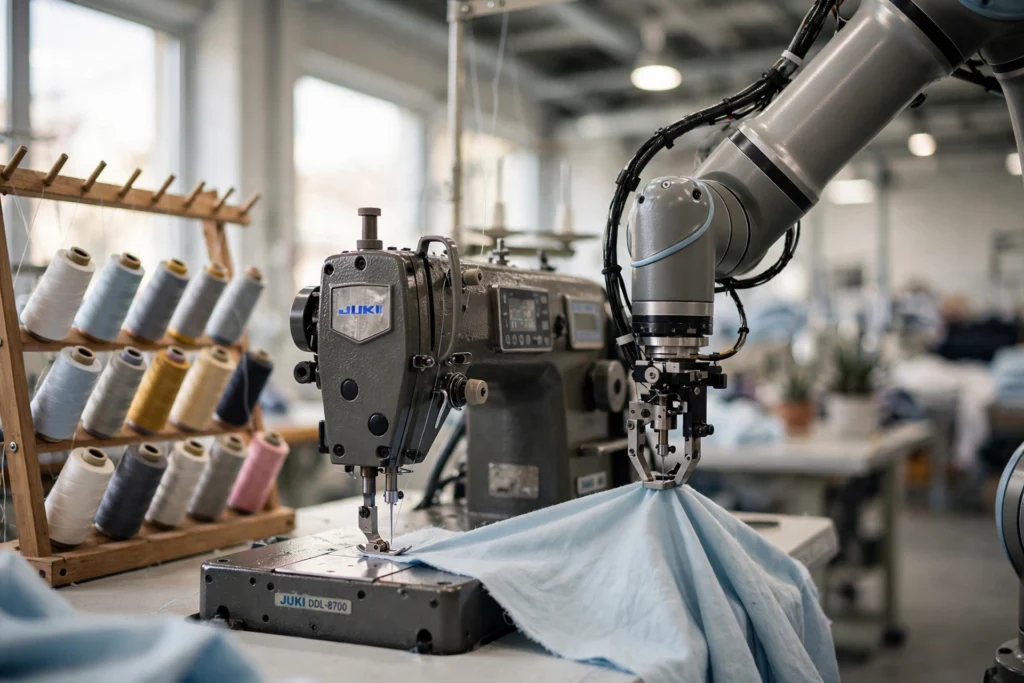
Sewing robots are machines that guide fabric through an industrial sewing machine, stitch a seam, and move the finished piece on — without a person holding the cloth. They pair a robotic arm with cameras, sensors, and a standard sewing machine, and they already handle simple, repeatable seams in garment factories.
Key Takeaways
- A sewing robot is a system: arm, vision, gripper, sewing head, and software.
- Fabric is the hard part. It bends and wrinkles, so the robot must watch it constantly.
- Straight seams on stable fabric — T-shirt hems, denim panels — are the most automated jobs.
- Research systems now sew curved seams by tracking the fabric edge with a camera.
- People still run the line: setup, fixing jams, and quality checks.
Why is fabric so hard for a robot to sew?
Metal parts stay where you put them. Fabric does not. A shirt panel can fold, curl, or stretch under its own weight, and any small change can push a seam off line. A human machinist feels this through their fingertips. A robot has no sense of touch, so it needs other ways to track the cloth.
That is why sewing has been one of the last factory jobs to automate. Car bodies and circuit boards are rigid, so robots mastered them decades ago. Garments stayed manual because every piece of cloth behaves a little differently. The breakthroughs of recent years have not been stronger arms. They have been better eyes and gentler hands.
How does a sewing robot stitch a seam?
A typical job runs in a short loop. First, the cut pieces arrive at the station, placed by a worker or picked from a stack. An overhead camera photographs the panel and finds its edges, then the software plans the stitch path and works out where the gripper should hold the fabric.
Then the gripper takes hold, using soft pads, vacuum cups, or small rollers that keep the cloth flat. The arm feeds the panel under the needle at a steady speed while the machine runs, and the camera keeps watching the edge. If the fabric drifts, the arm nudges it back. This closed loop — look, adjust, sew — is what separates a sewing robot from a plain automated sewing machine, which can only repeat a fixed motion.
What parts make up a sewing robot cell?
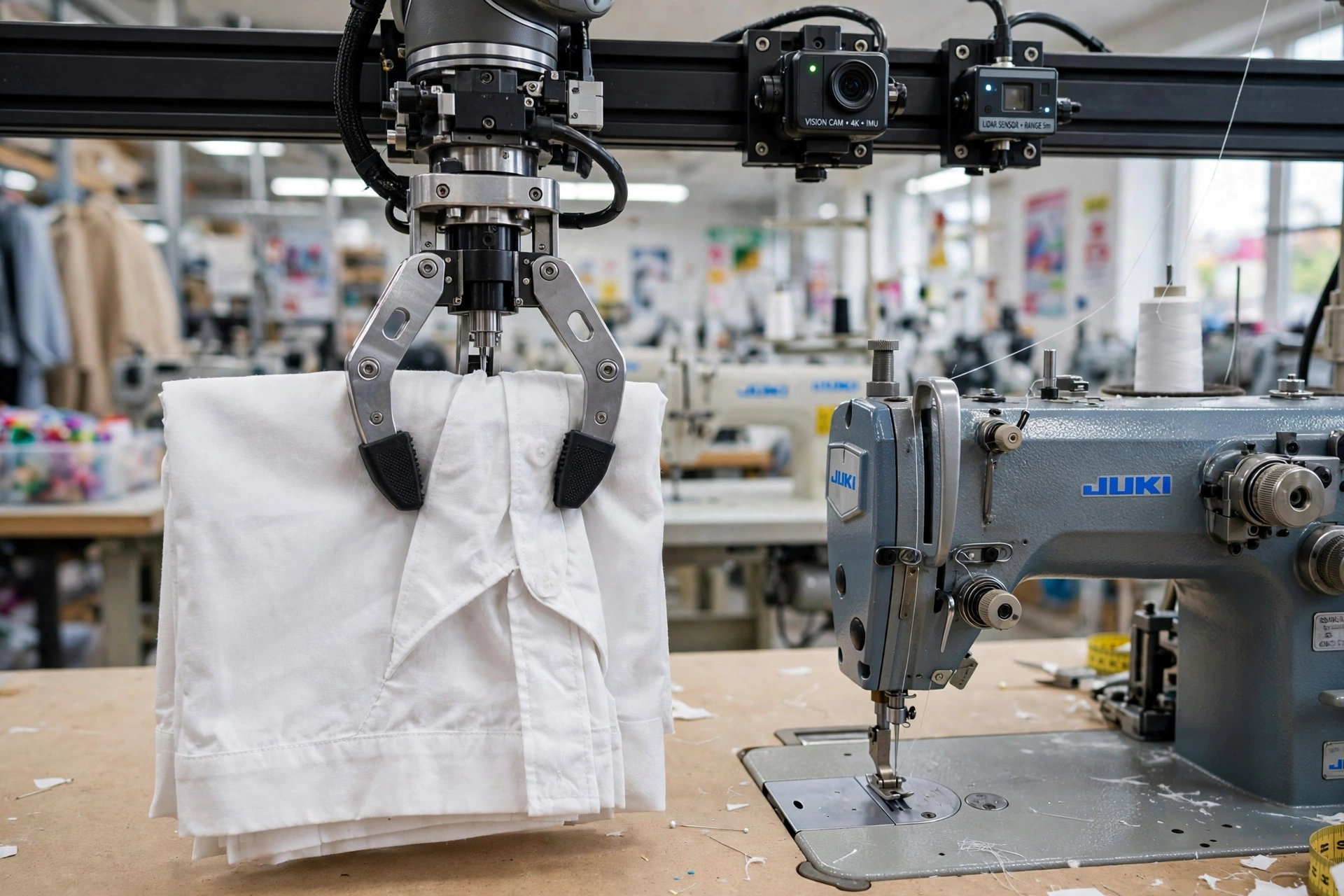
The robotic arm does the moving — often a six-axis industrial arm, the same kind that welds car parts, fitted with a fabric gripper instead of a torch. Simpler cells use a gantry, a frame that slides over the table, which costs less and suits flat panels.
The vision system does the seeing. One or two cameras watch the fabric from above, tracking edges and wrinkles in real time. On research systems, the stitch path is calculated from the panel’s actual outline rather than a fixed template, which matters because no two cut panels are exactly alike.
The gripper does the holding. Pinch too hard and the fabric creases; too soft and it slips. Modern grippers use soft pads, vacuum, or small rollers that feed cloth forward while keeping it flat.
The sewing head is usually an ordinary industrial sewing machine — factories already own these machines and know how to service them. The control software ties it all together, holding the stitch pattern, talking to the cameras, and deciding what to do when something looks wrong.
Sewing robots vs. human machinists
| Sewing robot | Human machinist | |
|---|---|---|
| Best at: | Long straight seams, repeated hundreds of times | Curves, corners, and complex garments |
| Speed: | Steady all shift, no fatigue | Fast on familiar work, slower on new styles |
| Consistency: | Same stitch length every time, if the fabric behaves | Varies a little, but adapts instantly |
| Fabric handling: | Needs cameras and careful gripping; struggles with silk and stretch | Feels wrinkles and stretch through the fingertips |
| Setup: | Slow to program for a new style | Learns a new style in minutes |
| Cost: | High up front, cheaper per seam at volume | Low up front, paid per hour |
The trade-off is clear. Robots win on repetition. People win on judgement.
What can sewing robots sew today — and what still trips them up?
The safest jobs are flat, stable, and straight: T-shirt hems, pillowcases, tote bags, denim leg panels, and car seat covers. The fabric is firm, the pieces are cut to a fixed shape, and the seam is a straight line.
Curved seams are the next frontier, and they are getting closer. A research team at the University of Patras built a system with a single robotic arm and an unmodified industrial sewing machine that traces curved seams by watching the fabric edge with a camera and adjusting the path as it goes. It learned where to grip the cloth by studying how human operators hold it.
What still trips robots up is variety. A slippery silk blouse, a stretchy sports top, and a thick denim jacket each need a different grip, speed, and needle, and changing between them takes setup time. And quality judgement — does this seam look right — is still a human skill. Cameras can spot a skipped stitch, but they cannot yet judge whether a garment drapes well.
Where are sewing robots already working?
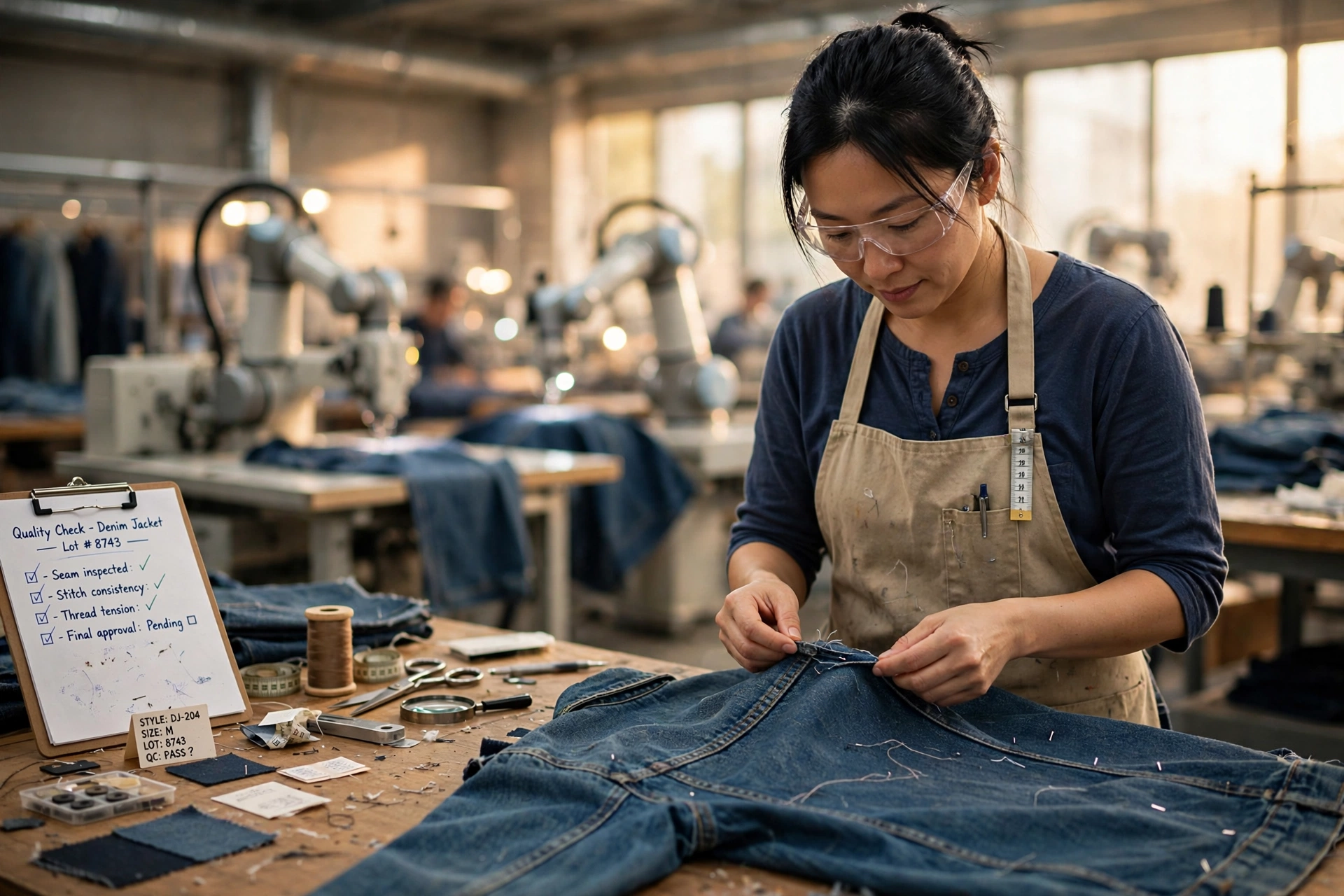
You will find them first in high-volume, low-variety production: plain T-shirts, workwear, bedding, and car interiors, where one style runs for weeks and the seam barely changes. Denim is another early home, because the fabric is stiff and forgiving and the panels are large and flat.
Nobody serious expects fully automated garment factories soon. The realistic picture for the next few years is a mixed line: robots doing the long, straight seams, and skilled machinists doing the collars, cuffs, curves, and final checks.
Frequently Asked Questions
Can a sewing robot sew a whole shirt by itself?
Not yet. A robot cell can sew individual seams well, but a whole shirt needs many different seams, plus turning, pressing, and buttons or zips. Today, robots handle some seams while people do the rest.
How fast is a sewing robot compared to a person?
On a long straight seam, a robot is steady rather than dramatically faster. Its advantage is consistency: it sews the hundredth seam exactly like the first.
Do sewing robots replace garment workers?
They change the work more than they erase it. Factories still need people to set up jobs, load fabric, fix jams, and check quality.
What fabrics are hardest for sewing robots?
Slippery, stretchy, and very thin fabrics cause the most trouble, because they move unpredictably under the gripper. Firm fabrics like denim are the easiest starting point.
Are sewing robots only for big factories?
Mostly, for now, because the equipment and setup cost is high. But simpler cells built around a standard sewing machine are getting cheaper.
What should you do next?
If you run a small workshop, start with one seam, not a whole garment. Pick your most repeated straight seam — a hem, a side seam, a bag panel — and ask an equipment supplier for a trial run on your own fabric before buying anything, because the fabric, not the robot, decides whether the job works.