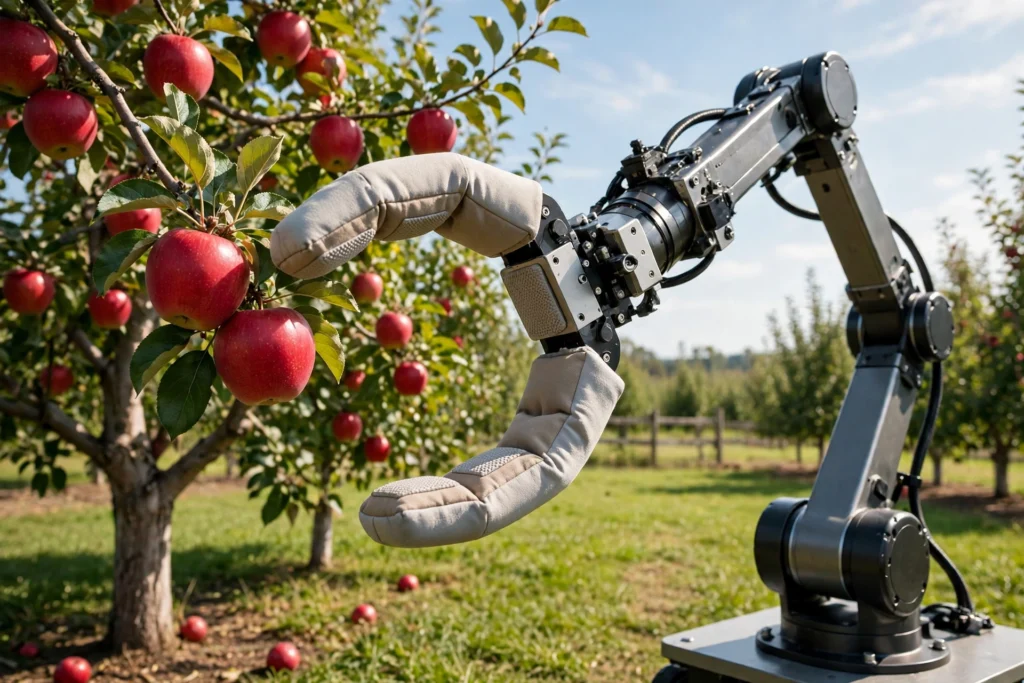
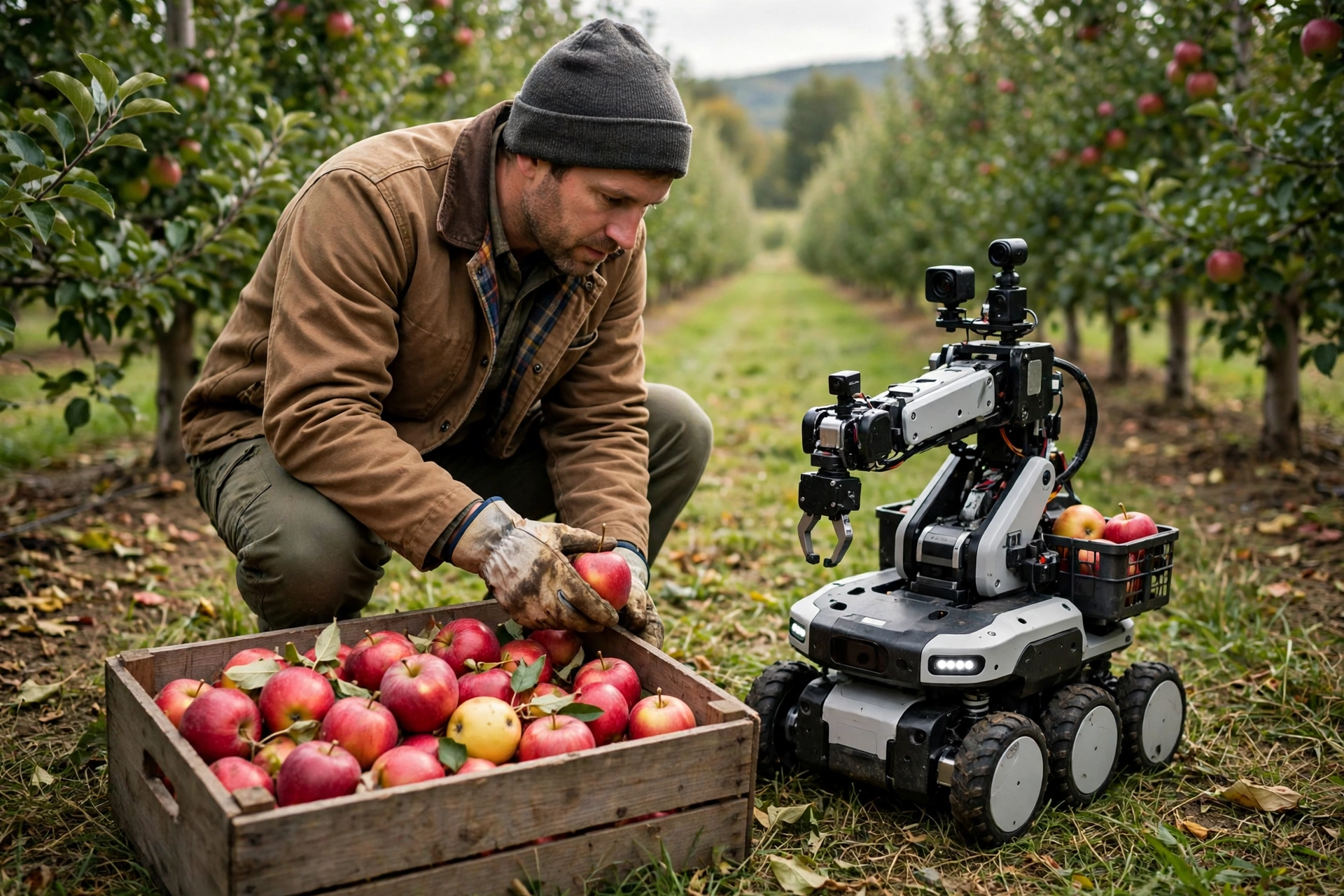
Fruit picking robots use cameras to find ripe fruit, a robotic arm to reach it, and a soft gripper to hold it without bruising it. Once picked, the fruit is placed gently into a tray or crate instead of being dropped. In short, the robot repeats the same careful steps a human picker uses — look, judge, reach, pick, and place — but it does them with sensors and software guiding every move.
Key Takeaways
– Cameras and sensors help the robot tell ripe fruit from leaves, branches, and unripe fruit.
– A robotic arm moves the gripper into place, often in tight spaces between branches.
– Soft grippers, suction cups, or small cutters are chosen to match the fruit’s size and fragility.
– Picked fruit is set down carefully, which helps reduce bruising and waste.
– Rain, wind, tangled branches, and mixed ripeness still make orchard work difficult for robots.
How does a fruit picking robot find the right fruit?
It starts by looking. Cameras mounted on the robot take pictures of the tree or plant, and software looks for shapes, colours, and sizes that match the target fruit. A red apple among green leaves stands out fairly well, while a green apple or a partly hidden strawberry is harder to spot. Some systems also use depth sensors, which measure how far away each object is, so the robot can tell whether a fruit is in front of a leaf or behind it.
Ripeness is the next judgement call. Colour is the most obvious clue, but it is not always enough. A fruit can look red on one side and still be unripe on the other, and sunlight can change how colours appear in a camera image. That is why some robots combine colour with size, shape, and even firmness estimates. When the system is unsure, a well-designed robot should skip that fruit rather than pick it too early or damage the plant. Skipping is slower, but it protects quality — and quality is what makes picked fruit worth selling.
What happens once the robot has chosen a fruit?
The robotic arm takes over. It has joints that bend and rotate, much like a shoulder, elbow, and wrist, so it can reach around branches without snapping them. The control system plans a path that avoids obstacles, moves smoothly, and stops at exactly the right distance. This part matters more than it might sound: a jerky or rushed movement can shake neighbouring fruit loose or scrape the bark.
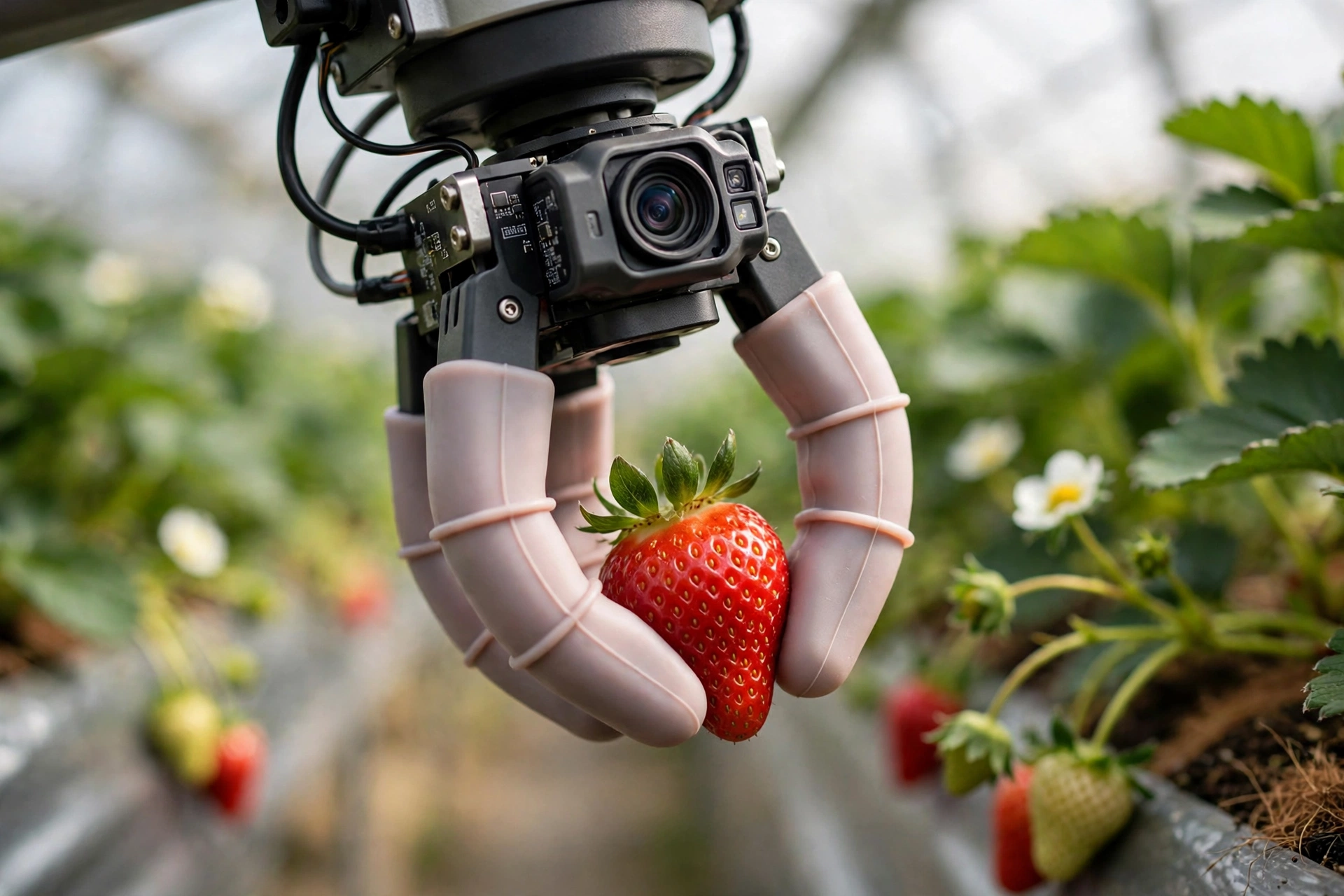
Then comes the gripper, the part that actually touches the fruit. Different fruits need different tools. Strawberries are soft and easily bruised, so a gentle suction cup or a padded cup that cradles the berry often works better than fingers that squeeze. Apples are firmer, so a gripper can hold them a little more firmly before twisting or cutting the stem. Some robots use a small blade to cut the stem cleanly, which can be gentler than pulling, especially for fruit that is tightly attached. The key idea is the same in every case: hold firmly enough not to drop it, but softly enough not to mark it.
How does the robot move the fruit without damaging it?
After the pick, the arm does not just let go. It carries the fruit to a collection tray, a conveyor, or a crate, and sets it down in a controlled way. Some robots place each piece in its own small space so fruit does not roll around and bump into other pieces. Others use padded trays or a soft chute that slows the fruit down before it lands.
This careful handling is one reason growers are interested in the technology. Bruised fruit spoils faster and is harder to sell, so even a small drop in damage can matter over a whole season. A robot also works at a steady pace and does not get tired at the end of a long row, although it still needs regular checks, cleaning, and maintenance — dust, sap, and mud build up quickly outdoors.
Where do fruit picking robots work best today?
They tend to do best where conditions are more predictable. Greenhouses and polytunnels, for example, shelter plants from wind and harsh light, and crops are often grown in neat rows at a reachable height. Strawberries grown on raised tables are a popular test case because the fruit hangs where a robot can see and reach it more easily.
Open orchards are harder. Trees vary in shape, branches cross each other, and fruit ripens unevenly across the same tree. A robot may need to return to the same tree more than once, or work alongside people who handle the trickiest picks. That mixed approach is common right now: robots take on the straightforward, repetitive picks, while people handle fruit hidden deep in the canopy or growing in awkward spots.
What limits fruit picking robots right now?
Speed is one limit. A skilled human picker is fast, and many robots are still slower per piece, especially when they have to pause, re-check a fruit, or work around branches. Cost is another. Cameras, arms, sensors, and software add up, and the machine also needs power, transport between rows, and someone who can fix it when it stops.
Weather and light cause trouble too. Bright sun can wash out a camera image, heavy rain can blur it, and wind moves branches while the robot is reaching. Muddy ground can slow a wheeled base or make it slip. None of these problems is impossible to solve, but each one adds complexity, and orchards do not offer the tidy, flat floors that factory robots enjoy.
There is also a practical question of fit. A robot built for apples may not work well for grapes, and a strawberry gripper will not suit a melon. Growers therefore need to think about which crop, which variety, and which orchard layout a machine is actually designed for, rather than assuming one robot can pick everything.
Are fruit picking robots replacing human pickers?
Not in the way headlines sometimes suggest. Picking fruit is skilled work: it involves judging ripeness at a glance, reaching without breaking branches, and working quickly in changing weather. Robots are getting better at parts of that job, but they still struggle with the full range of conditions a person handles without thinking.
A more realistic picture is a partnership. Robots can help when labour is short, when a crop ripens all at once, or when long hours in heat make the work especially tough. People can supervise the machines, check quality, handle difficult picks, and step in when something goes wrong. For many farms, that combination is more useful than trying to replace people entirely.
What should a grower check before trying one?
Start with the crop and the orchard. Is the fruit fragile or firm? Does it ripen evenly, or in stages? Are the rows wide enough for a machine, and are the trees pruned in a way a robot can work around? Next, ask how the robot is cleaned and repaired, how it handles rain and dust, and what happens when it meets a fruit it cannot identify. A short trial on a small block of trees will usually reveal more than a brochure will.
It is also worth checking what happens after picking. A robot that picks well but bruises fruit during transport has not solved the real problem. Look at how fruit is placed, carried, and transferred to crates, and compare the damage rate with careful hand picking over the same period.
FAQs
How do fruit picking robots know when fruit is ripe?
They mainly use cameras to check colour, size, and shape, sometimes combined with depth sensing. Some systems add other clues, such as firmness estimates, but colour alone is not always reliable, so uncertain fruit is often left for later.
Can a fruit picking robot damage the fruit?
Yes, if the gripper squeezes too hard, the arm moves too fast, or the fruit is dropped. That is why soft grippers, suction cups, stem cutters, and gentle placement are used — to keep bruising as low as possible.
Why are strawberries often used to test picking robots?
Strawberries are soft, valuable, and often grown on raised tables where a robot can reach them more easily. They are also a good test of gentle handling, since bruised berries spoil quickly.
Do fruit picking robots work in rain or strong sunlight?
They can struggle. Rain can blur camera images, bright sun can wash out colours, and wind moves branches during a pick. Sheltered growing, such as greenhouses, usually gives more reliable results.
Will fruit picking robots work for every type of fruit?
No. Different fruits vary in size, softness, stem strength, and how they grow on the plant. A gripper and camera setup tuned for one crop often needs changes before it works well on another.
Conclusion
Fruit picking robots work by combining careful seeing, reaching, and handling: cameras find and judge the fruit, an arm guides the gripper into place, and a soft tool picks and places it without rough treatment. They are not yet a simple replacement for experienced pickers, especially in tangled, open orchards. But where the crop and layout suit them, they can ease labour pressure and reduce damage from rushed or tired handling.
If you grow fruit or just follow farm technology, a practical next step is to watch how a robot handles your specific crop in a real orchard — not just in a demonstration video. Look at its pick rate, its bruise rate, and how often a person has to step in. Those three checks will tell you more about whether the technology fits than any single claim about speed.
Further reading: Britannica on robotics and Wikipedia on agricultural robots explain the wider machines and farm uses behind these pickers. Related posts on this site include robot arms, agricultural robots, warehouse robots, and milking robots.