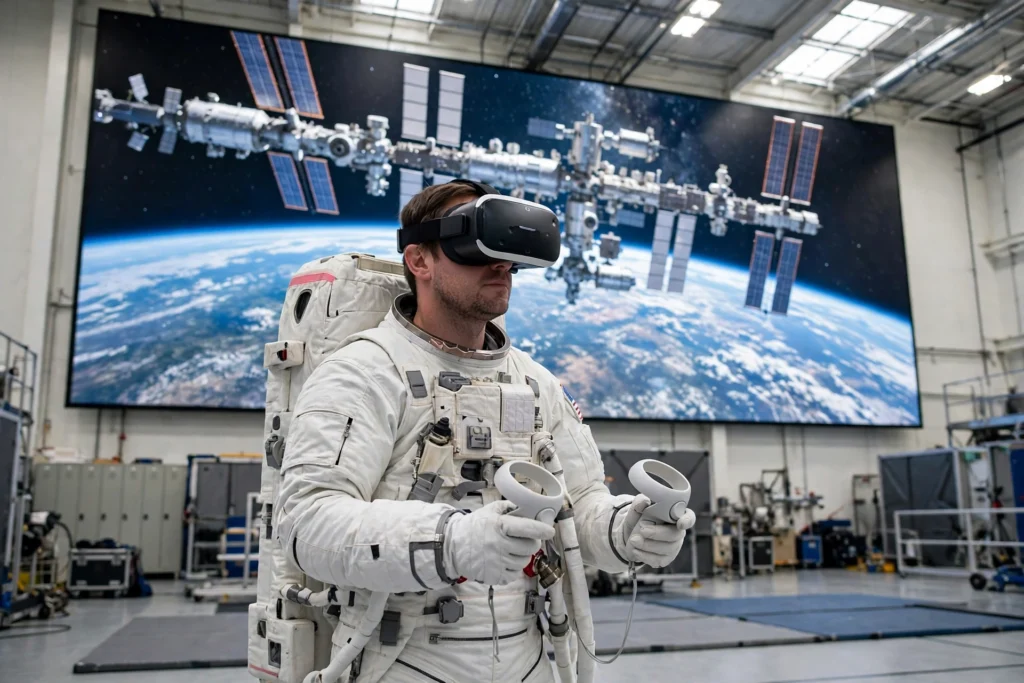
VR astronaut training puts astronauts inside a realistic virtual spacecraft, space station, or lunar surface, so they can rehearse spacewalks, docking, and emergencies again and again before launch. Wearing a headset and holding controllers — sometimes in a real spacesuit — they practise the exact moves, tools, and checklists they will use in orbit, without leaving the ground.
Key Takeaways
- VR recreates spacecraft, stations, and lunar surfaces so crews can rehearse before launch.
- Spacewalk practice in VR teaches handrail routes, tether work, and tool handling, safely and repeatedly.
- VR cannot recreate weightlessness, so it is paired with pool training and mock-ups.
- Emergency drills in VR let astronauts rehearse fires, leaks, and power failures under pressure.
- VR is one part of a much longer training programme, not a shortcut to spaceflight.
What does VR astronaut training actually involve?
Astronaut training takes years, and much of it happens in rooms that look nothing like space: classrooms, swimming pools, and full-size spacecraft mock-ups. VR fits into that mix as a flexible rehearsal space. A trainee puts on a VR headset, picks up controllers, and steps into a detailed virtual copy of the place they will actually work in — a space station module, a capsule cockpit, or the surface of the Moon.
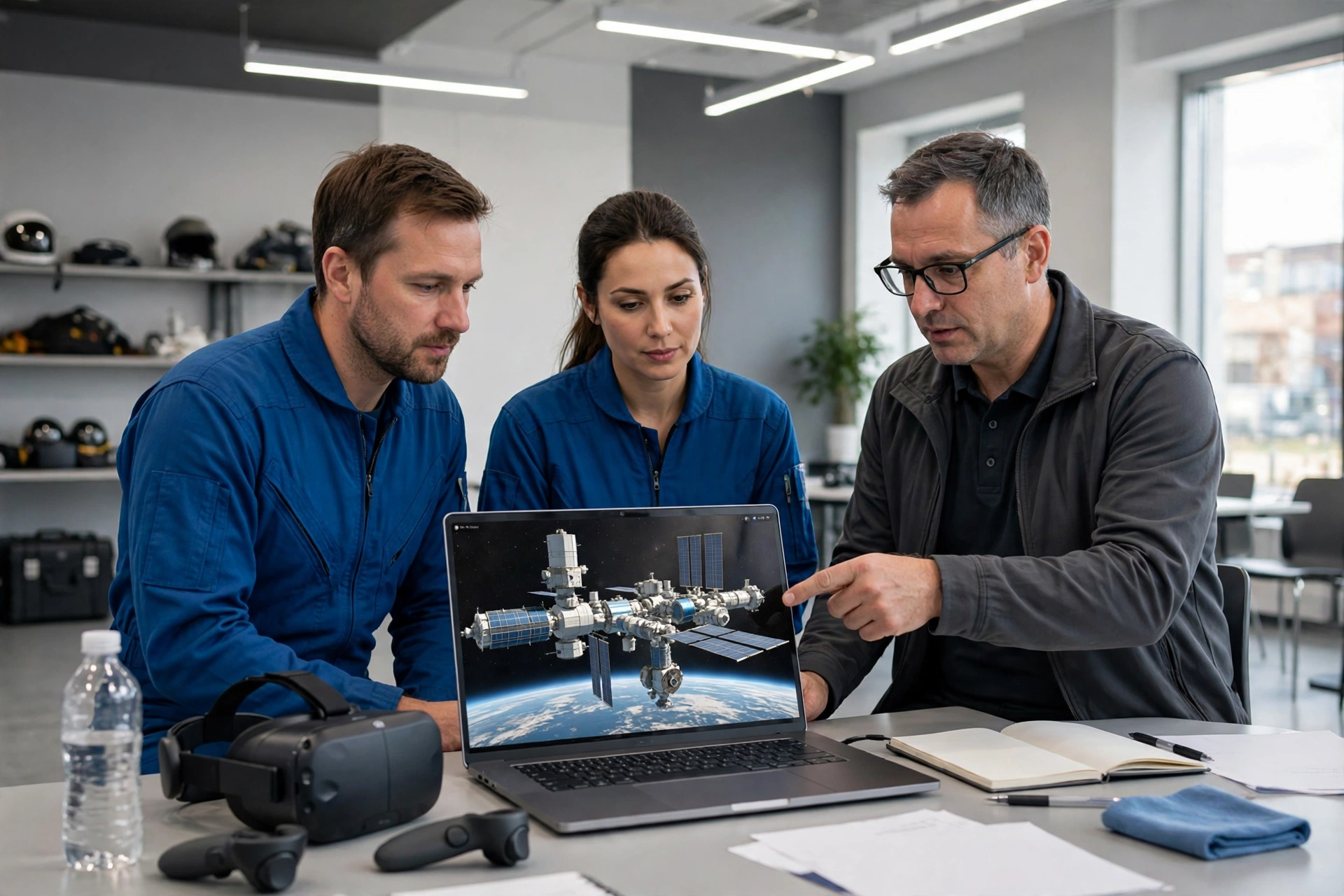
The virtual environment is built from the same engineering data as the real hardware, so the switches sit where they should and the layout matches the real thing. An astronaut who has already “walked” through a module a dozen times in VR is less likely to get lost or fumble when they float through it for real. Sessions are short and focused: a crew might spend twenty minutes rehearsing one docking procedure, then review what went wrong and run it again, while instructors watch on a monitor.
How do astronauts practise spacewalks in VR?
A spacewalk is one of the hardest jobs in spaceflight. The astronaut works outside the station in a bulky suit, moving hand over hand along rails, handling tools with thick gloves, and staying tethered at all times. Getting it wrong is not an option, yet there is no way to rehearse the real thing on Earth.
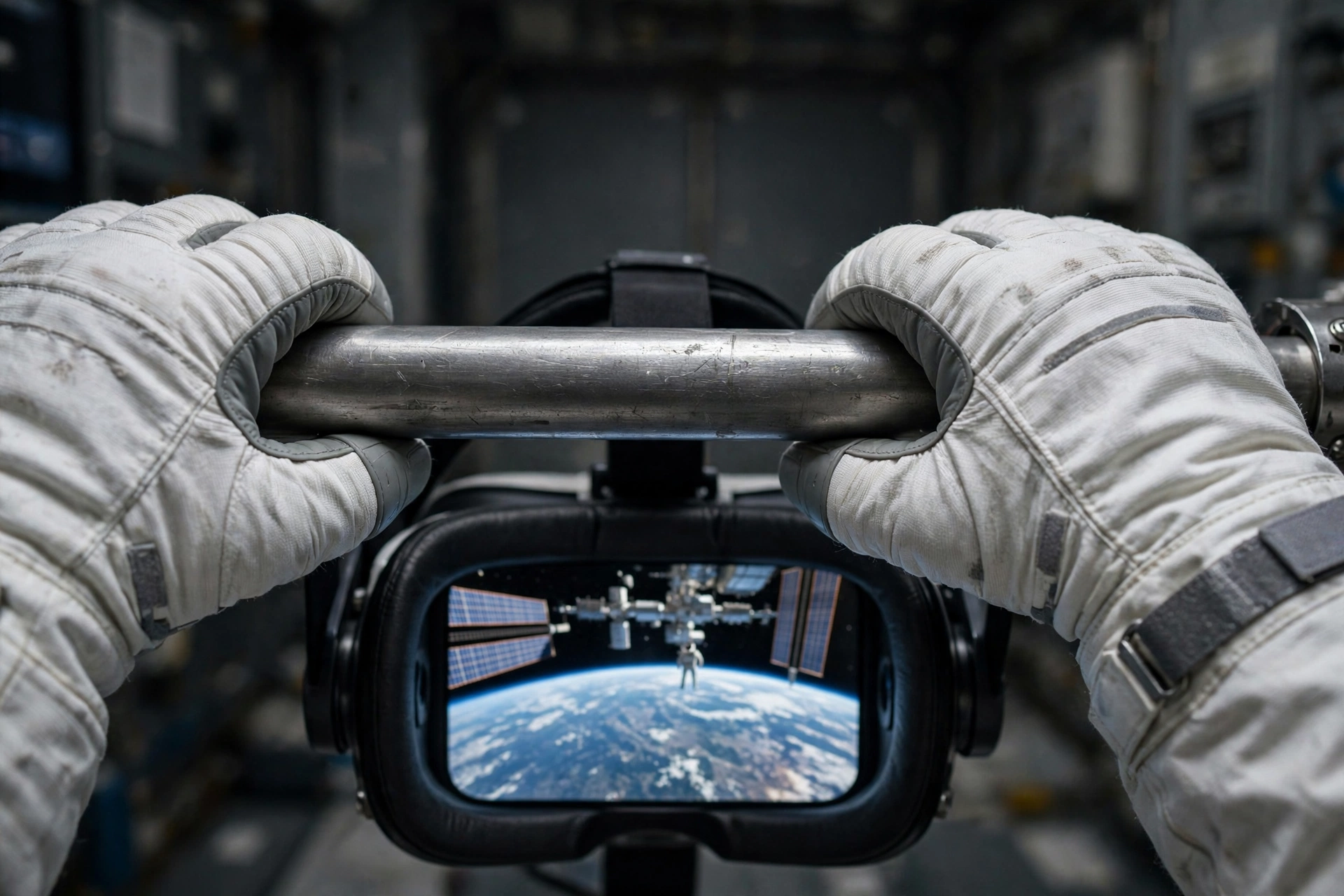
VR fills part of that gap. In a virtual spacewalk, the astronaut sees the station’s hull, the curve of Earth below, and the handrails they must follow, all in the right places. They practise moving along a route, clipping and unclipping tethers, and picking up a tool from a belt or worksite. The simulation can also add the tricky parts: limited visibility through a helmet visor, the glare of the Sun, and tasks that take far longer with gloved hands.
It is not a complete substitute. Real spacewalks are also rehearsed in a giant pool, where a submerged mock-up and a weighted suit give astronauts a sense of moving slowly and deliberately. VR is best at the parts the pool cannot teach easily: the route, the sequence of steps, and the look of the worksite.
Can VR recreate zero gravity?
Not really — and trainers are honest about that. A headset can show a world with no up or down, and make objects float when you let go of them, but your body still feels gravity. Your feet are still on the floor, your arms still get tired when you hold them up, and your inner ear still tells you which way is down. That mismatch is one reason VR sessions are kept short: the brain notices when what it sees and what it feels do not agree, and some trainees feel queasy.
So trainers use VR for the parts that do not depend on weightlessness — learning a layout, memorising a checklist, practising switch throws — and other methods for the parts that do. The pool gives a sense of slow, floating movement, and parabolic flights give short real tastes of weightlessness.
How do astronauts train for emergencies in VR?
Emergencies are where VR earns its keep. A fire, an air leak, or a power failure on a space station is rare, but when it happens the crew has minutes to respond. They cannot set a real module on fire to practise, so the simulation does it for them.
In a drill, the scenario starts without warning. An alarm sounds, a warning light flashes, and the astronaut must find the source, follow the checklist, and talk to the rest of the crew — all inside the headset. The simulation tracks how long each step takes and whether anything is missed. Afterwards, the instructor replays the session, and the crew talks through what happened: who did what, what took too long, and what they would change next time.
Because the drill is virtual, it can be repeated until the response is smooth, and varied each time — the leak might be in a different module next run. Crews also practise calling out readings and keeping calm when several things go wrong at once.
What are the limits of VR astronaut training?
VR is a strong rehearsal tool, but it has clear limits. The biggest is physical. A headset cannot reproduce weightlessness, the resistance of a pressurised suit, or the sheer effort of working in thick gloves. A task that takes ten seconds in VR might take ten minutes in a real suit.
There is also a comfort limit. Some people feel sick in VR, especially when the virtual world moves while their body stays still. Trainers keep sessions short and build up gradually, and anyone who feels unwell stops. A queasy trainee learns nothing, so comfort is treated as a training requirement, not a minor detail.
Finally, VR is only as good as its model. If a virtual module is out of date, or a procedure in the simulation does not match the real checklist, trainees can learn the wrong thing. That is why virtual environments are checked against the real hardware and updated when it changes. The same care applies to VR medical training on Earth: the simulation must match reality, or it teaches bad habits.
Frequently Asked Questions
Do astronauts train in VR before every mission?
Most do, yes. VR sessions are now a normal part of mission preparation, used to rehearse spacewalks, docking, and emergency drills alongside pool training and mock-up practice.
How long does VR astronaut training take?
There is no single answer: VR is one thread in a training programme that lasts years. Individual sessions are usually well under an hour, and are repeated many times so procedures become familiar.
Is VR astronaut training the same as the training the public can try?
No. Public VR space experiences are built for fun. Astronaut training simulations are built from engineering data, match real hardware, and are scored against real procedures.
Can VR replace training in the pool?
No, and it is not meant to. The pool teaches the slow, deliberate movement of working in a suit in something close to weightlessness. VR teaches routes, sequences, and procedures. Trainers use both, because each covers what the other cannot.
Will future astronauts train mostly in VR?
Probably not mostly — but VR will keep growing as a share of training. As headsets get lighter and simulations get more detailed, more rehearsal can happen virtually, though the physical parts will still need pools, mock-ups, and real hardware.
Conclusion
VR astronaut training works because it lets astronauts rehearse the hard parts of spaceflight — spacewalks, docking, emergencies — in a safe place where mistakes cost nothing and every run can be reviewed. It cannot recreate weightlessness, and it cannot replace the pool or the mock-up, but it gives crews something those cannot: unlimited, repeatable practice in an exact copy of the place they will work.
If you are curious about the technology behind it, start with how VR headsets track your head and hands, and how controllers turn your movements into actions in a virtual world.