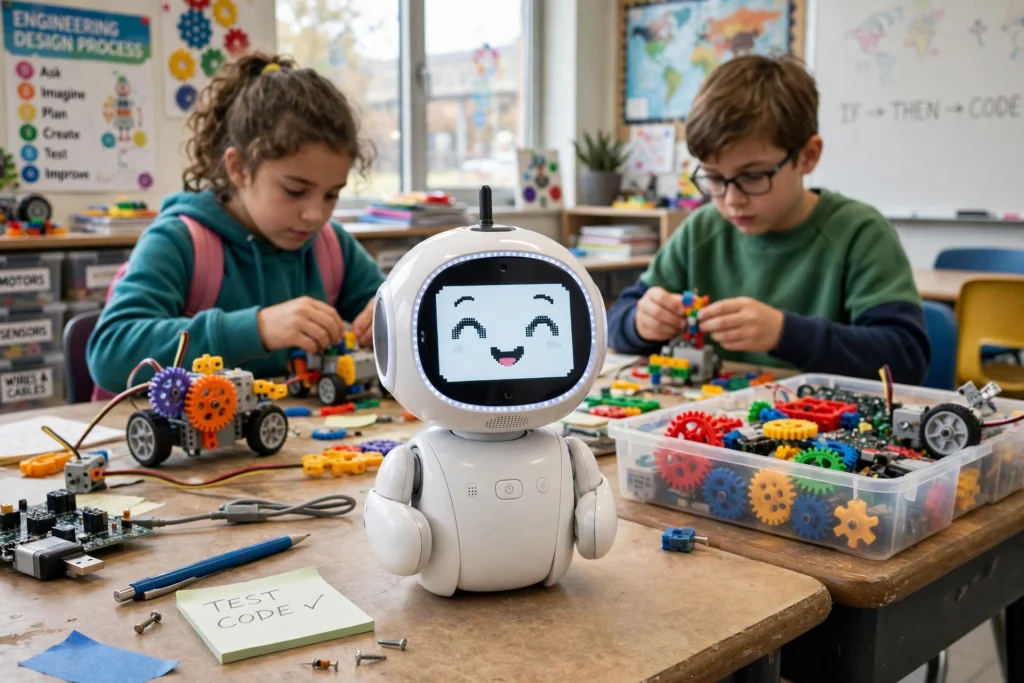
Educational robots work by turning code into something children can see and touch. A student writes a simple set of instructions, sends it to the robot, and watches the robot move, light up, or speak. When the robot does the wrong thing, the mistake is right there on the floor — and fixing it is the lesson.
Key Takeaways
- Educational robots are built for learning: simple controls, sturdy parts, and instant feedback.
- Most are programmed with block code — drag-and-drop commands instead of typed text.
- Sensors let the robot react to light, lines, obstacles, and touch, which makes lessons hands-on.
- Teachers use them for coding, maths, science, and teamwork, not just robotics clubs.
- A good classroom robot is safe, repairable, and simple enough for beginners but open enough to grow with.
What is an educational robot?
An educational robot is a machine designed to teach, not to do a job in a factory or a hospital. It is usually small, friendly-looking, and built to survive being dropped, bumped, and rebuilt many times. Some are ready-made robots with a screen face and wheels; others are kits of motors, sensors, and building blocks that students put together themselves.
They borrow ideas from other machines: humanoid robots that walk and balance, robot arms that grip and lift, telepresence robots that roll into a room on a screen, and companion robots that keep people company.
What they share is a simple idea: learning sticks better when you can try something and watch it happen. A maths problem on paper can feel abstract, but telling a robot to drive exactly 30 centimetres and then measuring whether it did makes the numbers real. The robot is a patient test subject — it does exactly what it was told, right or wrong, so students learn to think carefully about their instructions.
How do children program an educational robot?
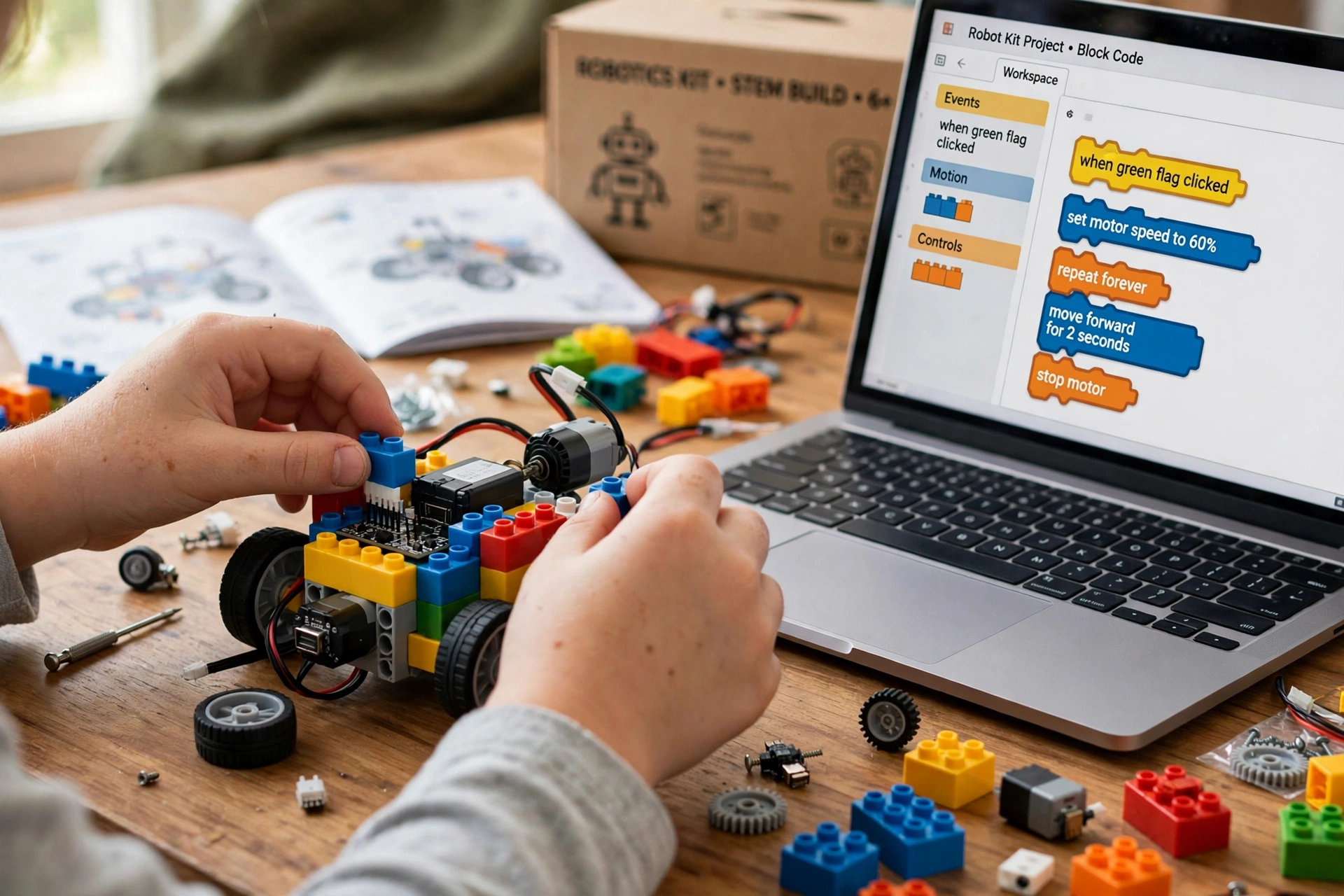
Most classroom robots are programmed with block code. Instead of typing lines of text, students drag coloured blocks into a sequence: “when the green flag is clicked, set motor speed to 60 percent, move forward for two seconds, stop.” Each block does one thing, and the blocks snap together like puzzle pieces, so a typing mistake cannot break the program.
That simplicity is deliberate. A beginner can make a robot move in minutes, which builds confidence fast. Then the same tool grows with them: loops repeat actions, conditions let the robot decide (“if you see a wall, turn left”), and variables keep count of laps or scores. By the time a student moves on to typed code, they already understand the logic underneath it.
How do educational robots sense and move?
Under the friendly shell, an educational robot works much like its industrial cousins, just smaller and gentler. Small electric motors turn the wheels or move the arms, and a rechargeable battery keeps it going for a lesson or two before it needs charging. A tiny computer — often a single board the size of a credit card — runs the program and talks to the motors and sensors.
Sensors are what make the lessons interesting. A light sensor can follow a black line on the floor, an ultrasonic sensor measures the distance to a wall, and a touch sensor knows when the robot has bumped into something. Some robots add a colour sensor, a gyroscope to track turns, or a microphone so they can respond to a clap or a spoken word.
What happens in a classroom robot lesson?
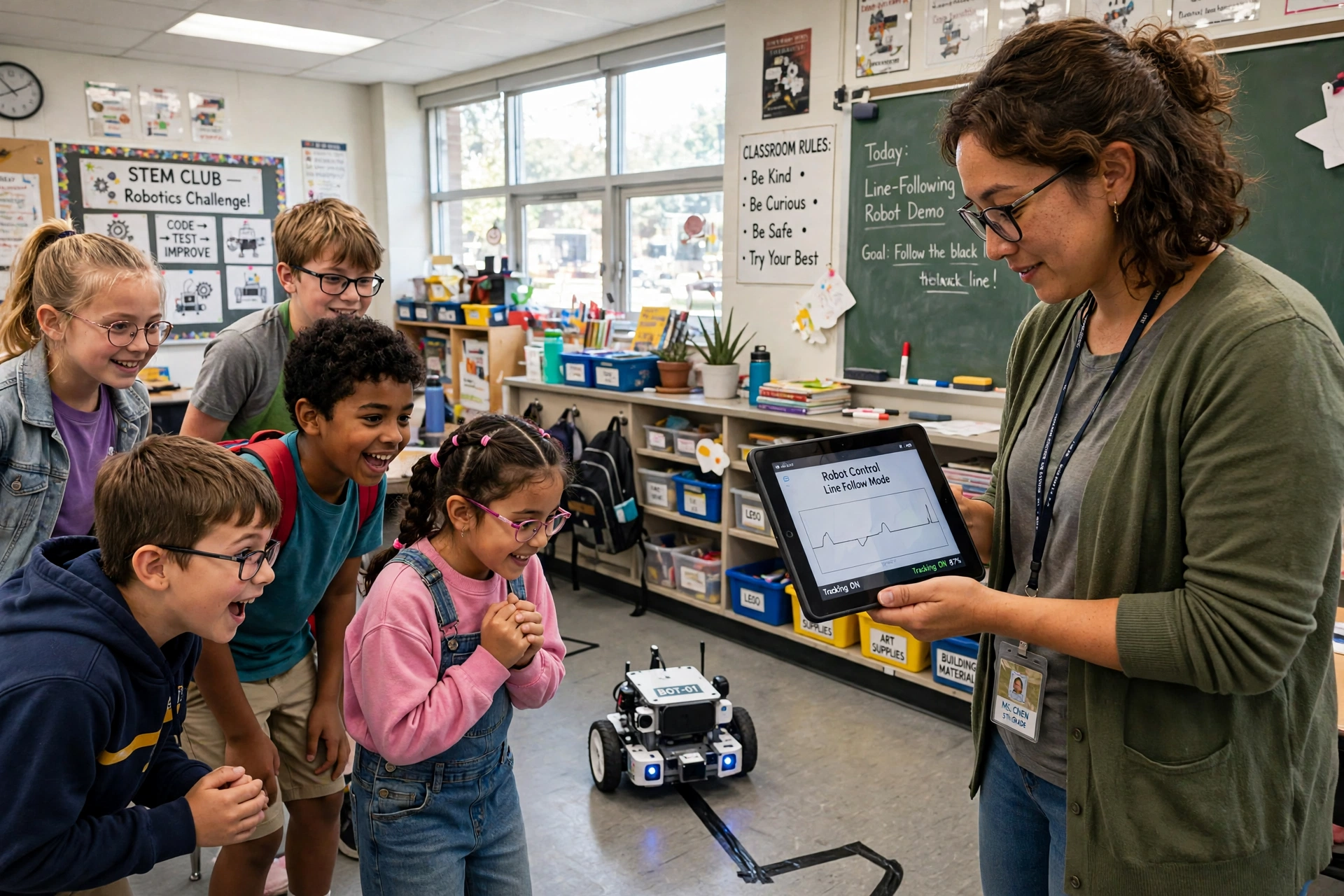
A typical lesson starts with a challenge, not a lecture. The teacher might ask: “Can your robot follow the line to the end of the table and stop before the edge?” Students work in pairs or small groups, build or set up their robot, write the program, and test it. The first attempt usually fails — and that is expected.
Then comes the part teachers value most: the group talks about what went wrong, changes one thing, and tries again. This test-and-improve loop mirrors how real engineers work, and it teaches patience alongside coding. Students also practise explaining their thinking to each other, which is a skill that matters far beyond the classroom.
What do students actually learn from them?
Coding is the obvious one, but it is not the only one. Measuring distances for a robot’s route uses maths; working out why a sensor misreads a shiny surface uses science; writing instructions that another person can follow uses clear communication. And because the work is usually done in groups, students practise sharing tasks and handling disagreements.
There is also a quieter benefit: confidence with technology. Many children arrive thinking robots are either magic or far too complicated for them. Watching a machine they built respond to their own code changes that. It turns technology from something that happens to them into something they can shape.
What are the limits of educational robots?
Educational robots are deliberately simple, and that is also their limit. They cannot do fine work, carry heavy loads, or handle rough terrain, and their sensors are basic compared with industrial machines. A classroom robot that works perfectly on a smooth floor may struggle on carpet, in bright sunlight, or in a noisy hall.
Cost is a real constraint for schools. A single kit is affordable, but a class set — plus spare parts, batteries, and replacements for the pieces that inevitably get lost — adds up. Some schools share kits between classes or run a robotics club with a small number of robots rather than one per student.
Frequently Asked Questions
What age are educational robots for?
There are robots for nearly every age. Simple floor robots suit children as young as five, block-based kits work well from about eight upwards, and text-programmed kits suit teenagers and older students.
Do children need to know how to code first?
No. Most educational robots are designed for complete beginners, using drag-and-drop block code. Students learn coding ideas — sequences, loops, decisions — by using them, not before.
Are educational robots safe for children?
Yes, when used as intended. They are built with low voltages, rounded parts, and no sharp edges, and classroom robots move slowly. Teachers still supervise, especially with younger children and small parts.
Can one robot be used for a whole class?
It can, but sharing works best in small groups of two or three students per robot. That way everyone gets hands-on time instead of just watching.
Do educational robots replace teachers?
No. The robot gives instant feedback and makes lessons hands-on, but planning the lesson, guiding discussion, and helping stuck students is the teacher’s job. The best results come from the two working together.
Conclusion
Educational robots work because they make abstract ideas visible: code becomes movement, a sensor reading becomes a decision, and a mistake becomes something you can see, fix, and learn from. They are simple machines with a simple job — to give students something real to experiment with. For background, see Britannica’s robotics overview and Wikipedia’s guide to educational robotics.
If you are choosing one for a classroom or at home, start small: pick a kit with block coding, a clear set of lessons, and spare parts you can actually buy. Let learners build, test, and break things — that is where the learning lives.