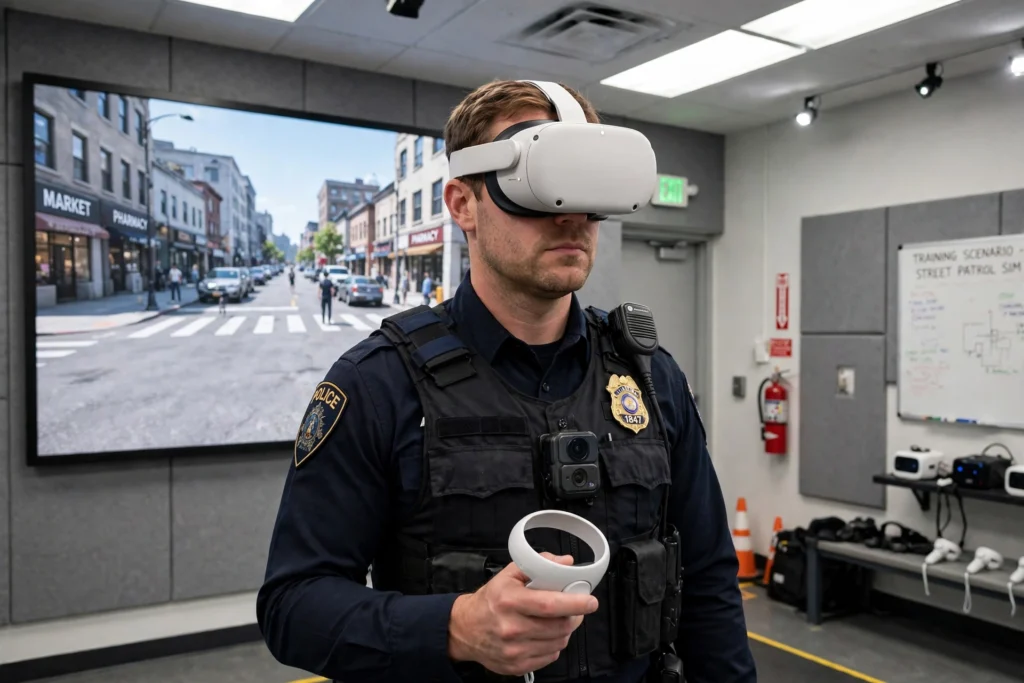
VR police training puts officers inside realistic, high-pressure situations — a tense traffic stop, a person in crisis, a crowded street — without any real danger. Wearing a headset, the officer sees, hears, and moves through a virtual scene, makes decisions in real time, and can repeat the same call until the response becomes second nature.
Key Takeaways
- VR police training recreates calls that are hard to practise live, such as crisis encounters and fast-changing incidents.
- Scenarios branch in real time: what the officer says and does changes how virtual people react.
- De-escalation practice is a major use, letting officers rehearse calm communication with people in distress.
- Firearms fundamentals can be drilled safely in VR, but it does not replace live-fire range training.
- Every session can be replayed, so instructors can review decisions, timing, and communication in detail.
What is VR police training?
VR police training is scenario-based training delivered through a virtual reality headset. Instead of a classroom lecture or a role-play exercise with colleagues, the officer steps into a three-dimensional scene: a street, a home, a school corridor, or a shop. Virtual people appear in the scene, speak, move, and react to what the officer does.
The technology is the same kind used in other professional training. A headset shows a slightly different image to each eye, which the brain reads as depth, while head and hand tracking let the officer look around, move, and gesture naturally. Our guide to how VR headsets work explains the screens, lenses, and tracking behind that sense of presence.
What makes it police training, rather than just a simulation, is the instructor’s control. From a tablet or a second headset, the trainer steers the virtual people — changing their words, tone, and behaviour in real time — and can escalate or calm a scene depending on how the officer responds. That cause-and-effect loop is the heart of the training, and it is part of a wider shift toward VR for practical skills, covered in our guide to how VR works for job training.
What kinds of scenarios do officers practise in VR?
The scenarios cover the calls officers find hardest to prepare for, because in real life they arrive without warning and cannot be rehearsed on demand. Traffic stops are a common starting point: the officer approaches a virtual car, talks to the driver, and reads the situation as it develops — a nervous driver, a passenger reaching for something, a story that does not add up. The details change each time, so the officer cannot simply memorise one version of the stop.
Domestic disturbance calls are another staple — among the most frequent and unpredictable calls an officer attends. In VR, the officer can practise separating people, listening to conflicting accounts, and deciding when to step in, then run the same call again with a different outcome. Other modules include active shooter response, hostage situations, and encounters with people in mental health crisis. Some programmes build large libraries: one immersive programme in Tennessee puts officers through well over a hundred real-life scenarios. An officer may only face a particular crisis once in a career, but in VR they can face it ten times before lunch.
How does de-escalation training work in VR?
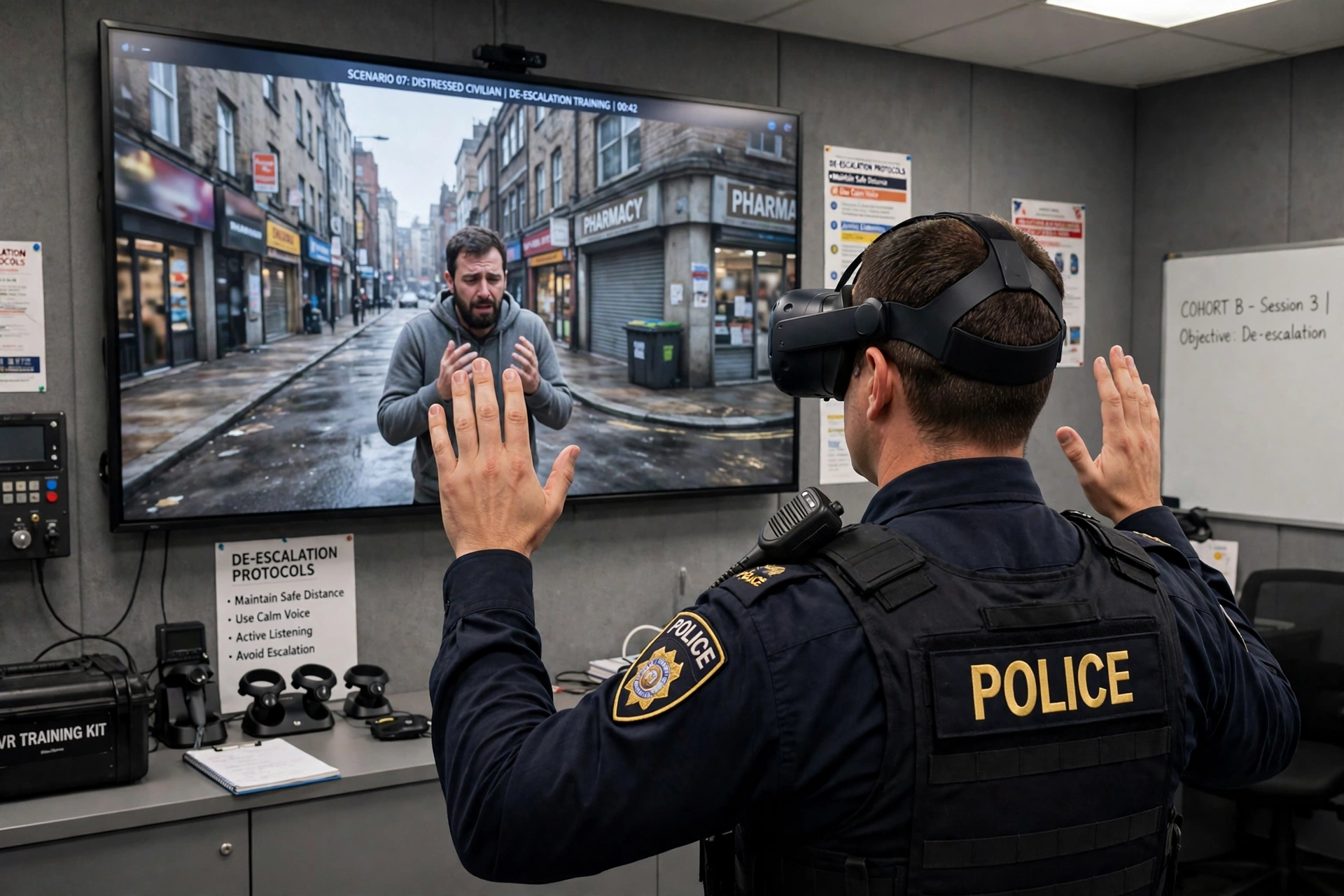
De-escalation is one of the clearest uses of VR in policing. The goal is simple: resolve a tense encounter with words, not force. In a VR drill, the officer faces a virtual person who is upset, frightened, or confused — perhaps someone in a mental health crisis or a domestic argument. The virtual person’s words and mood are controlled by the instructor, who can play the role in real time through a second headset. If the officer raises their voice or crowds the person, the scene escalates. If the officer slows down, listens, and speaks calmly, the person begins to settle.
This is where VR has an edge over traditional role-play. When colleagues act out a scenario, everyone knows each other and the pretence can wear thin. A virtual stranger stays in character, and the officer’s stress response — quickened breathing, tension, a sharper tone — is genuine. Trainers can watch for those reactions and coach the officer through them. The setting is also consequence-free: an officer can try a different approach, get it wrong, and try again without anyone being harmed. That freedom to fail is what turns a single drill into real skill.
How does VR firearms training work?
Firearms training in VR is about fundamentals, not marksmanship alone. Before a new recruit reaches a live range, they can practise grip, stance, sight picture, and trigger control in a virtual firing range, using hand controllers or replica training weapons that match the weight and feel of the real thing.
The advantage is repetition without cost or risk. Every round on a live range costs money, and every mistake carries real consequences. In VR, a recruit can run the same drill dozens of times, with the system tracking where each shot would have landed and flagging habits like flinching or rushing the trigger. Instructors can also change the environment — low light, a moving target, a bystander in the background — to test judgement, not just aim.
The limit matters: VR does not replace live-fire training. A headset cannot reproduce recoil, the sound of a real shot, or the weight of a loaded weapon with full accuracy. Trainers use VR to build the basics so range time is spent on the things only a range can teach. As one training deputy put it in an interview with Police1, VR can reduce the amount of remedial work needed on the range — but the range days still matter.
How do instructors review a VR training session?
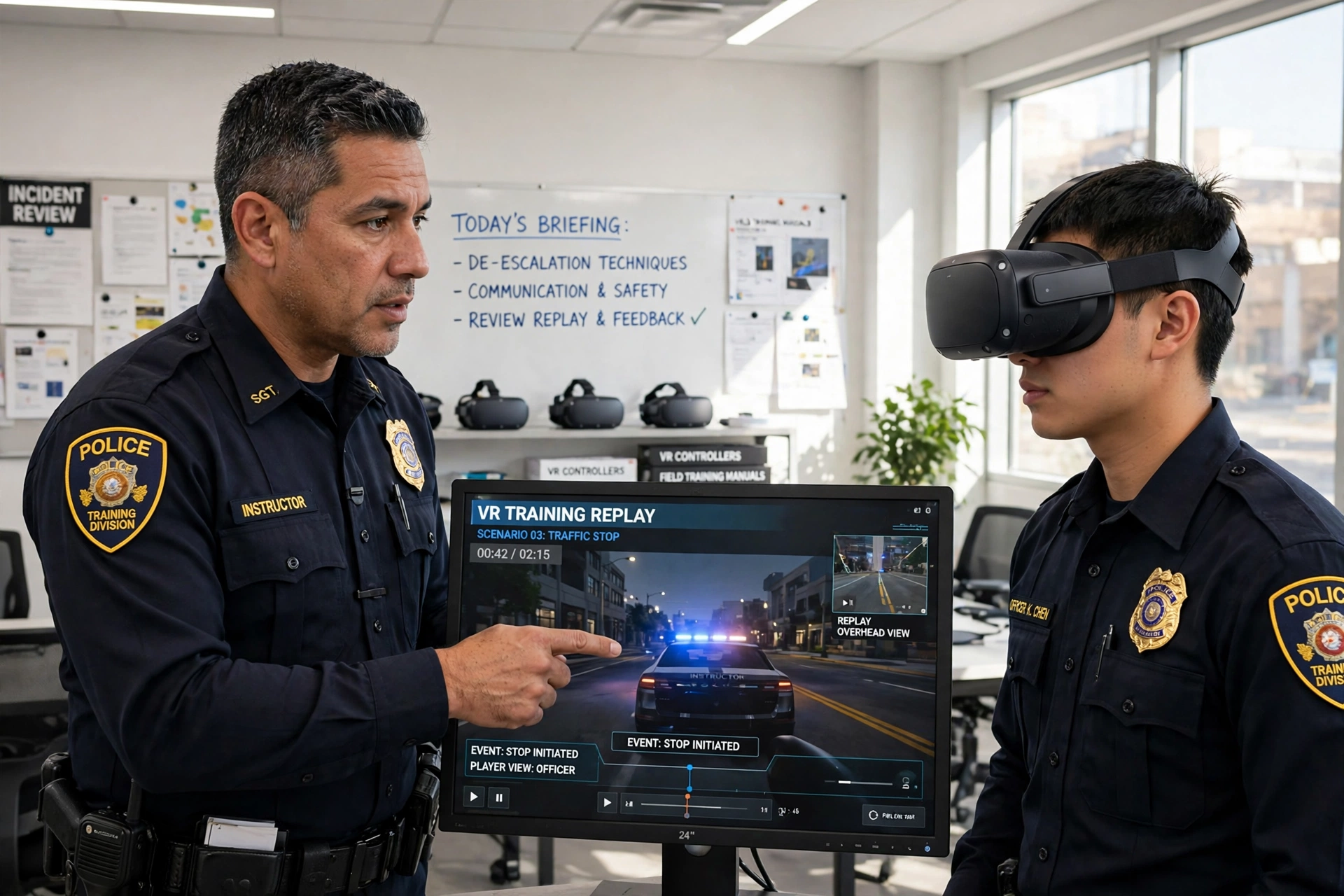
One of the most useful parts of VR police training happens after the headset comes off. Every session is recorded, and the instructor and officer can watch it back together, moment by moment. The replay shows what the officer saw, where they looked, what they said, and when they moved. An instructor can pause at the exact second a decision was made and ask: what did you notice here? What else could you have tried?
Some systems add data to the replay — reaction times, where the officer’s attention was focused, and how the scenario branched at each choice. Used well, that turns a gut feeling (“that went badly”) into something specific (“you watched the passenger, not the driver’s hands, for the first six seconds”). The review also protects the officer: a calm, professional response that still ends in a complaint can be shown, step by step, to demonstrate what actually happened.
What are the limits of VR police training?
VR is a strong training tool, but it is not a substitute for experience, and honest trainers say so plainly. It cannot reproduce everything about a real encounter — the smell of a room, the weight of a person, the unpredictability of a real crowd — and an officer who is brilliant in VR still needs street experience before the two match up.
Quality also depends entirely on the scenarios. A poorly written drill teaches poor habits just as effectively as a good one teaches good habits, so someone has to write the scenarios, keep them current, and make sure they reflect real law and procedure. There is a human limit too: some people feel unwell in a headset after twenty minutes or so, so training has to be paced with breaks. Firefighters face the same balance — our guide to how VR works for firefighter training shows the same pattern, with virtual drills for dangerous situations and real-world practice still doing the heavy lifting.
Does VR police training actually work?
The evidence so far is encouraging but still growing. Officers who train in VR report feeling more confident facing high-pressure calls, and trainers report seeing calmer, clearer communication in the field after de-escalation drills. The Los Angeles Police Department integrated VR into its crisis intervention training and reported a noticeable drop in use-of-force incidents afterwards, crediting the exercises with helping officers slow down and resolve incidents without escalation.
Academic research points the same way: a 2023 study in Ontario compared VR de-escalation training with traditional role-play and found both produced similar improvements in officers’ empathy and de-escalation skills. Those results come with a caveat — use-of-force rates depend on many factors, and no single training tool can claim full credit for a change. What the evidence supports is narrower and more useful: well-designed VR scenarios give officers realistic repetitions they would not otherwise get, and repetition under pressure is how judgement improves.
Frequently asked questions
Do officers train with real weapons in VR?
No. VR firearms training uses replica training weapons, weighted controllers, or inert replicas — never a loaded firearm. Live weapons are only used on a proper range, under range safety rules.
Can VR replace field training for new officers?
No. VR is a bridge between the classroom and the street, not a replacement for either. New officers still need supervised field training with experienced officers before they work alone.
How long does a VR police training session last?
A single scenario often takes five to fifteen minutes, followed by a review with the instructor. Sessions are usually kept short, with breaks, because long periods in a headset can cause tiredness or motion sickness.
Is VR police training only for large departments?
Not any more. Portable VR kits can run in a single room, and some regions share systems between agencies — a Kentucky programme, for example, loans VR units to dozens of small agencies, and grants have made the technology reachable for smaller departments.
What happens if an officer makes a mistake in VR?
Nothing harmful. The scenario can be reset and run again, and the mistake becomes part of the review. That is the point: officers are meant to fail safely in training so they are less likely to fail when it counts.
Conclusion
VR police training works by giving officers what real life cannot: unlimited, realistic repetitions of the hardest calls they will face. Scenarios branch with every word and decision, de-escalation can be practised against a person in crisis without anyone being harmed, and every session can be replayed and reviewed in detail.
It is not a replacement for the range, for defensive tactics, or for time on the street — it is a tool that makes those things more effective. For a department considering it, the practical next step is the one trainers recommend most often: name the call your newest officers handle worst, then find a VR programme that drills exactly that, because training tied to a real gap is the training that sticks. For a broader view, Operator XR’s overview of VR in police training covers scenario design, de-escalation, tactical planning, and crime scene work in more depth.