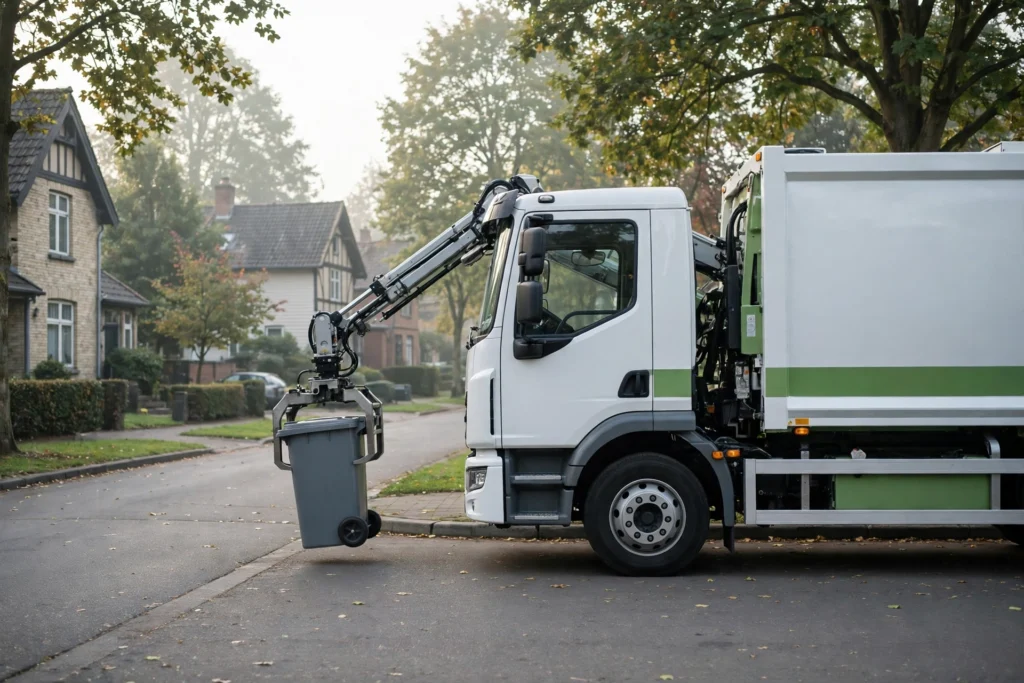
Garbage collection robots work by combining a sensor-guided vehicle with a mechanical arm that finds, grips, lifts, and empties your bin. Cameras and lidar map the street, the arm lines up with the bin, and a compactor packs the rubbish down inside the truck. A human operator still supervises the route and steps in when something looks wrong.
Key Takeaways
- Garbage collection robots use cameras, lidar, and GPS to follow a planned street route.
- A robotic arm grips the bin by its rim or handles, lifts it, and tips it into the truck’s hopper.
- Sensors check the bin’s weight and position before the arm moves, so it does not drop or crush a bin.
- A compactor inside the truck squeezes the rubbish down, letting one vehicle carry far more per round.
- Human workers still supervise, sort out problem bins, and step in when the robot stops.
How do garbage collection robots find and lift your bin?
It starts before the truck ever reaches your street. The collection route is loaded into the vehicle’s computer as a planned sequence of stops, and GPS keeps the truck on track from one address to the next. As the truck rolls along, cameras and lidar scan the kerb for bins, checking their shape, size, and position against the list of bins expected at each stop.
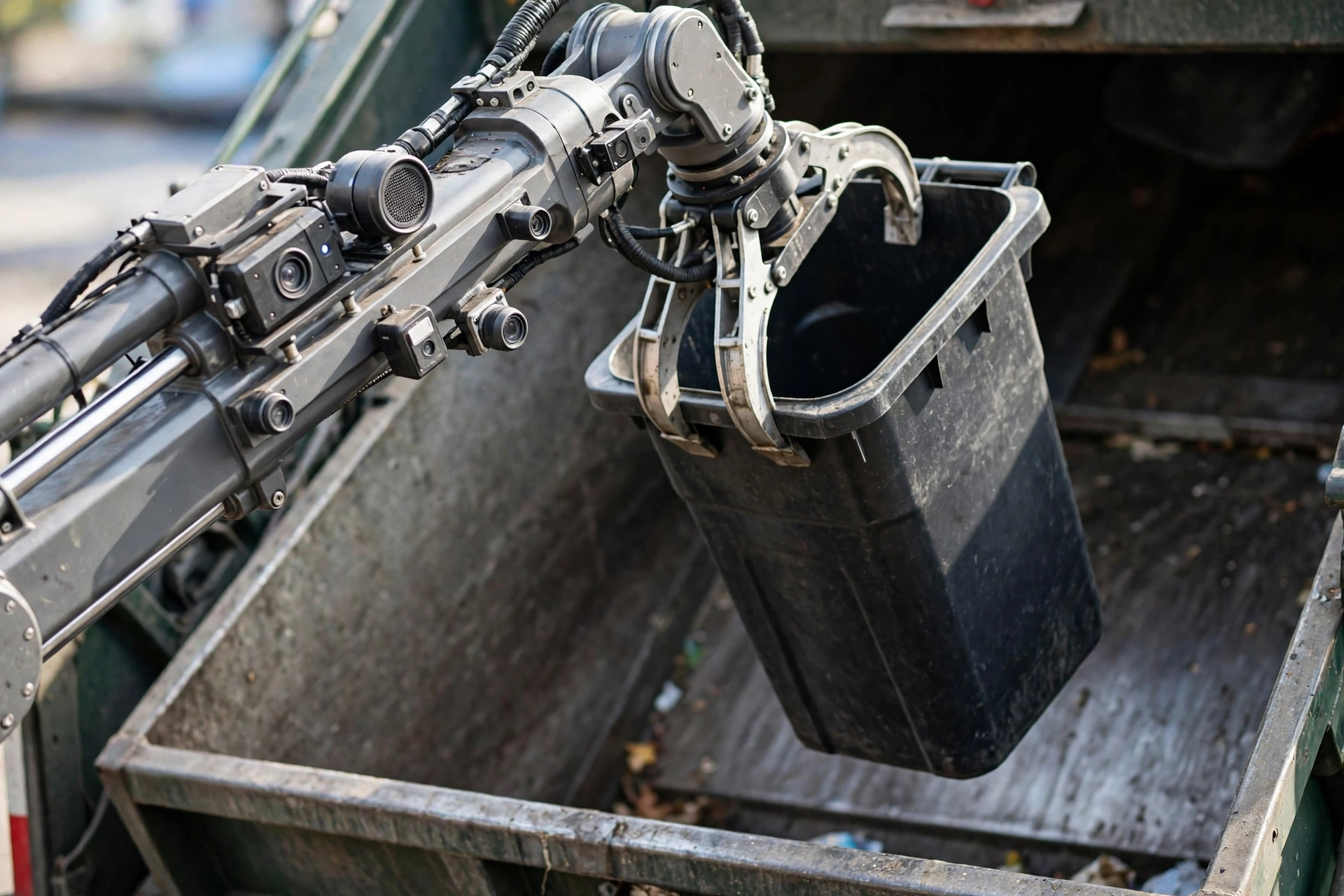
Once a bin is spotted, the robotic arm takes over. Most designs grip the bin around its rim or by moulded handles. Force sensors in the gripper tell the arm how tightly it is holding on — firm enough to lift a full bin, gentle enough not to crack the plastic. The arm lifts the bin in a smooth arc, tips it over the hopper, and returns it to the kerb, roughly where it found it. The whole lift takes a few seconds.
Weight matters too. A load cell in the arm or hopper can weigh the bin as it lifts. If the bin is far heavier than expected, the system may pause and flag it for the operator, since an overweight bin could hold rubble or something else that should not go into the truck. If the bin is missing, tipped over, or blocked by a parked car, the robot records the miss and moves on rather than forcing the lift.
How do they navigate a street full of parked cars and people?
A bin round is not a tidy factory floor. Cars park half on the pavement, children run out of driveways, and a neighbour’s hedge can swallow a bin whole. Garbage collection robots deal with this by moving slowly and watching constantly.
Lidar builds a live map of everything around the truck, while cameras pick out people, pets, and obstacles. When something moves into the truck’s path, the vehicle stops. Most systems are designed to stop first and ask questions later, which is exactly what you want from a heavy machine working on a residential street. The operator can then check the camera feed, decide whether the path is clear, and let the truck continue.
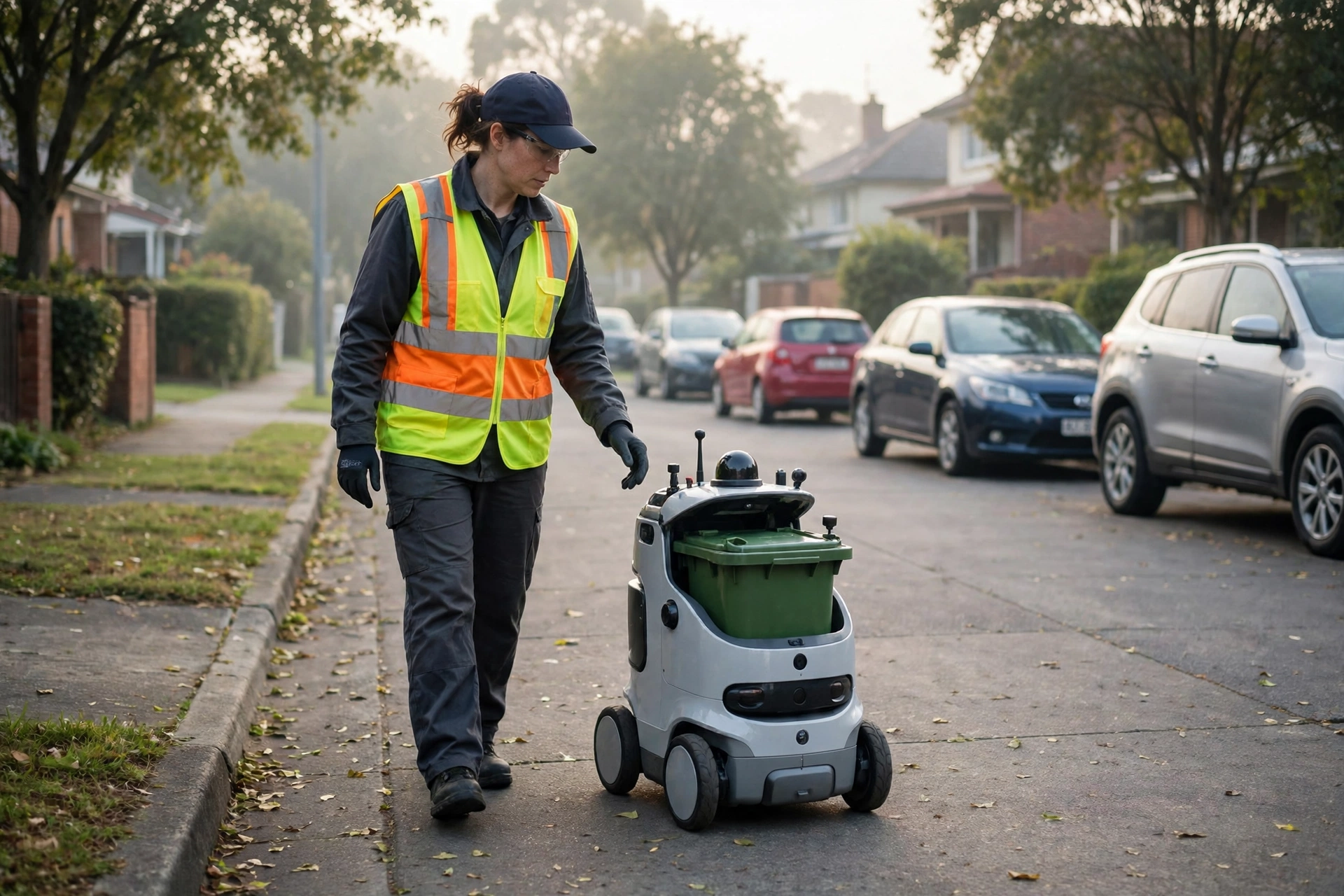
Smaller collection robots take a different approach. Some are compact wheeled machines that travel along the pavement, collect bins from a short stretch of houses, and carry them to a waiting truck. They move at walking pace and usually follow a worker who can take over with a remote control if the robot gets stuck on a kerb or a drain cover.
What happens to the rubbish once it is inside the truck?
Tipping the bin is only half the job. Inside the truck, a compactor plate pushes the rubbish towards the front of the body, squeezing out air and making room for the next load. This is what lets one truck finish a whole round without driving back to the depot every half hour.
Some newer systems sort as they collect. Cameras inside the hopper can spot obvious problems, such as a bag of garden waste in the general rubbish or a bulky item that could jam the compactor, and flag these for the operator. This early sorting is related to the work of recycling robots, which separate materials after collection. When the truck is full, it drives to a transfer station or processing plant, where the body tilts and the load is pushed out.
Do garbage collection robots replace refuse workers?
Not really, and not yet. The robot takes over the heaviest, most repetitive part of the job — lifting hundreds of bins a day — which is also the part most likely to cause back injuries. That matters, because refuse collection is physically demanding work and lifting injuries are one of the main reasons people leave the job.
What the robot does not do is think like a person. It cannot tell that a bin belongs to the house two doors down, that a resident has left a note asking for help with a heavy bin, or that a mattress dumped beside the bins needs reporting. Workers still handle those judgement calls, and in most trials they work alongside the robot rather than being replaced by it.
There is also cost. A robotic collection truck costs far more than a standard one, so for now these robots are most common in larger cities and pilot schemes, where the number of bins per route makes the investment easier to defend.
What are the limits of garbage collection robots today?
Weather is one. Heavy rain, snow, and fog can confuse cameras and lidar, and ice makes a bin’s wheels grip the pavement in ways the arm does not expect. Most systems slow down or hand control back to the operator in bad weather rather than risk a mistake.
Odd bins are another problem. A robot trained on standard wheelie bins can struggle with a cracked bin, a bin with a broken lid, or a bag left out instead of a bin. Some systems handle this by skipping the awkward item and flagging it, but that means a worker still has to come back for it.
Finally, streets change. Roadworks, a parked car, or a bin placed on the wrong side of the drive can throw the route off. The best systems update their maps constantly, but they still rely on a human to make sense of the unexpected.
Frequently Asked Questions
How do garbage collection robots know which bin to pick up?
They combine GPS with cameras and lidar. The route plan tells the truck which addresses to stop at, and the sensors identify bins by shape and position at the kerb. If a bin is not where it should be, or looks like the wrong type, the system flags it for the operator instead of guessing.
Can garbage collection robots lift a full wheelie bin?
Yes. The arm and gripper are built to handle a full standard wheelie bin, and load sensors measure the weight during the lift. If a bin is far heavier than normal, the system may pause the lift and alert the operator, since it could contain something that should not go in the truck.
Are garbage collection robots safe around children and pets?
They are designed to be. They move slowly, use cameras and lidar to spot people and animals, and stop when anything comes close. A human operator supervises the route and can halt the vehicle at any time. Even so, it is sensible to keep children and pets indoors while the collection truck is working.
What happens if the robot misses my bin?
The system records the missed stop and the depot can send a crew back, or add it to the next round. You can help by placing your bin at the kerb with the handles facing the road, clear of parked cars, and by putting it out the night before collection day.
Will robots collect all household waste in the future?
Possibly, in some areas, but it will take time. The technology works best on streets with standard bins and predictable layouts; flats, narrow lanes, and rural roads are harder, and the vehicles are still costly. A mix of robot-assisted trucks and human crews is the most likely picture for the next few years.
Conclusion
Garbage collection robots work by pairing a sensor-guided vehicle with a mechanical arm that finds, lifts, and empties your bin, while a compactor inside the truck makes room for the next load. They take the heavy lifting out of a demanding job, but they still need people — to supervise the route, handle the awkward bins, and make the judgement calls no sensor can manage.
If you want to help the robots on your street do their job well, start with the basics: put your bin out the night before, handles facing the road, with a clear metre of space around it. That small step is what lets the arm find your bin first time, every time.
Related reading
- How Do Recycling Robots Work?
- How Do Street Cleaning Robots Work?
- How Do Delivery Robots Work?
- How Do Robot Arms Work?
Further reading: Britannica’s overview of robotics and Wikipedia’s guide to waste collection.