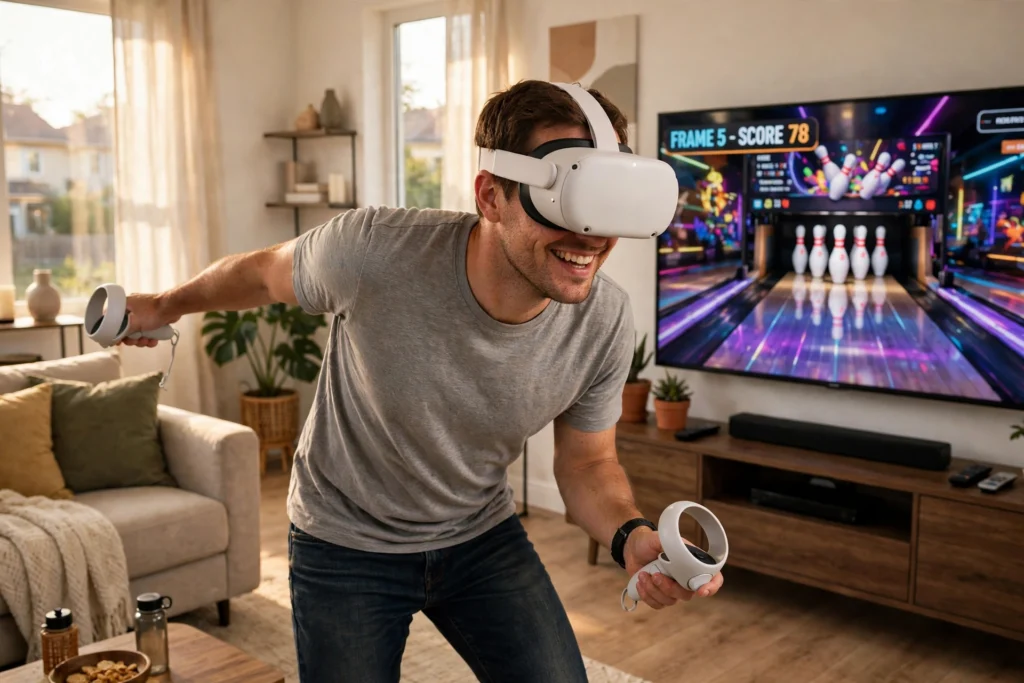
VR bowling turns your living room into a bowling alley. You put on a headset, pick up a controller, and swing your arm like you would with a real ball — then a virtual ball rolls down a virtual lane and knocks down virtual pins. The feel is surprisingly close to the real thing, even though the ball weighs nothing at all.
Key Takeaways
- VR bowling tracks your arm swing with headset cameras and controllers, then turns that motion into a virtual throw.
- The game simulates lane friction, ball spin, and pin physics, so your technique actually matters.
- You can play alone, against friends online, or pass the headset around the room.
- It is a fun way to practise, but it cannot fully copy the weight of a real bowling ball.
- Clear a little floor space first, and take breaks if you feel dizzy.
What Do You See When You Bowl in VR?
The moment the game starts, you are standing at the top of a lane. Pins glow at the far end, arrows mark the boards on the wood, and a ball sits ready at your side. Look down and you will usually see a pair of virtual hands holding the ball. Turn your head and the alley turns with you, just like a real one.
Most bowling games offer a few different alleys, from a classic local lanes look to neon-lit fantasy settings. The lane is built to the same proportions as a real one, so the distance to the pins and the angle of your throw feel familiar if you have ever bowled before.
How Does the Headset Track Your Swing?
Your swing is the whole game, and the headset watches it closely. The cameras on the front of the headset track your controllers in three dimensions, dozens of times a second. When you wind your arm back and swing forward, the game measures the speed, the angle, and the moment you let go.
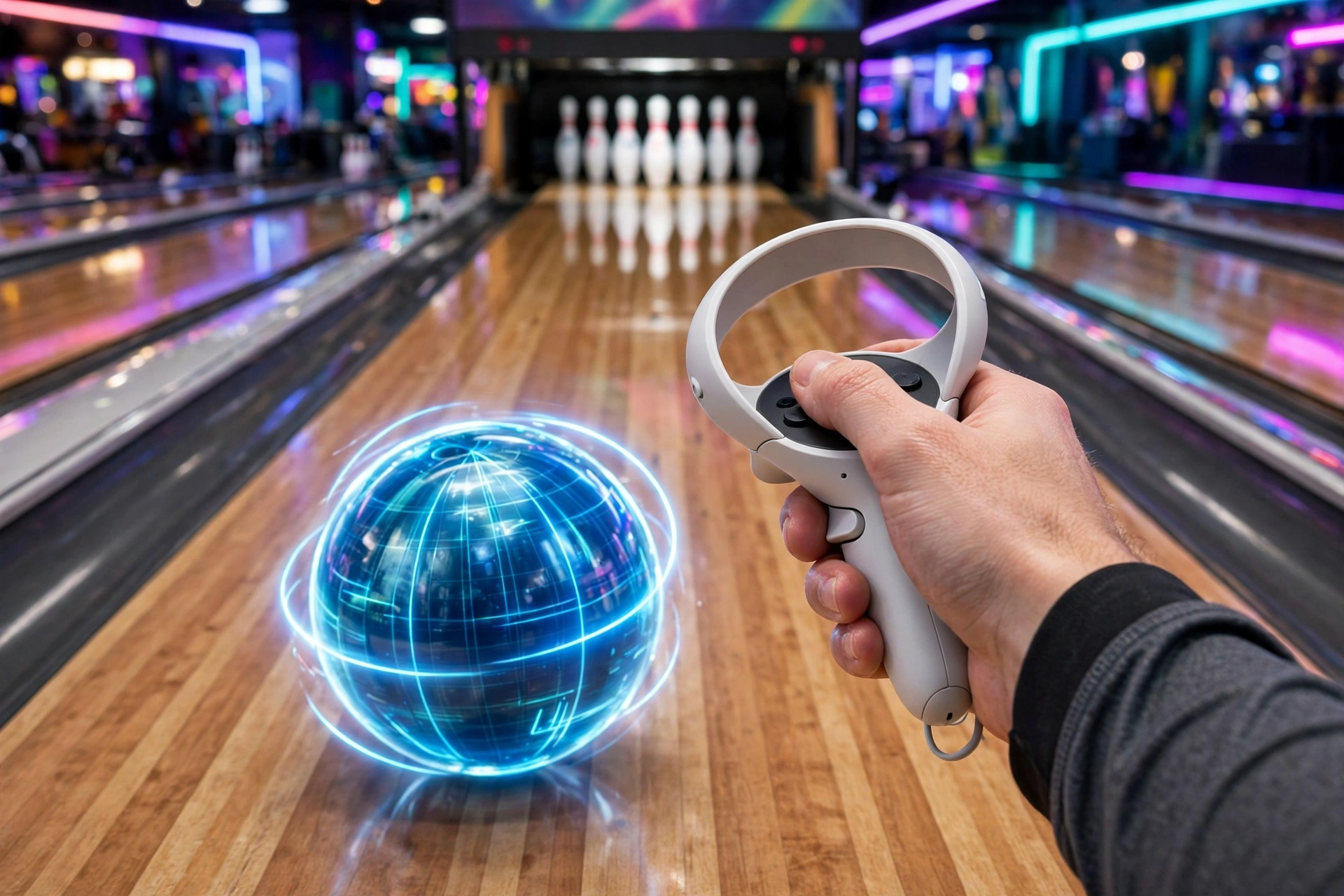
The trigger button on the controller acts as your grip. Hold it to pick up the ball, swing, and release the trigger at the right moment to let the ball go. Release too early and the ball sails high; release too late and it thuds into the lane early and loses speed. That timing is the skill, and it is the same skill real bowlers practise.
Some games also read a flick of your wrist at release. Twist your hand slightly and the ball hooks — it curves across the lane toward the pocket between the head pin and the pin next to it, just like a real hook shot.
What About the Ball, the Lane, and the Pins?
A virtual ball has no weight, which is the biggest difference from real bowling. In a real alley, a ball weighs several kilos, and that weight shapes your whole approach. In VR, your arm moves freely, so the game fakes the physics with numbers: ball speed from your swing, spin from your wrist, and friction as the ball rolls, so a slow ball drifts and a fast one holds its line. When it reaches the pins, a physics engine works out which fall and which stay standing.
The result is not perfect — a real ball reacts to oil patterns on the lane in ways a game can only approximate — but it is close enough that good technique is rewarded and sloppy throws are punished.
Can You Play VR Bowling With Friends?
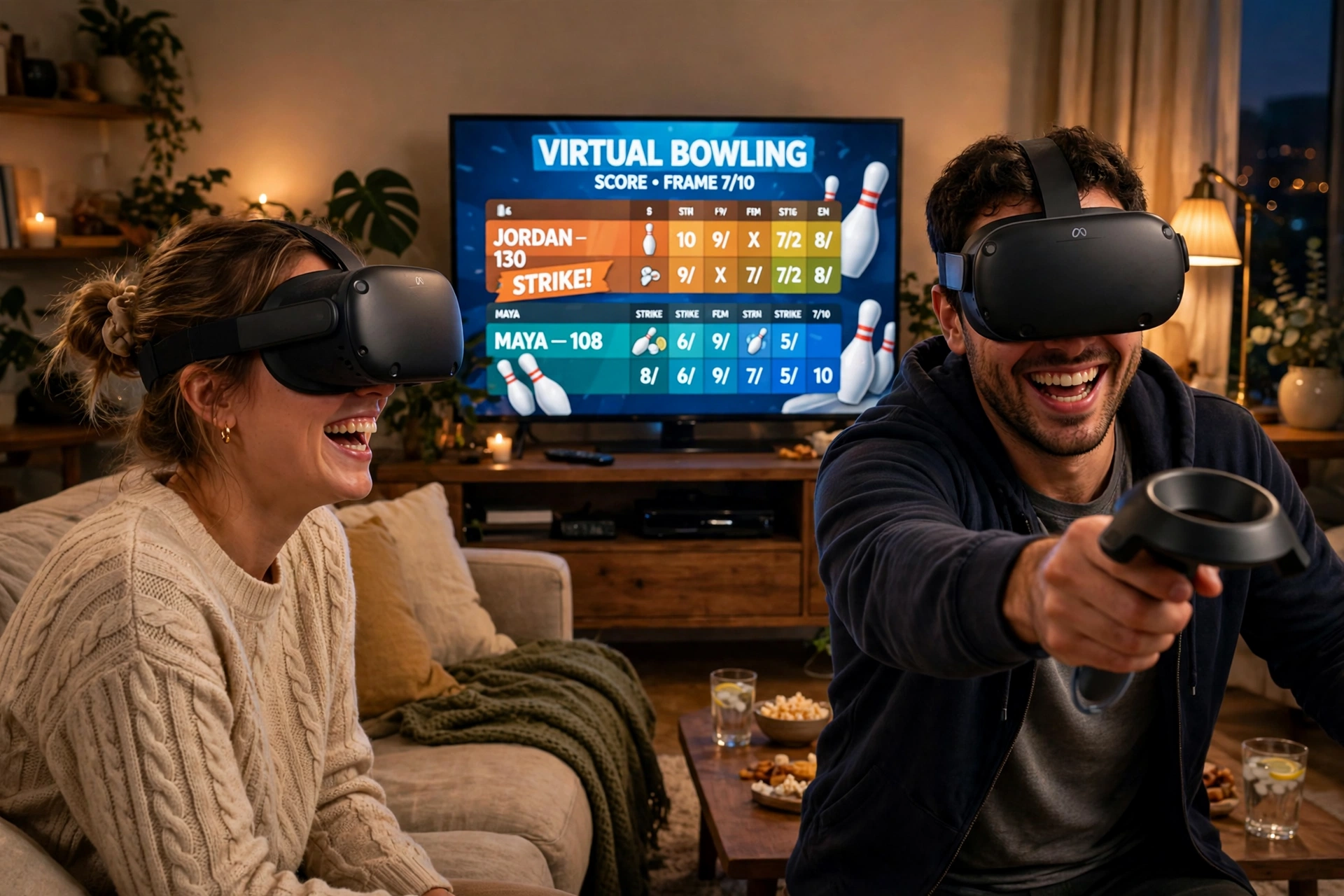
Yes, and this is where it really shines. Most VR bowling games let you play with friends in two ways. The simplest is pass-and-play: everyone takes turns with the same headset, and the game keeps score for the whole group. It works well for a family evening, and the TV can mirror what the player sees, so everyone in the room can watch and cheer.
The second way is online. You and your friends each join the same virtual alley from your own homes, and you can see each other’s avatars, hear each other talk, and watch each other’s throws. Some games also have leagues and tournaments, where you bowl a set number of frames against other players’ scores.
Is VR Bowling Good Practice for the Real Thing?
It can help, with limits. VR bowling is good for the parts of the game that live in your head and your timing: your approach, your release point, and reading the angle to the pocket. Players often say their aim improves after a few weeks of regular VR play, because they get far more throws in than they would at a real alley.
What it cannot teach is the feel of a heavy ball. Your muscles learn different things when they are swinging real weight, and VR cannot copy that. So think of it as a supplement, not a replacement. Use it to sharpen your timing and your eye, then take what you learned to a real lane and see how it holds up.
One honest warning: if you bowl for an hour straight, your arm may ache the next day anyway. Repeating the same swinging motion hundreds of times is a workout, even without a ball in your hand.
What Do You Need to Get Started?
You need less than you might think. A standalone VR headset and its controllers are enough — there is no need for a gaming PC or extra sensors. The bowling game itself is usually a one-off purchase from the headset’s store, and many headsets come with a bowling or sports game bundled in.
Space matters more than gear. Clear an area about two metres by two metres, move the coffee table, and check there is nothing fragile within arm’s reach. The headset will ask you to draw a boundary on the floor, and it will warn you if you step close to the edge. Respect it — a swinging arm and a bookshelf do not mix.
FAQs
Is VR bowling free?
Some headsets include a bowling or sports game in the box, and a few games are free. Most of the popular bowling titles are paid, but they are usually modestly priced, and one purchase covers the whole household on that headset.
Does VR bowling make you motion sick?
Most people are fine, because you stand still and the world stays still around you. A few people feel queasy at first, especially in games with fast camera movement. Short sessions help, and the feeling usually fades as you get used to it.
How accurate is the pin physics?
Good enough to be fair. The games use physics engines that model how pins knock into each other, so strikes, spares, and splits behave much like the real thing. Split leaves and lucky bounces both happen, just as they do at a real alley.
Can children play VR bowling?
Many families do, and kids usually pick it up fast. Check the age guidance for your headset first, keep sessions short, and supervise younger players so they do not swing into furniture. The headset is also worth adjusting to fit smaller heads.
Will VR bowling improve my real bowling score?
It can help your timing and your aim, which are a real part of the game. It will not build the arm strength or the feel for lane oil that only real bowling gives. Treat it as extra practice between visits to a real alley.
Conclusion
VR bowling is one of the easiest ways into virtual reality: the rules are familiar, the skill is real, and you can be playing within minutes of putting the headset on. It will not replace a night at the lanes, but it brings the lane to your living room whenever you want it.
If you are curious, start with a short session — ten frames, one game, and see how your arm feels and how your score looks. Then clear a little space, invite a friend round, and make it a regular game night.