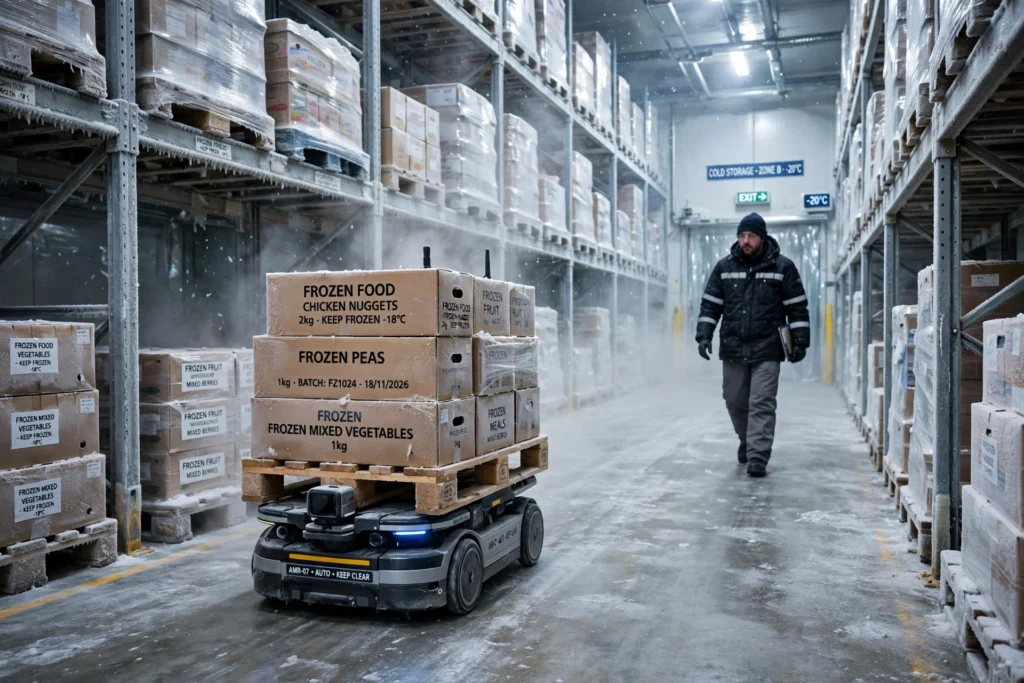
Cold storage robots work by moving pallets and picking orders inside freezers that sit at around -25°C, places where people can only work in short shifts. They follow digital maps, use sensors to steer around racking and each other, and keep running while the cold would wear a person out.
Key Takeaways
- Cold storage robots are autonomous mobile robots and stacker cranes built to run in freezers, not ordinary warehouse robots dropped into the cold.
- They navigate with lidar, cameras, and floor markers, and a central system gives each robot its next job.
- Frost, brittle materials, and weaker batteries are the big engineering problems, and each has a practical fix.
- People still matter: workers handle exceptions, maintenance, and the jobs robots cannot reach.
What is a cold storage robot?
A cold storage robot is a machine that stores, moves, and picks frozen goods inside a chilled warehouse. Most are one of two kinds: autonomous mobile robots (AMRs), low wheeled platforms that slide under a pallet, lift it, and carry it to the right bay; and stacker cranes, tall machines that run on rails between high racks and lift pallets up to shelves no forklift could reach quickly.
What makes them different from ordinary warehouse robots is the environment. A cold store is often held between -18°C and -30°C, and the damp air leaves frost on any cold surface. Ordinary grease thickens, plastic turns brittle, and screens fog up. So cold storage robots use low-temperature lubricants, heated sensor housings, and sealed electronics.
How do cold storage robots move around a freezer?
Navigation starts before the robot ever moves. The warehouse management system holds a digital map of every aisle, rack, and pick station, and hands each robot a job: collect pallet A from bay 12, deliver it to the packing door. The robot plans a route and follows it, updating its position as it goes.
Most robots find their way with a mix of tools. Lidar spins a laser beam around the robot and builds a live picture of walls, racks, and other vehicles. Cameras read floor markings and barcodes. Some sites add magnetic tape or QR-code stickers on the floor as extra reference points, which helps when frost confuses a camera.
When two robots meet in an aisle, the system decides who waits. Narrow freezer aisles are usually one-way, and robots queue rather than squeeze past each other. If a person steps into the aisle, the robot slows or stops.
How do they cope with frost and freezing temperatures?
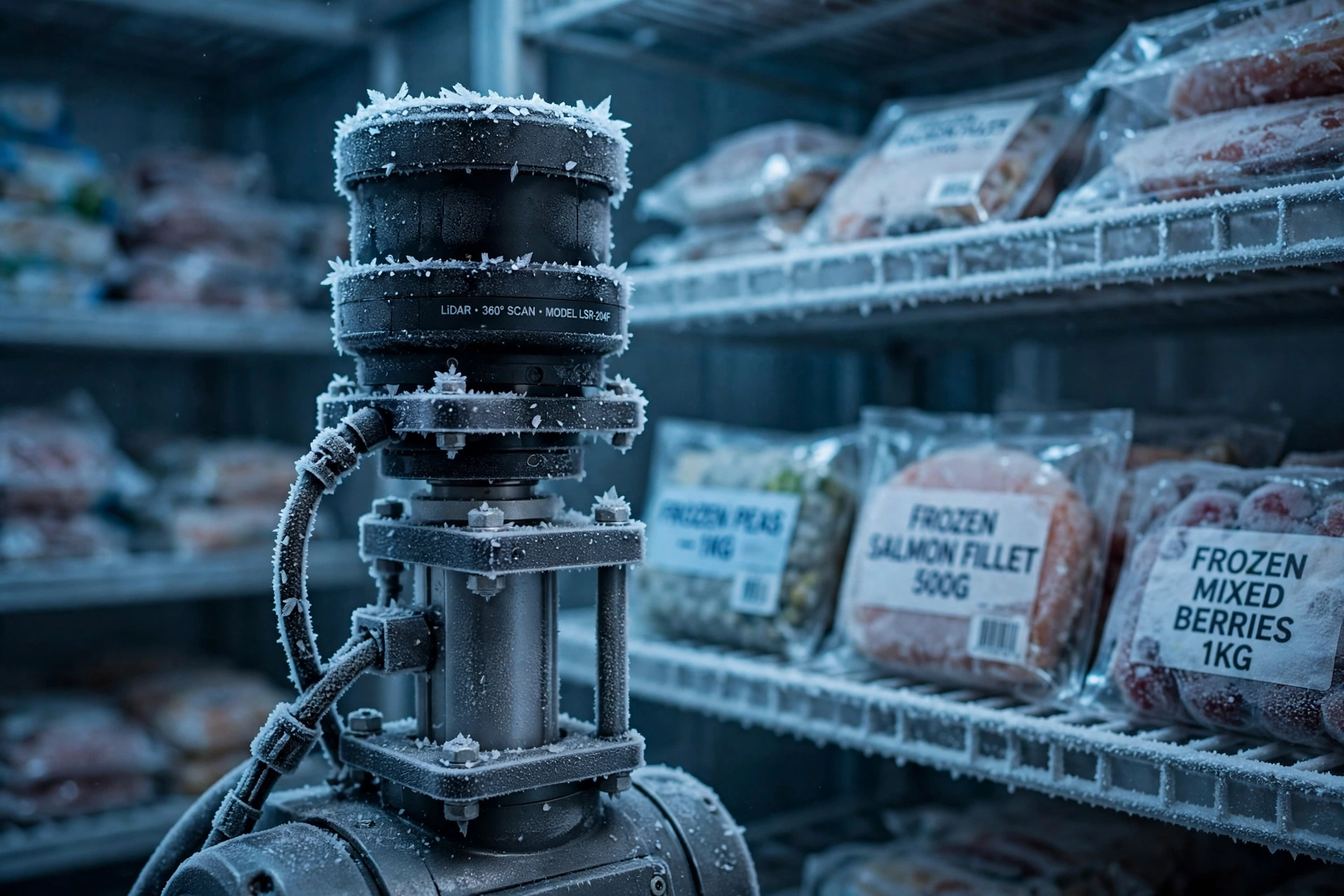
Frost is the everyday enemy. A lidar lens coated in ice cannot see, and a camera behind a fogged window is useless. Sensor housings often have small heaters that keep lenses clear, and some robots park under a warm-air blower between jobs to melt off any build-up.
Batteries are the second problem. Cold saps a battery’s charge, so a robot that runs for hours in a normal warehouse may manage noticeably less in a freezer. Sites handle this with heated battery packs, battery swaps, or charging docks in a slightly warmer airlock just outside the coldest zone.
Materials matter too. Steel contracts slightly in the cold, rubber seals stiffen, and cheap plastics can crack. Cold-rated robots use flexible seals, cold-tolerant cabling, and lubricants that stay fluid well below freezing.
What jobs do cold storage robots do?
The most common job is moving pallets. A robot picks up a full pallet from the goods-in door, carries it deep into the freezer, and slots it into a bay. Later, when an order comes in, another robot fetches the pallet and brings it to a picking station. Because the system knows exactly where everything sits, fast-moving goods stay near the door and slow movers go further back.
Some robots pick individual cases rather than whole pallets. A robotic arm on a mobile base can lift boxes of frozen meals or bags of vegetables and place them into an order tote, using soft pads and gentle force control so frosty cardboard doesn’t tear.
How do cold storage robots stay safe around people?
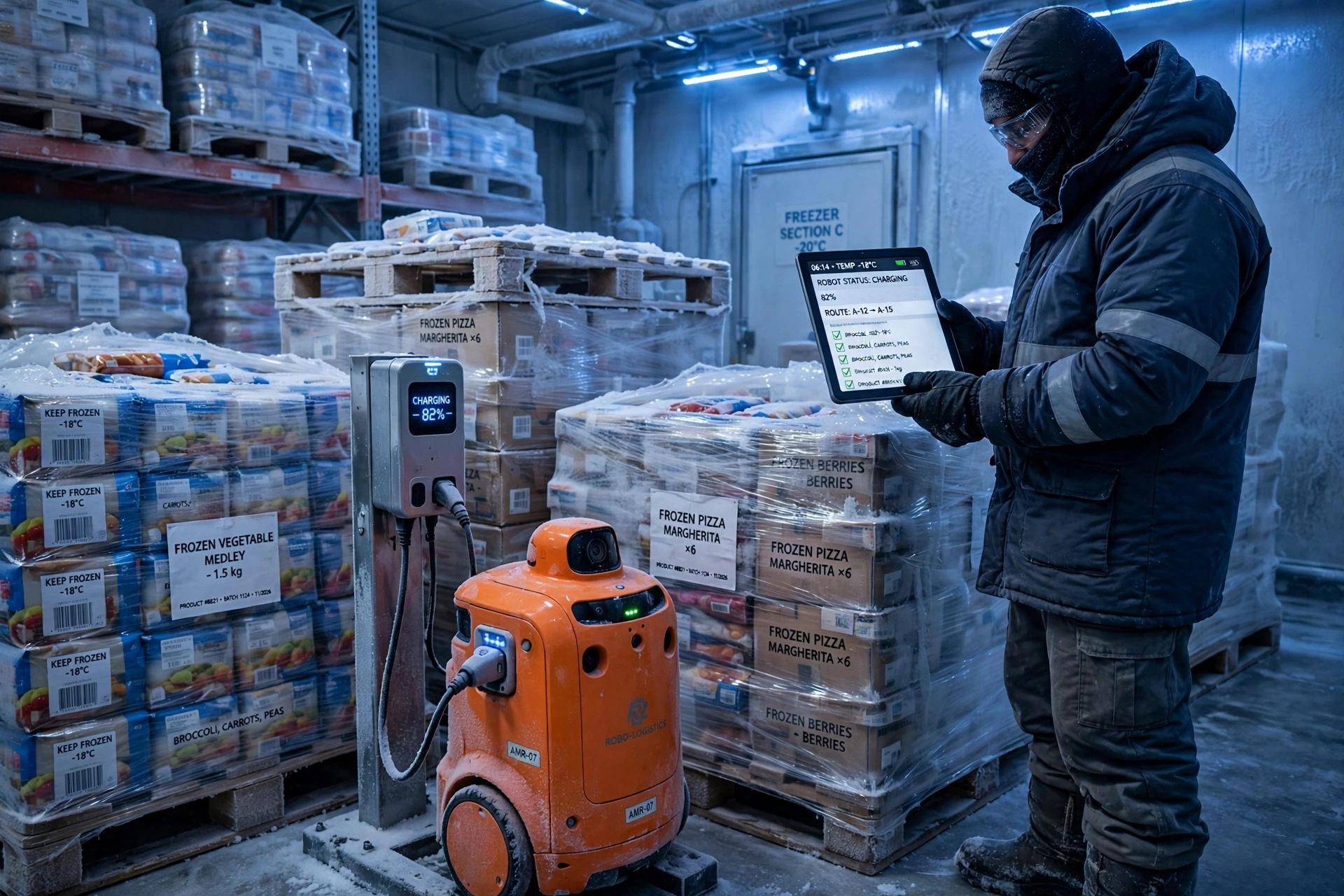
People still enter freezers, and safety comes first. Cold storage robots carry the same protection you’d expect anywhere robots and people share space: lidar that spots a person and slows the robot, bump sensors that stop it on contact, and flashing lights and beepers that announce it is moving.
Sites add their own rules on top. Aisles are marked, freezer doors have warning signs, and robots are often restricted to certain zones while people work in others. Some sites run robots mainly at night, when fewer people are inside.
What are the limits of cold storage robots?
Cold storage robots are good at repeatable trips in a mapped building, and weaker at anything unusual. A pallet stacked crookedly, a spill of frozen peas, or a door left half open can all confuse them. Most systems stop and call for help rather than guess, which is the right call in a freezer where a mistake can mean damaged stock.
Cost is another limit. A cold-rated robot costs more than a standard one, and the freezer itself needs changes — flat floors, clear markings, charging points, and a wireless network that works through thick insulated walls. Small cold stores often find the numbers don’t add up yet.
Finally, robots don’t remove the need for people. Someone has to maintain them, clear the odd jam, and handle the exceptions. What changes is the shape of the work: fewer hours spent shivering in an aisle, and more time spent supervising, fixing, and planning.
FAQs
Do cold storage robots work in any freezer?
Most are built for a set temperature range, often down to about -30°C. Below that, batteries and materials struggle, and a specialist design is needed.
How long can a cold storage robot run before charging?
It varies by model and load, but many manage several hours per charge in the cold, then top up at a dock between jobs so they rarely sit idle.
Can cold storage robots pick individual items?
Yes, some can. Robots with arms and soft grippers pick cases and totes, though whole-pallet moves remain the most common job.
Do cold storage robots replace warehouse workers?
They take over the coldest, most repetitive trips, but people still handle maintenance, exceptions, and skilled tasks. Most sites end up with a smaller, better-trained team rather than no team at all.
What happens if a cold storage robot breaks down in a freezer?
It stops safely and alerts the control system. A technician in thermal clothing goes in to recover it, and other robots are routed around it in the meantime.
Conclusion
Cold storage robots work by combining warehouse automation with cold-proof engineering: mapped routes, lidar navigation, heated sensors, and batteries built for the freeze. They move pallets and pick orders in conditions that wear people out fast. If you run or work in a cold store, the practical next step is to look at which trips your team repeats most in the cold — those are the jobs a robot would take first.
Further reading
For the wider picture, start with What Is Robotics? and How Do Warehouse Robots Work?, which cover the basics these freezer machines build on. How Do Robot Arms Work? explains the picking arms some cold storage robots carry, and How Do Delivery Robots Work? shows the same navigation ideas working outdoors. For background on the storage systems themselves, see the Britannica robotics overview and Wikipedia’s page on automated storage and retrieval systems.