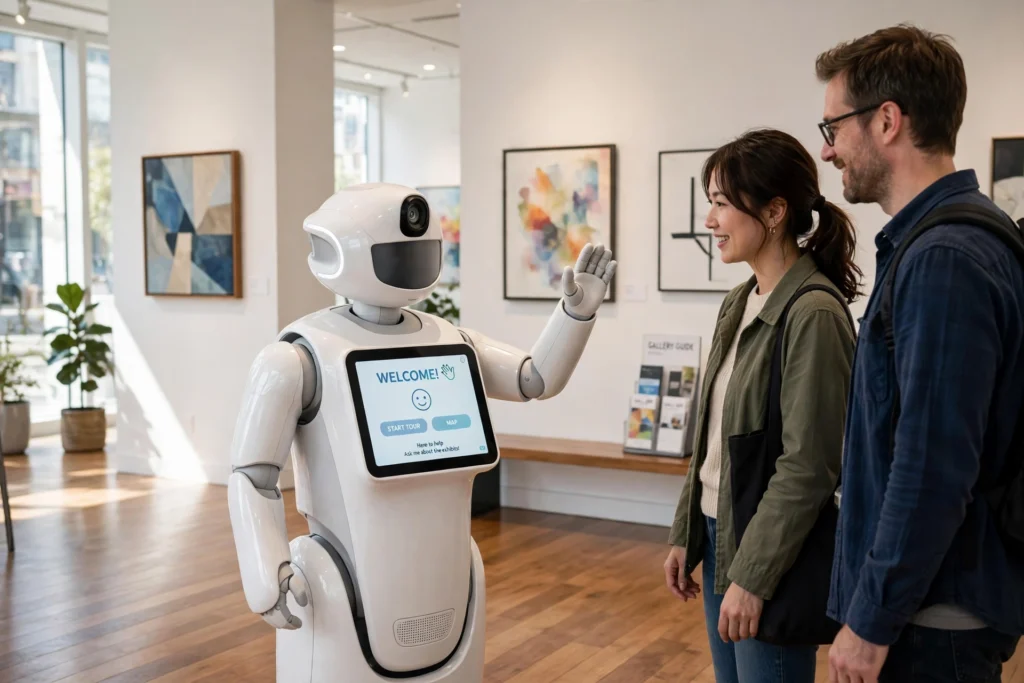
Museum robots work by combining a map of the building, sensors that watch for people and obstacles, and a friendly interface that answers questions and leads tours. A guide robot rolls up to a painting, tells you the story behind it, and then moves on to the next exhibit without bumping into anyone.
Key Takeaways
- Museum robots are mostly guides: they lead tours, answer questions, and point visitors toward exhibits.
- They navigate with a stored floor map plus cameras, lidar, and bump sensors that spot people and furniture in real time.
- Most robots follow set tour routes but can pause, reroute, or call a member of staff when something unexpected happens.
- They speak through touchscreens, speakers, and sometimes several languages.
- They do not replace human guides; they handle routine questions so staff can focus on deeper conversations.
What do museum robots actually do?
Walk into some larger museums today and you may be greeted by a robot rather than a person at the door. These machines usually have one of three jobs. The most common is the guide: the robot leads a small group from exhibit to exhibit, stops at each one, and explains what visitors are looking at.
A second job is wayfinding. Big museums can feel like mazes, and a robot near the entrance can point you toward the toilets, the cafe, or the Egyptian wing. Tap your destination on its screen and it shows you the route.
The third job is quieter: monitoring. Some museums use robots to patrol galleries during quiet periods, checking that nothing has been moved or touched. If something looks wrong, they alert a member of staff. They are not security guards, but they give the security team an extra pair of eyes.
How do museum robots find their way around a gallery?
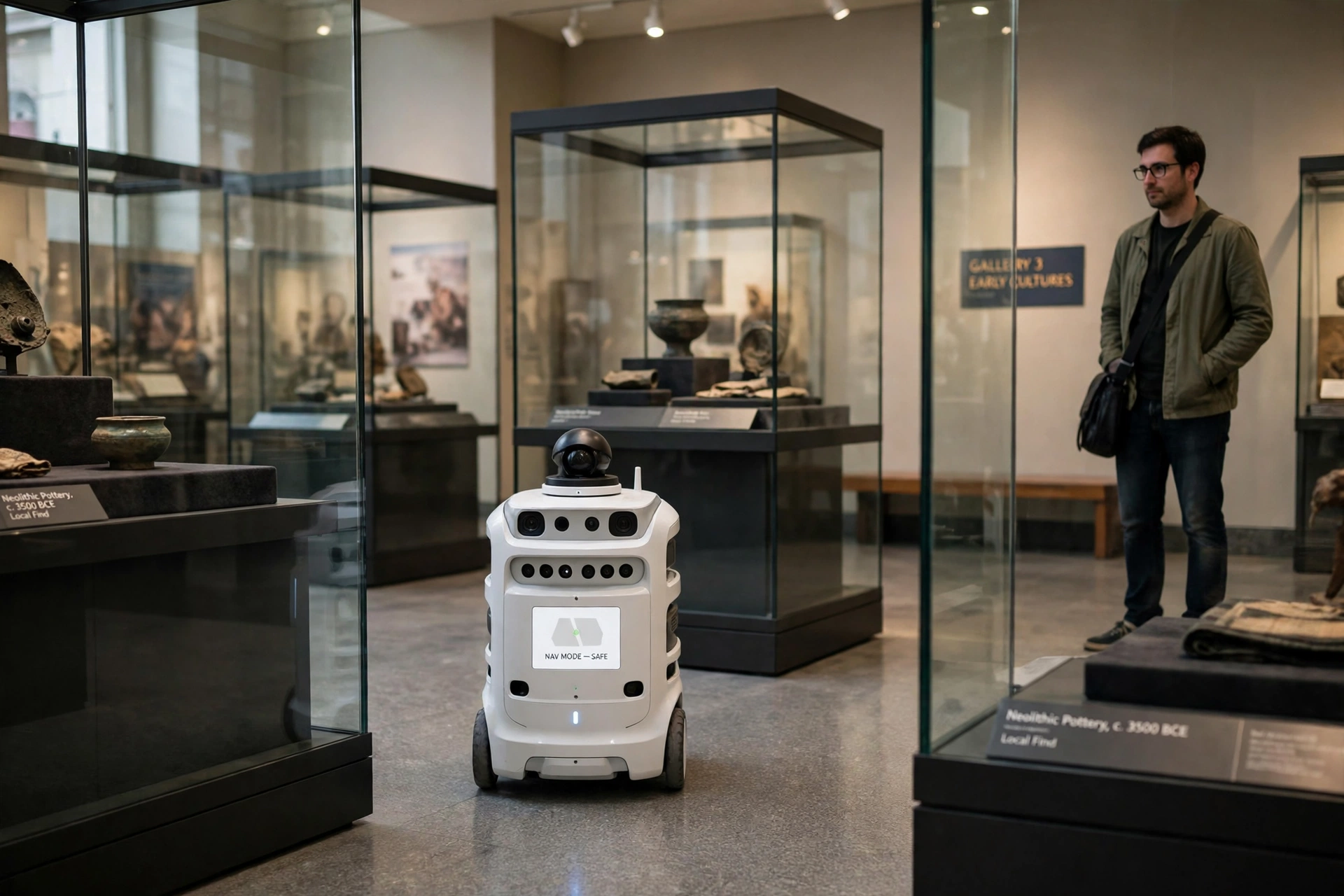
A museum is a tricky place for a robot: floors are polished, lighting changes from room to room, and crowds drift unpredictably. So museum robots work from a detailed digital map of the building, built in advance by walking the robot through each gallery or scanning the space with lidar.
Once it knows the map, the robot tracks its own position as it moves. Wheels with encoders count how far it has travelled, while cameras and lidar match what they see against the stored map. This technique, called simultaneous localisation and mapping, lets the robot correct itself when its wheels slip on a shiny floor.
Safety comes first. Bump sensors and depth cameras watch for people stepping in front of the robot and for low obstacles such as benches. If something gets too close, the robot slows down or stops, then waits or picks a new route. Most museum robots travel at walking pace or slower.
Tour routes are planned in advance by a curator, so the robot stays away from fragile exhibits and roped-off areas.
How do museum robots talk to visitors?
Talking to the public is the hardest part of the job. Most robots handle it with a touchscreen first and voice second: tap a question from a list, choose a language, and read the answer on screen. Voice recognition works too, but in a busy gallery the screen is often more reliable.
The answers come from a prepared set of facts about the collection, written by the museum’s own curators. When you ask about a painting, the robot pulls up the same notes a human guide would use: who made it, when, and why it matters. Some robots add pictures or a quiz for children.
Language matters. A robot that speaks four or five languages can help visitors who would otherwise struggle to follow a tour, and it can switch to a larger font or spoken answers for visitors with poor eyesight. None of this is perfect — accents and background noise still trip the software up — but for straightforward questions it usually works.
What happens when a museum robot gets stuck or runs low on power?
Even a well-mapped gallery can surprise a robot: a school group might block a corridor, or a visitor might park a pushchair in its path. The robot first tries to solve it itself — it waits, then looks for a way around. If the way is still blocked, it asks people to step aside or sends a message to the front desk.
If it cannot move at all, it stops safely and waits for help. Staff can drive it remotely from a tablet or walk over and guide it by hand, so museums that run robots keep someone nearby during busy hours.
Battery life is planned around opening hours. Most guide robots run for several hours on a charge, and when the battery gets low the robot finishes its current stop and rolls back to its charging dock by itself.
Do museum robots replace human guides?
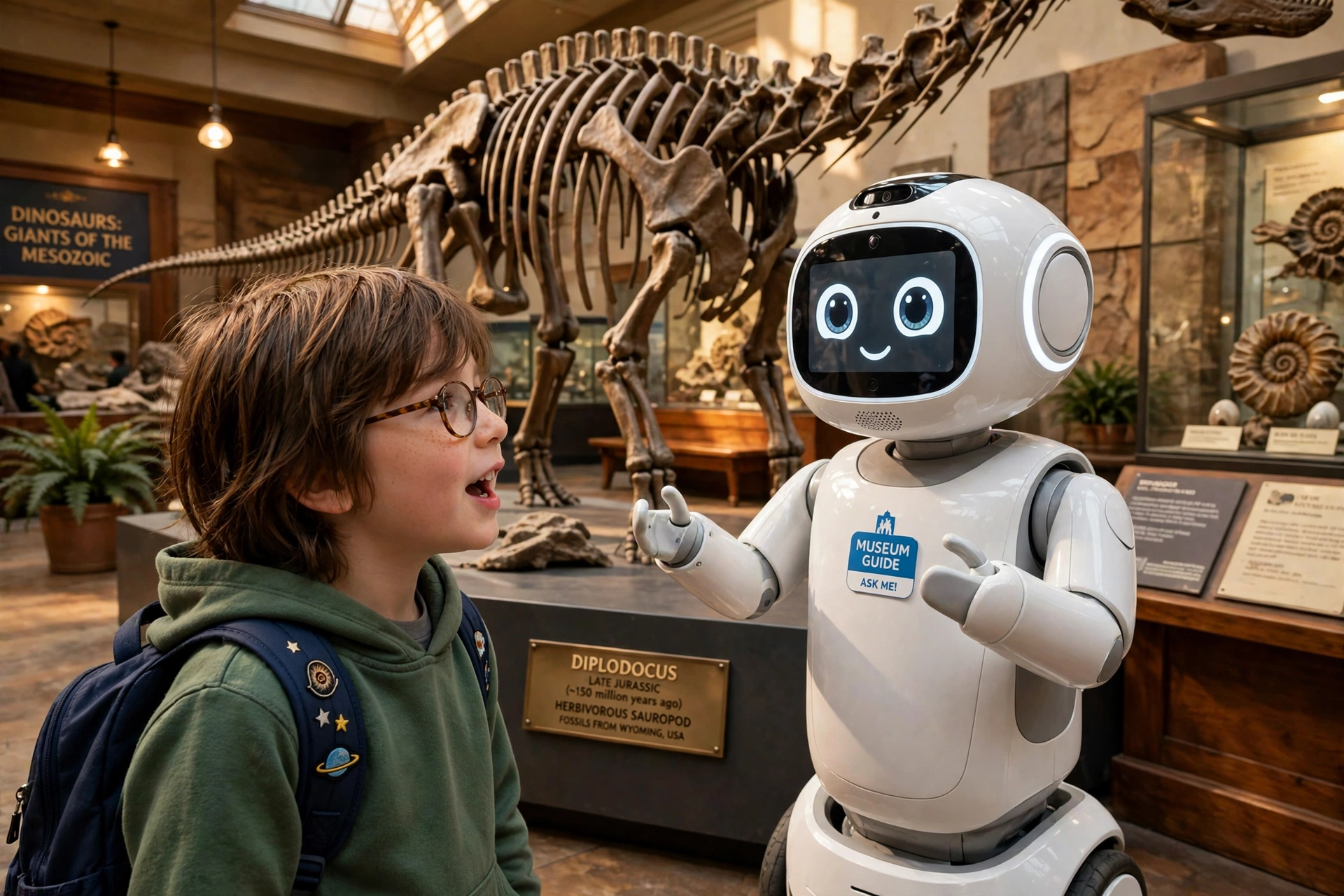
This is the question visitors ask most, and the honest answer is no. A robot is good at repeating the same tour fifty times a day without getting tired, and it never forgets a date or a name. But it cannot read a room the way a person can — it cannot tell that a group of teenagers is bored and switch to a funnier story.
What robots do is take over the routine work. They answer the same questions about opening times, directions, and the most famous painting, freeing human guides to run the special tours and the conversations that need a real person. Often the robot gathers a crowd and gives the introduction, then a human guide takes over for the detailed stories.
Frequently Asked Questions
Can a museum robot understand my question?
Usually, yes, if the question is about an exhibit or the building. You can type or tap it on the touchscreen, which is the most reliable way, or speak it aloud. Very open-ended questions may stump it, and it will usually suggest asking a member of staff instead.
Are museum robots safe around children?
Yes. They move slowly, stop automatically when something gets close, and have no sharp edges or hot parts. Museums still ask parents to keep an eye on younger children, just as they would near any moving equipment.
What happens if a museum robot bumps into an exhibit?
It is designed not to. Its map keeps it away from fragile objects, and its sensors stop it before contact.
How long can a museum robot work before charging?
Most guide robots run for several hours on a single charge, roughly matching a morning or afternoon shift. When the battery runs low, the robot returns to its dock on its own.
Will every museum have robots one day?
Probably not. They suit large museums with big open galleries and lots of visitors asking the same questions. Smaller museums often find a human guide cheaper and more flexible.
Conclusion
Museum robots work because they combine three simple ideas: a good map, careful sensors, and a friendly way of sharing what the museum knows. They do the repetitive jobs so human guides can do the interesting ones.
Next time you visit a museum and spot a robot rolling toward you, give it a try. Tap its screen and ask it about the exhibit in front of you. If it gets stuck, a human guide is never far away — and the best visits usually mix a little of both.
Further reading: for how guide robots compare with other service robots, see How Do Airport Robots Work?, How Do Hotel Robots Work?, How Do Reception Robots Work?, and How Do Telepresence Robots Work?. For the wider background, Britannica’s robotics overview explains the sensors and control systems these machines share, and Wikipedia’s service robot page covers how service robots are defined and where they are used.