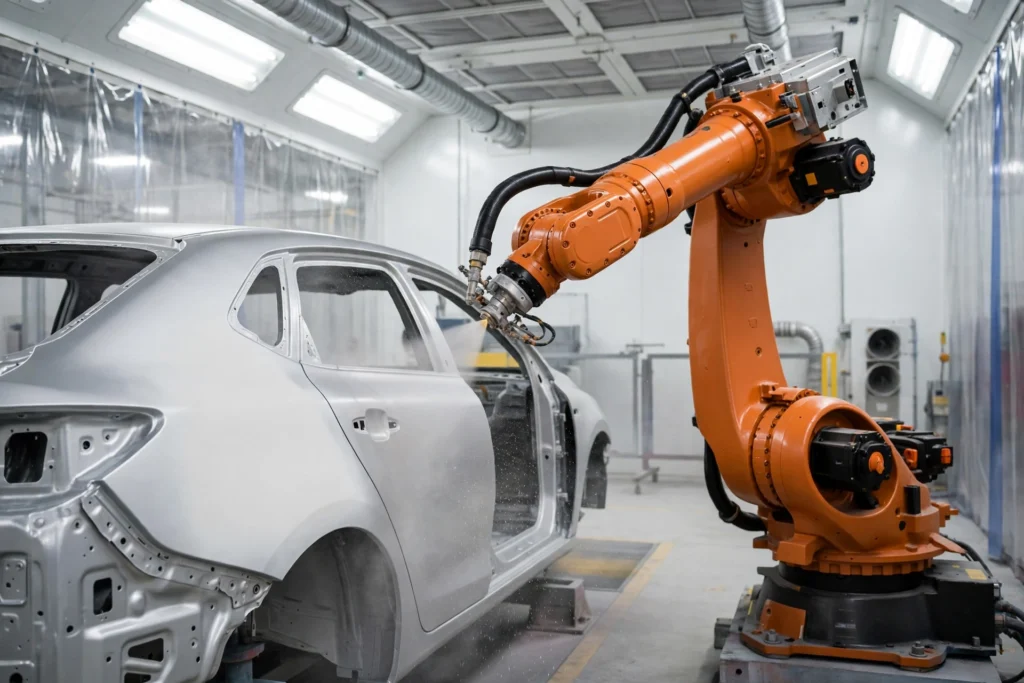
Painting robots work by moving a spray gun along a planned path while controlling paint flow, air pressure, and distance from the surface. The controller guides the arm, and the gun breaks paint into fine droplets that land in an even, repeatable coat.
Key Takeaways
- Painting robots follow a programmed path at a steady speed and distance.
- The spray gun, paint supply, and controller work together to control thickness and coverage.
- Robots suit repeated shapes and jobs where paint fumes make hand spraying risky.
- Good results still need clean surfaces, correct settings, and regular checks.
What Is a Painting Robot?
A painting robot is usually an industrial robot arm with a spray gun fitted where a gripper would normally sit. Think of it as a steady, tireless painter’s arm: it does not rush the last panel, and it can repeat the same motion hundreds of times with very little change.
Most painting robots are articulated arms with several joints, which lets them reach around curves and into awkward corners. Others run on a track or gantry above the work, which suits long items such as pipes or vehicle bodies. What sets a painting robot apart is the whole system around the arm: the spray gun, the paint supply, the booth, and the safety controls.
How Does a Painting Robot Move?
Movement starts with a program. An operator may guide the robot through the job once so it can learn the path, or a programmer may build the path in software from a 3D model of the part. Either way, the controller stores positions, speeds, and spray settings, then plays them back in order.
Each joint has a motor and a sensor reporting its position. The controller compares where the arm is with where it should be, many times a second, and makes small corrections. That feedback loop keeps motion smooth instead of jerky.
Speed matters as much as position. Move too fast and the coat turns thin and patchy. Move too slowly and paint pools or drips. A good program balances speed, distance, and flow so each pass overlaps the last just enough for full coverage without waste. For a car body, the robot works in sections — a door, then a fender, then the roof — following the shape rather than spraying in straight lines.
How Does the Spray Gun Make an Even Coat?
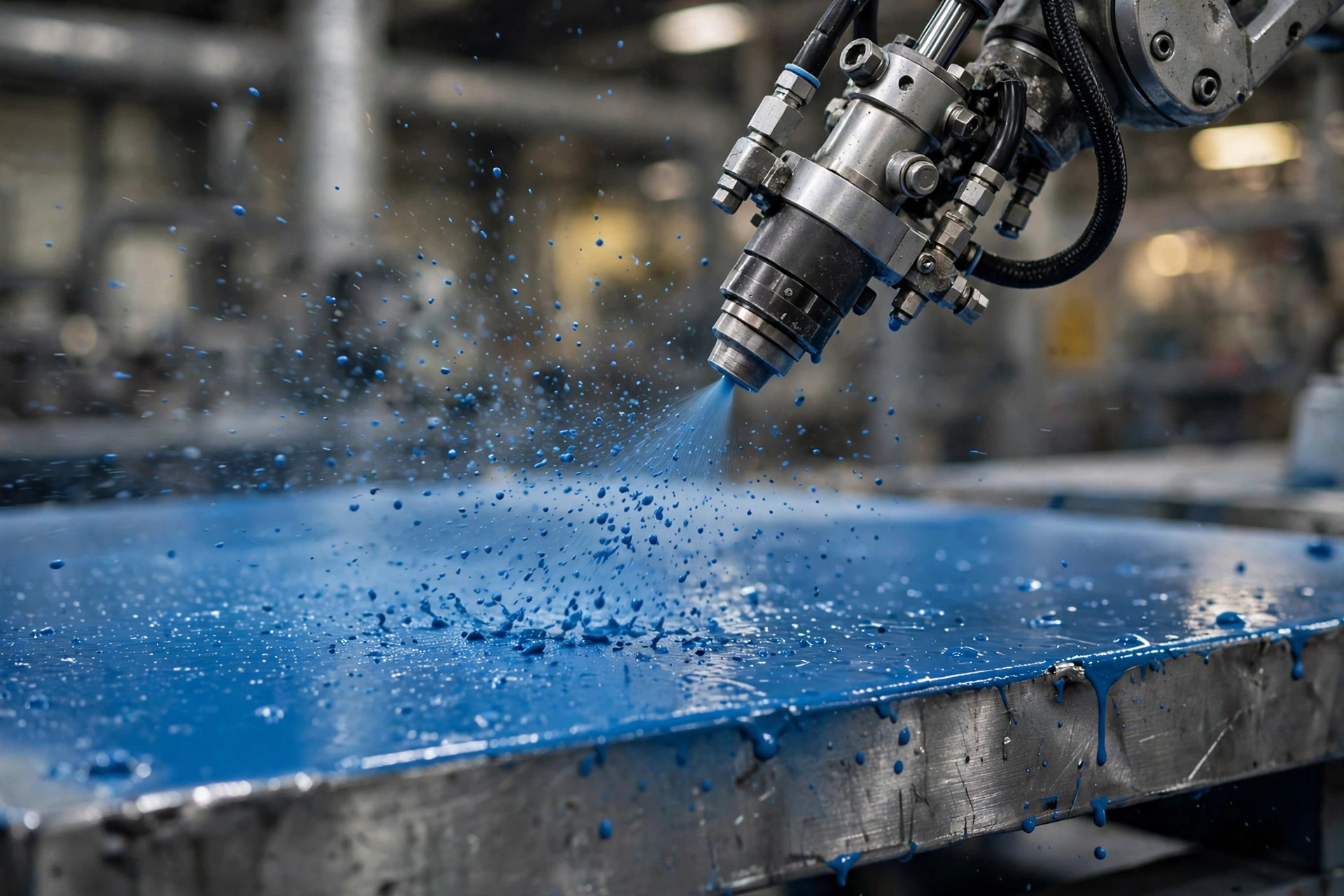
The spray gun turns liquid paint into a fine, controlled mist. Compressed air, high pressure, or an electric charge can break the paint into droplets, depending on the system. Smaller, more uniform droplets tend to give a smoother finish.
Several settings shape the result. Nozzle size affects droplet size and flow. Air pressure changes how far the spray spreads. Distance matters too: too close and paint builds up fast; too far and much of it drifts away as overspray.
Some systems use electrostatic spraying, where droplets carry a small electric charge and the part is grounded. The charged droplets are drawn toward the surface, which can improve coverage on edges and curves and reduce waste. It works best on conductive materials such as metal, and it needs proper grounding and safety controls.
What Sensors and Controls Keep the Job on Track?
Painting robots rely on more than a fixed program. Sensors check the arm’s position and the paint flow, and in some setups a vision system finds the part or checks its orientation. If a part sits slightly out of place, a sensor-guided system can adjust the path instead of missing an edge.
Simpler lines use fixtures — jigs that hold every part in exactly the same place — so the robot can trust its program without checking each time. Fixtures are cheaper and very reliable, but they only suit parts that are always the same shape.
The controller also watches for faults. A blocked nozzle, a drop in air pressure, or a paint-supply problem can trigger a pause or an alert, so an operator can fix it before a whole batch is ruined.
Where Are Painting Robots Used?
Car factories are the best-known example. A car body has curves, edges, and hidden areas that are hard to coat evenly by hand, and the same model may be painted thousands of times. Robots give that work a consistent finish while keeping workers out of the spray booth for most of the process.
They also paint furniture parts, metal cabinets, and agricultural equipment. In some workshops a compact robot handles small batches of chairs or doors, freeing skilled painters for touch-ups and unusual jobs. Larger machines paint walls, ship hulls, or storage tanks, where the surface is huge and access is awkward — though wind, temperature, and surface condition still affect the finish.
One-off, highly detailed artwork is a different story. For a surface that changes shape every time, a human painter’s judgement still wins.
How Do Painting Robots Stay Safe?
Paint spray brings real hazards: flammable solvents, fine mist that should not be breathed in, and moving machinery. Safety starts with the booth or enclosure. Ventilation pulls overspray and fumes away, filters catch droplets, and the workspace is kept clear of ignition sources.
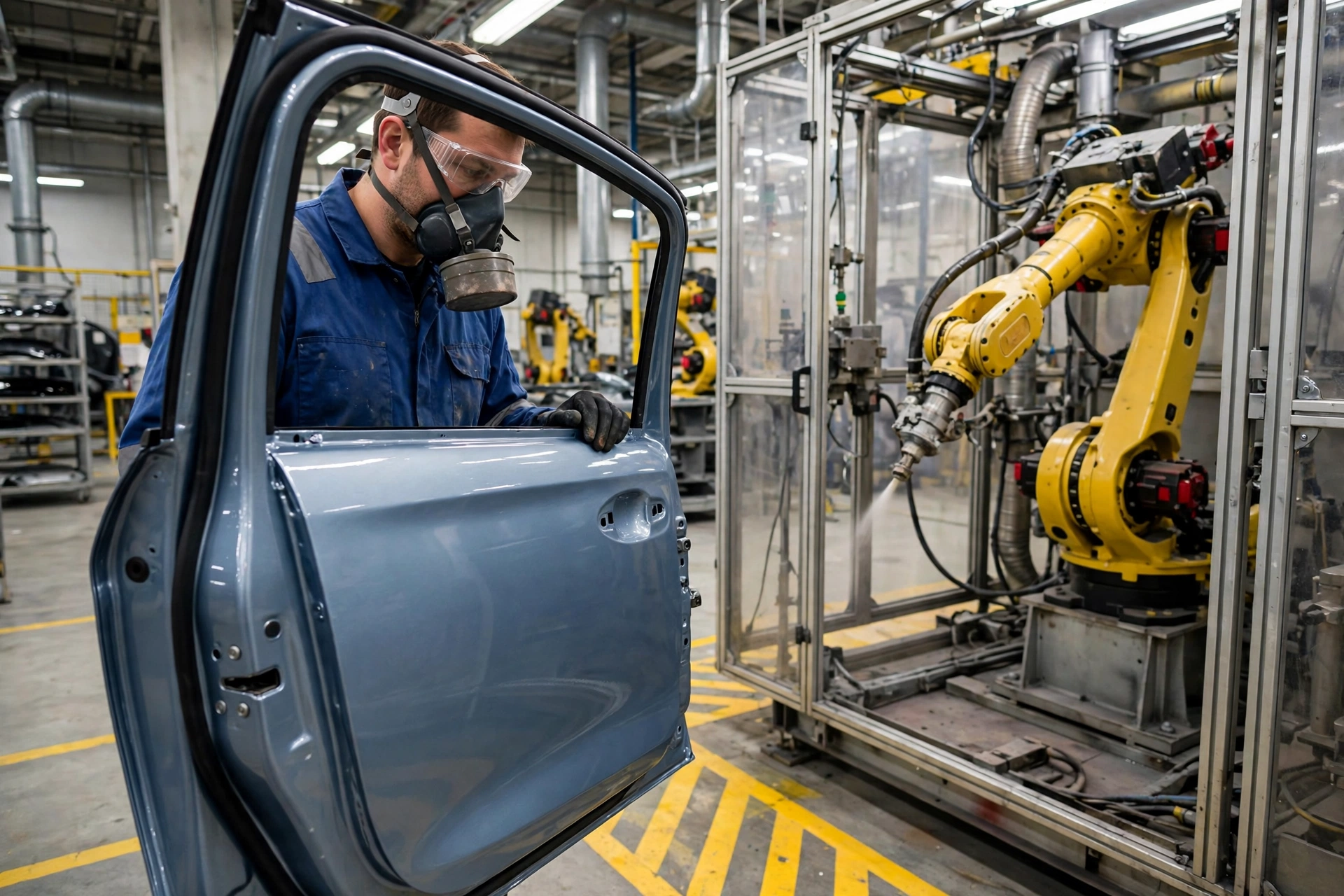
People are usually kept out of the robot’s working area while it runs, using fences, light curtains, or interlocked doors that stop the robot if someone opens them. Operators watch from outside and step in only when the system is paused and safe.
Workers who do enter a booth wear protective gear, including respirators, eye protection, and coveralls, and follow the paint maker’s safety guidance. A robot moves the riskiest spraying away from people, but the area around it still needs respect, and worn hoses or clogged nozzles need regular checks.
What Can Go Wrong, and How Is It Fixed?
Common problems are easy to picture once you know the variables. Runs and drips usually mean the gun moved too slowly or the paint flow was too high. Thin or patchy areas often mean the opposite, or a nozzle that needs cleaning. A bumpy, orange-peel texture can come from the wrong droplet size or from spraying when it is too hot or dry.
Fixing these issues means changing one thing at a time: speed, distance, pressure, or paint mix. Experienced operators keep notes on what worked for each part and colour, so the next run starts from a known-good recipe instead of guesswork. Test panels — spraying a sample part and checking the finish before a full run — catch problems before they become a batch of rejects.
FAQs
Do painting robots replace human painters completely?
No. Robots handle repetitive spraying, but people still program them, prepare surfaces, inspect finishes, and do touch-ups and detail work.
Can a painting robot paint any colour?
Yes, within the limits of its paint supply system. Colour changes need a flush between colours to avoid contamination, and some colours need different settings for best coverage.
How long does it take to program a painting robot?
It varies a lot. A simple flat panel may take minutes, while a complex car body can take hours or days the first time. Once saved, a program can be reused whenever that part returns.
Is robot painting better for the environment?
It can help, because steady spraying and electrostatic systems can cut overspray and paint waste. Still, paint, solvents, and filters must be handled and disposed of properly.
Can I use a painting robot at home?
A full industrial painting robot is not a home tool: it needs a proper booth, ventilation, power supply, and safety controls. For home projects, a hand sprayer in a well-ventilated space is the realistic option.
Conclusion
Painting robots earn their place by doing one thing very well: repeating a careful spray path, at a steady speed and distance, without getting tired or distracted. That steadiness gives even coats, less waste, and a safer distance between people and paint mist.
If you are considering one, start small and practical: pick your most repeated part, check the space and ventilation you would need, and ask a supplier for a trial run on that exact part. A short, real-world test will show whether the finish, speed, and cost work for your shop.
Related reading on Techserps: How Do Robot Arms Work?, How Do Warehouse Robots Work?, How Do Construction Robots Work?, and How Do Welding Robots Work?. For background on robots in general, see Britannica’s guide to robotics and Wikipedia’s overview of industrial robots.