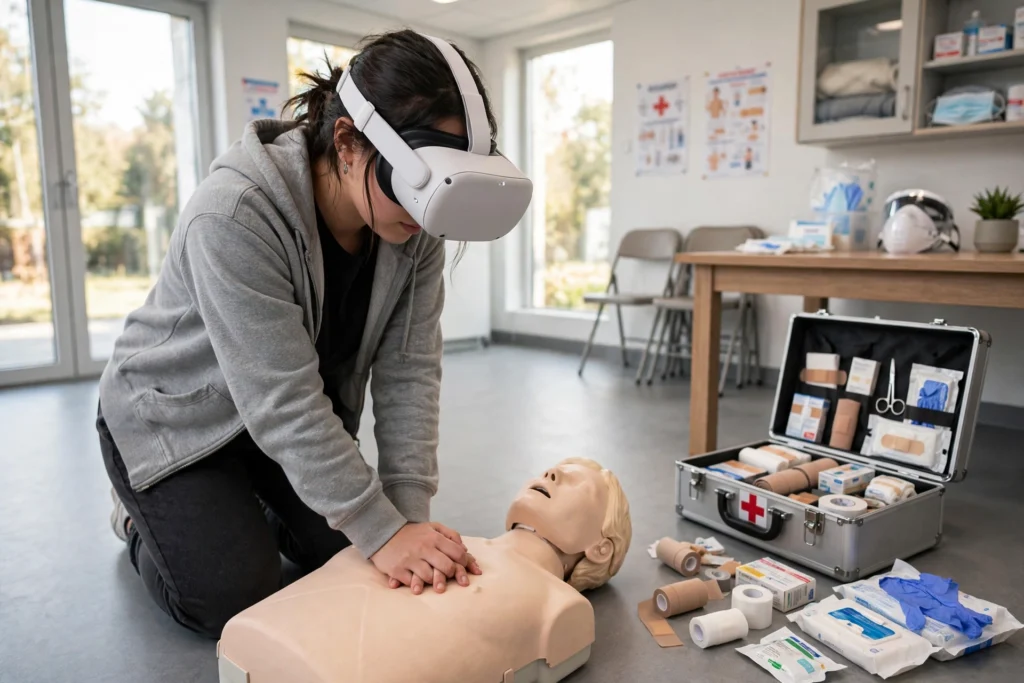
VR first aid training puts you inside a realistic emergency using a headset, so you can practise CPR, bandaging, and calling for help without any real danger. The simulation shows you a casualty, tracks your hands, and gives instant feedback, then lets you repeat the scene until the steps feel natural.
Please note: this article is general information, not medical advice. In a real emergency, call your local emergency number first. VR practice builds confidence, but it does not replace a certified first aid course.
Key Takeaways
- VR first aid training turns a headset into a safe emergency scene for CPR, bandaging, choking response, and defibrillator practice.
- The software watches your hand position, depth, and timing, then tells you straight away what to fix.
- Repeating the scene builds muscle memory, so the steps come naturally under real pressure.
- It works best alongside a certified course and a real mannequin, not as a replacement.
- Short sessions of ten to twenty minutes are enough to learn one skill well.
How does a VR first aid lesson actually work?
You put on a headset and pick up the hand controllers. The headset tracks where you are in the room, and the software places you in a scene — a living room, a gym, or a busy street. A virtual casualty appears, and a calm voice talks you through the first steps: check the scene is safe, check whether the person responds, and call for help.
From there, your hands do the work. The controllers follow your movements, so when you press on a virtual chest, the simulation measures how deep and fast you push, and a coloured guide shows whether your compressions are on target. Some programmes add a physical mannequin under your hands, so you feel a real chest while the headset shows the scene. Each lesson ends with a short debrief, then you can run the scene again — which a classroom rarely offers.
What first aid skills can you practise in VR?
CPR is the most common one. The American Heart Association helped build a Hands-Only CPR VR experience with a learn mode for the steps and a practice mode that scores you on calling for help, compressions, and using an AED. England Football also uses VR CPR training in a noisy virtual stadium to teach focus under pressure.
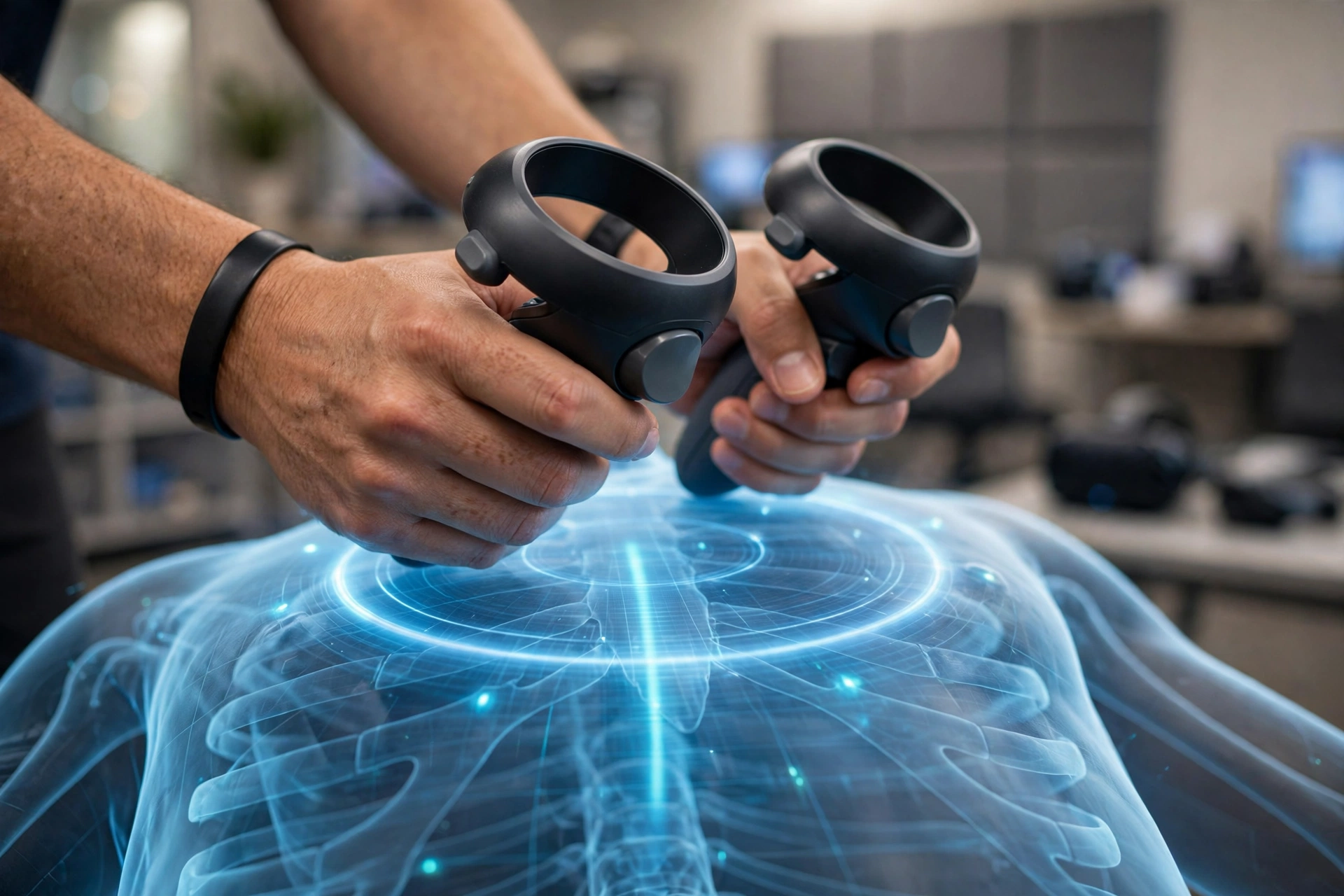
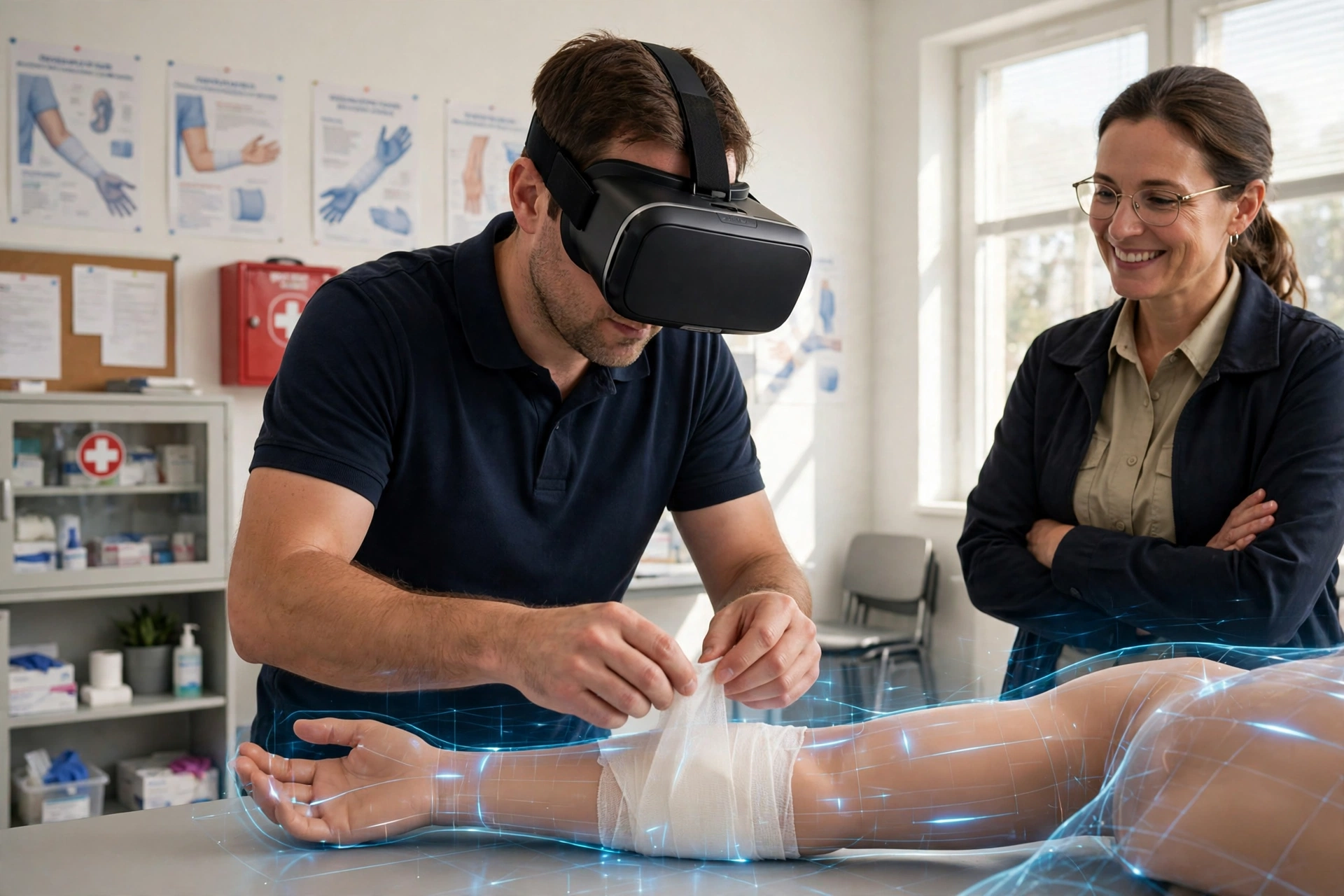
Bandaging and bleeding control come next. The simulation shows a cut or wound, and you practise pressing on it, choosing the right dressing, and wrapping a bandage around an arm or leg. Because the patient is virtual, awkward angles carry no risk.
Choking response is another good fit: the scene shows someone clutching their throat, and you practise back blows and abdominal thrusts in order, first slowly, then at full speed. Many programmes also cover using a defibrillator, or AED: the headset walks you through switching it on, placing the pads, and standing clear. You also practise staying calm and giving clear instructions, such as “you, call an ambulance”.
Why is VR useful for learning first aid?
The biggest advantage is repetition without risk. In a normal class, you might practise CPR on a mannequin once or twice before the group moves on. In VR, you can run the same scene five times in a row, with the software telling you what improved each time.
Pressure is the second advantage. A real emergency is noisy, confusing, and stressful, and classroom practice rarely feels like that. VR can add crowd noise, a ticking clock, or questions from a bystander, so you learn to keep your hands steady while your head is busy. The same idea drives VR safety training for workplaces.
The third advantage is access. Not everyone can attend a weekend course, and not every workplace has a trainer on site. A headset and a training app let a small team practise together in an office or classroom, each person taking a turn. For schools and clubs, that can mean ten trained first aiders instead of one.
What are the limits of VR first aid training?
The first limit is touch. Pressing a virtual chest does not feel the same as a real one, even with a mannequin underneath, so your sense of depth is only approximate. Trainers still recommend hands-on practice with a real mannequin.
The second limit is certification. Most VR programmes are practice tools, not accredited courses. If you need a certificate for work, you still need a recognised course with an assessor. Some people feel queasy in a headset, so short sessions matter. And a decent headset is not cheap, so sharing the kit across a group makes most sense.
How do you start VR first aid training?
The simplest start is to look for a local course or workplace session that already uses VR. Many providers now include a headset station in their first aid day, and several training apps are free to try.
If you buy a headset for a team, plan short sessions: ten to twenty minutes per person, with the group rotating while others watch on a screen. Practise with a partner: one person in the headset, the other playing the bystander who calls for help. Treat VR as the rehearsal and the certified course as the real thing: learn the steps in VR first, then prove them on a real mannequin.
Frequently Asked Questions
Q: Can VR first aid training replace a certified first aid course?
A: No. VR is excellent for rehearsing the steps, but most employers still require a certificate from a recognised course with a human assessor. Use VR to prepare and stay fresh between courses.
Q: Do you need a mannequin as well as a headset?
A: It helps, but it is not required. Some programmes use controllers alone; others pair the headset with a mannequin so you can feel the compressions. Use both if you can.
Q: How long does a VR first aid session take?
A: Most single-skill sessions last ten to twenty minutes, including the debrief. A full session covering CPR, bandaging, and AED use takes about forty minutes, split into shorter scenes.
Q: Can children use VR first aid training?
A: Many programmes suit teenagers and adults, and some are made for schools. Younger children should use a headset only with adult supervision, for short sessions. Check the app’s age guidance first.
Q: Is VR first aid training expensive?
A: It depends. A headset costs a few hundred pounds or dollars, and some training apps are free while others charge a licence fee. For a school or workplace training many people, the cost per person is usually low.
Conclusion
VR first aid training works because it lets you fail safely and try again. You practise CPR, bandaging, and calling for help in a scene that feels real, get instant feedback, and repeat it until the steps feel automatic. It does not replace a certified course, but it makes it easier.
To try it, find a local provider or workplace session with a VR station and book a short hands-on session as a rehearsal. Then book a certified course to complete the training. And if you ever face a real emergency, remember the first step is always the same — call for help, then start helping.