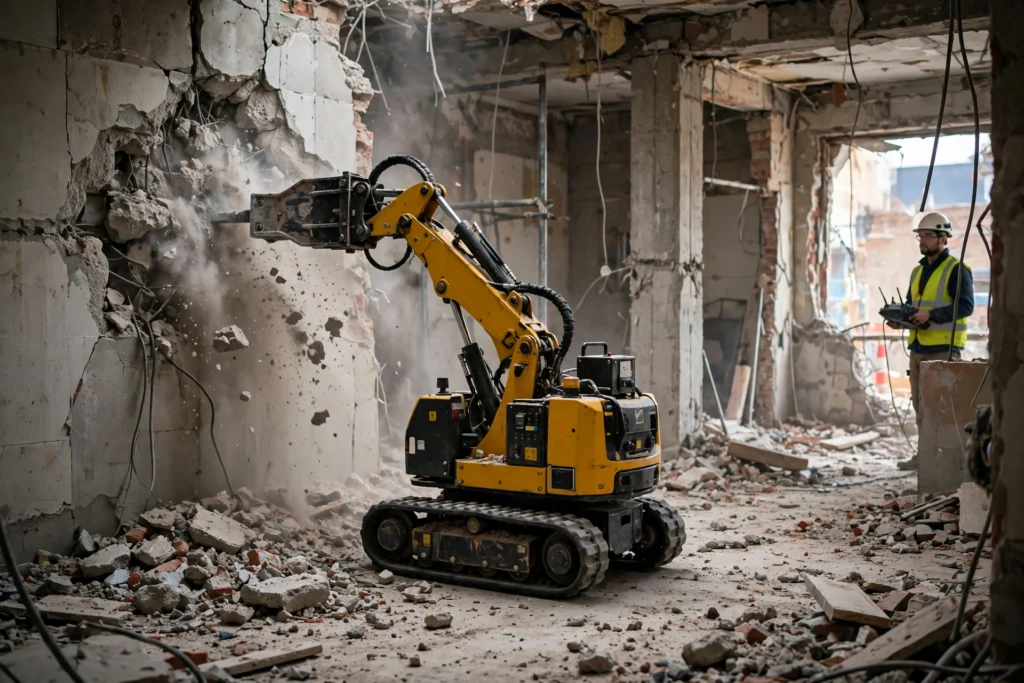
Demolition robots work by putting distance between the worker and the breaking. A compact tracked machine carries a hydraulic breaker, crusher, or grapple on its arm, and the operator drives it with a remote control from behind a barrier. Cameras, lights, and sensors help the operator see the work area without standing in it.
Key Takeaways
- A demolition robot is a small tracked machine with a breaker or crusher on its arm, driven by remote control.
- The operator stays clear of falling debris, dust, and unstable floors while still controlling the tool.
- Hydraulic power gives the arm its breaking force, and tracks let the machine climb rubble and fit through doorways.
- Dust control, usually water spray, keeps the air clearer and the work visible.
- Planning, barriers, and trained operators matter as much as the machine itself.
What is a demolition robot?
A demolition robot is a remote-controlled machine built to break, crush, or pull apart concrete, brick, and steel where people should not stand close. Most models are about the size of a small car or smaller, run on rubber or steel tracks, and carry one tool at a time on a jointed arm.
The idea behind them is simple. Demolition is dusty, loud, and full of falling material. A machine that does the breaking while the operator watches from a safer spot removes the person from the worst of it. The robot does not decide what to demolish. People plan the job, mark what stays and what goes, and the robot carries out the breaking step.
How does a demolition robot break concrete?
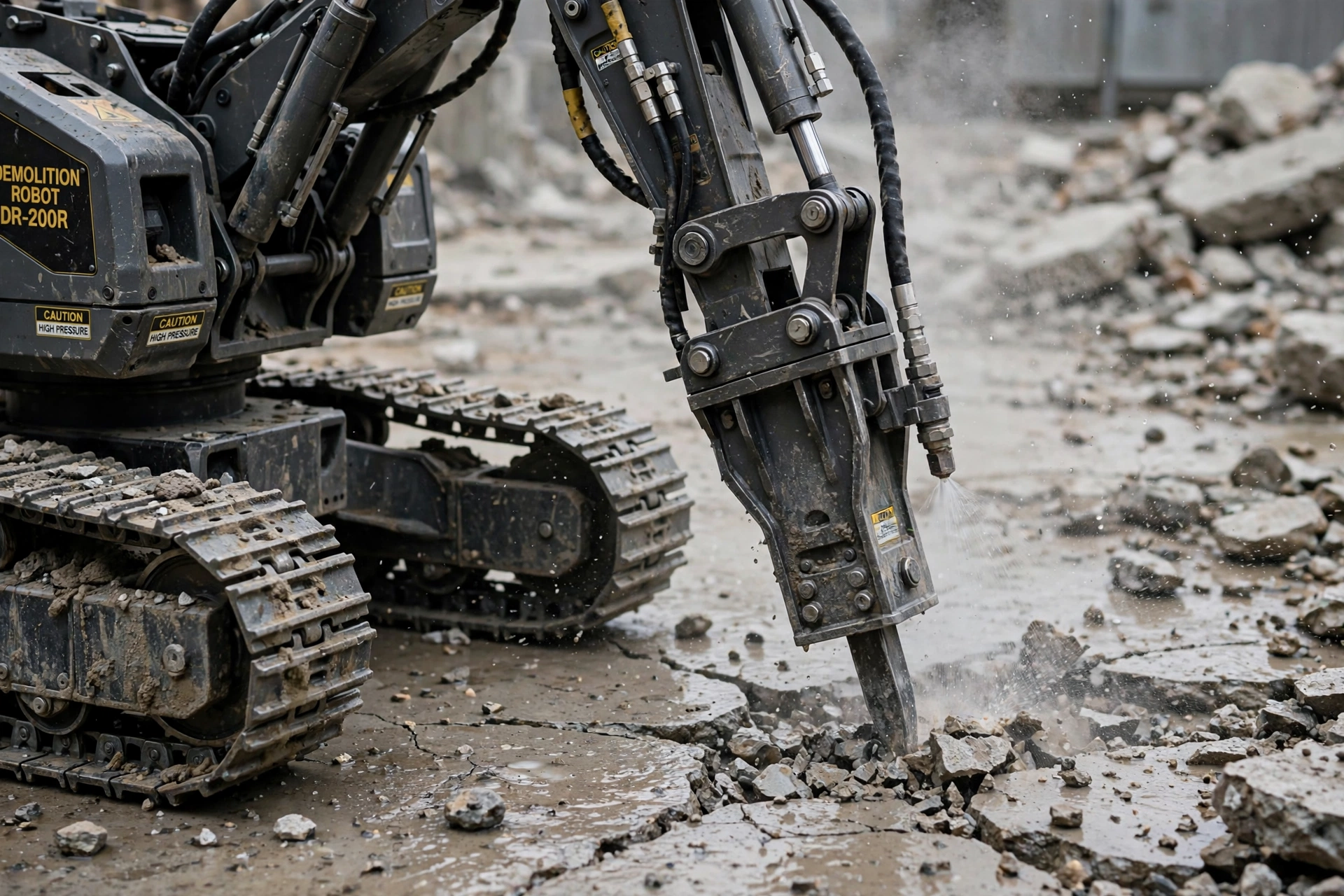
The workhorse tool is the hydraulic breaker, a heavy steel tool that strikes the same spot many times a second, cracking concrete a little more with each blow. The operator positions the tip, holds it against the surface, and lets the repeated impacts do the work.
The force comes from hydraulics. A pump on the machine pushes oil under pressure through hoses to the breaker and to the arm’s joints. That pressure is what turns a small machine into a strong one: a robot weighing under a tonne can deliver blows that would take a person with a hand-held breaker far longer, and with far more strain.
Different tools suit different jobs. A breaker handles concrete and masonry. A crusher jaw bites into concrete and crushes it, often leaving the steel reinforcement behind for separate removal. A grapple or sorting bucket picks up and moves rubble. Some machines can swap tools on site, so one robot can break a wall in the morning and load the rubble into a skip in the afternoon.
How does the operator control it?
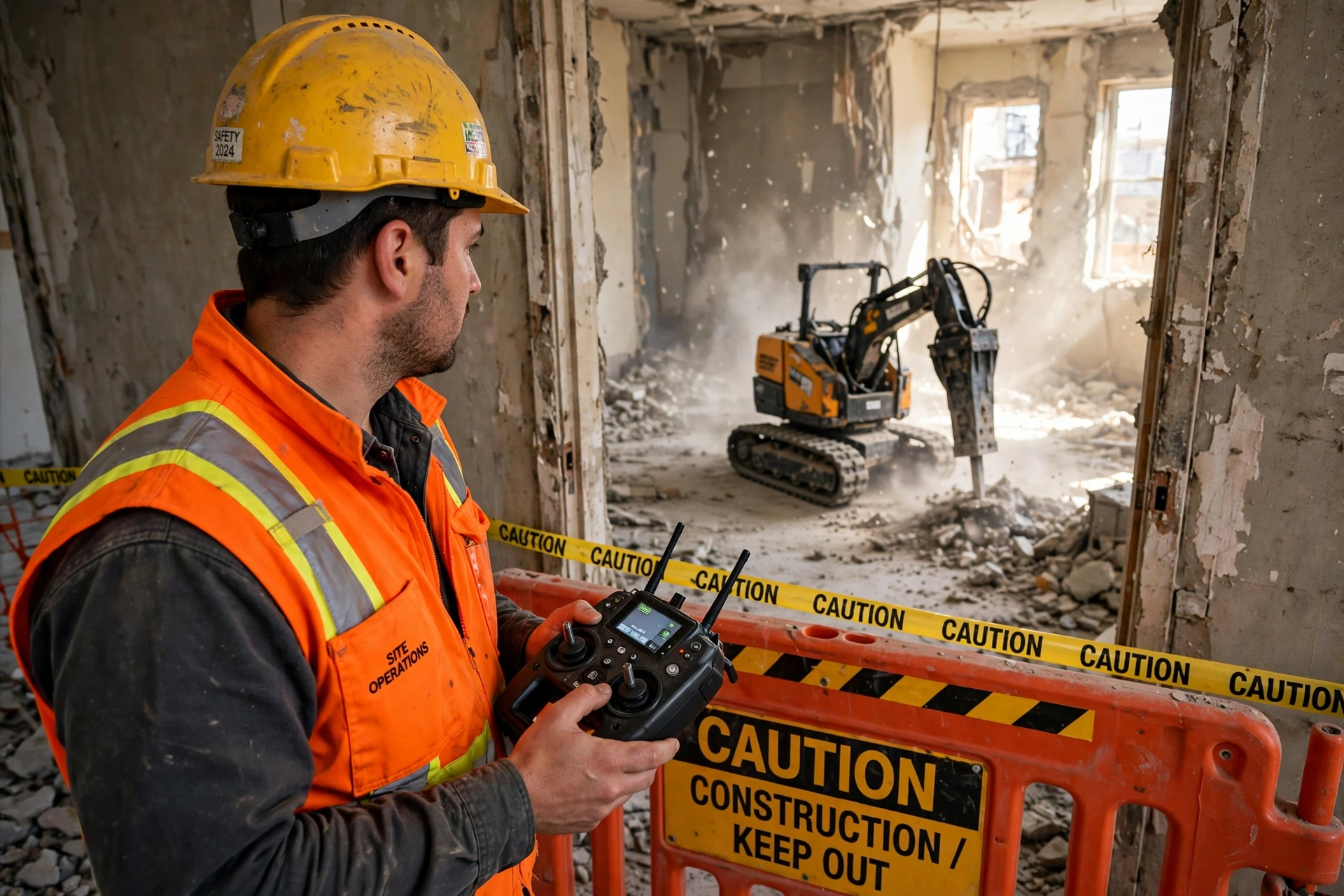
Most demolition robots are driven with a remote control unit worn on a belt or held in both hands. The unit has joysticks for driving and for moving the arm, plus buttons for the tool, lights, and the emergency stop. The operator usually works a few metres away, often behind a barrier or in the next room, watching through a doorway or on a screen.
Some newer models add a camera feed to the remote, so the operator can see the tool tip even when dust or a wall blocks the view. Lights on the machine help in dim interiors, and a tilt sensor can warn the operator if the machine is leaning too far on uneven rubble.
Control is not instant in the way a video game is. There is a small delay, and the operator must learn how the machine responds on different surfaces. That is why training matters: an experienced operator knows when to ease off the breaker, when the concrete is about to give way, and when to stop and check the structure before going further.
Where do demolition robots work best?
They shine in places where people should not be, or where big machines cannot go. Inside a building, a compact tracked robot can pass through a standard doorway and break a concrete floor while the operator stays in the corridor. In tunnels and basements, the same small size and remote control keep the operator out of confined, dusty air.
They are also useful where vibration must be limited. A breaker on a small robot delivers force to a small area, which can be kinder to nearby structures than a large excavator swinging a heavy hammer. That matters in refurbishment work, where one wall comes down and the rest of the building stays.
How is dust kept under control?
Breaking concrete makes dust, and dust is both a health risk and a visibility problem. The most common answer is water. A spray nozzle near the breaker tip wets the surface as it breaks, which keeps much of the dust out of the air. On larger jobs, a separate water supply or a hose held by a worker keeps the area damp.
Ventilation helps in enclosed spaces. Fans or ducting move dusty air away from the work area, and the operator’s position outside the dusty zone is itself a form of protection. Even so, anyone entering the work area should wear the right mask and eye protection, because a damp surface can dry out and a broken slab can release a fresh cloud.
What safety rules apply around a demolition robot?
Safety starts before the machine moves. The crew should agree on where the robot will work, where people will walk, and where the operator will stand. Barriers and signs mark the zone, and everyone on site should know what they mean. A short briefing at the start of the shift can prevent a lot of confusion.
During work, the habits are simple. Keep clear of a moving arm. Do not step into the work zone to move a cable or check a result while the breaker is live. Treat a stopped robot as still live until the operator confirms it is safe. Report a strange noise, a leaking hose, or a damaged guard straight away, rather than working around it.
The structure itself needs checking, too. Before breaking starts, the crew must know what is load-bearing, where services such as gas, water, and electricity run, and how debris will leave the site. A robot does not make those decisions. It only carries out the breaking after people have planned it and set safe boundaries.
FAQs
Can a demolition robot demolish a whole building?
Not on its own, in most cases. They are best at detailed, close-in work: breaking floors and walls inside a building or in tight spaces. Tall structures usually need high-reach excavators, and sometimes controlled implosion, for the main demolition.
Is a demolition robot safer than manual demolition?
It can reduce exposure to debris, dust, and unstable structures, because the operator works from a distance. It is not automatically safe, though. Planning, barriers, dust control, and trained operation are still essential, and the machine itself must be checked and maintained.
How far away can the operator stand?
That depends on the model, but most remote controls work reliably within a few dozen metres with a clear line of sight. In practice the operator stays close enough to see the work, often just outside the room or behind a barrier.
Do demolition robots work in wet or dusty conditions?
They are built for dusty work, and water spray is part of normal dust control. Wet ground and poor visibility still affect traction and sensors, so crews should check the machine guidance and site conditions before starting.
Will demolition robots replace demolition workers?
They are more likely to change the work than remove it. Operators, site managers, and skilled workers still plan, check, and finish the job, while the robot handles the breaking step in the riskiest spots. New roles in setup, remote operation, and maintenance are also emerging.
Conclusion
Demolition robots work by keeping the operator at a safe distance from the breaking. A compact tracked machine, a hydraulic breaker, and a remote control turn a dusty, hazardous job into one a trained operator can manage from behind a barrier. Water spray keeps the dust down, cameras keep the work visible, and careful planning keeps the structure and the crew safe.
If you are considering one for a project, start with a single defined task, such as breaking a concrete floor in one room. Agree on clear work zones, sort out dust control and debris removal first, and make sure the operator is trained on that exact machine.
Related reading: How Do Robot Arms Work? (https://techserps.com/how-do-robot-arms-work/), How Do Warehouse Robots Work? (https://techserps.com/how-do-warehouse-robots-work/), How Do Construction Robots Work? (https://techserps.com/how-do-construction-robots-work/), and How Do Welding Robots Work? (https://techserps.com/how-do-welding-robots-work/).
Further reading: Britannica robotics (https://www.britannica.com/technology/robotics) and Wikipedia demolition (https://en.wikipedia.org/wiki/Demolition).